eBook - ePub
Developing Resilience in Disruptive Times
Insights from Strategic Management
- 386 pages
- English
- ePUB (mobile friendly)
- Available on iOS & Android
eBook - ePub
Developing Resilience in Disruptive Times
Insights from Strategic Management
About this book
The first half of the book presents case studies on how the pandemic has affected businesses, management and communities and share insightful stories on tough decisions during, midst, and after the shock of the pandemic. The second half of the book presents case studies on market positioning and business model transformations which provide us insight on customer loyalty and satisfaction, online reviews, and children as a growing customer group. This book comprises both research and teaching cases that offer new insights on business management.
Trusted by 375,005 students
Access to over 1.5 million titles for a fair monthly price.
Study more efficiently using our study tools.
Information
THEME 1
Covid-19 Impact on Business
Meals on Wheels of Tampa Confronts Covid-19
Federico Giovannetti1
ABSTRACT
Meals on Wheels of Tampa (MOWT), a 501(c)(3) tax-exempt organisation founded in 1975, delivers hot meals to people in need in the community, mostly the elderly and the homebound that live alone. The meals are prepared, packaged, and delivered by the organisation on a daily basis, approximately 870 meals per day. Beneficiaries of the program truly depend on it, not only because of their inability to procure their own meals but also because for some, this is the only nutritious meal they eat every day. The work is done by staff and volunteers. The staff does a remarkable job of coordinating the volunteers, especially regarding the logistics of delivering the meals. All the funds needed for this operation come from charitable donations and local community support. When the COVID-19 pandemic started lurking in early 2020, it was very clear that it would be a large disruptor to the MOWT operation.
Dilemma/Questions: Because of the pandemic and its contagious nature, MOWT faced a great dilemma. How to continue their much-needed operation while protecting beneficiaries, staff, and volunteers from the COVID-19 virus? As the need in their target demographic grew, they had to find a way to continue while minimising physical contact.
Theory: Successful and lasting organisations are better prepared to deal with unforeseen circumstances when they base their decisions on their core values or missions. In this case, the mission of the MOWT organisation is to serve their much-needed beneficiaries and therefore their decision is based on continuing doing so.
Basis of the Case: Event
Type of the case: Applied Problem Solving
Protagonist: Present
Findings/Options: All options considered to resolve the dilemma had to include the continuation of at least some nourishing daily meals to the beneficiaries. There were several options centred around some form of reduced operations mode. For example:
• Reduce the number of weekly meals delivered
• Deliver all weekly meals in one day
• Implement a meal pick up option
• Purchase the meals instead of preparing them
• Outsource the delivery of the meals
Discussion/Case questions:
1. What is a 501(c)(3) organization and what is the typical financial and operational structure?
2. Explore the topic of food insecurities in the United States of America (or developed countries)
3. Dissect the important role of the protagonist (Executive Director) within the organization: development (funding), staff management, relations with volunteers.
4. How did the COVID-19 pandemic affect the USA and what were the main guidelines provided to institutions and citizens?
5. The elderly and the homebound living alone… what are their most pressing needs?
6. What are the main characteristics of kitchen operation?
7. How do you put together a deliver-by-car operation based exclusively on volunteers?
8. How does an organization react to completely unforeseen events? How does their mission influence their decision? Does it legitimize the mission?
Keywords: Covid-19, elderly, food insecurity, logistics, pandemic, service,volunteers.
INTRODUCTION
The people that need us the most are the same people experts are saying are most at-risk!
Steve King, Executive Director at Meals on Wheels of Tampa (MOWT), had this realisation in February 2020 when discussions about COVID-19 started to flood the airwaves. In a way, it was a blessing in disguise, because it put him into action mode much earlier than other business leaders in the community. Steve had been leading the organisation for fourteen years. Things were going remarkably well up to this point. Community support and donations were strong, and the program had steadily grown for the last decade, a testament to Steve’s leadership. However, this challenge was completely different from any they had ever seen. COVID-19 had the potential to attack the very heart of the organisation’s mission.
MOWT delivers close to 870 hot meals per weekday to the elderly and homebound in the Tampa community. The meals are made in their own kitchen and are carefully crafted to nourish this segment of the population. Beneficiaries of the program truly depend on it, not only because of their inability to procure their own meals but also because for some, this is the only nutritious meal they eat every day. How do they do it? Steve will promptly praise his staff, the wonderful volunteers that deliver the meals (the “wheels” part) and the tremendous support of community sponsors and donors. This complex logistical operation runs like a well-oiled machine after years of constant refining under Steve’s supervision.
When the COVID-19 pandemic started lurking in early 2020, it was very clear that it would be a large disruptor to the MOWT operation. First, they needed measures to protect not only the staff and volunteers but the very people they served, as they were the most at-risk. Secondly, an increase in meals requests was clearly expected, as experts’ guidelines strongly recommended that elders stay home.
It was all hands on deck at this point. Several brainstorming sessions ensued. The prospect of suspending the operation came up but was quickly shut down. “Right now is when they need us the most,” several people remarked. The next alternative became clear: continue to operate while reducing physical contact as much as possible. What did that mean? Reduce the number of beneficiaries? Reduce the number of weekly meals delivered? Deliver all weekly meals in one day? Outsource some parts of the operation?
It seemed like every option had ramifications to consider. The worst part, Steve thought, were the pandemic related uncertainties that could not be anticipated at this point.
FOOD INSECURITY IN AMERICA
One of the definitions of “hunger” in the Merriam-Webster dictionary is “a weakened condition brought about by prolonged lack of food”. In 2006, the United States Department of Agriculture (USDA) started to make a clear distinction between the definitions (and measuring) of hunger and food insecurity in America. Food insecurity is defined as a household-level economic and social condition of limited or uncertain access to adequate food (US Department of Agriculture, 2019). Hunger is, in fact, a possible consequence of food insecurity.
Influential Factors
Hunger is quite commonly linked to poverty. However, food insecurity is a much more complex problem than hunger and it is influenced by many factors besides poverty. In fact, not everyone living below the Federal poverty level suffers food insecurity and some people living above the Federal poverty level do suffer food insecurity. Among the factors that influence access to nutritious food are (Lloyd, 2017):
• Affordability: determined by household income and size, includes poverty levels
• Availability: or difficulty of getting to the food sources. It could be based on distance, transportation options, business hours, etc.
• Health: mobility, exposure to the environment, mental health
• Education: food choices
• Life balance: working long hours or multiple jobs
• Environment: any changes in the environment that affect the supply chain, such as natural disasters
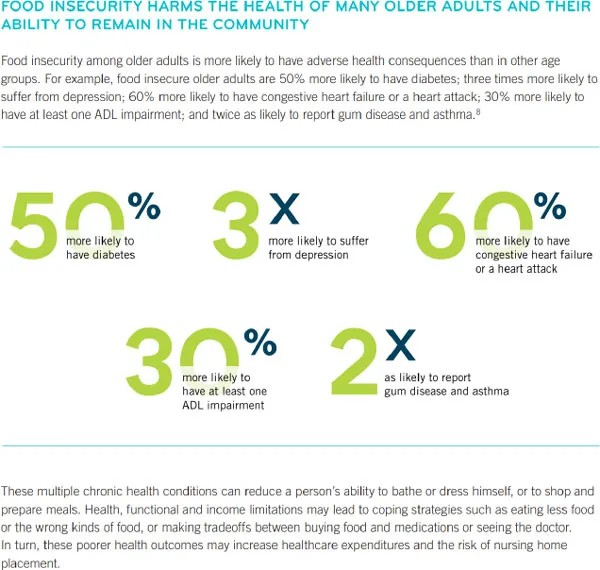
Depending on what factors are in play for a household or individual, food insecurity can be permanent or temporary. The elderly population is perhaps the most susceptible to be affected by multiple factors from the list above. In addition, the effects of food insecurity on the health of American seniors are devastating. Please see Exhibit 1 for an illustration of such effects and their social and lifestyle consequences, which connect directly with the MOWT mission.
Exhibit 1: Effects of food insecurity on America’s senior population
Source: Meals on Wheels America: Hunger in Older Adults Report
https://www.mealsonwheelsamerica.org/docs/default-source/research/hungerinolderadults-fullreport-feb2017.pdf
https://www.mealsonwheelsamerica.org/docs/default-source/research/hungerinolderadults-fullreport-feb2017.pdf
Measuring and Levels
According to USDA, there are four levels of food security (US Department of Agriculture, 2019). Notice that although the most common term used when referring to this issue is “food insecurity”, these USDA levels are defined using the inverse terminology: “food security”. All this means is that high food insecurity is equivalent to low food security. The four levels in question are:
• High food security: no reported indications of food-access problems or limitations.
• Marginal food security: one or two reported indications—typically of anxiety over food sufficiency or shortage of food in the house; little or no indication of changes in diets or food intake.
• Low food security (previously known as food insecurity without hunger): reports of reduced quality, variety, or desirability of diet; little or no indication of reduced food intake.
• Very low food security (previously known as food insecurity with hunger): Reports of multiple indications of disrupted eating patterns and reduced food intake.
Latest Statistics
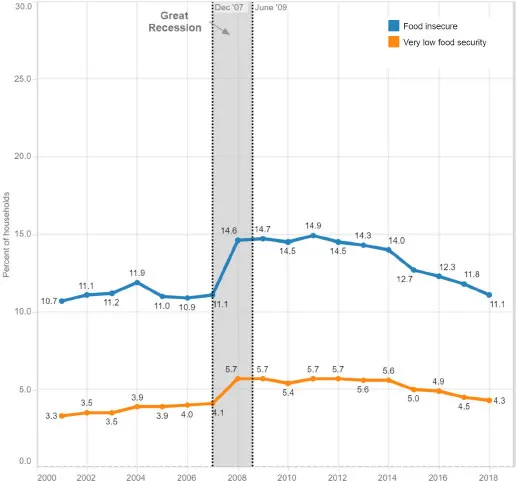
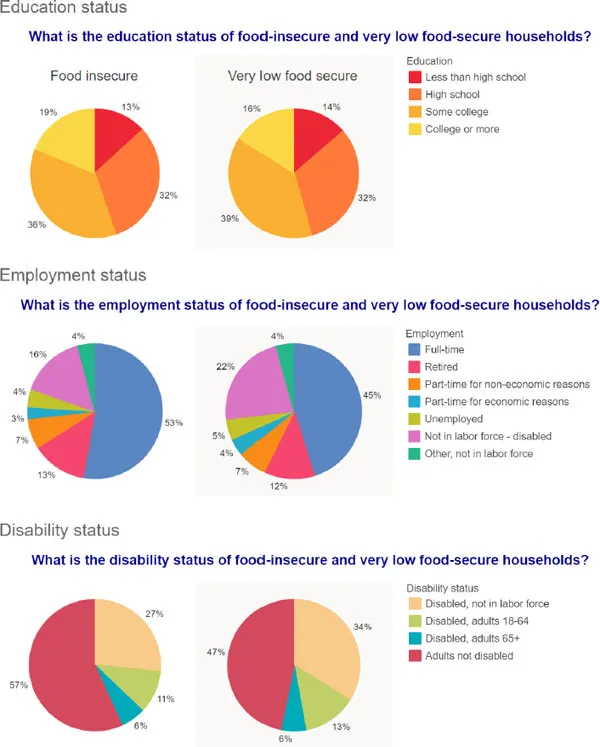
Between 2011 and 2018, anywhere between one in six to one in nine U.S. households suffered food insecurity (low food security as defined by the USDA), and up to one in 20 suffered from very high food insecurity (very low food security) or in more common terminology, hunger. Please see Exhibit 2 for detailed statistics on food insecurity in the United States, including a break down by employment, education, and disability status.
Exhibit 2: Food insecurity in America: trends and categories
Trends in the prevalence of food insecurity and very low food insecurity in U.S. households, 2001 - 2018
Distribution of food-insecure households
Source: Calculated by USDA, Economic Research Service, using Current Population Survey Food Security Supplement data. https://www.ers.usda.gov/topics/food-nutrition-assistance/food-security-in-the-us/
In terms of the statistics related to the elderly population, according to Lloyd (2017), it was estimated that in 2016 approximately ten million older adults suffered from food insecurity in the United States. This is equivalent to 16% (one in six) of older adults.
CHARITABLE ORGANISATIONS
In the United States, ...
Table of contents
- Cover
- Half Title
- Title Page
- Copyright
- Contents
- Introduction
- Theme 1: COVID-19 Impact on Business
- Theme 2: COVID-19 Impact on Management
- Theme 3: COVID-19 Impact on Communities
- Theme 4: Strategy Making and Business Models
- Theme 5: Marketing and Business Growth
- Theme 6: Branding, Customer Orientation and e-Business
- Auther Index
Frequently asked questions
Yes, you can cancel anytime from the Subscription tab in your account settings on the Perlego website. Your subscription will stay active until the end of your current billing period. Learn how to cancel your subscription
No, books cannot be downloaded as external files, such as PDFs, for use outside of Perlego. However, you can download books within the Perlego app for offline reading on mobile or tablet. Learn how to download books offline
We are an online textbook subscription service, where you can get access to an entire online library for less than the price of a single book per month. With over 1.5 million books across 990+ topics, we’ve got you covered! Learn about our mission
Look out for the read-aloud symbol on your next book to see if you can listen to it. The read-aloud tool reads text aloud for you, highlighting the text as it is being read. You can pause it, speed it up and slow it down. Learn more about Read Aloud
Yes! You can use the Perlego app on both iOS and Android devices to read anytime, anywhere — even offline. Perfect for commutes or when you’re on the go.
Please note we cannot support devices running on iOS 13 and Android 7 or earlier. Learn more about using the app
Please note we cannot support devices running on iOS 13 and Android 7 or earlier. Learn more about using the app
Yes, you can access Developing Resilience in Disruptive Times by Ajoy Kumar Dey,Ville-Veikko Piispanen,Shreya Mishra in PDF and/or ePUB format, as well as other popular books in Business & Management. We have over 1.5 million books available in our catalogue for you to explore.