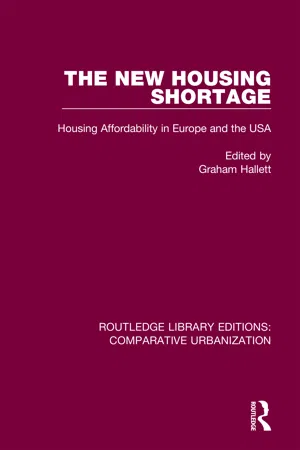
Originally published in 1993, this book is a detailed comparative examination of the housing issue by housing experts, looking at the USA, UK, Germany, the Netherlands and France. The volume offers an excellent blend of critical analysis and practical policy recommendations, including a better targeting of tax concessions, a move back to social housing more diverse than in the past and measures for reducing homelessness. Perennial issues which remain as pertinent today as when the book was first published are also discussed: homelessness, housing affordability for people on low incomes, changes in housing markets.
- 286 pages
- English
- ePUB (mobile friendly)
- Available on iOS & Android
eBook - ePub
1 Introduction
National similarities and differences
Graham Hallett
The countries in this study have many similarities in their economic and housing systems, together with some significant differences. The USA, UK, Netherlands, France and the ‘old’ German Federal Republic are highly developed industrial economies. The German Democratic Republic was also an industrial economy, generally considered to be the most successful of the socialist East European states. Because of its very different economic system, it cannot be readily compared with the other countries, although there are some points of comparison.
All the ‘Western’ countries have housing systems which are largely market-orientated, but with substantial degrees of state intervention. In a (pure) market economy, people get the housing they can pay for; if they are very poor, they will get little housing, or even no housing. This harsh rule is modified - to varying degrees in the Western countries studied - by income-support, housing allowances, tax concessions and the provision of subsidized housing (called ‘public housing’ in the USA and ‘social housing’ in continental Europe and, increasingly, in the UK). In other words, in the provision of housing, market principles are modified by public action. In the German Democratic Republic, on the other hand, housing was, in theory, allocated according to need, irrespective of ability to pay; the government prided itself on having avoided the differences in housing conditions between rich and poor which characterized the West.
Macro-Economic Performance
Economic growth, inflation and unemployment can all affect the housing market and the housing conditions of the less well-off. The 1980s saw continued economic growth - at slightly higher rates than in the 1970s in the USA and the UK, and significantly lower rates in France, West Germany and the Netherlands (Table 1.1). In terms of real income per capita, the USA, in the mid-1980s (in spite of all the talk about its relative decline) was still some 30 per cent above the average of the West European countries. In Europe, West Germany had a slight lead over the other countries, but they were grouped fairly closely together. Unemployment rose sharply in the European countries in the 1980s, compared with the previous decade. The rise in the USA was smaller and, during the 1980s, the USA had lower rates of unemployment than the UK, the Netherlands and France. Inflation in all countries was lower in the 1980s than in the 1970s, but these averages conceal some large year-to-year fluctuations.
Economic Average, 1970-9 | Growth* p.a. % 1980-9 | Unemployment Average, % | Inflation Average, p.a. % | Real Income per capita. USA = 100 mid-1980s | |||
1970-9 | 1980-9 | 1970-9 | 1980-9 | 1969-78 | 1978-90 | ||
USA | 2.0 | 2.3 | 6.2 | 7.0 | 6.6 | 6.0 | 100 |
UK | 2.2 | 2.5 | 4.5 | 10.7 | 12.4 | 7.7 | 66.1 |
Netherlands | 2.2 | 1.3 | 3.9 | 9.6 | 7.3 | 2.9 | 68.2 |
France | 2.9 | 1.5 | 3.9 | 9.0 | 8.6 | 7.4 | 69.3 |
W. Germany | 2.7 | 1.8 | 2.3 | 6.1 | 5.0 | 3.0 | 73.8 |
* Growth of real GNP per capita
Source: OECD, Economic Outlook; World Bank, World Development Report, 1990 p. 237.
Housing conditions and housing systems
The countries studied can be crudely divided, according to their housing systems, into three groups. The West European countries have a good deal in common in their housing policies and tenure patterns, although the UK stands apart in some respects. The German Democratic Republic was very different, because of its comprehensive state socialism. The US housing system is at the other end of the spectrum, being predominantly ‘private enterprise’ -although underpinned by the Federal Government through tax relief on mortgage interest, housing allowances, and the underwriting of mortgages and of the Savings and Loan Associations.
Tenure patterns still show substantial national differences, despite some convergence. The UK has the highest levels of owner-occupation, at 67 per cent, followed by the USA (64 per cent) (Table 1.2). In the USA, higher costs of homeownership led to a fall in the percentage of owner-occupation in the 1980s (see Table 2.5). In the UK, the percentages have risen steadily; the 1987 Conservative Government set a target of 80 per cent for the year 2000. In the ‘continental West European’ countries, the percentages have risen but, at 40, 44 and 51 per cent, are significantly below the British level.
UK % | USA % | W. Germany % | France % | Netherlands % | |
Owner-occupied | 67 | 64 | 40 | 51 | 44 |
Private rented | 7 | 33 | 45 | 26 | 13 |
Social rented | 26 | 3 | 15 | 23 | 43 |
TOTAL | 100 | 100 | 100 | 100 | 100 |
Source: UN. ECE and national statistics.
1975 % | 1985 % | 1988/190 % | |
USA | 1 | 0 | 0 |
UK | 52 | 21 | 14 |
FRG | 19 | 11 | 28 |
GDR | 88 | 82 | 86 |
Netherlands | 40 | 41 | 37 |
France | 30 | 53 | 35 |
Source: ECE and national statistics
1982 % | 1989 % | |
UK | 32.1 | 58.3 |
US... |
Table of contents
- Cover
- Half Title
- Title Page
- Copyright Page
- Original Title Page
- Original Copyright Page
- Table of Contents
- List of figures
- List of tables
- Contributors
- Preface
- Acknowledgements
- 1 Introduction: National similarities and differences
- 2 The new housing shortage: the problem of housing affordability in the United States
- 3 Housing tenure and affordability: the British disease
- 4 Housing affordability in the Federal Republic of Germany
- 5 Housing problems in the former German Democratic Republic and the ‘New German States’
- 6 Housing affordability in France
- 7 Low income and housing in the Dutch welfare state
- 8 The new housing shortage: an international review
- Index
Trusted by 375,005 students
Access to over 1.5 million titles for a fair monthly price.
Study more efficiently using our study tools.
Frequently asked questions
Yes, you can cancel anytime from the Subscription tab in your account settings on the Perlego website. Your subscription will stay active until the end of your current billing period. Learn how to cancel your subscription
No, books cannot be downloaded as external files, such as PDFs, for use outside of Perlego. However, you can download books within the Perlego app for offline reading on mobile or tablet. Learn how to download books offline
Perlego offers two plans: Essential and Complete
- Essential is ideal for learners and professionals who enjoy exploring a wide range of subjects. Access the Essential Library with 800,000+ trusted titles and best-sellers across business, personal growth, and the humanities. Includes unlimited reading time and Standard Read Aloud voice.
- Complete: Perfect for advanced learners and researchers needing full, unrestricted access. Unlock 1.5M+ books across hundreds of subjects, including academic and specialized titles. The Complete Plan also includes advanced features like Premium Read Aloud and Research Assistant.
We are an online textbook subscription service, where you can get access to an entire online library for less than the price of a single book per month. With over 1.5 million books across 990+ topics, we’ve got you covered! Learn about our mission
Look out for the read-aloud symbol on your next book to see if you can listen to it. The read-aloud tool reads text aloud for you, highlighting the text as it is being read. You can pause it, speed it up and slow it down. Learn more about Read Aloud
Yes! You can use the Perlego app on both iOS and Android devices to read anytime, anywhere — even offline. Perfect for commutes or when you’re on the go.
Please note we cannot support devices running on iOS 13 and Android 7 or earlier. Learn more about using the app
Please note we cannot support devices running on iOS 13 and Android 7 or earlier. Learn more about using the app
Yes, you can access The New Housing Shortage by Graham Hallett in PDF and/or ePUB format, as well as other popular books in Social Sciences & Geography. We have over 1.5 million books available in our catalogue for you to explore.