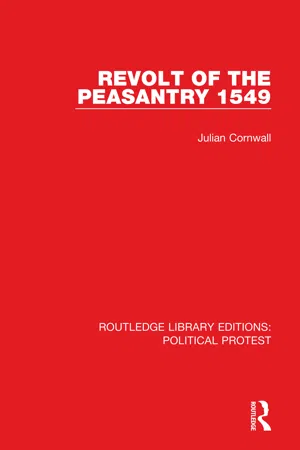
This book, first published in 1977, looks at the two peasant revolts that occurred in 1549, in the troubled period following the death of Henry VIII. The uprisings reveal a harsh background of economic and social injustice, intensified at the time by inflation. Peasants in North Devon rose against the imposition of the English Prayer Book, and with the local authorities paralysed and the government wavering between conciliation and repression, a general rebellion broke out. Reinforced by Cornishmen, rallying to the defence of their national identity, the peasants assembled a formidable army and laid siege to Exeter itself. Only after three major battles was the revolt suppressed. The Norfolk peasants rose against agrarian abuses, routing a small royal force and occupying Norwich. Ably led by Robert Kett, they expelled the gentry and governed the county on a programme of social justice until they were crushed by the forces released by the collapse of the other risings. These revolts display the deep-seated resentments and injustices felt by the peasantry of the sixteenth century.
- 264 pages
- English
- ePUB (mobile friendly)
- Available on iOS & Android
eBook - ePub
Revolt of the Peasantry 1549
About this book
Information
Chapter 1
Agrarian Problems and Others
I
In the month of April 1549 the Privy Council began receiving reports of disturbances among the peasantry in many parts of the country, the Midlands, the West Country, and the South East. The news was not startling in itself. A degree of violence was endemic among all classes in English society in the sixteenth century. Assault, wounding and manslaughter, forcible entry and riotous assembly were daily occurrences. Self-control was not an English virtue, quite the contrary; foreigners saw the English as an emotional, quarrelsome and generally unruly race, who rarely lacked a motive for taking the law into their own hands. As often as not recourse to the courts was the refuge of the man who had been worsted in the direct confrontation.
Agrarian disorder was commonplace and always provided a good proportion of the cases adjudicated by the Star Chamber, the court whose special province was breach of the peace. The inhabitants of Great Dunham, Norfolk, for example, had had a dispute with Sir Thomas Coldyng, the farmer of the demesne of the manor, who had enclosed a piece of the common and thereby deprived them of their rights. They had complained to commissioners appointed to enquire into such abuses, and had obtained an award in their favour. But Coldyng had ignored it, and so at 10 o’clock on the night of 16 May 1544 they had assembled, armed with pitchforks and other weapons, in order to enforce the verdict themselves. Coldyng had then complained to the Star Chamber, arguing that action of this sort ‘should much encourage like offenders in time to come if some speedy remedy be not found’.
The history of agrarian disputes in Norfolk has been intensively studied; they had been occurring with some regularity for many years, and not infrequently culminated in violence. But their number could undoubtedly be matched in other counties as well. At about the same time, the tenants of the manor of Ecclesden in West Angmering, Sussex, alleged that the lord, John Palmer, had descended on them with a band of armed servants and ejected them from their farms which he wanted for his own purposes. As it happens there was another side to this story. Nevertheless, we may suspect that Palmer, despite his strenuous denial, did employ some form of intimidation, and that Sir John Rodney’s accusations against his tenants at Draycot and Stoke Gifford in Somerset were not without foundation, for all their posturings as the unresisting victims of naked brutality.
The majority of these early stirrings in 1549 were very small affairs which came to nothing, but in the second week of May the duke of Somerset, Lord Protector of the Realm, received a report from his agent, Richard Fulmerston, of a disquieting new development. On the previous Sunday, 5 May, some 200 men, mostly weavers, tinkers and other workmen, had gathered at the small clothmaking town of Frome and set to work tearing down sundry hedges and fences. The next morning the local magnates, Lord Stourton and the bishop of Bath and Wells, with a couple of justices of the peace, had hastened there to confront the lawbreakers. They questioned many of the men who unanimously asserted that what they were doing was entirely lawful, sanctioned by a royal proclamation ordering the destruction of enclosures, which they understood to have been recently published in Somerset.
William Barlow, the bishop, skilfully avoided a collision. He and his colleagues were confident that the trouble was entirely the work of a handful of agitators — ‘lewd’ or ‘light’ persons, in contemporary parlance — maliciously stirring up foolish and ignorant people. (Even more than four centuries afterwards this outlook on the part of authority has a tediously familiar ring about it.) To gentlemen and landowners, the natural governors of a predominantly agricultural society, it was inconceivable that anything could be so seriously amiss as to create among those whom they ruled a genuine grievance which stood in such urgent need of redress that the normal processes of law and administration were hopelessly inadequate to satisfy it. In this complacent frame of mind they proceeded to turn a commonplace outburst of irritation into a dangerous confrontation.
Barlow did not attempt to dispute the people’s case, contenting himself with pointing out that they were misinformed about the proclamation (which in fact did not go beyond the appointment of a commission of enquiry); he suggested that they should go away quietly to put their complaints in writing and deliver them to Stourton’s house. They welcomed his advice. Their assembly had been peaceful; disorder and violence were the last things they intended. Honestly believing that they were doing no more than expedite the due execution of the law, they were more than satisfied with this apparent display of understanding on the part of the county magistrates. Alas, they were speedily undeceived! Not only did the justices have no sympathy whatever for them, they had not the least intention of even trying to understand the nature of the problem. The bishop’s ploy was nothing more than a ruse to trap the ringleaders into identifying themselves: the four or five men who presented themselves at Stourhead with the petition were instantly clapped into gaol. But the plan misfired badly. It provoked a menacing wave of unlawful assemblies all over Somerset and Wiltshire. More hedges were uprooted. Subversive opinions were uttered, such as ‘why should one man have all and another nothing?’, and the rioters boasted that should the magistrates dare arrest one man more, 1,000 at least would come to his rescue.
Now the authorities were forced to resort to sterner measures. Quarter Sessions were due to be held the following Saturday, to which all the gentlemen of the shire were commanded to come at the head of their servants and the ‘honest’ yeomen and farmers from among their tenants. This, the magistrates were confident, would ensure the mustering of a force ample to deal effectively with the disturbances. Again they underestimated the problem. Disaffection spread rapidly, threatening to engulf both counties. Rioters broke into the parks of Stourton himself and of Sir William Herbert at Washerne, tore down palings and slaughtered his deer. In order .to create this park a whole village had been razed to the ground and its inhabitants driven away. The uproar went on for two or three weeks and was only quelled when Herbert marched in Welsh levies from his estates in Glamorgan who ‘slew to death divers of the rebels’.
Almost simultaneously came trouble in other shires. By 15 May the Council was warning justices of the peace in the counties bordering Wiltshire to be on their guard, and indeed some sort of assembly took place at Overton, Hampshire, on 20 May. A more violent confrontation had already occurred in Kent which was promptly suppressed by the gentry under the energetic leadership of Sir Thomas Wyatt who hanged two rioters at Ashford on 13 May, and a third at Canterbury a day later. He then borrowed artillery from the government and stationed it at Canterbury where it formed an effective deterrent during the coming months. Soon tremors were felt across the Midlands, in Leicestershire, Rutland and Lincolnshire, although in most places, ‘by good policy of the Council and other noblemen of the country’, they were pacified. The earl of Shrewsbury was notably successful in maintaining the peace in the north Midlands. In most cases, however, the task was an easy one. The peasants rarely resorted to violence, if at all. Gatherings were on the whole peaceful and businesslike, concentrating on the methodical destruction of offending enclosures. This was what happened at, for example, Attleborough in Norfolk on 10 June when, after they had completed the job, the villagers quietly dispersed to their homes. A disturbance at Bristol in May was largely fortuitous. A band of soldiers en route to Ireland had been discharged there without conduct money to get them home, and their captain did not have enough in his own purse to advance it to them. So they had wandered about the city, selling their equipment to buy food, grumbling loudly about the government, and refusing to go home without their pay. A riotous assembly soon formed, although in the end it too fizzled out without serious consequences.
II
The 1540s was a decade of acute crisis which, since four-fifths of the population depended more or less directly on agriculture, was intimately bound up with the land. The agrarian problem comprised several distinct grievances of which the most inflammatory was enclosure, so much so that it had become the omnibus term for the lot.
Strictly defined, enclosure connoted the fencing off for individual use of pieces of common agricultural land over which the whole community of a village exercised rights. On the one hand it might involve individual strips in the open arable fields, which had little practical effect on the other farmers, although the fact that this facilitated more efficient and profitable cultivation could provoke jealously on the part of less progressive men; for as Thomas Tusser, the rhyming advocate of improvement, pointed out,
Good land that is several crops may have three in champion country it may not so be ....
But to enclose, on the other hand, a portion of common grazing land clearly diminished the rights of the rest of the community, and if carried far enough could leave some farmers with insufficient pasturage to support their horses and oxen, and so gravely hamper their work. Much enclosure was effected piecemeal by the more enterprising peasants themselves, and probably caused little real damage to their neighbours, but there were occasions when landlords or the farmers of manor demesnes practised it on a large scale, even to the extent of driving the smaller tenants from the land, pulling down their homes and converting the cornfields into sheepwalks. During the fifteenth century scores of villages and hamlets had been depopulated, especially in the Midland counties, in order to take advantage of the rapidly expanding demand of the textile industry for wool. The majority were very small, many having already wasted away with the general decline of population which had commenced early in the fourteenth century, accelerated with the Black Death, and was not reversed until late in the fifteenth century. None the less, there were occasions when thriving communities were deliberately uprooted, as was Pickworth in Rutland in 1489, enough of them to lend substance to the prevalent belief that vast numbers of human beings had been reduced to vagabondage for the sake of sheep and the profits they yielded. Enclosure thus comprehended depopulation and the conversion of arable land to pasture; in reality they were two aspects of a single problem, the destruction of the rural community.
Another grievance, and on the whole the more common experience, was the engrossing of farms, ‘gathering of divers men’s livings into one man’s hand ...’. In the fifteenth century this had been innocuous enough, when holdings frequently stood vacant for want of takers. But once farms had been thrown together they were apt to stay that way, with the result that the growth of population was creating a new class of landless peasants, and by intensifying demand was also driving up rents. If anything it was this that provoked most of the discontents of the 1540s. Formerly, arable and sheep farming had existed side by side peaceably enough and, with demand restricted, no one had objected when arable land was laid down to grass and farms thrown together. But since about 1520, if not earlier, the situation had begun to be reversed; land came to be in short supply relative to the population, so that there developed an increasingly vociferous condemnation of what had hitherto been tolerated, and insistence that grassland should be ploughed up, enclosures thrown open, and holdings made available for everyone who wished to farm them.
A later generation came to remember the 1530s and 1540s as hard times. In his Description of England (1577) William Harrison quotes old men of Rad win ter in Essex, who could bear witness to the way in which the standard of living had ‘marvellously altered . . . within their sound remembrance’. As anyone who had turned 50 would have been regarded as elderly, these early recollections would have harped back to these very decades when life was perforce Spartan,
and yet for all this frugality (if it be so justly called) they were scarce able to live and pay their rents at their days without selling of a cow, or an horse, or more, although they paid but four pounds at the uttermost by the year. Such also was their poverty, that if some odd farmer or husbandman had been at the alehouse . . . and there in a bravery to shew what store he had, did cast down his purse, and therein a noble or six shillings show unto them ... it was very likely that all the rest could not lay down so much against it.
This miserable state of affairs seems to have developed mostly after 1515 when an anonymous writer had asked smugly, ‘What common folk in all this world may compare with the commons of England, in riches, freedom, liberty, welfare and all prosperity? What common folk is so mighty, so strong in the field, as the commons of England?’ Simple chauvinism perhaps; the subjects of Henry VIII were a braggart race, like their ruler. Nevertheless, only a few years earlier still an Italian visitor had confirmed the abundance of agricultural land which supplied everything the people could possibly want, and could have yielded an abundance of grain for export had they taken the trouble to grow it. By the time of Edward VI, Englishmen had ce.ased to boast of their advantages and turned to bewailing their miseries. Had they, one wonders, taken life too easily around the turn of the century, and were they now enduring economic nemesis?
If enclosure as such had ceased to be a factor of importance, the motive behind it remained an active force: sheep farming. Everything was blamed on sheep. A contemporary tract said precisely this in its title:
Certain causes gathered together, wherein is shewed the decay of England, only by the great multitude of sheep, to the utter decay of household keeping, maintenance of men, dearth of corn, and other notable discommodities, approved by six old proverbs.
These proverbs were employed with disarming simplicity to demonstrate that the increase of sheep made everything else dearer — wool, mutton, beef, corn, white meat and eggs. Despite the obvious contradictions, the writer managed to prove his case to his own, and a great many other people’s, satisfaction. One example of his reasoning will suffice to illustrate the way they felt about it:
the most substance of our feeding was wont to be on beef, and now it is on mutton. And so many mouths goeth to mutton, which causeth mutton to be dear.
Bullocks of course were being crowded off the land by sheep. Before indulging in the luxury of a patronising smile we should remind ourselves that it was through the efforts of successive generations to find an answer to this sort of puzzle that systematic economics gradually evolved.
It remains none the less true that sheep presented a very real problem at this time. The long term buoyancy of the market greatly stimulated the production of wool, and this posed the question where to put the sheep. For the ordinary small farmer it was not a personal concern. His 10, 20, 30 acres were occupied by the crops which fed his family and paid the rent. In those areas where most of the population lived, village custom dictated that individual holdings, scattered round the great fields, should be utilised for this purpose and no other. Most farmers were content to conform and consequently remained small and poor. They had to keep most of their livestock on the common pasture grounds where the number permitted to each man was limited by stint, and since priority had to be given to working animals, few peasants could own more than a handful of sheep. Not that they objected to sheep, quite the reverse. Corn and sheep normally went together, but the prime function of the animal was to manure the land, the fleece was merely a bonus, a sideline like eggs and the butter produced by the farmers’ wives.
Even though they possessed but a handful of animals apiece, the many thousands of peasant farmers must have accounted for a considerable volume of wool production, but in order to make the big profits it held out large scale grazing was necessary. For this reason wool growing was the speciality of the big farmer, and was characteristically associated with the exploitation of manorial demesne, whether by the lord in person or by his tenant. In the previous century large flocks had been accommodated without undue strain. An enterprising man experienced little difficulty in renting some grazing land and laying the foundations of a prosperous business. William Spenser ...
Table of contents
- Cover
- Half Title
- Title Page
- Copyright Page
- Original Title Page
- Original Copyright Page
- Dedication Page
- Table of Contents
- Maps
- Acknowledgments
- Introduction
- 1 Agrarian Problems and Others
- 2 A Land Apart
- 3 Protest and Provocation
- 4 Half Measures
- 5 The Siege of Exeter
- 6 War of Words
- 7 The Norfolk Rising
- 8 The Battle of Fenny Bridges
- 9 Fiasco at Norwich
- 10 Clyst St Mary and the Relief of Exeter
- 11 Sampford Courtenay and the Pacification of Cornwall
- 12 Dussindale
- 13 The Reckoning
- Notes
- Select Bibliography
- Index
Trusted by 375,005 students
Access to over 1.5 million titles for a fair monthly price.
Study more efficiently using our study tools.
Frequently asked questions
Yes, you can cancel anytime from the Subscription tab in your account settings on the Perlego website. Your subscription will stay active until the end of your current billing period. Learn how to cancel your subscription
No, books cannot be downloaded as external files, such as PDFs, for use outside of Perlego. However, you can download books within the Perlego app for offline reading on mobile or tablet. Learn how to download books offline
Perlego offers two plans: Essential and Complete
- Essential is ideal for learners and professionals who enjoy exploring a wide range of subjects. Access the Essential Library with 800,000+ trusted titles and best-sellers across business, personal growth, and the humanities. Includes unlimited reading time and Standard Read Aloud voice.
- Complete: Perfect for advanced learners and researchers needing full, unrestricted access. Unlock 1.5M+ books across hundreds of subjects, including academic and specialized titles. The Complete Plan also includes advanced features like Premium Read Aloud and Research Assistant.
We are an online textbook subscription service, where you can get access to an entire online library for less than the price of a single book per month. With over 1.5 million books across 990+ topics, we’ve got you covered! Learn about our mission
Look out for the read-aloud symbol on your next book to see if you can listen to it. The read-aloud tool reads text aloud for you, highlighting the text as it is being read. You can pause it, speed it up and slow it down. Learn more about Read Aloud
Yes! You can use the Perlego app on both iOS and Android devices to read anytime, anywhere — even offline. Perfect for commutes or when you’re on the go.
Please note we cannot support devices running on iOS 13 and Android 7 or earlier. Learn more about using the app
Please note we cannot support devices running on iOS 13 and Android 7 or earlier. Learn more about using the app
Yes, you can access Revolt of the Peasantry 1549 by Julian Cornwall in PDF and/or ePUB format, as well as other popular books in Politics & International Relations & Politics. We have over 1.5 million books available in our catalogue for you to explore.