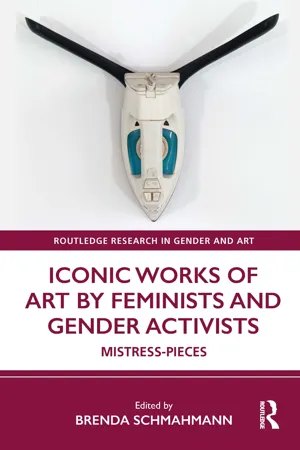
In this book, contributors identify and explore a range of iconic works – "Mistress-Pieces" – that have been made by feminists and gender activists since the 1970s. The first volume for which the defining of iconic feminist art is the raison d'être, its contributors interpret a "Mistress-Piece" as a work that has proved influential in a particular context because of its distinctiveness and relevance.
Reinterpreting iconic art by Alice Neel, Hannah Wilke and Ana Mendieta, the authors also offer important insights about works that may be less well known – those by Natalia LL, Tanja Ostoji?, Swoon, Clara Menéres, Diane Victor, Usha Seejarim, Ilse Fusková, Phaptawan Suwannakudt ?and Tracey Moffatt, among others. While in some instances revealing cross influences between artists working in different frameworks, the publication simultaneously makes evident how social and political factors specific to particular countries had significant impact on the making and reception of art focused on gender.
The book will be of interest to scholars working in art history, visual studies and gender studies.
The Women’s Peace Camp at Greenham Common (1981–2000)
Alexandra Kokoli
The women’s peace camp at Greenham Common, which lasted an unprecedented 19 years, from 1981 to 2000, was a women-only camp established in protest against nuclear proliferation and the Cold War ideology of deterrence that fuelled the arms race. It occupied the periphery of the US military base at Royal Air Force (RAF, i.e. the United Kingdom’s aerial warfare force) Greenham Common in Berkshire, England, which thus came to be known as United States Air Force (USAF) Greenham Common, where nuclear Cruise missiles were kept and from which they were deployed.1 Consisting of separate encampments across the different gates to the airbase, the peace camp also initiated a series of performative protest actions on and off site and maintained a network of occasional participants, visitors and allies regionally, nationally and internationally, through campaigns such as “Carry Greenham Home”. In lieu of any single feminist “Mistress-Piece” from Britain, this chapter proposes the performative activist strategies of women protestors at Greenham Common and their craft-based interventions on the periphery fence of the airbase. Taking stock of feminist art historical critiques of the monographic approach as well as the post-medium materialist emphasis on (art)work as labour rather than artefact, I suggest that a virtual archive of diverse documentation (visual, material, textual oral historical) is better suited to represent the aesthetic, political and ethical legacies of the feminist 1980s in Britain than any single artwork or project. Protesters at Greenham Common showed a precocious aptitude for visual activism, knowingly mobilising women’s crafts with all their ambiguous connotations as a form of intensely anti-militarist and anti-masculinist resistance.
Greenham Common as Mistress-Piece both deserves and resists canonisation. It is hybrid, encompassing artistic and visual activist practices. It is difficult if not impossible to contain, spread across archives, both public and personal, some more accessible than others, and so rich in materials that no single study can cover. Finally, its status as a research object is in a state of flux, mutating in ways that both benefit and inhibit research. What started as the analysis of a historical object (the art and visual activism of feminist anti-nuclear activism) has gradually morphed into something more complex: the Greenham Common women’s peace camp and its Berkshire site are in the process of acquiring the ambiguous status of English and Welsh heritage with a transnational reach. Through my scholarly work, I aim to consolidate and further promote this recognition, while also troubling the notion of “heritage” with the tool kit of feminist art history.
“Like it or not, We are History Now”2: The Peace Camp Lives on
When I first started working on the range of visual activist and artistic practices at, in reference to and/or in support of the women’s peace camp at Greenham Common in 2015, the project fitted in my established research interests in the art and visual cultures of second-wave feminism, but did not seem particularly topical or pressing. In the beginning, I found myself on the familiar ground of a feminist “minor mode” (cf. Solomon-Godeau 2006), in which failure featured prominently if tacitly, before its queer reclamations (e.g. Halberstam2011).3 A sympathetic history of Greenham Common by journalist David Fairhall (2006) who covered the peace camp as The Guardian newspaper’s defence correspondent during the last years of the Cold War, included a straw poll with the question “What did the Greenham women’s protest achieve, and what difference, if any, did it make to the outcome of the Cold War?”, to which most responses were dismissive if not damning. Predictably, Andrew Brookes, last operational RAF commander at Greenham Common, 1989–1991, not only dismissed offhand any impact that the Greenham peace camp and anti-nuclear protests had on the end of the Cold War but also quantified the damage that the women inflicted through the protest tactic of cutting into the perimeter fence, for the repairs to which he claimed to have been given an annual budget of £750,000 (in Fairhall 2006, 193). Journalist and nuclear disarmament proponent Polly Toynbee was only slightly more generous in her appraisal:
I never went to Greenham. My sister did, with her six-year-old son, but she was sent away because he was a boy. I think it had no effect at all on the Cold War, but had some galvanising effect on the women’s movement in the Thatcher years.
(in Fairhall 2006, 202)4
Whether and to what degree Greenham helped end the Cold War is hardly measurable (at least not from an art historical perspective), whereas its more diffuse impact and its significance as a network of visual and other feminist activist practices cannot be doubted. In any case, the fortunes of Greenham changed fast, with the completion of a new oral history project Greenham Women Everywhere (Mordan and Kerrow 2020),5 and a buoyant programme of exhibitions and events at the Control Tower at Greenham Common, re-opened in September 2018 as a cultural centre, including an exhibition of prints and drawings in reference to the peace camp by Pam Hardman in 2019 and a series of photographs from the Blue Gate of the camp by Wendy Carrig in 2018. In 2019, the arts festival Reading International chose the legacies of Greenham Common as its focus and, among other projects, commissioned a performance by Nina Wakeford, “an apprenticeship in queer I believe it was”. Wakeford’s performance, which was dedicated to sociologist and Greenham woman Sasha Roseneil, takes its title from Roseneil’s (2000) formative sociological writing on Greenham, exemplifying the close dialogue if not confluence between art and scholarship in this unfolding revival. Yet as Greenham appears to be shedding the charge of failure, it is important to remember that amateur aesthetics and, to some degree, an amateur approach to organising were defining features of this and other women’s peace camps. In the words of Ann Pettitt (2006, 309), Greenham pioneer:
In my view, it is thanks to the millions of people in the western world for whom protest was a relatively easy option, and to a brave few in the East for whom it wasn’t, that the arms race ended with a whimper […] and not with a bang (the end of the world as we know it). […] We did this […] not because we were good at campaigning, but because we were bad at it; not because we went about things in a professional way, but because we were amateurs; not because we were clever, but because we were naïve.
Whether a failure or a success, by whatever criteria, the place of the Greenham Common peace camp in collective memory in Britain and globally has never been in question. At the time of writing (2020), Greenham is actively revisited from multiple quarters, including my own art historical research, often with activist intentions. Some hope of re-activation shadows commemorations and memorialisations of Greenham, while visual culture has emerged as a privileged signifier and crucial platform for the evaluation and dissemination of anti-nuclear, anti-war activism inspired and motivated by feminism. With its visual impact often identified as one of its most influential and defining features (e.g. Paul Rogers cited in Fairhall 2006, 201),6 Greenham’s re-activations often take place within contemporary art practices. Discussing her project The Fence and the Shadow, first shown at the Midlands Arts Centre, Birmingham, in 2017, painter Sally Payen (2020) notes:
It’s not a legacy project or an archival project, even though I am interviewing some Greenham Women and researching archives. It is a project about how that contested landscape touched my life back then and the experience of what is still alive and vital today.
(Fig. 1.1)
Figure 1.1Sally Payen, Fence and Shadow, Invisible Woman and the Telephonic Tree. 2017, oil on canvas, 160 × 200 cm.
Source: Courtesy of the artist.
Payen approaches the peace camp as both a physical site and an imaginary realm where individual, public and conflicting memories intersect, and the camp itself as both a studio and exhibition space, comparing the perimeter fence, host to so many visual activist interventions, to a loom (Payen and Fowler 2017, 22).7
The prevalence of the camp and its site in the collective imagination, particularly but not singularly in Britain, has made it unusually difficult for me to decide how and in how much detail to introduce the history of Greenham Common. This is complicated further by my own positionality as a first-generation immigrant to Britain, whose history or story this is not. While Payen captures the pervasiveness of Greenham into public consciousness as well as in her biography, my own experience of it remains retrospective and largely scholarly. My Mistress-Piece is not only diffuse, extending into contemporary art practices like Payen’s but also intricately woven into social, political and military histories, including notably the history of women’s movements, partly overlapping but not fully coinciding with anti-nuclear activism, anti-militarism and pacifism. An expanded or rather exploded artwork, or possibly a virtual feminist museum (Pollock 2007), Greenham Common remains dizzyingly interdisciplinary and presents a curatorial conundrum as well as an art historical provocation.
Rarely have I presented my research on Greenham Common in Britain without at least a few of my listeners identifying as Greenham women (or male daytime visitors), and offering their own insights and information. Judging from the numbers of visitors, “campers” and “stayers”, the peace camp appears to have been a radically inclusive space in which committed activists freely mixed with inexperienced supporters. The camp encouraged contributions of all kinds and engagement in wildly varying degrees to suit different abilities, availability, social groups and situations. It would be apt to frame visits to Greenham as a kind of secular pilgrimage, if pilgrimages are to be understood as “movements of people that loosen the hold of institutional, structural descriptions in the creation of liminal spaces” (Lugones 2003, 8, drawing on Victor Turner). By all accounts, spending any amount of time at the camp was personally and politically transformative (Roseneil 1995). The peace camp helped map the world anew, literally and metaphorically, by making the spatial dimension of military-patriarchal oppression both obvious and concrete, and fostering the development of protest methods that deliberately trespassed against it. In the work of decolonial feminist philosopher María Lugones (2003, 12), “trespassing […] violat[es] the spatiality and logic of oppression”. The camp created plentiful opportunities for both enacting and reflecting on border violations as a form of eloquent resistance, from the détournement of the perimeter fence into a gallery, a loom and a screen through which protesters and the military viewed and interacted with one other, to actual breaches of the fence by the Greenham women with wire cutters.
Angela Dimitrakaki (2013, 7) coins the term “artWork” as a means of “tak[ing] further feminist art history’s partial displacement of the delivered artwork as the exclusive origin of meaning and rethink[ing] what ‘process-based work’ can possibly describe”. Greenham Common stretches this definition beyond artistic process to shed light on the labour of activism and particularly of the total commitment that staying at the peace camp involved, even for short periods of time. Furthermore, this work involves the “post-production” labour of documentation, its archiving and preservation, including crucially the maintenance and management of its accessibility of which I am a beneficiary, among many others. Such work is a labour of commitment and the hope of transmissibility, if not love. The persistence of the Mistress-Piece “Greenham Common” is a hybrid of Warburgian “afterlife” (Didi-Huberman 2003), a survival through transformation, of feminist commitment, and of the burden as well as promise of transmission (Pollock 2007; see also Chidgey 2018).
Artistic and Activist Strategies: From Pre-emptive Mourning to Sticky Time
Art informed by 1970s feminism often casts domestic space as a site of ambivalence if not unhomeliness, inspired by anti-patriarchal dissent (Kokoli 2016). A focus on the art and activist practices of feminist anti-nuclear activism expands this repertoire to include the performativity of die-in demonstrations, the protest tactics and site-specific interventions of the Greenham women on the periphery fence of the airbase and the recreations of this fence by Margaret Harrison, among others, in which domesticity is thrown into crisis anew: here living space becomes untethered from the nuclear family home to retain its character as haven but is also transformed into the site of cruelly premature, violent death by total nuclear disaster. The present contribution seeks to blur the line between artistic and activist interventions just as it challenges the distinction between private and public space. In their spatial mappings, the public and the private are neither directly opposed nor completely separate: if the personal is indeed political, domesticity needs to be considered as a microcosm of widespread ideological operations, a lab for world-m...
Table of contents
Cover
Half Title
Series Page
Title Page
Copyright Page
Contents
List of Figures
List of Contributors
Acknowledgements
Introduction
PART I Reconfiguring Domestic Life
PART II Critiquing Gender Violence and Abuse
PART III Great Goddess Iconographies
PART IV Body Politics
Index
Trusted by 375,005 students
Access to over 1.5 million titles for a fair monthly price.
Study more efficiently using our study tools.
Frequently asked questions
Yes, you can cancel anytime from the Subscription tab in your account settings on the Perlego website. Your subscription will stay active until the end of your current billing period. Learn how to cancel your subscription
No, books cannot be downloaded as external files, such as PDFs, for use outside of Perlego. However, you can download books within the Perlego app for offline reading on mobile or tablet. Learn how to download books offline
Perlego offers two plans: Essential and Complete
Essential is ideal for learners and professionals who enjoy exploring a wide range of subjects. Access the Essential Library with 800,000+ trusted titles and best-sellers across business, personal growth, and the humanities. Includes unlimited reading time and Standard Read Aloud voice.
Complete: Perfect for advanced learners and researchers needing full, unrestricted access. Unlock 1.5M+ books across hundreds of subjects, including academic and specialized titles. The Complete Plan also includes advanced features like Premium Read Aloud and Research Assistant.
Both plans are available with monthly, semester, or annual billing cycles.
We are an online textbook subscription service, where you can get access to an entire online library for less than the price of a single book per month. With over 1.5 million books across 990+ topics, we’ve got you covered! Learn about our mission
Look out for the read-aloud symbol on your next book to see if you can listen to it. The read-aloud tool reads text aloud for you, highlighting the text as it is being read. You can pause it, speed it up and slow it down. Learn more about Read Aloud
Yes! You can use the Perlego app on both iOS and Android devices to read anytime, anywhere — even offline. Perfect for commutes or when you’re on the go. Please note we cannot support devices running on iOS 13 and Android 7 or earlier. Learn more about using the app
Yes, you can access Iconic Works of Art by Feminists and Gender Activists by Brenda Schmahmann in PDF and/or ePUB format, as well as other popular books in Art & Art General. We have over 1.5 million books available in our catalogue for you to explore.