With recent advances in IT in areas such as AI and IoT, collaboration systems such as business chat, cloud services, conferencing systems, and unified communications are rapidly becoming widely used as new IT applications in global corporations' strategic activities. Through in-depth longitudinal studies of global corporations, the book presents a new theoretical framework and implications for IT-enabled dynamic capabilities using collaboration systems from the perspective of micro strategy theory and organization theory.
The content of the book is based on longitudinal analyses that employ various qualitative research methods including ethnography, participant observation, action research and in-depth case studies of global corporations in Europe, the United States and Asia that actively use collaboration systems. It presents a new concept of micro dynamism whereby dynamic "IT-enabled knowledge communities" such as "IT-enabled communities of practice" and "IT-enabled strategic communities" create "IT-enabled dynamic capabilities" through the integration of four research streams - an information systems view, micro strategy view, micro organization view and knowledge-based view. The book demonstrates that collaboration systems create, maintain and develop "IT-enabled knowledge communities" within companies and are strategic IT applications for enhancing the competitiveness of companies in the ongoing creation of new innovation and the realization of sustainable growth in a 21st century knowledge-based society.
This book is primarily written for academics, researchers and graduate students, but will also offer practical implications for business leaders and managers. Its use is anticipated not only in business and management schools, graduate schools and university education environments around the world but also in the broad business environment including management and leadership development training.
1 Introduction: issues in information systems research and new research approaches
DOI: 10.4324/9781003027997-1
1 Purpose of this book
With advances in IT in areas such as artificial intelligence (AI) and the Internet of Things (IoT) in recent years, the use of collaboration systems (CS) such as business chat (Slack, Microsoft Teams, etc.), cloud services (Zoom, Spark, Skype for Business, etc.), video and web conferencing systems and unified communications (UC) is growing in popularity worldwide (see Box 1.1). The video communications functions of collaboration systems are incorporated in iPhones (FaceTime) and various SNS, and their use is growing in popularity not only in the areas of business-to-business (B2B) and business-to-consumer (B2C) but also in consumer-to-consumer (C2C), where they are widely used at present. If the positions of these various collaboration systems were shown on two axes representing elements and functions (image quality/cost and level of media integration), as in Figure 1.1, the common functions of these systems would be video communications, information sharing and groupware calls. Companies (organizations) pursuing agility and efficiency in business processes make full use of products in such product positions based on characteristics of their business portfolios.
In business, education, healthcare and welfare in particular, new forms of services using interactive video communications are becoming more widespread (e.g., Dubé et al., 2006; du Plessis, 2008; Maher & Prescott, 2017; Piotrowski & Robertson, 2017; Clifton et al., 2017; Zournazis & Marlow, 2015). Video communications are a promising area of technology, with significant potential in a wide range of areas from corporate purposes to household and individual use. Traditionally there have been expectations for the use of video communications not only for the transmission of accurate image information but also as a means of personal self-expression and for use in areas such as education, healthcare, and welfare as well as integration with art (e.g., Kodama, 1999a, 1999b, 2000, 2001). Furthermore, in this current era of 5G, a worldwide mobile communications system, there are also expectations that such video communication technology will play a role in creating new virtual business and video business using AI.
On the market side, further expansion in the use of collaboration systems with video communication functions is evident due to a broad range of reasons including corporate promotion of global management, the acceleration of distributed project operations, the promotion of information sharing and acceleration of decision-making within and outside companies, the provision of instruction and transfer of specific skills and know-how for human resource development purposes, the promotion of telework as an approach for improving motivation, and the use of collaborations systems for emergency measures including disaster preparedness (e.g., Bond-Barnard et al., 2016; Wolfe, 2007; García-Álvarez, 2015). Additional factors driving the growing popularity of collaboration systems centered on video communications include: the development of various technologies including acceleration in the spread of broadband such as 5G as a new mobile communications system, Voiceover Internet Protocol (VoIP, as well as Multimedia over IP); cost reductions due to the advent of simplified video conference systems and video conference software; high image quality and high functionality (HD, Telepresence, 4K, 8K, etc.); the availability of a wide range of wireless mobile terminals including smartphones and tablets, unified communications (UC), cloud services and AI/IoT (see Figure 1.1).
Figure 1.1 Positioning of various collaboration systems and application domains
With advances in IT in areas such as AI and IoT in recent years, collaboration systems such as business chat, cloud services, video and web conferencing systems, and unified communications are rapidly becoming widely used as new IT applications in global corporations’ strategic activities. Through in-depth longitudinal case studies of global corporations, this book will present a new theoretical framework and implications for IT-enabled dynamic capabilities using collaboration systems from the perspective of micro strategy theory and organization theory. The rationale for examining collaboration systems as IT applications is because these systems have a significant impact on the sharing of business processes and knowledge among people and organizations (at the community level) and also on innovation as knowledge creation activities.
The content of the book is based on longitudinal analyses that employ various qualitative research methods including ethnography, participant observation, action research and in-depth case studies of global corporations in Europe, the United States and Asia that actively use collaboration systems. The book presents a new concept of micro dynamism whereby dynamic “IT-enabled knowledge communities” such as “IT-enabled communities of practice” and “IT-enabled strategic communities” create “IT-enabled dynamic capabilities” through the integration of four research streams – an information systems view, micro strategy view, micro organization view and knowledge-based view. The integration of these four research streams is extremely important in shedding light on the “black box” of the micro-strategic and organizational dynamism of IT-enabled dynamic capabilities and, in a broad sense, IT-enabled capabilities, which to date have not been examined in prior research or quantitative studies focusing on statistical analysis.
This book will demonstrate that collaboration systems create, maintain and develop “IT-enabled knowledge communities” within companies and among companies, include customers, and are strategic IT applications for enhancing the competitiveness of companies in the ongoing creation of new innovation and the realization of sustainable growth in the knowledge-based society of the 21st century.
2 Prior research and new research questions
In the field of research on information systems, the relationship between IT, including IT applications, and business process agility has been discussed as an important research theme by various researchers (Luftman et al., 2013; Roberts & Grover, 2012). In prior research, various IT-related functions such as information management functions, IT infrastructure functions and planning functions have been shown to generate benefits in performance for companies (e.g., Lu & Ramamurthy, 2011; Mithas et al., 2011). Furthermore, the impact of IT resources and capabilities on the agility of business processes and resulting impact on corporate performance are also attracting attention (Chen et al., 2014; Tallon & Pinsonneault, 2011). IT infrastructure, however, has been commoditized and, as a result, is not an element that enables differentiation for companies (e.g., Bhatt & Grover, 2005).
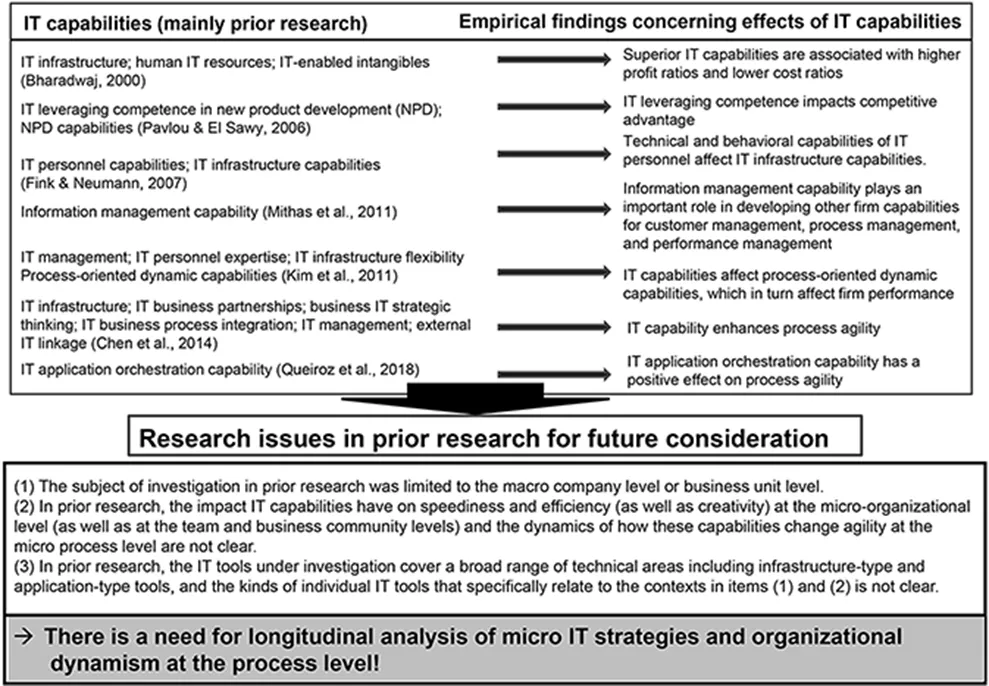
IT capabilities are essentially the “ability to mobilize and deploy IT-based resources in combination or copresent with other resources and capabilities” (Bharadwaj, 2000, p. 171) and, as stated earlier, various aspects of IT functions have been the focus of prior research (security and risk management, communications, data management, application infrastructure, IT infrastructure management and IT architecture). As Figure 1.2 shows, empirical verification in a series of prior studies has demonstrated that IT functions are an important factor in a company’s corporate performance (see “Empirical findings concerning effects of IT capabilities” in Figure 1.2).
At the same time, many of these studies argue that the main impact of IT occurs at the business process level, and that this impact may be concentrated as far as the corporate level (Barua et al., 1995; Melville et al., 2004; Mithas et al., 2011; Setia et al., 2008; Tallon, 2007). This suggests that the impact of IT at the process level is important in understanding the correlation between IT functions and company performance. There is also prior research that reports technical IT skills and flexibility in IT infrastructure have no impact on the performance of processes (Ray et al., 2005). In addition, this research argues that shared knowledge has an impact on the performance of processes and diminishes the correlation between IT technology and the performance of processes.
Shared knowledge is developed over a long period. A shared body of firm-specific knowledge at a level that can effectively apply new IT applications takes a number of years to develop and in many cases becomes a joint development project. Therefore, the development of shared knowledge is path-dependent and becomes a complex social process. However, so long as such knowledge has value, is unevenly distributed among companies and does not become the target of low-cost imitation, the actual building of IT capabilities can become an important differentiator in IT capabilities. Research along these lines suggests the importance of the knowledge-based view and the knowledge management view (e.g., Nonaka & Takeuchi, 1995; Grant, 1996) in analyzing IT capabilities.
Figure 1.2 Selected prior research and future research issues
Furthermore, research on IT application-related functions such as collaboration systems mentioned earlier as well as ways in which companies generate profit using IT applications has been given little attention (Nazir & Pinsonneault, 2012). Moreover, there has also been almost no research to date that clarifies the impact that capabilities of companies which use IT applications have on agility, efficiency and even creativity, or the extent of the impact that agility has on corporate performance. Likewise, the body of research on dynamic IT capabilities related to IT applications, where there is significant potential for corporate differentiation strategies, is extremely small (Koch, 2010; Pavlou & El Sawy, 2011; Roberts & Grover, 2012). For example, research that clarifies the impact that IT-enabled dynamic capabilities in collaboration systems have on results at the process level in regard to agility or efficiency of business processes is almost non-existent.
Moreover, Kodama (2013), who discusses the relationship between knowledge communities and the use of videoconference systems representative of collaboration systems within and outside companies, provides two insights. The first concerns the “diverse communication and collaboration effects” afforded by videoconference systems. The functions of real-time communications and ...
Table of contents
Cover
Half Title
Series Page
Title Page
Copyright Page
Dedication
Table of Contents
List of figures
List of tables
About the Author
Acknowledgments
Preface
1. Introduction: issues in information systems research and new research approaches
2. IT-enabled dynamic capabilities and collaboration systems
3. IT-enabled knowledge communities and collaboration systems
4. Product development through ambidextrous IT management
5. Dynamic business process and collaboration systems
6. Accelerating IT-enabled dynamic capabilities through the creation of Ba
7. Accelerating IT-enabled dynamic capabilities through Ma creation
8. Developing IT-enabled dynamic capabilities through holistic leadership
9. Sustainable growth through IT-enabled dynamic capabilities
10. Implications and conclusion
Research methodology and data collection
Index
Trusted by 375,005 students
Access to over 1.5 million titles for a fair monthly price.
Study more efficiently using our study tools.
Frequently asked questions
Yes, you can cancel anytime from the Subscription tab in your account settings on the Perlego website. Your subscription will stay active until the end of your current billing period. Learn how to cancel your subscription
No, books cannot be downloaded as external files, such as PDFs, for use outside of Perlego. However, you can download books within the Perlego app for offline reading on mobile or tablet. Learn how to download books offline
Perlego offers two plans: Essential and Complete
Essential is ideal for learners and professionals who enjoy exploring a wide range of subjects. Access the Essential Library with 800,000+ trusted titles and best-sellers across business, personal growth, and the humanities. Includes unlimited reading time and Standard Read Aloud voice.
Complete: Perfect for advanced learners and researchers needing full, unrestricted access. Unlock 1.5M+ books across hundreds of subjects, including academic and specialized titles. The Complete Plan also includes advanced features like Premium Read Aloud and Research Assistant.
Both plans are available with monthly, semester, or annual billing cycles.
We are an online textbook subscription service, where you can get access to an entire online library for less than the price of a single book per month. With over 1.5 million books across 990+ topics, we’ve got you covered! Learn about our mission
Look out for the read-aloud symbol on your next book to see if you can listen to it. The read-aloud tool reads text aloud for you, highlighting the text as it is being read. You can pause it, speed it up and slow it down. Learn more about Read Aloud
Yes! You can use the Perlego app on both iOS and Android devices to read anytime, anywhere — even offline. Perfect for commutes or when you’re on the go. Please note we cannot support devices running on iOS 13 and Android 7 or earlier. Learn more about using the app
Yes, you can access Managing IT for Innovation by Mitsuru Kodama in PDF and/or ePUB format, as well as other popular books in Business & Business General. We have over 1.5 million books available in our catalogue for you to explore.