Originally published in 1973, this book provides a detailed history and analysis of Tudor dynastic problems from their origin in 1460 when Richard of York asserted his claim to the crown, to 1571 when Elizabeth I's second Treasons Act virtually established parliamentary statute as the constitutional way to settle questions of succession. The book deals with each important development and provides a comparison Of the dynastic attitudes of the three great Tudors which should be an important component in appraisals of these monarchs. The study is supplemented by documents some of which had never been printed before which supply the reader with contemporary evidence to help them reach their own conclusions.
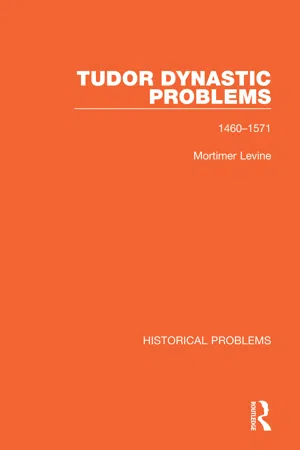
- 190 pages
- English
- ePUB (mobile friendly)
- Available on iOS & Android
eBook - ePub
About this book
Information
INTRODUCTION

Figure 1. Some descendants of Edward III to 1603; the Lancaster and Tudor lines

Figure 2. Some descendants of Edward III to 1603; the York and Stafford lines
1
The Dynastic Rivalry of Lancaster and York
The Wars of the Roses1 did not originate out of any dynastic rivalry. Doubtless the basic cause of those wars was the incompetence of Henry VI. The king’s inability to rule permitted the development of a struggle for power at the centre between the Beaufort faction and the Gloucester faction, the headship of which passed after the death of Humphrey, duke of Gloucester, in 1447 to Richard, duke of York. Henry’s inability to maintain law and order permitted the development of baronial feuds and gentry quarrels in various parts of the realm which often erupted into violence. Ultimately the Beaufort and Gloucester factions and many of the local contestants chose sides in a great feud between the Percies and the Nevilles which led to the initiation of the Wars of the Roses at St Albans on 22 May 1455. Whatever the secret ambition of Richard of York, who was allied with the Nevilles, no dynastic issue was involved at St Albans.2
1 The term ‘Wars of the Roses’ has been attacked as unhistorical and misleading (S. B. Chrimes, Lancastrians, Yorkists, and Henry VII (London 1964), pp. xii-xiv; R. L. Storey, The End of the House of Lancaster (London 1966), pp. 6–7; idem, The Reign of Henry VII (London 1988), pp. 31–2). I agree that the civil wars of the second half of the fifteenth century were not fought over roses and were not merely dynastic. Nevertheless, I shall use the customary name because it has implications that reflect the meaning given to the wars by Tudor England.
2 The best detailed account of the origins of the Wars of the Roses is now Storey, End of Lancaster.
Earlier, however, there was a dynastic issue of sorts. From the death of Humphrey of Gloucester, next in line according to an act of Henry IV (Doc. 2), to the birth of Prince Edward in October 1453, there was no established successor to Henry VI. Richard of York no doubt aspired to be designated heir presumptive. In the Parliament of November 1450, Thomas Young, a burgess for Bristol who had been in Richard’s service for some time and must have been acting at his instigation, moved that he be so designated and was committed to the Tower for his presumption.3 Though this motion may have been doomed to failure because it was ill-timed,4 there was also some justification for its fate.
3 Letters and Papers Illustrative of the Wars of the English in France during the Reign of Henry VI, ed. Joseph Stevenson (Rolls Series, London 1861–46), ii. Pt ii. 770.
4 J. R. Lander, The Wars of the Roses (London 1965), p. 66.
Richard’s claim to be heir presumptive to, but not king instead of, Henry VI derived from his paternal grandfather, Edmund of Langley, duke of York and fifth son of Edward III. Hereditarily this claim was inferior to that of his potential rivals, Lady Margaret Beaufort or, if, as was probable, a male were to be preferred, Edmund Beaufort, duke of Somerset, that is, if a bar sinister in their descent did not stand in their way. The Beauforts, like Henry VI, descended from John of Gaunt, duke of Lancaster and fourth son of Edward III. Gaunt had four children by Catherine Swynford before he made the lady his third wife. These children were given the surname Beaufort rather than the royal name of Plantagenet. Subsequently they were legitimated by the pope, and in 1397 Richard II issued a patent of legitimation that was ratified in Parliament.5 When Henry IV confirmed Richard IPs patent in 1407, he added a clause that barred the Beauforts from the royal succession.6 In law this addition probably could not prevail against the original patent with its parliamentary confirmation;7 besides, if Henry IV had authority to insert words in the patent, Henry VI, who was partial to Edmund of Somerset, equally had authority to delete the words. Richard of York’s claim to be heir presumptive was shaky both legally and practically. At any rate, the claim became obsolete with the birth of an heir apparent in 1453.
5 Rot. Pari. in. 343.
6 The Reign of Henry VII from Contemporary Sources, ed. A. F. Pollard (London 1913–14), ii. 8–9.
7 Select Documents of English Constitutional History, 1306–1485, ed. S. B. Chrimes and A. L. Brown (London 1961), p. 166.
Now, assuming the continued existence of Prince Edward, if Richard wanted to make a claim of any potential worth, it would have to be a greater one. Through his mother York was the heir of Lionel of Antwerp, duke of Clarence and third son of Edward III. But to assume the arms of Clarence would be tantamount to asserting an immediate claim to the crown: unless the English succession was governed by a Salic law, York’s descent from Edward Ill’s third son, which included two females, had priority over Henry VI’s direct male descent from Edward’s fourth son. Richard was not prepared to assert the Clarence claim in 1453; he was not prepared to do so after the St Albans victory of 1455 or at any time before October 1460.
The first battle of St Albans was more a murder than a battle. Some sixty men were slain, among them Henry Percy, second earl of Nor thumberland, and Edmund of Somerset. The Nevilles, Richard, earl of Salisbury, and his son Richard, earl of Warwick, had settled scores against Percy and his allies.8 St Albans had the effect of turning a feud into a definite blood-feud that was to produce future batdes. It certainly did not place Richard of York in a position to claim the crown, even if, as is more than doubtful, the Nevilles would have supported such a claim. In 1455 the York-Neville party - it is meaningless to speak of a Yorkist party before 1460 or 1461 - contained a very small minority of the peerage, and the killings at St Albans could not have added to its backing or to the popularity of its titular leader.
8 Even Somerset’s death may have been the work of Warwick rather than York. See Storey, End of Lancaster, p. 162.
The party scarcely grew at all until after the disaster at Ludford on 12 October 1459, which resulted in a flight of the York-Neville leadership overseas - York to Ireland, and Salisbury, Warwick and York’s son and heir, Edward, earl of March, to Calais. This was followed by the Parliament of Devils of November-December 1459, which attainted York and his chief allies.9 Then, perhaps due to a reaction against the attainders involving forfeitures of inheritances - the right of inheritance was regarded as sacrosanct by contemporaries10 -and to fear of the intentions of the court party, now led by Henry VI’s indomitable queen Margaret of Anjou, more peers began to side with York and the Nevilles. Their party grew in numbers though it remained a minority: even in early 1461, just before the accession of the first Yorkist king, its fighting strength was some seventeen out of a lay peerage of about sixty.11 York’s support remained small and that support most probably would have disintegrated if there had been any suspicion that he intended to claim the throne.
9 Rot. Pari. v. 349–50.
10 J. R. Lander, ‘Attainder and Forfeiture, 1453 to 1509’, Hist. J. (1961), iv, pp. 145–6.
11 The best estimates of the strength of the York-Neville party between 1455 and 1461 are in J. R. Lander, ‘Marriage and Politics in the Fifteenth Century: The Nevilles and the Wydevflles’, BIHR (1963), xxxvi, pp. 124–9.
At the end of June 1460, March, Salisbury and Warwick deemed the situation sufficiently favourable to permit their return to England. In London, about 2 July, Warwick stated publicly that they had ‘ever bore true faith and ligeance to the King’s person’ and indicated that the main purpose of their return was to seek reform.12 Then, after their victory over the royal forces at Northampton on 10 July, March and Warwick stated to Henry VI their desire ‘to be your true liegemen, while our lives shall endure’.13 Their subsequent respectftd treatment of the king gives no reason to doubt the sincerity of the earls.14 Significantly March’ the future Edward IV, was a party to both pledges of loyalty. Neither he nor the Nevilles, so it seems, had the slightest inkling of what his father had in mind.
12 An English Chronicle of the Reigns of Richard II, Henry IV, Henry V, and Henry VI ed. J. S. Davies (Camden Society, London 1856), p. 95.
13 Davies, English Chronicle, pp. 97–8.
14 Lander, BIHR (1963), xxxvi. p. 126; Storey, End of Lancaster, p. 188.
Richard of York dallied in Ireland for two months after his allies had won the battle of Northampton. Then another month passed between his landing at Chester and his arrival in London. The obvious explanation of York’s delay is that he wanted to avoid meeting his allies, who so recently had pledged their loyalty to Henry VI, until the Parliament scheduled for early October was under way. He first revealed his purpose at Abington where he ‘sent for trumpeters and clarioners to bring him to London, and… gave them banners with the whole arms of England without any diversity, and commanded his sword to be borne upright before him’,15 as if he were king. Reaching London, York went to the Parliament Chamber at Westminster where the Lords were in session and laid his hand upon the vacant throne. The only reaction of the Lords was silence. When the archbishop of Canterbury broke the silence by asking him if he would come and see the king, York made his much-quoted utterance: ‘I do not recall that I know anyone within the kingdom whom it would not befit to come sooner to me and see me rather than I should go and visit him.’16
15 The Historical Collections of a Citizen of London in the Fifteenth Century, ed. James Gairdner (Camden Society, London 1876), p. 208.
16 Lander, BIHR (1963), xxxvi. p. 1275 idem, Wars of Roses, p. 108.
These words ring of the bravado of a man who knew he had miscalculated. York must have expected a not-unfriendly assembly of Lords - his enemies were absent from Parliament - to acclaim him king on the spot. He did not anticipate the reluctance of peers to perjure themselves by thus violating the solemn oaths of allegiance they had taken to Henry VI and his son at Coventry but a year before.17 Nor did he anticipate public react...
Table of contents
- Cover
- Half Title
- Title Page
- Copyright Page
- Original Title Page
- Original Copyright Page
- Dedication Page
- Contents
- Abbreviations
- Chart Showing Some Descendants of Edward III to 1603
- Documents
- INDEX
Trusted by 375,005 students
Access to over 1.5 million titles for a fair monthly price.
Study more efficiently using our study tools.
Frequently asked questions
Yes, you can cancel anytime from the Subscription tab in your account settings on the Perlego website. Your subscription will stay active until the end of your current billing period. Learn how to cancel your subscription
No, books cannot be downloaded as external files, such as PDFs, for use outside of Perlego. However, you can download books within the Perlego app for offline reading on mobile or tablet. Learn how to download books offline
Perlego offers two plans: Essential and Complete
- Essential is ideal for learners and professionals who enjoy exploring a wide range of subjects. Access the Essential Library with 800,000+ trusted titles and best-sellers across business, personal growth, and the humanities. Includes unlimited reading time and Standard Read Aloud voice.
- Complete: Perfect for advanced learners and researchers needing full, unrestricted access. Unlock 1.5M+ books across hundreds of subjects, including academic and specialized titles. The Complete Plan also includes advanced features like Premium Read Aloud and Research Assistant.
We are an online textbook subscription service, where you can get access to an entire online library for less than the price of a single book per month. With over 1.5 million books across 990+ topics, we’ve got you covered! Learn about our mission
Look out for the read-aloud symbol on your next book to see if you can listen to it. The read-aloud tool reads text aloud for you, highlighting the text as it is being read. You can pause it, speed it up and slow it down. Learn more about Read Aloud
Yes! You can use the Perlego app on both iOS and Android devices to read anytime, anywhere — even offline. Perfect for commutes or when you’re on the go.
Please note we cannot support devices running on iOS 13 and Android 7 or earlier. Learn more about using the app
Please note we cannot support devices running on iOS 13 and Android 7 or earlier. Learn more about using the app
Yes, you can access Tudor Dynastic Problems by Mortimer Levine in PDF and/or ePUB format, as well as other popular books in Geschichte & Britische Geschichte. We have over 1.5 million books available in our catalogue for you to explore.