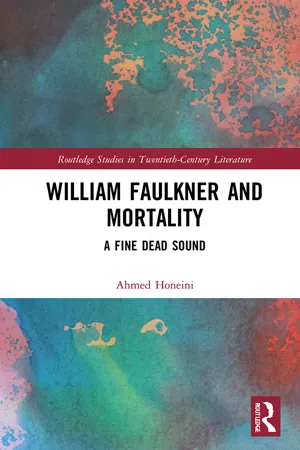
William Faulkner and Mortality is the first full-length study of mortality in William Faulkner's fiction. The book challenges earlier, influential scholarly considerations of death in Faulkner's work that claimed that writing was his authorial method of 'saying No to death'. Through close-readings of six key works – The Sound and the Fury, As I Lay Dying, "A Rose for Emily", Light in August, Absalom, Absalom!, and Go Down, Moses – this book examines how Faulkner's characters confront various experiences of human mortality, including grief, bereavement, mourning, and violence. The trauma and ambivalence caused by these experiences ultimately compel these characters to 'say Yes to death'. The book makes a clear distinction between Faulkner's quest for literary immortality through writing and the desire for death exhibited by the principal characters in the works analysed. William Faulkner and Mortality: A Fine Dead Sound offers a new paradigm for reading Faulkner's oeuvre, and adds an alternative voice to a debate within Faulkner scholarship long thought to have ended.
- 216 pages
- English
- ePUB (mobile friendly)
- Available on iOS & Android
eBook - ePub
About this book
Information
1 A Fine Dead Sound
Quentin Compson’s Suicide in The Sound and the Fury
DOI: 10.4324/9781003048930-2
Quentin Compson’s suicide on June Second, 1910, has been aptly described by Andrew Bennett as being ‘the central event’ in The Sound and the Fury (55).1 Accordingly, this chapter explores Quentin’s first-person speech on the day of his death. Throughout his chapter, Faulkner makes clear that Quentin actively seeks his own erasure and repeatedly invokes death upon himself before ultimately surrendering to it. Indeed, Faulkner incorporates numerous, albeit muted, references to death in Quentin’s chapter from its outset, and a palpable despondency characterises his tone of voice throughout. These elements of Quentin’s voice indicate, in Jean-Paul Sartre’s classic terms, that ‘not for one second does Quentin envisage the possibility of not killing himself’ (332, italics Sartre’s). With this interplay between Quentin’s voice and his suicide in mind, this chapter argues that Quentin deliberately expresses himself in a mechanised and affectless manner; he uses, in Dorrit Cohn’s words, ‘sober reportorial language’ in order to illustrate his metaphorically lifeless existence (251).
Throughout the scholarly history of The Sound and the Fury, numerous critics have attempted to deduce a single, overarching reason for Quentin’s decision to die. These reasons have included feelings of ‘despair’ and ‘guilt’ for his cruelty towards and mistreatment of his younger sister, Caddy (Butery, 1989; Bauer, 2000); mental illness and ‘madness’ brought about by, amongst other factors, ‘a lack of faith’ in Christianity (Campbell, 2005; Jones, 2018); and the corrosive influence of southern history and masculine gender norms more generally (Miller, 2005; Railey, 1992). While this chapter takes all of these reasons into account, it does not place a single reason for Quentin’s death at the forefront of its analysis. The chapter deploys this critical strategy because, as David Wendell Moller points out, a comprehensive ‘understanding of why human beings kill themselves may never be fully attained’: ‘The personal and sociocultural factors of suicide, taken individually and in combination, are so complex that it would be impossible to arrive at a definitive explanation’ (194–95). Instead, this chapter makes the case that Quentin’s fate is due to a number of often contradictory though nonetheless interconnected reasons, ranging from his incestuous desires for Caddy; his aggressive insistence that she retain her sexual purity; his own violent tendencies which arise from the adverse impact of masculine gender expectations upon his life; and the damaging impact of exterior voices, most notably his own father’s, Jason Compson III.
Finally, through its substantial focus on Quentin’s incorporation of these exterior voices into his speech, this chapter is indebted to Mikhail Bakhtin’s influential concept of “heteroglossia”. Bakhtin defines heteroglossia as being ‘another person’s speech in another’s discourse’ that is ‘always internally dialogized’ and that constitutes ‘a concentrated dialogue of two voices, two world views, two languages’ (324–25). The concept of heteroglossia aids this chapter’s exploration of the interplay between voice and speech acts upon Quentin’s suicide. My work in this chapter also builds upon the arguments of Stephen M. Ross, whose views on the use and function of these voices differs from Bakhtin’s outline of the homologous voice described above. Ross notes, for instance, that ‘Quentin allows others’ words to formulate his subjective life for him, passively absorbing experiences that he should actively engage in’ (181). By using both Bakhtin and Ross to bolster its discussion of Quentin’s speech throughout The Sound and the Fury, this chapter makes clear that Quentin’s attitude and verbal responses to his impending suicide are heavily influenced by southern society’s prejudices and anxieties towards death by one’s own hand, and in particular the views expressed by his father.
June Second, 1910: Morning – An Affectless Voice
Quentin’s decision to commit suicide is firmly within his mind from the moment his day begins. He makes his determination for death clear in two primary ways: his affectless speech and the actions he performs shortly after waking up on the morning of June Second: ‘When the shadow of the sash appeared on the curtains it was between seven and eight oclock and then I was in time again, hearing the watch’ (50). These descriptions immediately establish Quentin’s vocal style as being an automatically produced and unembellished transcription of events. Indeed, his voice mirrors the ‘mechanical hands on an arbitrary dial which is a symptom of mind function’ that Quentin later notes his father once compared to the movement of a clock (51). Faulkner’s authorial technique when introducing Quentin into the narrative therefore complements Quentin’s own resolve to commit suicide, because it soon becomes clear that he has made his decision to die long before the events of June Second take place.
André Bleikasten contends that ‘it is probably not mere chance that makes (Quentin) choose the most passive form of death: death by water. His suicide, however well prepared, is less an act of will, a free decision than an entranced surrender’ (89). Though Bleikasten is partly correct in his argument here, this chapter develops and challenges his assertion regarding Quentin’s engagement with death as a seemingly ‘passive’ or ‘entranced’ endeavour. In other words, although Quentin does attempt to willingly acquiesce and ‘say Yes to death’, his attempts are hindered by societal qualms towards suicide at various stages. The simplicity with which he describes how he ‘got up and went to the dresser […] and touched the watch’ (50), for instance, implies that he merely transitions through life, transcribing what he sees, hears, and touches. Even in passages at the very beginning of his chapter, Quentin displays a profound indifference towards and disconnection from life. These feelings are then manifested through his subdued mode of speech. In other words, he has already accepted and embraced his death, and is now beyond the point of anxiety or fear. Indeed, the extent to which he purposefully disengages with life complicates whether he speaks with active or even intended readers in mind. As his consistently passive voice implies, Quentin appears to be speaking to himself as he enacts his ritualistic preparations for death, in order to make his decision to die all the more definite and real.2
The unexpected act of smashing his watch is, in itself, the first of many (self-)destructive acts that Quentin performs. These acts escalate in severity as the day goes on. Quentin describes how he ‘tapped the crystal on the corner of the dresser and caught the fragments of glass in my hand […] and twisted the hands off’ (53). The absence of any response from Quentin towards exterior stimuli here shows the extent of his desensitisation and depersonalisation from life. The very same affectless style of voice seen here is again present when Quentin describes the minutiae of events that occur moment by moment around him, such as when he notices ‘a red smear’ of blood on the watch: ‘When I saw it my thumb began to smart. I put the watch down […] and painted the cut’ (53). By describing his injured thumb as simply being ‘cut’ and negating to provide any detailed or explicit responses to his pain, Quentin’s suicidal mindset renders him incapable of registering even the most conventional human responses to the outside world. Instead, he deliberately enacts a self-imposed form of alienation from life. In consequence, as Daniel J. Singal observes, Quentin’s ‘body is so detached from his consciousness that he doesn’t even realise when he cuts himself by breaking the crystal on his grandfather’s watch’ (28). In that sense, Quentin’s act of cutting himself with the watch’s broken glass constitutes a subdued and almost subliminal form of self-harm.
Quentin exhibits his willed alienation from life further when he details the organisation of his personal effects. He simply glosses over his motives for organising these belongings and instead catalogues and stows them away because they no longer hold any significance to him. He quickly notes that he ‘laid out two suits of underwear, with socks, shirts, collars and ties’ (53). Indeed, he feels no attachment towards nor ownership of these items because they are merely objects which he will never use again. Quentin actively erases any connection he has to these objects in order to prime himself towards the finality of his suicide. He secludes himself from the world around him and performs these acts alone, in silence, and with cold and clinical distance. His behaviour here recalls Émile Durkheim’s contention that, in the immediate leadup to suicide, ‘the subject disconnects himself from the object and removes himself from it in order to return into himself’ (308). It is precisely this retreat into the self which Durkheim identifies here that reinforces my argument that all of the actions Quentin performs at the start of his day are part of an elaborate, self-performed funerary ritual.
These actions are intensified through his depersonalised tone of voice and culminate in his bathing and shaving (54). Therefore, Quentin’s desire and readiness for death is supplemented by his rigid insistence upon purifying himself. As Bleikasten observes, purity is a central issue for Quentin, because he ‘is determined to leave everything in impeccable order. His death, at least, shall leave no mess’ and ‘he wants his exit to be a gentleman’s’ (78–79). Quentin’s need to strictly display southern masculinity of the sort that Bleikasten identifies here causes him to feel as if he has nobody to perform his burial ritual. These feelings are combined with his insistence upon alienating himself from these around him, both at home in the South and away at Harvard in the North. In consequence, he organises and enacts this purification ritual himself, treating himself with the respect, pomp, and circumstance he feels nobody else ever did, especially Caddy because of her ultimate rejection of his incestuous advances. Quentin’s voice, speech acts, and overall behaviour here therefore validates Karen Ann Butery’s claim that, ‘as an adult, he copes with life primarily through withdrawal’: ‘Neither aggressive nor rebellious as Jason and Caddy are, he avoids the risks of rejection, failure, and disappointment by diminishing his expectations of others and curtailing his own ambitions’ (212). However, despite the fact that he never openly acknowledges his suicide, Quentin does not seek to evade the experience of death. Instead, he always faces and embraces his mortality, ‘saying Yes to death’.
Quentin rehearses his self-destruction in advance by ‘trampling’ on his ‘shadow’s bones’, an act which he repeats dozens of times throughout the day and which further emphasises his alienation from his own being (54). By trampling on his shadow, he symbolically enacts his undeviating need to inflict violence, destruction, and death upon himself. In these moments, he metaphorically performs what he will later literally enact at nightfall. Quentin’s preparations for his suicide at the beginning of his day are thus acts of utmost importance which he must perform in order to successfully complete his transition from life to death. Having come to terms with his own mortality, Quentin already considers himself as dead, even at his chapter’s start. As Pardis Dabashi argues, his ‘consciousness’ is firmly ‘acquainted with its own moment of termination’ (541). Accordingly, Quentin progresses through his day as if he is an animated corpse that is preoccupied with uttering concealed, muted references to death throughout his chapter, such as when he anticipates the moment when he will ‘see (his) murmuring bones’ at rest within ‘the deep water’ of the Charles River (53). As the language Quentin uses within these passages suggests, he places himself and remains at the very edge of human existence.
These aspects of Quentin’s speech, along with his subdued outlook on life on the day of his death, leads me to disagree with Donald M. Kartiganer’s assertion that ‘The whole tenor of Quentin’s elaborate preparations is that of one who is imitating the gestures of suicide without seriously intending to realise them’ (392). Kartiganer makes the case that ‘Quentin behaves as someone who is nothing if not well practiced in the niceties of suicide, yet his very efficiency colors his conduct with a decidedly theatrical tint’ (393). As I have been arguing so far, Quentin’s speech and behaviour are, as a matter of fact, primed exclusively towards his impending suicide: he envisages no escape or evasion of his fate. More recently, and along similar lines to my point here, Heather Fox observes that ‘Quentin’s living is a mock performance since, in life, he is actually […] in the process of dying’ (65). These qualities of Quentin’s voice and actions therefore refute Kartiganer’s assertion that Quentin is not ‘seriously intending’ to enact his own death. Instead, every act he performs drives him closer to his suicidal endpoint, a fact that he himself demonstrates when he describes how he ‘folded the trunk key into a sheet of paper and put it in an envelope and addressed it to Father’ (54). In other words, Quentin insists upon severing all ties to those around him, while, at the same time, making sure that he leaves a muted expression of his motivations behind for his family to discover. It is as if he cannot accurately render his decision to die into words. The experience is either too profound to be voiced or too scandalous and socially unacceptable to be adequately justified.
***
Thus far, this chapter has highlighted the ways in which Quentin’s behaviour and overall morose mindset at the start of his day, living as if in the very moment of his death, represents his self-inflicted displacement from the world around him. The remainder of this section will show how Quentin consistently evinces a desire to escape life, time and, above all, the influence of his father, Jason Compson III. Compson’s words are forever branded upon Quentin’s consciousness. His voice, for all intents and purposes, is the first voice heard outside of Quentin’s in this chapter, from Quentin’s initial waking thoughts onwards. Compson’s voice is initially heard when Quentin recalls the reasons and practicalities for his having been given the watch in the first place: ‘I give it to you not that you may remember time, but that you may forget it now and then for a moment’ (50). Compson’s voice saturates Quentin’s thoughts throughout his chapter, which causes Quentin’s speech to be largely made up of his father’s sentiments rather than his own. When Quentin initially addresses his incestuous desires for Caddy and his anxieties towards his own virginity, it is Compson’s voice that is heard declaiming that ‘In the South you are ashamed of being a virgin. Boys. Men. They lie about it. […] He said it was men that invented virginity not women’ (52). Compson’s opinions and rhetoric regarding issues of sexuality and gender roles in the South adversely affect Quentin; they deepen his self-consciousness of and shame towards his virginity and, more importantly, his rampant incestuous feelings for Caddy. Quentin’s reaction to Compson’s speech highlights the contradiction in Quentin’s own wish to be a powerful, financially independent, and respected southern gentleman while, at the same time, harbouring outlandish and socially reprehensible desires for his sister. When his desires are ultimately left unfulfilled, Quentin finds resolution in the equally taboo act of suicide.
As Quentin packs his trunk, he recalls that ‘Father said it used to be a gentleman was known by his books; nowadays he is known by the ones he has not returned’ (53–54). Calling attention to Compson’s opinion here, Faulkner makes clear that Quentin is consistently reminded of his home, family, and fa...
Table of contents
- Cover
- Half Title
- Series Page
- Title Page
- Copyright Page
- Dedication
- Table of Contents
- Acknowledgements
- Introduction: Saying No to Death?: William Faulkner’s Aesthetic of Mortality
- 1. A Fine Dead Sound: Quentin Compson’s Suicide in The Sound and the Fury
- 2. Living Was Terrible: Confrontations with Mortality in As I Lay Dying
- 3. Burying the Fallen Monument: The Death of the Old South in “A Rose for Emily”
- 4. A Bloody Mischancing of Human Affairs: Murder and Violence in Light in August and Absalom, Absalom!
- 5. Ah’m Goan Home: Narration, Homegoing, and Whiteness in Go Down, Moses
- Conclusion: Breaking the Pencil: Death and Voice in Faulkner’s Fiction
- Index
Trusted by 375,005 students
Access to over 1.5 million titles for a fair monthly price.
Study more efficiently using our study tools.
Frequently asked questions
Yes, you can cancel anytime from the Subscription tab in your account settings on the Perlego website. Your subscription will stay active until the end of your current billing period. Learn how to cancel your subscription
No, books cannot be downloaded as external files, such as PDFs, for use outside of Perlego. However, you can download books within the Perlego app for offline reading on mobile or tablet. Learn how to download books offline
Perlego offers two plans: Essential and Complete
- Essential is ideal for learners and professionals who enjoy exploring a wide range of subjects. Access the Essential Library with 800,000+ trusted titles and best-sellers across business, personal growth, and the humanities. Includes unlimited reading time and Standard Read Aloud voice.
- Complete: Perfect for advanced learners and researchers needing full, unrestricted access. Unlock 1.5M+ books across hundreds of subjects, including academic and specialized titles. The Complete Plan also includes advanced features like Premium Read Aloud and Research Assistant.
We are an online textbook subscription service, where you can get access to an entire online library for less than the price of a single book per month. With over 1.5 million books across 990+ topics, we’ve got you covered! Learn about our mission
Look out for the read-aloud symbol on your next book to see if you can listen to it. The read-aloud tool reads text aloud for you, highlighting the text as it is being read. You can pause it, speed it up and slow it down. Learn more about Read Aloud
Yes! You can use the Perlego app on both iOS and Android devices to read anytime, anywhere — even offline. Perfect for commutes or when you’re on the go.
Please note we cannot support devices running on iOS 13 and Android 7 or earlier. Learn more about using the app
Please note we cannot support devices running on iOS 13 and Android 7 or earlier. Learn more about using the app
Yes, you can access William Faulkner and Mortality by Ahmed Honeini in PDF and/or ePUB format, as well as other popular books in Literature & Literary Criticism. We have over 1.5 million books available in our catalogue for you to explore.