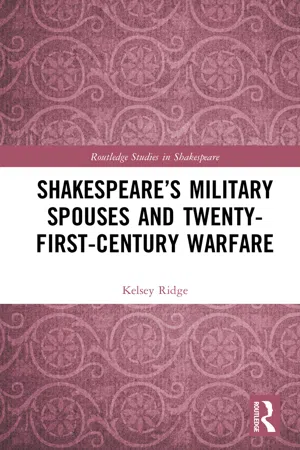
This volume presents a fresh look at the military spouses in Shakespeare's Othello, 1 Henry IV, Julius Caesar, Troilus and Cressida, Macbeth, and Coriolanus, vital to understanding the plays themselves. By analysing the characters as military spouses, we can better understand current dynamics in modern American civilian and military culture as modern American military spouses live through the War on Terror. Shakespeare's Military Spouses and Twenty-First-Century Warfare explains what these plays have to say about the role of military families and cultural constructions of masculinity both in the texts themselves and in modern America. Concerns relevant to today's military families – domestic violence, PTSD, infertility, the treatment of queer servicemembers, war crimes, and the growing civil-military divide – pervade Shakespeare's works. These parallels to the contemporary lived experience are brought out through reference to memoirs written by modern-day military spouses, sociological studies of the American armed forces, and reports issued by the Department of Defence. Shakespeare's military spouses create a discourse that recognizes the role of the military in national defence but criticizes risky or damaging behaviours and norms, promoting the idea of a martial identity that permits military defence without the dangers of toxic masculinity. Meeting at the intersection of Shakespeare Studies, trauma studies, and military studies, this focus on military spouses is a unique and unprecedented resource for academics in these fields, as well as for groups interested in Shakespeare and theatre as a way of thinking through and responding to psychiatric issues and traumatic experiences.
- 224 pages
- English
- ePUB (mobile friendly)
- Available on iOS & Android
eBook - ePub
Shakespeare’s Military Spouses and Twenty-First-Century Warfare
About this book
Information
1 “Our General’s Wife Is Now the General”
Desdemona and Emilia
DOI: 10.4324/9781003187035-2
In a post-9/11 military context, Othello is not just a compelling play; Othello is a nightmare scenario. In the summer of 2002, there were five domestic murders near Fort Bragg in North Carolina (Henderson 202). One of these involved a man strangling his wife; two were murder–suicides (Starr). Although “[a]ll the marriages apparently had been troubled beforehand, and none of the soldiers or their wives had reached out to any of the support programs the Army had available at the time,” and although there is no evidence that the servicemembers’ deployments to Afghanistan were related to the killings, the murders jumpstarted the military’s Deployment Cycle Support program in an effort to avert further disastrous events (Henderson 202).1 The military has built support systems to try to ensure these tragedies never reoccur. When one looks at the jealousy, the abuse, and the violence in Shakespeare’s text, one looks at a nightmare the likes of which the military continues to actively try to avert, because it is not something that one can pretend could never happen. Instead, in the tragedy, we see the dangers we must remember to avoid.
Although other chapters examine the military spouses and their reactions to hegemonic masculinity in juxtaposition, reading two responses against each other, Emilia and Desdemona are different from the other military spouses. They do not take diverging views on their situations as much as they have diverging backgrounds and levels of experience and therefore present a different connectedness to their roles as spouses and the military culture. Desdemona is new to the lifestyle, and she experiences problems of adjustment and culture shock. Emilia, on the other hand, has lived in this culture and suffered its systemic problems longer. However, they both face, from their different vantages, the issues of jealousy and domestic abuse, reflections of toxic masculinity. Their parallel has not gone unnoticed. Irene Dash noted that in Othello, “Shakespeare takes not one, but two marriages – one new and fresh, one old and worn – to give us a double vision of the experience” (104). These marriages are specifically military marriages, alike unto other marriages but unique as well. So, when Dash notes that “[b]y examining not one, but two marriages, Shakespeare records the effect of ‘adjustment,’ of being a ‘proper wife’, on a woman,” one should remember that in this case Shakespeare specifically depicts the need for adjustment to being a military spouse when one steps outside of civilian life into the military culture (129).
Desdemona and Emilia experience jealousy and domestic violence. Neither issue is unique to a military environment, though the military creates added pressure. Both problems are byproducts of hegemonic masculinity: jealousy because a man’s respect and power become tied to his ability to secure his female partner’s sexual fidelity; domestic violence because toxic masculinity lauds violence, the unhealthy expression or suppression of emotion, and the subordination of women. Shakespeare depicts these aspects of toxic masculinity and demonstrates how the culture allows and encourages these behaviors. The obligation to control these toxic behaviors must fall to the men who engage in them, not the women who fall victim to them. Allowing these behaviors and the gender system that creates them to continue to exist, Othello demonstrates, can lead to a breakdown in military performance and, worse, body counts, even in domestic life.
Given the similarity of Desdemona and Emilia’s experiences, instead of reading the women separately, this chapter will read them concurrently through their shared experiences and concerns. Discussion of modern productions will be folded in to consider how the War on Terror and military contexts have been brought to bear on Othello. It will begin by situating Desdemona and Emilia in the military culture. It will then consider their shared experiences as victims of toxic masculinity, which manifests as spousal jealousy and domestic abuse, especially interpreting Emilia’s behavior through a modern understanding of Battered Person Syndrome.2 Looking at Emilia through this modern lens enables us to understand her behavior with respect to Iago and Desdemona. We can also see how modern communities, particularly in the military, are trying, and sometimes tragically failing, to respond to these problems. While from a marital perspective, Othello is a play about jealousy, from a military perspective, Othello is a depiction of soldiers who betrayed their own military obligations in their unhealthy focus on their wives and their own masculinity.
Desdemona and Emilia as Military Spouses
Both Desdemona and Emilia are military spouses. However, they have different relationships to the military, given their ages and the lengths of their marriages. Desdemona is likely younger, and she is newly married to her soldier, meaning she is newer to the military culture and the role of military spouse. Emilia, on the other hand, appears older, or at least seems so in light of her cynicism and military experience, and she has been a military spouse for longer, as can be seen when she tells Desdemona, “’Tis not a year or two shows us a man” (Othello 3.4.104).
It is almost certain that Desdemona was not raised as an army brat. The modern American term is anachronistic, but not overly so. Although England did not, Venice maintained in the sixteenth and early seventeenth centuries a standing army, which means the Venetians would have understood the concept of military children (Hale and Mallett 213–214). There would have been a distinction between Brabantio and a member of that army. Her father is a counselor to the Duke, and his advice is sought on military matters; however, his advice is not military leadership – there is no suggestion of actually putting him in charge of the troops – but instead in responding to reported intelligence. While he could conceivably have a military past, it is never referred to, so it cannot be confirmed. In modern America, there are important offices, such as Secretary of Defense, that advise the President on the military but are civilian positions. He might be more in that vein. If he is a civilian, Brabantio’s daughter would not have been raised in a military culture. Although that fact may or may not distinguish her from Emilia – the audience hears little of Emilia’s backstory – it does distinguish her from several of Shakespeare’s army brats who grew into military spouses. Lady Mortimer is daughter to Owen Glendower, who led the Welsh in rebellion against Henry IV. In Rome, power, politics, and military service were inextricably bound, so it is unsurprising in Shakespeare’s Roman plays to see military spouses grown from soldiers’ daughters. Portia boasts that she is Cato’s daughter and therefore deserving of trust and respect (Julius Caesar 2.1.294–296). Military brats cum military wives exist, but Desdemona is not one of them. She marries into the culture instead of being born into it.
However, Desdemona displays willingness to accept that she is marrying into a military culture. One sees this in her desire to follow Othello to Cyprus, even though she had heard his stories of battles and hairs-breadth escapes from danger:
OTHELLO. I […] do undertake
This present war against the Ottomites.
Most humbly therefore, bending to your state,
I crave fit disposition for my wife,
Due reference of place, and exhibition,
With such accommodation and besort
As levels with her breeding.[…]
DESDEMONA. That I did love the Moor to live with him
My downright violence and scorn of fortunes
May trumpet to the world. My heart’s subdued
Even to the very quality of my lord:
I saw Othello’s visage in his mind,
And to his honours and his valiant parts
Did I my soul and fortunes consecrate,
So that, dear lords, if I be left behind,
A moth of peace, and he go to the war,
The rites for which I love him are bereft me,
And I a heavy interim shall support
By his dear absence. Let me go with him.
(Othello 1.3.234–240, 249–260)
One sees in her impassioned speech echoes of the kind of rhetoric associated with Othello: “downright violence,” “scorn of fortunes” (or “storm of fortunes” depending on editions), “trumpet to the world.” She talks about their relationship like he talks about campaign life. Furthermore, she says that she consecrated herself to “his honours” and to “his valiant parts.” She pitied his history, but she also admires him and loves his valor. One sees this behavior in other military spouses, from Volumnia’s great pride in her son’s wounds, honors, and service to Lady Macbeth’s intense interest in her husband’s honor and titles, which may border on the sexual. Othello’s honors and valor are tied to his performance of the hegemonic masculinity in his lifestyle and his military service. Desdemona, like some other military spouses in Shakespeare, is interested in and attracted to Othello’s performance of the hegemonic masculinity. Her choice of him is not in spite of his history as a soldier but instead profoundly tied to it. Although Brabantio might wish this “witchcraft” had not worked, it appears it did (Othello 1.3.65). Moreover, the Duke comments, “I think this tale would win my daughter too” (Othello 1.3.172). The Duke also believes that these war stories would work on women. Othello, like Desdemona, uses military language to discuss the future he plans for them. He refers to the accommodation he plans for her as “disposition,” a term used in the period for military arrangements, including placement and allocation. While the Duke assumes the best “accommodation” for Desdemona would be in her father’s home, Othello may intend it be with him in Cyprus, accommodated with himself. Despite the assumptions of the Duke that she should reside with Brabantio, Desdemona does not allow herself to be shut out of the military life her husband leads. She is no Penelope to wait at home.3 She intends to follow him.
Following a servicemember spouse can lead a new spouse to isolation on the order that Desdemona experiences. Joanne Stanley, a civilian social worker at the Robinson Health Clinic at Fort Bragg, reported that “she had these young spouses come in who had left their families many states away and were here in Fayetteville doing things on their own for the very first time, with no family or friends to fall back on, with no life experience to go on, in this wartime situation that was not normal” (Henderson 199). Desdemona finds herself in a new place surrounded by new people, and she must struggle to adapt to married life and her new culture at the same time, while utterly cut off from any support systems she had in Venice. (Her situation is not helped by the fact that she seems to have no mother, has no siblings, and her father disowns her when she marries (Othello 1.3.190–199). Iago says she has kinsmen, and she calls Lodovico “cousin,” but she does not seem to know him at all well. For much of the play, her only social network seems to be Emilia, who she may not have known well before they were stationed together in the spousely “band of sisters.”) There is another military spouse who follows in Shakespeare – Patroclus. However, Patroclus follows also because he, like his partner, is a soldier, and therefore his position at the front is rendered less questionable, although it is not without question from the other soldiers. Emilia also follows to the front at Othello’s request due to his decision to bring Desdemona:
Honest Iago,
My Desdemona must I leave to thee:
I prithee, let thy wife attend on her
And bring them after in the best advantage.
(Othello 1.3.295–298)
However, Emilia’s following is motivated differently than Desdemona’s. While Desdemona asks to go to accompany her spouse, Emilia’s presence is more at request. In theory, she follows because Othello desires someone to accompany his wife. The audience never learns what Iago thinks of his wife coming. On the one hand, he does not seem to like his wife, so he may get no pleasure from her presence. On the other hand, he is very jealous, and thus may prefer to have her under his eye. The text does not say. Nicholas Hytner’s 2013 production at the National Theatre – a War on Terror concept production which relied on imagery of a modern desert war – chose to cast Emilia as ...
Table of contents
- Cover
- Half Title
- Series
- Title
- Copyright
- Contents
- Acknowledgments
- “Our Great Captain’s Captain”: An Introduction
- 1 “Our General’s Wife Is Now the General”: Desdemona and Emilia
- 2 “But Yet A Woman”: Lady Percy and Lady Mortimer
- 3 “Think You I Am No Stronger Than My Sex”: Portia and Calpurnia
- 4 “In Time of Action”: Andromache and Patroclus
- 5 “Of A Woman Born”: Lady Macbeth and Lady Macduff
- 6 “Thy valiantness was mine”: Virgilia and Volumnia as Military (In)Dependents
- “My story being done”: A Conclusion
- Glossary
- Index
Trusted by 375,005 students
Access to over 1.5 million titles for a fair monthly price.
Study more efficiently using our study tools.
Frequently asked questions
Yes, you can cancel anytime from the Subscription tab in your account settings on the Perlego website. Your subscription will stay active until the end of your current billing period. Learn how to cancel your subscription
No, books cannot be downloaded as external files, such as PDFs, for use outside of Perlego. However, you can download books within the Perlego app for offline reading on mobile or tablet. Learn how to download books offline
Perlego offers two plans: Essential and Complete
- Essential is ideal for learners and professionals who enjoy exploring a wide range of subjects. Access the Essential Library with 800,000+ trusted titles and best-sellers across business, personal growth, and the humanities. Includes unlimited reading time and Standard Read Aloud voice.
- Complete: Perfect for advanced learners and researchers needing full, unrestricted access. Unlock 1.5M+ books across hundreds of subjects, including academic and specialized titles. The Complete Plan also includes advanced features like Premium Read Aloud and Research Assistant.
We are an online textbook subscription service, where you can get access to an entire online library for less than the price of a single book per month. With over 1.5 million books across 990+ topics, we’ve got you covered! Learn about our mission
Look out for the read-aloud symbol on your next book to see if you can listen to it. The read-aloud tool reads text aloud for you, highlighting the text as it is being read. You can pause it, speed it up and slow it down. Learn more about Read Aloud
Yes! You can use the Perlego app on both iOS and Android devices to read anytime, anywhere — even offline. Perfect for commutes or when you’re on the go.
Please note we cannot support devices running on iOS 13 and Android 7 or earlier. Learn more about using the app
Please note we cannot support devices running on iOS 13 and Android 7 or earlier. Learn more about using the app
Yes, you can access Shakespeare’s Military Spouses and Twenty-First-Century Warfare by Kelsey Ridge in PDF and/or ePUB format, as well as other popular books in Literature & Literary Criticism. We have over 1.5 million books available in our catalogue for you to explore.