This book investigates decolonization as a local process and its connections to international relations, introducing "internal colonialism" as a crucial analytical category for internationalists. Using Bolivia as a case study, the author argues that the reshaping of colonialism and its resistance domestically is also reflected and reproduced abroad by political actors, be they the governments or indigenous movements.
By problematizing postcolonial debate concerning the constitution/reproduction of colonial logics in International Relations, the book proposes a return to the local to show how power relations are exercised concretely by the protagonists of political process. Such dynamics reveal the interrelationship between the local and the international, especially, in which the latter represents a necessary dimension to both reinforce colonialism and oppose colonial logics.
Of interest to scholars and students of IR, Latin American and Andean Studies, this book will also appeal to those working in the fields of area studies, anthropology, indigenous politics, comparative politics, decolonization and political ecology.
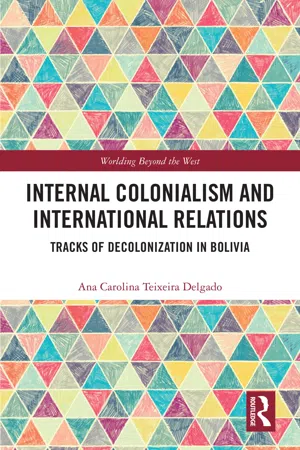
eBook - ePub
Internal Colonialism and International Relations
Tracks of Decolonization in Bolivia
- 190 pages
- English
- ePUB (mobile friendly)
- Available on iOS & Android
eBook - ePub
Internal Colonialism and International Relations
Tracks of Decolonization in Bolivia
About this book
Information
1 Tracks of decolonization
An introduction
Decolonization, Latin America and International Relations
The theme of decolonization has gained momentum among scholars over the last decade. Triggered by events in Latin America, especially in Bolivia, many academics have interpreted political affairs in the Andean country either romantically or by emphasizing mainly their domestic facet in contrast to scholars concerned about the international. Among the social scientists, their theoretical evaluations have addressed, in particular, democratic processes and the emergence of the so-called progressive leadership in Latin America, the pursuit of a new extractivist project, the empowerment of indigenous movements and the prospects of a rupture with the colonial past. In doing so, they consequently silence the crucial role played by the international and the global in decolonization, how those dimensions might condition or interfere in the political strategies employed by governments, how those might be mobilized by collective actors to project and empower themselves. In International Relations (IR), decolonization as a process has been relatively neglected by the literature, whose focus rests instead on the aim to decolonize the discipline. Rather than being the “subject” of analysis itself, decolonization would denote what Sabaratnan (2011: 4) identifies in her work on IR postcolonial literature as an “intellectual strategy”.
This book takes a somewhat unexplored path: it investigates decolonization as a local process and its connections to IR, introducing internal colonialism as a crucial analytical category for internationalists. In that sense, it argues that the reshaping of colonialism and its resistance in Bolivian society is also reflected and reproduced abroad by political actors involved in decolonization, be it governmental or social movements’ members. Such a dynamic reveals the interrelationship between the local and the international, especially, in which the latter represents a necessary dimension to both reinforce colonialism and oppose colonial logic. I have chosen the Bolivian experience for several reasons. Besides the resonance achieved in the academic literature on decolonization, the case stands out as one crossed by contradictions despite its overwhelming projection in international and global dimensions as an example of success in terms of liberation for social movements in general, especially indigenous ones, against colonialism and its signifiers, i.e. capitalism and neoliberalism. This is so due to the constant mobilization of an allegedly indigenous discourse and initiatives abroad (especially in international fora) that would endorse the empowerment of collective actors regardless of local strategies to repress and criminalize indigenous leaders or the symbolic fact that, in institutional terms, decolonization corresponded to a Vice Ministry under the Ministry of Cultures and Tourism. On the one hand, the government’s incorporation of indigenous cosmology in the official discourse not only served to project Evo Morales’ administration abroad but also to conceal a structure of colonial domination reproduced in the country. This is so because once indigenous cosmology is adjusted to the State narrative, it poses no threat to the foundations of the international and its pattern of inclusion based on Western colonial values. On the other hand, indigenous groups critical to the government search in the international a space for their empowerment, be it through the “globalization” of the Aymara cosmology and Mother Earth discourse or the denouncing of the government’s persecution at home.
In this work, I seek to problematize postcolonial debate concerning the constitution/reproduction of colonial logic in IR, proposing a return to the local. In doing so, the book evinces how power relations are exercised concretely by the protagonists of the political process. The uniqueness of this case study to IR rests upon (1) indigenous movements’ empowerment in parallel to the emergence of a cosmological discourse and its resonance abroad, (2) their alliance and contention towards Bolivian government and (3) the governmental projection to the international based on the country’s indigenous uniqueness despite the deployment of repression and criminalization towards native groups in the national scene. In this way, Internal Colonialism and International Relations: Tracks of Decolonization in Bolivia focuses on two major issues: the construction of narratives over Suma Qamaña, translated as Living Well (Vivir Bien), and the dispute concerning the building of a road in the lowlands. Both cases express latent conflicts between indigenous peoples, peasant groups, the government, the link with the international and, to some degree, with the global. Finally, the book reveals contradictions regarding decolonization, expressed also by (a) the capture/projection of Suma Qamaña by the government in the international realm and the implications of such a move, (b) the fragmentation among indigenous groups, part of them conforming an opposition bloc to the government, (c) the ties between Bolivian and Brazilian governments over a regional developmental project sustained on extractivism and the redistribution of wealth, (d) the alliance between the Morales administration and the agribusiness elite, (e) indigenous resistance strategies against internal colonialism and the “new” forms of political practice performed by those groups, a fundamental issue for IR and (f) the openness of the international to either domination and resistance for the actors involved in Bolivian contemporary decolonization.
The book stands as part of a relatively recent IR literature on indigenous peoples and the study of difference in the discipline (see, for example, Beier 2009, 2009a, Garvie and Shaw 2015, Lightfoot 2016, Low and Shaw 2012, Picq 2018, Shapiro 2004, Shaw 2008, Shaw et al. 2015, Smith 2012, Stephenson and Shaw 2013). Due to its formation as an Anglo-Saxon discipline, most references hardly address Latin American experience properly.1 Some are completely silent about the region’s colonial legacy. Others mention its colonial past or even establish a debate with Latin American authors, but do not concentrate their work on the region itself. That would be the case of Shapiro’s (2004) book, Methods and Nations, in which he takes Mignolo’s argument on the colonial character of Modern epistemologies to think of Social Science and modernity. Lightfoot (2016) mentions the fact that Bolivia has been the first country to incorporate the United Nations Declaration on the Rights of Indigenous Peoples in 2007, but dismisses the paradoxes presented by Morales’ government as she concentrates on Canada and New Zealand’s experience in absorbing International Law on Indigenous Peoples.
A similar pattern is observed in postcolonial publications in IR and their efforts to decolonize the discipline. While Muppidi’s (2004) The Politics of the Global explores the colonial politics implied in diverse theoretical conceptualizations of globalization and the possibilities of resistance to such colonization of the global space, Grovogui’s (2006) Beyond Eurocentrism and Anarchy highlights Western and European uniqueness underlying theorists’ understanding of international society and IR conceptual tools. Both authors focus primarily on regions dominated historically by British and French colonialism, India and the United States, as the new colonial power, and French African countries, although Muppidi mentions events involving other parts of the world, such as Guatemala. Lately, Grovogui has directed his attention to colonial Latin America as he investigates the Palmares insurgence in Brazil and the Haitian Revolution as examples of traditions of civil liberties that would resonate during anti-colonial movements from the 20th century.
This extension of IR scope is also observed in Muppidi’s (2012) The Colonial Signs of International Relations, in which the author incorporates some of the contributions of Latin American thinkers, namely Walter Mignolo and Eduardo Galeano. Moreover, coloniality and Other cosmologies related to Latin America has only recently been incorporated by a select group of IR scholars as part of an ongoing discussion on the discipline’s plural character and its theoretical renovation (Blaney and Tickner 2017, Conway and Singh 2011, Jackson 2017, Metzler and Rojas 2014, Pasha 2011, Persaud and Walker 2015, Rojas 2007, 2016, Sajed 2013, Shilliam 2015, Taylor 2012, Tickner and Blaney 2013, Tickner and Smith 2020, among others). Despite the reduced engagement with Latin authors when compared to those from other parts of the world, this fact seems to point to a gradual insertion of the regional production in postcolonial IR. Earlier, Inayatullah and Blaney (2004) had already addressed Latin American colonial history and regional intellectuals in The Problem of Difference in IR. In Globalization and Postcolonialism, Krishna (2009) unveils the narrative of modernization subjacent to neoliberal globalization and identifies in postcolonialism the resistance to the former. Despite the relevance attributed to Spanish and Portuguese colonization to world inequality and his criticism of modernization theory, Krishna is relatively silent about Latin American postcolonial thinkers, only to mention the foundation of the Latin American Subaltern Studies Group. This fact contrasts with his extensive analysis of postcolonialism and the emphasis attributed to India’s postcolonial tradition of thought.
So, only recently the region has gained more attention from IR scholars worried about the discipline’s marginalization of non-Modern, non-Western civilizations and their “worldview”. Shilliam’s (2011) International Relations and Non-Western Thought and Darby’s (2016) From International Relations to Relations International also reflect the growing interest in Latin America beyond the frontiers of Regional Integration Studies and Foreign Policy Analysis. Still, the central themes of Internal Colonialism and International Relations, i.e. Bolivia’s decolonization and the reinforcement of internal colonialism, remain as a relatively unexplored issue for internationalists. One of the greatest exceptions is Cristina Rojas’s work, most of it on indigenous struggles, citizenship, pluriverse, development. Although Rojas is aware of the paradoxical feature of decolonization in the Andean country during Morales’ administration, the author hasn’t advanced her analysis on those frictions specifically, nor has she presented an interpretation of Suma Qamaña detached from its developmental attribute. Nevertheless, her work reveals the increasing presence and concern for Latin America and the themes regarding decolonization among the discipline’s post-Western literature, as observed during the International Relations Association Meeting, held in Atlanta in 2016.
Internal Colonialism and International Relations addresses the issues mentioned above and offers a possibility to think the international differently, in multidisciplinary terms, stressing the crucial role played by phenomena that could be considered primarily local (or even national), such as internal colonialism. Furthermore, it offers the reader a chance to be introduced to the works of Bolivian intellectuals, whose propositions are hardly known in IR. This is due not just to the discipline’s marginalization of non-Modern thought, its Anglo-Saxon origin and what is regarded a “proper” object of research, but to the isolated feature of Bolivia as well: publications edited in the country only occasionally are available online or published abroad. This is observed especially regarding indigenous intellectuals, some of them not affiliated to universities, whose works are published by small editors or even sponsored by the authors themselves. The analysis developed here demonstrates the interconnection between global, international, national and local spheres through the analysis of different cosmologies, their projection into the actors’ strategies and political struggles.
Warriors of the rainbow: the Bolivian case
When the Earth is ravaged and the animals are dying, a new Tribe of people shall come unto the Earth from many colors, classes, creeds, and who by their actions and deeds shall make the Earth green again. They will be known as the warriors of the rainbow.
For many people, the year 2006 was an unprecedented moment in Bolivia’s histo...
Table of contents
- Cover
- Half Title
- Series Page
- Title Page
- Copyright Page
- Table of Contents
- List of figures
- Acknowledgments
- List of abbreviations
- 1 Tracks of decolonization: an introduction
- 2 The decolonial process in perspective: mapping the theoretical debate
- 3 Narratives on Suma Qamaña/Living Well: between modes of life and power disputes
- 4 The TIPNIS case and the deconstruction of the indigenous myth
- 5 Decolonization, internal colonialism and international relations: considerations on the Bolivian case
- Index
Trusted by 375,005 students
Access to over 1.5 million titles for a fair monthly price.
Study more efficiently using our study tools.
Frequently asked questions
Yes, you can cancel anytime from the Subscription tab in your account settings on the Perlego website. Your subscription will stay active until the end of your current billing period. Learn how to cancel your subscription
No, books cannot be downloaded as external files, such as PDFs, for use outside of Perlego. However, you can download books within the Perlego app for offline reading on mobile or tablet. Learn how to download books offline
Perlego offers two plans: Essential and Complete
- Essential is ideal for learners and professionals who enjoy exploring a wide range of subjects. Access the Essential Library with 800,000+ trusted titles and best-sellers across business, personal growth, and the humanities. Includes unlimited reading time and Standard Read Aloud voice.
- Complete: Perfect for advanced learners and researchers needing full, unrestricted access. Unlock 1.5M+ books across hundreds of subjects, including academic and specialized titles. The Complete Plan also includes advanced features like Premium Read Aloud and Research Assistant.
We are an online textbook subscription service, where you can get access to an entire online library for less than the price of a single book per month. With over 1.5 million books across 990+ topics, we’ve got you covered! Learn about our mission
Look out for the read-aloud symbol on your next book to see if you can listen to it. The read-aloud tool reads text aloud for you, highlighting the text as it is being read. You can pause it, speed it up and slow it down. Learn more about Read Aloud
Yes! You can use the Perlego app on both iOS and Android devices to read anytime, anywhere — even offline. Perfect for commutes or when you’re on the go.
Please note we cannot support devices running on iOS 13 and Android 7 or earlier. Learn more about using the app
Please note we cannot support devices running on iOS 13 and Android 7 or earlier. Learn more about using the app
Yes, you can access Internal Colonialism and International Relations by Ana Carolina Teixeira Delgado in PDF and/or ePUB format, as well as other popular books in Politics & International Relations & Politics. We have over 1.5 million books available in our catalogue for you to explore.