The Imaginary of Animals
eBook - ePub

The Imaginary of Animals

  1. 304 pages
  2. English
  3. ePUB (mobile friendly)
  4. Available on iOS & Android
eBook - ePub

The Imaginary of Animals

About this book

This book explores the phenomenon of animal imagination and its profound power over the human imagination. It examines the structural and ethical role that the human imagination must play to provide an interface between humans' subjectivity and the real cognitive capacities of animals.

The book offers a systematic study of the increasing importance of the metaphors, the virtual, and figures in contemporary animal studies. It explores human-animal and real-imaginary dichotomies, revealing them to be the source of oppressive cultural structures. Through an analysis of creative, playful and theatric enactments and mimicry of animal behaviors and communication, the book establishes that human imagination is based on animal imagination. This helps redefine our traditional knowledge about animals and presents new practices and ethical concerns in regard to the animals. The book strongly contends that allowing imagination to play a role in our relation to animals will lead to the development of a more empathetic approach towards them.

Drawing on works in phenomenology, contemporary animal philosophy, as well as ethological evidence and biosemiotics, this book is the first to rethink the traditional philosophical concepts of imagination, images, the imaginary, and reality in the light of a zoocentric perspective. It will appeal to philosophers, scholars and students in the field of animal studies, as well as anyone interested in human and non-human imaginations.

Trusted by 375,005 students

Access to over 1.5 million titles for a fair monthly price.

Study more efficiently using our study tools.

Information

Publisher
Routledge
Year
2021
Print ISBN
9780367772987
eBook ISBN
9781000414325

1Human-animal metaphors

Identity and similarity at issue

§6 Similar but not the same: An ontological issue

One of the most stubborn, in fact ever-recurring, issues in the field of animal studies is whether it is legitimate or not to apply words that classically describe human beings to non-human animals: Subjectivity, cognition, language, feelings, imagination, morals, agency, will, decision, or culture, for instance. Even when scientific studies show that certain animal behaviors display characteristics that can be, point-to-point, likened to a cognitive or moral behavior such as it can be observed in human existence, the objection remains unshaken: Is animal “cognition” genuine cognition? Is animal moral sense genuinely “moral”? De Waal, who regularly came up against this objection, consistently responds by reasserting the importance of using anthropomorphism in ethology: “The curious situation in which scientists who work with these fascinating animals find themselves is that they cannot help but interpret many of their actions in human terms, which then automatically provokes the wrath of philosophers and other scientists.”1 By contrast, De Waal argues, those who strive to make the meaning of concepts narrower and narrower so that only human behaviors can fit them2 are simply secretly driven by the same foolish human pride that made so many people try to outperform the “chimpion” Ayumu, the chimpanzee who can recall a series of number appearing randomly, for a fraction of second, on a screen.3 But the issue also arises at an apparently more rational level: Differences matter as much as—if not more than—common features or similarities, especially if we want to give a clear and analytical scientific account of beings. Surely, a non-human and a human behavior can never be exactly the same. The issue at stake is perfectly summarized by the sentence spelled out at the end of a YouTube video posted on the channel of the Primate Research Institute of the University of Kyoto, about Ayumu's incredible skills: “Chimpanzees are so similar to us… But not the same.”4 The problem is whether and how similarity may gain an ontological status and find a place in the framework of the search for a relevant scientific method for life studies.
In a famous passage of The Fundamental Concepts of Metaphysics, Heidegger affords us a striking instance of this similarity problem. As the next chapter will show, Heidegger actually remained entangled in the web of this issue, but, at least, he succeeded in phrasing it without eluding its intricate and paradoxical nature. “The dog feeds [frißt] with us… no we do not feed. It eats [ißt] with us… no it does not eat. And yet, with us. A going along with… a transposedness, and yet not.”5 Indeed, in German one does not use the same verb to designate the non-human and human action of eating (freßen-eßen). Admittedly, strictly speaking, there are differences between animal and human “eating,” the most fundamental of which being the huge symbolic dimension that has deeply permeated the human food rituals and ceremonials. But how exactly should we account for the not-less stubborn feeling of similarity? Heidegger's description of the “transposedness and yet not” does not help much: It is hardly conceptual, rather wavering, and almost stammering. The logically unacceptable “X is and is not X” form shows the tension between the phenomenon of similarity and classical logics.
At least those who proclaim the prohibition of anthropomorphism cut to the chase. A non-human behavior or mode of existence is either the same as a human one, or different. And, in the latter case, it is simply rigorous to avoid using the same word to designate them. After all, this is a regular application of the principle of the excluded third.
Similarity stands beyond this dichotomy, but can it be turned into a fundamental concept? Would an ontology of resemblance be compatible with a scientific study of life? Is such a shift worth the cost that we would necessarily have to pay, namely a logical and methodological revolution?
Before examining, in the next chapter of this book, how an ontology inspired by the phenomenology of the imaginary can shed new light on animal studies, I will present two antithetical and equally problematic contemporary approaches that grapple with this problem of similarity—in the field of anthropology and cognitive ethology. The ontological issue at stake will thus be defined more concretely as a thorny question at the heart of animal studies that engages the attention of researchers beyond philosophical studies. The study of animal life is doomed to face ontological dilemmas and the connection between such ontological consideration and the question of the proper method for a scientific study of animals will also appear more clearly.
We will first focus on the misadventures of the theory of true imitation at the end of the twentieth century in cognitive ethology (§7-8). Such misadventures demonstrate that refusing to use the same words to denote similar behaviors in human and non-human animals—allegedly for the sake of scientific meticulousness—is not as metaphysically neutral as it may seem, nor even scientifically fruitful. We shall then turn to a thinker who takes the opposite view, by examining Ingold's criticism of the concept of anthropomorphic metaphors (§9-11). Ingold unmasks the metaphysical biases of the classical analytical approaches, but I contend that he lapses into the opposite mistake. Ingold explicitly calls for a new ontology, but his approach reduces similarity to identity and thus fails to provide a satisfactory ontological framework to animal studies.

PART I. HUMANS APE BETTER

§7 Can animals imitate? The “true imitation” theory and its flaws

If a non-human animal copies the general pattern of behavior that provokes an interesting result—even a behavior that is unfamiliar to her and not part of the action repertoire of her species—this cannot be called true imitation, a number of eminent scientists assert.6 The argument goes as follows: Non-human animals do not focus on the detailed topography of the gestures performed by the model, but, instead, on the result of the action, the affordances of the tools, or a rough pattern of actions that can be exploited by each individual according to its own behavioral strategies. A non-human animal can roughly do as the model does: She selectively reproduces some aspects of the model's gestures.7 Does she not imitate? This looks like imitation, but, according to the “true imitation” theory, this should be called emulation learning8 based, for instance, on local and/or stimulus enhancement.9 In other words, apes do not ape:10 Smart trick, indeed. Michael Tomasello, a prominent researcher in the field of Evolutionary Anthropology, did not dither too long before concluding that only humans are capable of true imitation11 and he contended that the latter is the backbone of culture, namely a highly cumulative evolution12, a.k.a. true culture.13 Cultural evolution, the argument goes, is a process in which ever new ways of doing things are noticed and transmitted. Without a capacity for true imitation, such unique features would never be retained; they would be lost in a schematic reproduction of general patterns of behavior.
Several daring and debatable metaphysical presuppositions are actually at work in this approach under the guise of a fine-grained description of the lineaments of behaviors. Even a half-attentive reading can ferret out symptoms of such biases: The phrase “true imitation,” for instance, can only set off some alarms, as its proponents themselves sense it.14 Certainly, the issues raised by this platonic approach warrant a more detailed look.
The “true imitation” theory chooses to radically break with the common sense of “imitation” and loses touch with vernacular language.15 To be sure, the latter is often loose and sometimes conflates what should be kept separate. Nonetheless, in this case, as often, everyday language acknowledges a similarity between behaviors, that is an integral part of the phenomenality of these behaviors and that a fine-grained description should integrate into its account. Common language possesses a fluidity and a flexibility that makes a more comprehensive description possible and, correlatively, sustains an ethics of community that is also crucial in animal studies. Indeed, in this particular theory of true imitation, is Tomasello interested in paying attention to animals or, eventually, in finding a way of reasserting human uniqueness? Nevertheless, shouldn’t a scientific approach use clearly circumscribed concepts? It is significant, however, that De Waal chooses, for instance, the phrase “selective imitation” to designate behaviors that the proponents of the “true imitation” theory would call “emulation learning.”
More specifically, several researchers have strongly challenged the true imitation theory. Andrew Whiten and Deborah Custance,16 for instance, develop criticism based on meticulous experiments, but also on a reflection on the most accurate method that should be used to shrewdly account for such experiments. Many experiments show that animals of several species can actually truly imitate;17 hence, they challenge Tomasello's theory without challenging his concept of imitation. By contrast, the general thrust of Whiten and Custance's work, such as it is presented in Heyes’ and Galef's Social Learning in Animals: The Roots of Culture, is that drawing a clear boundary between emulation and imitation is impossible.
There is indeed a dimension of imitation in the behaviors that some have tried to describe exclusively in terms of emulation.
a First, no imitation can be perfect, not only because perfection is only divine—which makes true imitation an “ever elusive,” although still pertinent, ideal—but more fundamentally because imitation essentially implies duplication, de-centration, and, consequently, some modifications. The body of the imitator is not exactly the same as the body of the model, even more so in frequent cases of interspecific emulation learning. As pointed out by Whiten and Custance, “All imitative copies must have a schematic or program-like character, because not every muscle twitch is going to be copied.”18 Identity and imitation are antinomic. The very concept of true imitation as a slavish process that sticks to every possible detail of an action is an unviable monster. This concept additionally enters into tension with another version of the true imitation theory. Tomasello sometimes argues that proper imitation should imply understanding of the intentions that rule the acts of the imitated model.19 But such an understanding essentially consists in generalizing and catching, at least performatively, the outline structure of a task that can be reapplied to ...
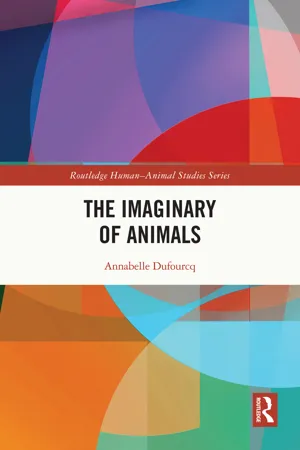
Table of contents

  1. Cover
  2. Half Title
  3. Title Page
  4. Copyright Page
  5. Contents
  6. List of figures
  7. Acknowledgments
  8. Introduction. The imaginary: A human-non-human-animal interface
  9. 1 Human-animal metaphors: Identity and similarity at issue
  10. 2 Phenomenology of the animal imaginary: Non-human subjects, ambiguous worlds, empathy
  11. 3 Animal bodies and the virtual: Animals as real phantoms
  12. 4 They talk the way we dream: Animal communication and the symbolic realm
  13. 5 Metamorphoses and corporeal imagination: The “second person” at stake
  14. Conclusion: Why imagine (with) animals?
  15. Bibliography
  16. Index

Frequently asked questions

Yes, you can cancel anytime from the Subscription tab in your account settings on the Perlego website. Your subscription will stay active until the end of your current billing period. Learn how to cancel your subscription
No, books cannot be downloaded as external files, such as PDFs, for use outside of Perlego. However, you can download books within the Perlego app for offline reading on mobile or tablet. Learn how to download books offline
Perlego offers two plans: Essential and Complete
  • Essential is ideal for learners and professionals who enjoy exploring a wide range of subjects. Access the Essential Library with 800,000+ trusted titles and best-sellers across business, personal growth, and the humanities. Includes unlimited reading time and Standard Read Aloud voice.
  • Complete: Perfect for advanced learners and researchers needing full, unrestricted access. Unlock 1.5M+ books across hundreds of subjects, including academic and specialized titles. The Complete Plan also includes advanced features like Premium Read Aloud and Research Assistant.
Both plans are available with monthly, semester, or annual billing cycles.
We are an online textbook subscription service, where you can get access to an entire online library for less than the price of a single book per month. With over 1.5 million books across 990+ topics, we’ve got you covered! Learn about our mission
Look out for the read-aloud symbol on your next book to see if you can listen to it. The read-aloud tool reads text aloud for you, highlighting the text as it is being read. You can pause it, speed it up and slow it down. Learn more about Read Aloud
Yes! You can use the Perlego app on both iOS and Android devices to read anytime, anywhere — even offline. Perfect for commutes or when you’re on the go.
Please note we cannot support devices running on iOS 13 and Android 7 or earlier. Learn more about using the app
Yes, you can access The Imaginary of Animals by Annabelle Dufourcq in PDF and/or ePUB format, as well as other popular books in Physical Sciences & Human Geography. We have over 1.5 million books available in our catalogue for you to explore.