There are many UNESCO World Heritage Sites in Germany. Most of them are built with natural stones. These sites are commonly presented to the public with a lot of information regarding historical, cultural and artistic aspects. Mostly, there is no focus on the main building material if it concerns natural stones.
This work aims to show that it is precisely the natural stone that lends the sites their distinctive character. The used stones demonstrate the context and the interaction with the geology of the surrounding countryside as well as possibilities of transport and treatment. They reflect the culture and society at the time of the building phases.
The second part of the work presents the most important stones that were used at these sites, along with their occurrences, aspects of quarrying in historical times and of course their petrographical, mineralogical and technical features. It is shown how these features influence the weathering of the stones and how restoration of stones is carried out.
The book will serve as a useful source book for geologists, archaeologists, architects, representatives of the natural stone industry, historians and cultural heritage management professionals specifically, and for academic and nonacademic communities, travelers and tourism industry operators in general.
1.1 Town Hall and Roland on the marketplace of Bremen
Jürgen Pätzold
Brief description
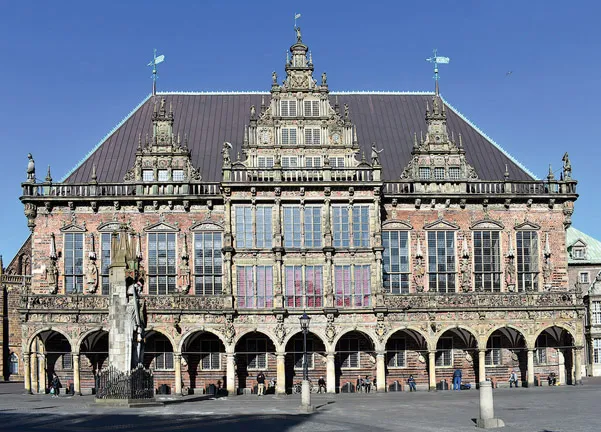
The Town Hall and Roland on the marketplace of Bremen in northwest Germany are recognized as an outstanding ensemble, representing the civic autonomy and sovereignty that developed in the Holy Roman Empire in Europe (UNESCO WHC 2004; Elmshäuser et al. 2002, Figure 1.1.1). The Old Town Hall was constructed in the Gothic style at the close of the Middle Ages in the early 15th century. The stone statue of Roland, erected in 1404, stands in front of the town hall, symbolizing the rights and privileges of the free and imperial city of Bremen. The medieval building was renovated and modified in the style of the so-called Weser Renaissance during the early 17th century. The New Town Hall was built adjacent to the old one in the early 20th century in Neo-Renaissance style. The complete ensemble escaped destruction during World War II and was included in the list of UNESCO World Heritage Sites in 2004.
Figure 1.1.1 Bremen Town Hall, southwest façade as seen from the marketplace.
Old Town Hall
The Old Town Hall was built as a Gothic hall structure in the years 1405–1410. It is a transverse rectangular two-story hall building (Saalgeschossbau), a representative of the palas type, with an arcade extending along its entire width and a balustrade beneath a high roof. The façade of the Gothic town hall is characterized by the combination of alternating layers of raw and black-glazed bricks, with the extensive use of ashlar. For lack of natural stone resources in the North German lowlands, ash-lars were transported from the catchment area of the Weser River and its tributaries. Sandstones of Mesozoic age were primarily used. The procurement of building materials from the area around Hannover is alluded to in a number of entries in the preserved book of accounts related to the town hall construction. Fine homogeneous grey sandstones (called “Graustein” or “Grauwerk”) from the Wealden facies of the Early Cretaceous (see Chapter 2.6) in the Weser Mountains were used in large quantities. Massive Red Weser Sandstones from the Middle Buntsandstein (see Chapter 2.1) of the upper Weser region were used as floor tiles in the cellar (Ratskeller) and plates from laminated Red Weser Sandstone were utilized for roofing. Brown Porta Sandstone from the Middle Jurassic was only used in smaller quantities. In addition, Hannover limestones and mussel shells from the North Sea were brought in for local production of mortar. The Bremen account book also names a number of stone-masons and stone carvers. Sixteen stone figures by master sculptor Johan and his journeymen were placed between the large windows of the first upper story, all of them standing on consoles beneath canopies. The original Gothic statues of the emperor and seven electoral princes are preserved in the Focke Museum, Bremen, while copies from Obernkirchen Sandstone were placed on the main town hall façade in 1960–1961. The preserved figures on the northwest and southeast side were originally intended to represent prophets from the bible (Gramatzki 1994).
Bremen Roland
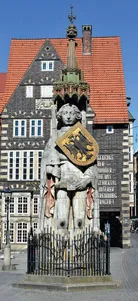
Even before construction of the old town hall began in 1405, a statue of Roland had been erected on the marketplace in Bremen (Figure 1.1.2). An entry in the Bremen book of accounts states that the council of Bremen had a Roland built of stone, which cost 170 Bremer Marks and was invoiced by Clawes Zeelsleghere and Jacob Olde.
Figure 1.1.2 Roland on the marketplace.
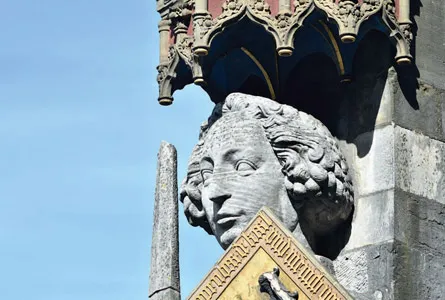
The 5.5 m high stone statue of Roland was constructed using Elm limestone (Elm-Kalkstein) and placed on a stepped base with a supporting column topped by a Gothic-ornamented canopy. The monument reaches a total height of 10.2 m and is the first free-standing statue of the German Middle Ages. Historical representations document that it was painted with intense coloring during its early centuries. The limestone material came from quarries still known today from the Elm, south of Königslutter. The Bremen Roland has been repeatedly restored over the centuries and individual stones of Elm limestone (Elm-Kalkstein) have been replaced by Obernkirchen Sandstone. However, it can still be regarded as original because the replacement was performed stone by stone. The original head from 1404 was not replaced until 1983, and it is now in the museum. The copy was made of original material of the Elm-Kalkstein, which represents a shallow-marine facies of the Terebratel Beds of the Lower Muschelkalk. The copy exhibits the characteristic cross-bedding (Figure 1.1.3), while the original head from 1404 shows the typical grey weathering crusts on the surface. The last active quarry in the Elm limestone at Hainholz near Königslutter was abandoned around 2005 (Lepper et al. 2018). Today, the Bremen Roland is considered to be the oldest and largest statue of this type still in place.
Figure 1.1.3 Head of Roland.
Weser Renaissance
Under the direction of master builder Lüder von Bentheim, the Bremen town hall was extensively renovated and reconstructed at the beginning of the 17th century in the style of the so-called Weser Renaissance of Northern Germany and was richly decorated using Obernkirchen Sandstone after Dutch models (Figure 1.1.1). The use of Obernkirchen Sandstone in the Weser region dates back to the 11th century (see Chapter 2.6). Due to its very favorable material properties, the sandstone was increasingly used by stone sculptors with the spread of the Weser Renaissance. Both raw and prefabricated building blocks were transported by horse carts from the Bückeberge near Obernkirchen to the Weser near Rinteln, where they were loaded onto oak barges (so-called Eken) then taken downstream to Bremen to be stored and further processed (Kuster-Wendenburg 2002). Because of their light grey weathering color, they were known by the trade name “greystone”. From Bremen, the sandstones were also ...
Table of contents
Cover
Half Title
Series Page
Title Page
Copyright Page
Contents
UNESCO World Heritage Sites in Germany and natural stones: introduction
1 UNESCO sites in Germany
2 Natural stones at UNESCO sites in Germany
References
Index
Trusted by 375,005 students
Access to over 1.5 million titles for a fair monthly price.
Study more efficiently using our study tools.
Frequently asked questions
Yes, you can cancel anytime from the Subscription tab in your account settings on the Perlego website. Your subscription will stay active until the end of your current billing period. Learn how to cancel your subscription
No, books cannot be downloaded as external files, such as PDFs, for use outside of Perlego. However, you can download books within the Perlego app for offline reading on mobile or tablet. Learn how to download books offline
Perlego offers two plans: Essential and Complete
Essential is ideal for learners and professionals who enjoy exploring a wide range of subjects. Access the Essential Library with 800,000+ trusted titles and best-sellers across business, personal growth, and the humanities. Includes unlimited reading time and Standard Read Aloud voice.
Complete: Perfect for advanced learners and researchers needing full, unrestricted access. Unlock 1.5M+ books across hundreds of subjects, including academic and specialized titles. The Complete Plan also includes advanced features like Premium Read Aloud and Research Assistant.
Both plans are available with monthly, semester, or annual billing cycles.
We are an online textbook subscription service, where you can get access to an entire online library for less than the price of a single book per month. With over 1.5 million books across 990+ topics, we’ve got you covered! Learn about our mission
Look out for the read-aloud symbol on your next book to see if you can listen to it. The read-aloud tool reads text aloud for you, highlighting the text as it is being read. You can pause it, speed it up and slow it down. Learn more about Read Aloud
Yes! You can use the Perlego app on both iOS and Android devices to read anytime, anywhere — even offline. Perfect for commutes or when you’re on the go. Please note we cannot support devices running on iOS 13 and Android 7 or earlier. Learn more about using the app
Yes, you can access Natural Stone and World Heritage by Angela Ehling,Friedrich Häfner,Heiner Siedel in PDF and/or ePUB format, as well as other popular books in Physical Sciences & Geology & Earth Sciences. We have over 1.5 million books available in our catalogue for you to explore.