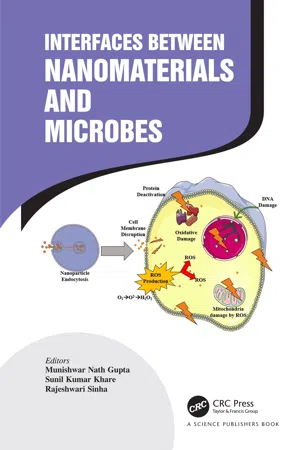
Nanomaterials are becoming ubiquitous; microbes similarly are everywhere. This book focuses on various ways the diverse nanomaterials interact with microbial communities and implications of such interactions. Both toxicity and beneficial effects of nanomaterial-microbe interactions have been covered. This includes areas such as fate and bioavailability of nanomaterials in environments, microbial synthesis of nanomaterials and antimicrobial action of nanomaterials. Fairly comprehensive but with narrow focus, the book provides useful insights into these interactions which need to be factored in while designing nanoscience based new technologies.
eBook - ePub
Interfaces Between Nanomaterials and Microbes
- 294 pages
- English
- ePUB (mobile friendly)
- Available on iOS & Android
eBook - ePub
Interfaces Between Nanomaterials and Microbes
About this book
Information
1
Introduction to the Microbial World
Munishwar Nath Gupta1, Sunil Kumar Khare2* and Rajeshwari Sinha3
1Former Emeritus Professor Department of Biochemical Engineering and Biotechnology Indian Institute of Technology Delhi, Hauz Khas, New Delhi 110016, India
Email: [email protected]
Email: [email protected]
2 Institute Chair Professor of Biochemistry, Enzyme and Microbial Biochemistry Laboratory, Department of Chemistry Indian Institute of Technology Delhi, Hauz Khas, New Delhi 110016, India
Tel: +91 11 2659 6533, Fax: +91 11 2658 1102
Email: [email protected], [email protected]
Tel: +91 11 2659 6533, Fax: +91 11 2658 1102
Email: [email protected], [email protected]
3Independent Researcher, M25-Kalkaji, New Delhi 110019, India
Email: [email protected]
Email: [email protected]
INTRODUCTION: A PRIMER FOR MICROBIOLOGY
The first sentence in the excellent book by Frankel and Whitesides (2009) reads “Small is different”. Very small is very different. Microorganisms are one such class which is very small indeed. The term micro comes from “micros”, which means small. These organisms were so named because most of these cannot be seen with naked eyes. Various microscopic techniques have been critical to studies on microorganisms.
It was John Ray who coined the term “species” in the 17th century for living organisms. The current binomial system of nomenclature (the name has two words) was given to us by Carolus Linnaeus in the 18th century. While early scientists thought that there were two kinds of species (two kingdoms), Whittaker (1959), on the basis of the updated knowledge, proposed 5 kingdoms. These kingdoms are called: Monera, Protista, Plantae, Fungi, and Animalia. His classification used three parameters: cellular structure, structure of organism, and how an organism derived its nutrition (essential molecules for the metabolic activity) and energy. Before we further discuss the five kingdoms, let us first discuss these three criteria which define these kingdoms for the sake of clarity. Our discussion, of course, is based on the updated information since the times of Whittaker.
Microorganisms include unicellular organisms (archae, bacteria, some protista, some fungi, and some chlorophyta), few multicellular organisms (large fungi and some chlorophyta), and viruses. It is helpful to remember that classifying any organism as a microorganism had no biological criterion; it was purely a question of size. However, cell size is not an incidental property. Directly or indirectly, there are biological requirements which tailor the cell sizes.
The availability of the light microscope had revealed that at the cellular level, organisms can be called prokaryotes or eukaryotes. In 1977, Carl Woese proposed that archaebacteria are different from bacteria. Hence, many scientists accept that the primordial cell evolved into archaea, bacteria (including cyanobacteria), and eukarya (eukaryotes). The eukaryotes include protists, fungi, plants, and animals.
The primordial cell, the ancestor of all cells, is believed to have come into existence about 3 billion years ago. There are some conflicting views about the evolutionary relationship among archaea, present day bacteria, and eukaryotes. However, there is general agreement on archaea being the most ancient and these and bacteria evolved somewhere around 1.3–1.5 billion years ago. Initially, archaea were found in harsh environments, but have been later found in diverse habitats, and hence include both mesophiles and extremophiles. The major 3 groups are methanogens (who produce methane by reduction of carbon dioxide), halophiles (which occur and even require high saline conditions), and thermoacidophiles. It should be added that halophilic organisms are not restricted to archaea; there are bacterial halophiles, and even some eukaryotes such as algae Dunaliella salina or fungus Wallemia ichthyophaga are known. The niches for thermoacidophiles are hot springs and hydrothermal vents. Some archaea are also alkalophiles, but these are a subclass of halophiles, and are called haloacidophiles.
So, prokaryotes are of two kinds: archaea and bacteria. Prokaryotes, except planctomycetes, have free deoxyribonucleic acid (DNA) in the cytoplasm, which means that DNA is not enclosed in any membrane. Chromosomes are this DNA associated with some “histone-like” proteins, and may contain extrachromosomal DNA as part of the bacterial genome. Cell division is by binary fission; the exchange of genetic material takes place by conjugation, transduction, or transformation. Eukaryotes have 70S ribosomes. The specialized pathways like for ammonia oxidation or photosynthesis (in cases these pathways exist) are enclosed by internal membranes. Some prokaryotes have flagella (used for motion); these have a single protein called flagellin.
In eukaryotes, there are always more than one chromosome, and these have DNA bound with histones and are inside a nucleus enclosed in a membrane. In fact, there are many cellular organelles enclosed in membranes, such as golgi bodies, chloroplasts (in photosynthetic eukaryotes), and endoplasmic reticulum, the membranous structures present throughout the cytoplasm. Extrachromosomal DNA is present only inside organelles (e.g., mitochondria). Flagella (in those eukaryotes which have these) consist of multi-protein fibrils. The eukaryotic cells have 80S ribosomes.
There are a couple of aspects in which not only the two prokaryotes differ even between themselves, but even bacteria are not all similarly constructed.
CELL WALL AND CELL MEMBRANES
One of the earliest ways of classifying bacteria is by staining technique invented by Hans Christian Gram in 1894. Treated with the dye crystal violet and iodine solutions, and then followed by an alcohol wash, if cells retain the deep purple color, these are called gram-positive. Those which don’t are called gram-negative bacteria. Treatment with another dye safranin turns these into pink, whereas this counterstain is hidden by the deep purple color of the stained gram-positive bacterial population. The distinct result is due to the outermost cellular component called cell wall. The gram-positive bacteria have a 20–80 nm thick cell wall, which is responsible for giving rigidity/shape as well as retaining the color of iodine. This is made of peptidoglycan (also called murein as its backbone chain has alternating groups of N-acetylglucosamine and N-acetylmuramic acid; the enzyme lysozyme hydrolyzes murein and hence is also called muramidase!) in which the carbohydrate backbone is crosslinked with amino acids and diaaminopimelic acid. Teichoic acid and teichuronic acids are also physically linked to this peptidoglycan layer.
The diverse behavior of bacteria is underlined by some gram-positive bacteria becoming gram variable. This may be the case with old cultures; in some cases, such as Bacillus, Butylvibrio, and Clostridium, growth results in thinning out of the peptidoglycan wall and cells not being able to retain the stain. In yet another kind called gram-indeterminate bacteria (notable examples being M. tuberculosis and M. leprae), gram stain gives unpredictable response. Both Mycobacteria and Nocardia do not get stained (by gram stain) as their cell wall has polymers of arabinogalactan esters (of mycolic acid) attached to the peptidoglycan backbone. Coryneform also have a similar kind of cell wall. Planctomycetes, again are an exception and do not have a peptidoglycan cell wall. Their shape instead is maintained by S-layers.
In gram-negative bacteria, the outermost part is a bilayer of lipopolysaccharides (LPS). The composition of LPS varies among species. Both kinds of bacteria have the cytoplasm enclosed in the bilayer of phospholipids (the well-known fluid mosaic model), in which proteins are interspersed (integral proteins) or bound to the outsides of the phospholipid bilayer (peripheral proteins). In gram-negative bacteria, in between the LPS bilayer and the inner biomembrane, there is the periplasmic space, and there is a thin (5–10 nm) murein layer present in that space. Some scientists prefer to call this outermost component cell envelope and reserve the term cell wall for the outer component of gram-positive bacteria.
Another exceptional case with respect to cell wall presence is that of the mycoplasma. These smallest (some as small as 0.3 μm in diameter) and simplest kind of bacteria have no cell wall, but only cell membrane.
Gram-positive bacteria without cell walls are called protoplasts; gram-negative bacteria without cell walls (but retaining the outer membrane) are called spheroplasts.
Many gram-negative bacteria (e.g., N. meningitis, K. pneumoniae, H. influenzae, P. aeruginosa, Salmonella sp.) and even some strains of E. coli have a capsule in addition to the cell envelope. These capsules are made up of polysaccharides (usually) or glycoproteins; B. anthracis has a capsule of poly (D-glutamic acid).
Most of the eukaryotes do not have cell walls, but their exterior is strengthened by microtubular cycloskeletons. Plants have cellulosic cell wall, and fungal cell walls are made of chitin (a polymer of N-acetylglucosamine which is partially deacylated; the degree of deacetylation varies with the fungus).
Some gram-positive b...
Table of contents
- Cover
- Title
- Copyright
- Preface
- Contents
- 1. Introduction to the Microbial World
- 2. An Overview of Interactions between Microorganisms and Nanomaterials
- 3. Interactions of Metal-Containing Nanomaterials with Microorganisms
- 4. Challenges in the Risk Assessment of Nanomaterial Toxicity Towards Microbes
- 5. Nanocrystalline Cellulose (NCC) Composites with Antimicrobial Properties
- 6. TiO2 Nanoparticles and Composite Materials: Antimicrobial Activity, Antimicrobial Mechanism and Applications
- 7. Appraisal of Organic and Inorganic Nanomaterials in Cellular Microenvironment
- 8. Microbial Synthesis of Nanoparticles and Their Applications
- 9. Microbial Synthesis of Nanomaterials and Their Biotechnological Applications
- 10. Biosynthesis of Metallic Nanoparticles by Extremophiles and Their Applications
- 11. Synthesis and Biological Applications of Greener Nanoparticles
- 12. Liposomal Delivery: A Powerful Tool to Promote the Efficacy of Antimicrobial Agents
- Index
Trusted by 375,005 students
Access to over 1.5 million titles for a fair monthly price.
Study more efficiently using our study tools.
Frequently asked questions
Yes, you can cancel anytime from the Subscription tab in your account settings on the Perlego website. Your subscription will stay active until the end of your current billing period. Learn how to cancel your subscription
No, books cannot be downloaded as external files, such as PDFs, for use outside of Perlego. However, you can download books within the Perlego app for offline reading on mobile or tablet. Learn how to download books offline
Perlego offers two plans: Essential and Complete
- Essential is ideal for learners and professionals who enjoy exploring a wide range of subjects. Access the Essential Library with 800,000+ trusted titles and best-sellers across business, personal growth, and the humanities. Includes unlimited reading time and Standard Read Aloud voice.
- Complete: Perfect for advanced learners and researchers needing full, unrestricted access. Unlock 1.5M+ books across hundreds of subjects, including academic and specialized titles. The Complete Plan also includes advanced features like Premium Read Aloud and Research Assistant.
We are an online textbook subscription service, where you can get access to an entire online library for less than the price of a single book per month. With over 1.5 million books across 990+ topics, we’ve got you covered! Learn about our mission
Look out for the read-aloud symbol on your next book to see if you can listen to it. The read-aloud tool reads text aloud for you, highlighting the text as it is being read. You can pause it, speed it up and slow it down. Learn more about Read Aloud
Yes! You can use the Perlego app on both iOS and Android devices to read anytime, anywhere — even offline. Perfect for commutes or when you’re on the go.
Please note we cannot support devices running on iOS 13 and Android 7 or earlier. Learn more about using the app
Please note we cannot support devices running on iOS 13 and Android 7 or earlier. Learn more about using the app
Yes, you can access Interfaces Between Nanomaterials and Microbes by Munishwar Nath Gupta, Sunil Kumar Khare, Rajeshwari Sinha, Munishwar Nath Gupta,Sunil Kumar Khare,Rajeshwari Sinha in PDF and/or ePUB format, as well as other popular books in Scienze fisiche & Biologia. We have over 1.5 million books available in our catalogue for you to explore.