Staging Detection reveals how the new figure of the stage detective emerged in nineteenth-century Britain. The first book to explore the productive intersections between detection and performance across a range of Victorian plays, Staging Detection foregrounds the role of the stage detective in shaping important theatrical modes of the period, from popular melodrama to society comedy.
Beginning in 1863 with Tom Taylor's blockbuster play, The Ticket-of-Leave Man, the book criss-crosses London following the earliest performances of stage detectives. Centring the work of playwrights, novelists, critics and actors, from Sarah Lane and Horace Wigan to Wilkie Collins and Oscar Wilde, Staging Detection sheds new light on Victorian acting styles, furthers our understanding of melodrama, and resituates the famous Wildean dandy as a successor to the stage detective. Drawing on histories of masculinity and gender performance as well as developing scientific theory and nineteenth-century visual culture, Staging Detection shows how the earliest stage portrayals of the detective shaped broader Victorian debates concerning fraud, omniscience and earned authority.
This book will be of great interest to students and scholars of theatre history, Victorian literature and popular culture – as well as anyone with an interest in the figure of the detective.
On 27 May 1863, two decades after the establishment of the detective branch of the Metropolitan Police, Britain's first detective drama, Tom Taylor's The Ticket-of-Leave Man opened at the Olympic Theatre. The play traces the fate of ‘Lancashire lad’ Bob Brierly, the story's ‘ticket-of-leave man’ (or ex-convict on parole1). First, as he unwittingly becomes involved with a gang of London thieves and then, after his release from prison, as he attempts to reclaim his life and reputation. Appearing initially as Brierly's arresting officer and, after Act 1, as an agent of his redemption, is Detective Jack Hawkshaw, who by the play's close manages to expose and arrest the drama's true offenders including criminal mastermind ‘Tiger’ Dalton. The piece was a resounding success, playing for an astonishing 407 nights and spawning, within weeks of its opening, a number of savvy imitations, including C. H. Hazlewood's The Detective, or a Ticket of Leave (lic. 26 July) and the anonymously authored The Return of the Ticket of Leave Man (lic. 30 June). The reach and influence of Taylor's original were far and enduring. It was produced across the United Kingdom and Ireland with major revivals in 1873, 1879 and 1888.2 Even its cynical spinoffs were able to participate in its success. Hazlewood, a savvy and successful East End playwright, immediately understood the draw of Taylor's innovative detective character and gave the role pride of place in his title. It was a calculation that paid off. Hazlewood's The Detective was given 36 performances on its initial run at the Britannia, becoming one of that theatre's most profitable pieces in the decade to follow.3 Indeed, the popularity of Taylor's Hawkshaw spawned a generation of stage sleuths whose extraordinary powers of observation were suggested by names that similarly echoed the keen-eyed sight of an avian predator: Eagleson (The Detective 1863), Hawkseye (The Female Detective 1865), John Hawk (The Boy Detective 1867) and Hawkins (Foul Play 1868).4 So persistent was the fame of Taylor's detective character that three decades later, at the century's close, William Archer could refer to Oscar Wilde's amateur sleuth Lord Goring (An Ideal Husband 1895) as employing the ‘subtle policy of Hawkshaw the detective’ and assume that his readers would catch the reference.5
Taylor's play created two substantial characters and effectively made the careers of the actors who first performed them. Bob Brierly was played by the 26-year-old Henry Neville, a Mancunian from a theatrical family who specialized in ‘dashing’ romantic leads. Brierly became Neville's signature role which, over the course of his career, he would perform some 2,000 times. Neville, who would go on to manage the Olympic Theatre, moved confidently on the melodramatic stage, producing and starring in multiple revivals of The Ticket-of-Leave Man as well as Lady Audley's Secret, and appearing, in 1877, as Franklin Blake, the romantic lead in Wilkie Collins's stage adaptation of The Moonstone. At the close of his career, Neville would contribute a weighty account of his craft to Hugh Campbell's Voice, Speech and Gesture: A Practical Handbook to the Elocutionary Art (1895). Indeed, it is Neville's professionally grounded section on the semiotics of melodrama that distinguishes Campbell's guide from its purely amateur rivals. Here among some 60 pages of illustrated commentary we find Neville drawing upon decades of stage experience to present an informed discussion of the attitudes, tableaux, situations and realizations that made up much mid-Victorian theatre. At the outset, Neville confidently asserts that ‘it is necessary to remember that every passion, emotion, and sentiment has a particular attitude of the body, and physiognomical expression, which should be carefully studied and practiced with force and frequency in order that we may wear ourselves into the habit of assuming them with perfect ease’.6 In the examples that follow, we discover, that ‘attitudes […] are not only poses struck for their iconic values, but parts of a dramatic continuum – positions […] one adopts at the end of a walk or stage stride’.7 Equally striking is Neville's diagram ‘The Stroke and Time of Gesture’ used to distinguish between what Neville terms the colloquial, rhetorical and epic movement of the arms. Most everyday stage actions, we are told, can be accomplished by keeping the arms below shoulder level (the colloquial radius). Raising the arm to shoulder height and pointing (the rhetorical radius) is reserved for moments of accusation or moral crisis, usually at the close of a scene or act. Extending the hands to the head or shooting the arm bolt upright (the epic radius) is sparingly used, either for denunciation or to indicate madness.8
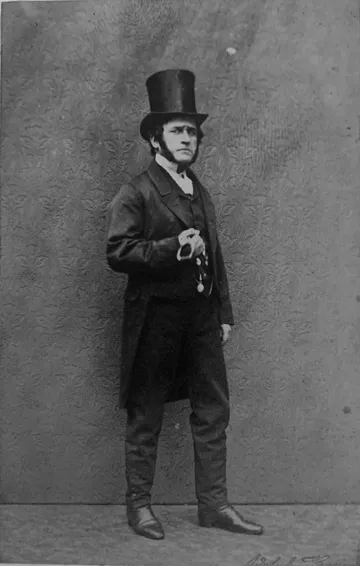
While operating within the same broad melodramatic framework, but at the opposite end of the continuum, the role of Hawkshaw the Detective was created by Horace Wigan, who in 1867 would also go on to manage the Olympic. Some 47 years old in 1863, Wigan was the antithesis of the dashing, romantic Neville, described by contemporaries as a quiet, stolid, undemonstrative actor, ideally suited to phlegmatic parts that called for no excess displays of emotion. The role of Detective Jack Hawkshaw was ideally suited to a performer who excelled in understatement and was praised for his ‘conscientious style’.9 Twelve years later Wigan would build upon his ability to play professional restraint to create the similarly understated role of Inspector Walker in Clement Scott's The Detective. In 1863, as Martin Banham suggests, Wigan together with Tom Taylor established ‘a pattern’ for the cold-blooded, unflappable stage detective, one that would continue ‘to fascinate audiences throughout the rest of the nineteenth century’ – and, we might add, up to the present day.10 Although we should heed David Mayer's caution and resist decontextualizing the character of Hawkshaw, reading backwards to find in him the characteristics we come to recognize as those of the modern-day sleuth, Banham is nevertheless correct in identifying Hawkshaw as the foundational figure in the formation of the English stage detective.11 And ‘English’ here is key because, as with so many plays in this pre-copyright period, The Ticket-of-Leave Man is, in fact, derived from a French original – Léonard by Édouard Brisebarre and Eugène Nus. Although Taylor's play is firmly rooted in contemporary London, its French origin is an important indicator of Hawkshaw's complex pedigree and the productive tension between English and French culture in the period. Wigan's performance as Hawkshaw, as well as the ‘professional performances’ of Hawkshaw himself within the play, was responsive to and in conversation with contemporaneous notions about the appearance of detectives and specific anxieties about French forebears and precedents. Taylor's detective thus remains informed by and responsive to English attitudes to and representations of French antecedents, both general and specific. What is more, the dramatic style that is employed to counter such anxieties situates Wigan's Hawkshaw within changing discourses about theatrical style, and functions as an oblique comment upon English versus continental performance methods. Establishing himself firmly as a performer of the English cut, Hawkshaw embeds the stage detective within a broad illusionistic culture that values visible skill and dexterity. In so doing, he ensures that entertainment is pursued in the service of detection and vice versa.
Image 1.2Carte de visite of Horace Wigan as Detective Jack Hawkshaw (1863). Photograph by Adolphe Beau. Author's own collection.
I
We see the ‘underplaying’ of Wigan/Hawkshaw from the character's very first appearance in the play. Hawkshaw, on stakeout, with two fellow detectives, ‘strolls carelessly’, across the stage, avoiding the eyes of his associates and speaking in what is marked as a clear undertone:
(Enter HAWKSHAW. He strolls carelessly to the DETECTIVES’ table, then in an undertone and without looking at them -)
HAWKSHAW. Report.
1st DETECTIVE. (In same tone and without looking at HAWKSHAW) All right.
HAWKSHAW. (Same tone) Here's old Moss. Keep an eye on him. (Strolls off.)12
When Hawkshaw re-appears a short while later, his affected ease segues into an exchange with the gang's disguised leader, ‘Tiger’ Dalton:
HAWKSHAW. (Sitting down coolly at the table and unfolding the paper) Papers very dull lately, don't you think so, sir?
DALTON. (Assuming a country dialect) I never trouble ’em much, sir, except for the Smithfield Market List, in the way of business.
HAWKSHAW. Ah, much my own case. They put a fellow up to the dodges of the town, though; for instance, these cases of bad notes offered at the bank lately. (Watching him close.) (170; Act 1)
Hawkshaw's attitude of nonchalance, sitting ‘coolly’ as he unfolds his paper and casually raising the matter of counterfeit notes with Dalton was the opening gambit of a remarkable performance duly noted by the press. The critic for the Times praised Wigan's impersonation of ‘a cool detective officer’ while the reviewer for The Daily News noted that Wigan ‘as usual, did excellent service to the author by his quiet telling style as a detective’.13 In fact, Wigan's understated performance may have helped set the style for later productions. The reviewer for The Manchester Courier and Lancashire General Advertiser makes similar comments about the performance of one G. F. Sinclair – ‘the very type of a shrewd, sagacious, cool and clear-headed detective’ – in an 1864 production which featured a young Henry Irving as Dalton.14
In any case, Wigan's appearance as the ‘cool, alert detective officer’ did play to his strengths. The Era critic referred to the ‘vigilant Hawkshaw’ and, in an unrelated but apposite introductory paragraph on Wigan's appearance in Bulwer-Lytton's Lady of Lyons, described his impersonation as rendered in his ‘usual conscientious style’15 – a suggestion that Wigan's own approach was typified by a diligent and industrious quality that resonated well with Hawkshaw's quotidian manner. In Robson of the Olympic, Mollie Sands similarly notes that Wigan's ‘quiet, solid undemonstrative’ style made him a good foil for his more flamboyant contemporaries.16 Some of Wigan's calculated understatement and attention to detail may in fact have been a family trait. In Players and Performances in the Victorian Theatre, George Taylor notes that a similar approach characterized the work of his older brother, actor-manager Alfred Wigan, as well as Alfred's wife, Leonora (née Pincott).17 Eight years previously, Alfred had appeared as John Mildmay, in Tom Taylor's Still Waters Run Deep (1855). Though not a detective by profession, Mildmay features as the quiet, cool and underestimated husband who, through his low-key English inquiries, foils the plot of a philandering adventurer. He is described by one who does not underestimate him as one of ‘thim north-country boys’ who are ‘as cute [i.e. acute] as Dublin car dhrivers’.18 In this Alfred's Mildmay anticipates Hawkshaw who is similarly described as ‘the ’cutest detective in the force’ (167, Act 1).
According to the Times reviewer of Still Waters, Alfred Wigan's performance had been characterized by subtlety. He did ‘not aim at violent contrast’, instead ‘allow[ing] the impression of superiority to be gradually conveyed’.19 A number of years later, as George Taylor observes, a Liverpool critic characterized Alfred's ‘strong point’ as ‘minuteness’. And, according to Taylor, ‘a similar restrained...
Table of contents
Cover
Half Title
Series
Title Page
Copyright Page
Dedication
Contents
List of images
Acknowledgements
Introduction: ‘But then until lately we have known little of detectives’
1 Enter Hawkshaw: Performing detection
2 ‘Women's Work’: Female detectives on the Britannia stage
3 Professionals of the theatre: The Detective
4 Mediating melodrama and envisioning justice: Staging Sergeant Cuff
5 A ‘tell-tale bracelet’: The detective and the dandy
Afterword
Bibliography
Index
Trusted by 375,005 students
Access to over 1.5 million titles for a fair monthly price.
Study more efficiently using our study tools.
Frequently asked questions
Yes, you can cancel anytime from the Subscription tab in your account settings on the Perlego website. Your subscription will stay active until the end of your current billing period. Learn how to cancel your subscription
No, books cannot be downloaded as external files, such as PDFs, for use outside of Perlego. However, you can download books within the Perlego app for offline reading on mobile or tablet. Learn how to download books offline
Perlego offers two plans: Essential and Complete
Essential is ideal for learners and professionals who enjoy exploring a wide range of subjects. Access the Essential Library with 800,000+ trusted titles and best-sellers across business, personal growth, and the humanities. Includes unlimited reading time and Standard Read Aloud voice.
Complete: Perfect for advanced learners and researchers needing full, unrestricted access. Unlock 1.5M+ books across hundreds of subjects, including academic and specialized titles. The Complete Plan also includes advanced features like Premium Read Aloud and Research Assistant.
Both plans are available with monthly, semester, or annual billing cycles.
We are an online textbook subscription service, where you can get access to an entire online library for less than the price of a single book per month. With over 1.5 million books across 990+ topics, we’ve got you covered! Learn about our mission
Look out for the read-aloud symbol on your next book to see if you can listen to it. The read-aloud tool reads text aloud for you, highlighting the text as it is being read. You can pause it, speed it up and slow it down. Learn more about Read Aloud
Yes! You can use the Perlego app on both iOS and Android devices to read anytime, anywhere — even offline. Perfect for commutes or when you’re on the go. Please note we cannot support devices running on iOS 13 and Android 7 or earlier. Learn more about using the app
Yes, you can access Staging Detection by Isabel Stowell-Kaplan in PDF and/or ePUB format, as well as other popular books in Media & Performing Arts & Art General. We have over 1.5 million books available in our catalogue for you to explore.