This book studies R. Buckminster Fuller's World Game and similar world games, past and present.
Proposed by Fuller in 1964 and first played in colleges and universities across North America at a time of growing ecological crisis, the World Game attempted to turn data analysis, systems modelling, scenario building, computer technology, and information design to more egalitarian ends to meet human needs. It challenged players to redistribute finite planetary resources more equitably, to 'make the world work'. Criticised and lauded in equal measure, the World Game has evolved through several formats and continues today in correspondence with debates on planetary stewardship, gamification, data management, and the democratic deficit. This book looks again at how the World Game has been played, focusing on its architecture, design, and gameplay. With hindsight, the World Game might appear naïve, utopian, or technocratic, but we share its problems, if not necessarily its solutions.
Such a study will be of interest to scholars working in art history, design history, game studies, media studies, architecture, and the environmental humanities.
‘Spaceship Earth’ named a technological object, a political arena, and a matter of environmental concern that, by the end of the 1960s, influenced both United Nations (UN) sustainable development policy and countercultural experiments in ecological redesign and sustainable living, especially in the United States.1 The World Game attempted to model the life-support systems of this Spaceship, to make them visible, playable, governable, and, for some, optimally functional. ‘We are all astronauts now’, wrote Fuller in his Operating Manual for Spaceship Earth, published in 1968,2 in command of an ‘integrally-designed machine which to be persistently successful must be comprehended and serviced in total’.3 This made the World Game a ‘great world logistics game’ for planetary systems,4 the aim of which was to ‘make the total system work more efficiently’ and for everyone.5
Two major architectural projects were proposed for the World Game, namely the US Pavilion for Expo 67 in Montreal and the World Resources Simulation Center (WRSC) planned for the Edwardsville campus of Southern Illinois University (SIU), envisaged as the first stages of a global network of command centres. Neither project was completed as planned, and the actual architectures of the Game were workshops and seminars, still global in scope but less technologically sophisticated.
On 10 May 1965, economist and systems theorist Kenneth Boulding presented a paper titled ‘Earth as a Space Ship’ to the National Aeronautics and Space Administration (NASA) Committee on Space Sciences. Humans had to move beyond local, short-term thinking.
Man must live in the whole system, in which he must recycle his wastes and really face up to the problem of increase in material entropy which his activities create. In a space ship, there are no sewers.6
Also, in 1965, US ambassador to the UN, Adlai Stevenson, used the metaphor to refer to a fragile, threatened planet for which the international community was responsible.7 The following year, Boulding argued that the Earth was not an open system but a closed system, visualised by a ‘closed sphere’ rather than the ‘illimitable plane’ of the Mercator projection. This closed sphere required a cyclical, solar-powered ‘spaceman economy’ to replace the ‘cowboy economy’ of limitless resource extraction and waste.8 Spaceship Earth would follow cybernetic principles of feedback, regulation, and efficient management. Conversely, life was reduced to its essential conditions as, faced with a looming environmental crisis, the planet was to be placed on life support.9 In 1966, the influential economist and journalist Dame Barbara Ward (later Baroness Jackson of Lodsworth) published Spaceship Earth, in which she argued that a new planetary responsibility, made operative through progressive taxation, would correct geopolitical inequality. ‘Our physical unity has gone far ahead of our moral unity’, she wrote. ‘Our inability to do anything but live together physically is not matched by any of the institutions that would enable us to live together decently’.10 Largely due to the advocacy of Ward, care for Spaceship Earth also shaped the ideals of sustainable development, institutionalised through the likes of the International Institute for Environment and Development, an environmental policy and action research organisation founded by Ward in 1973, and reoriented official UN policy on the environment. For the 1972 United Nations Conference on the Human Environment in Stockholm, she co-authored the report Only One Earth: The Care and Maintenance of a Small Planet with the American microbiologist René Dubos. At this Conference, which charged itself with outlining, as Ward wrote, ‘what should be done to maintain earth as a place suitable for human life not only now, but also for future generations’, the US counterculture, mediated by entrepreneur Stewart Brand, sought common purpose with the UN.11
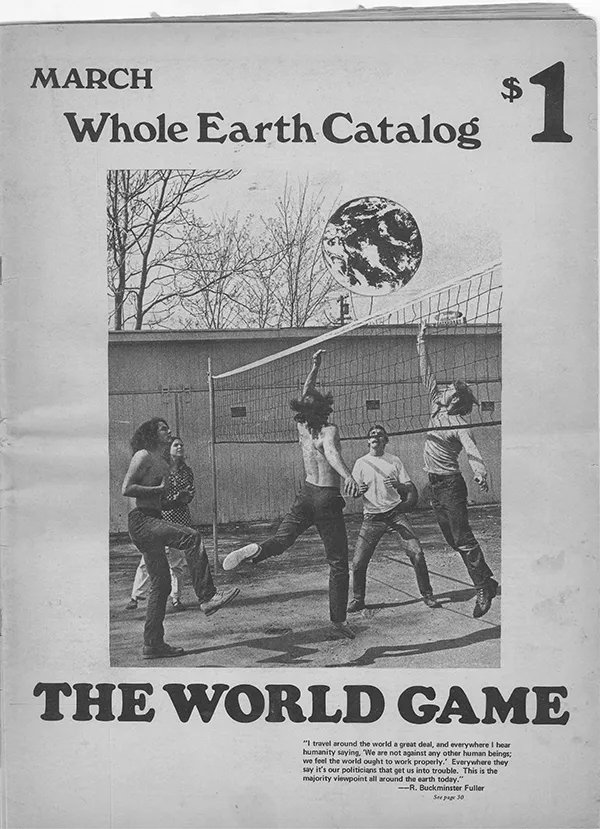
The metaphor of Spaceship Earth was a call to environmental action. Its holism struck a chord with the US counterculture, exemplified by the Whole Earth Catalog (WEC) motto, ‘We can’t put it together. It is together’. For example, in March 1970, the WEC included a supplement on the World Game, written by Gene Youngblood based on several articles previously published in the Los Angeles Free Press, and featured on its cover (Figure 1.1) a photomontage of five young hippies playing volleyball with a photograph of the Earth, above a quote from Fuller:
I travel around the world a great deal, and everywhere I hear humanity saying, ‘We are not against any other human beings; we feel the world ought to work properly’. Everywhere they say it’s our politicians that get us into trouble.12
Figure 1.1 Cover of World Game supplement, Whole Earth Catalog, March 1970, Menlo Park: Portola Institute Inc. Courtesy of Stewart Brand.
The Earth photograph is that taken by the Applications Technology Satellite 3 (ATS-3) in 1967, used on the cover of the WEC’s first edition, published in the autumn of 1968. This photomontage asserts the WEC and its subscribers as defenders and agents of ecological holism and presents the World Game as a version of Earthball, a game conceived by Stewart Brand in 1966 in response to the escalation of the Vietnam War to let players ‘understand war by appreciating and experiencing the source of it within themselves’.13 Earthball then became a symbol of Earth Day in the early 1970s and spawned the New Games Movement, led by Bernie de Koven.
The Biggest System
For Brand and others, such whole earth photographs gave a unified image of Spaceship Earth.14 The World Game, however, sought to model the Spaceship’s planetary systems. For Fuller, although planetary systems might be ‘extraordinary’ and ‘unpredictable’ (or ‘synergistic’, in Fuller’s jargon – what we might now call emergent), and not reducible to statistical or probabilistic analysis, they never work ‘in ways you can’t model’. ‘The most important and useful work I’ve been able to do will be achieving this return to modelability’, he declared in a 1971 interview.15
The World Game’s ‘systems approach’, which Fuller’s research assistant John McHale (see Chapter 4) called ‘a new social instrument for complex planning’, aimed to define the functional requirements of planetary systems and identify ‘within their design various feedback sub-procedures which regulate the system towards the desired optimal end function’.16 This approach adapted the general systems theory (GST) of the Austrian biologist Ludwig Von Bertalanffy, first outlined in the early 1950s,17 and combined it with economist John von Neumann’s game theory, which studies how strategic interaction between rational economic actors produces intentional and non-intentional outcomes.18
In more detail, first, GST provided, in the words of Von Bertalanffy, a ‘general science of “wholeness”’ to study isomorphisms across open, complex systems and integrate the otherwise disparate fields of biology, robotics, information theory, sociology, economics, and psychology.19 GST made sense of ‘the complexity of the world… in terms of wholes and relationships rather than splitting [it] into its parts and looking at each in isolation’.20 In notes for an undated World Game presentation at SIU, Fuller made clear that GST enabled him to model ‘Spaceship Earth as a closed system’.21 In Operating Manual for Spaceship Earth, he wrote that GST helped him to ‘think in terms of wholes’.22 Medard Gabel, one of the Seminar players who was employed by SIU from 1969 to work on propagating the World Game, wrote that GST was a
tool for competent and comprehensive problem-solving [because it demonstrated that] the known behaviour of the whole system and the known behaviour of some of its parts makes possible discovery or true prediction of the remainder of its parts.23
This parts/whole correlation made the World Game’s strategies ‘as comprehensive and correct as is presently possible’.24 Knowledge of the whole, or what Fuller called the ‘biggest system’, meant that players could ‘automatically avoid leaving out any strategically critical variables’.25 With this knowledge, too, design scientists – the crew of Spaceship Earth – could learn the ‘universe’s game’ and plan the future. ‘If you know something about you...
Table of contents
Cover
Half Title
Series Page
Title Page
Copyright Page
Table of Contents
List of Figures
Preface
Acknowledgements
1 Aboard Spaceship Earth
2 The First World Game Seminar
3 Ecogame
4 Ecologies of the Future
5 World Gaming
Conclusion
Bibliography
Index
Trusted by 375,005 students
Access to over 1.5 million titles for a fair monthly price.
Study more efficiently using our study tools.
Frequently asked questions
Yes, you can cancel anytime from the Subscription tab in your account settings on the Perlego website. Your subscription will stay active until the end of your current billing period. Learn how to cancel your subscription
No, books cannot be downloaded as external files, such as PDFs, for use outside of Perlego. However, you can download books within the Perlego app for offline reading on mobile or tablet. Learn how to download books offline
Perlego offers two plans: Essential and Complete
Essential is ideal for learners and professionals who enjoy exploring a wide range of subjects. Access the Essential Library with 800,000+ trusted titles and best-sellers across business, personal growth, and the humanities. Includes unlimited reading time and Standard Read Aloud voice.
Complete: Perfect for advanced learners and researchers needing full, unrestricted access. Unlock 1.5M+ books across hundreds of subjects, including academic and specialized titles. The Complete Plan also includes advanced features like Premium Read Aloud and Research Assistant.
Both plans are available with monthly, semester, or annual billing cycles.
We are an online textbook subscription service, where you can get access to an entire online library for less than the price of a single book per month. With over 1.5 million books across 990+ topics, we’ve got you covered! Learn about our mission
Look out for the read-aloud symbol on your next book to see if you can listen to it. The read-aloud tool reads text aloud for you, highlighting the text as it is being read. You can pause it, speed it up and slow it down. Learn more about Read Aloud
Yes! You can use the Perlego app on both iOS and Android devices to read anytime, anywhere — even offline. Perfect for commutes or when you’re on the go. Please note we cannot support devices running on iOS 13 and Android 7 or earlier. Learn more about using the app
Yes, you can access Buckminster Fuller’s World Game and Its Legacy by Timothy Stott in PDF and/or ePUB format, as well as other popular books in Design & History of Art. We have over 1.5 million books available in our catalogue for you to explore.