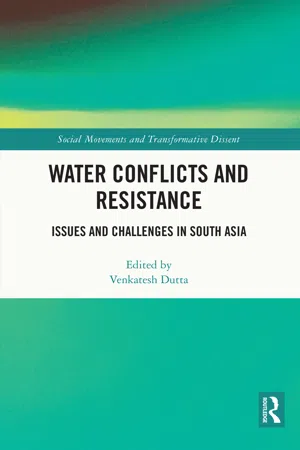
Water Conflicts and Resistance
eBook - ePub

Water Conflicts and Resistance

Issues and Challenges in South Asia

  1. 368 pages
  2. English
  3. ePUB (mobile friendly)
  4. Available on iOS & Android
eBook - ePub

Water Conflicts and Resistance

Issues and Challenges in South Asia

About this book

This book presents a systematic study of transboundary, regional and local water conflicts and resistance across several river basins in South Asia. Addressing hydro-socio-economic aspects in competing water sharing and transfer agreements, as well as conflicting regimes of legal plurality, property rights and policy implementation, it discusses themes such as rights over land and natural resources; resettlement of dam-displaced people; urban–rural conflicts over water allocation; peri-urbanisation, land use conflicts and water security; tradeoffs and constraints in restoration of ecological flows in rivers; resilience against water conflicts in a river basin; and irrigation projects and sustainability of water resources.

Bringing together experts, professionals, lawyers, government and the civil society, the volume analyses water conflicts at local, regional and transboundary scales; reviews current debates with case studies; and outlines emerging challenges in water policy, law, governance and institutions in South Asia. It also offers alternative tools and frameworks of water sharing mechanisms, conflict resolution, dialogue, and models of cooperation and collaboration for key stakeholders towards possible solutions for effective, equitable and strategic water management.

This book will be useful to scholars and researchers of development studies, environment studies, water studies, public policy, political science, international relations, conflict resolution, political economy, economics, sociology and social anthropology, environmental law, governance and South Asian studies. It will also benefit practitioners, water policy thinktanks and associations, policymakers, diplomats and NGOs.

Trusted by 375,005 students

Access to over 1.5 million titles for a fair monthly price.

Study more efficiently using our study tools.

Information

Year
2021
Print ISBN
9781032203591
eBook ISBN
9781000408270

1Shared water

Contest, conflicts and cooperation

Venkatesh Dutta
Water is essential to all forms of life, and for achieving all the objectives of sustainable development goals (SDG), including livelihood security. Water conflicts within and between regions, states and nations are widespread all over the world (Shah 2019). Various researchers argue that water conflicts are largely associated with the scarcity of water, which is increasingly becoming an inevitable threat to humanity due to a steady increase in global water demand (Qin et al. 2019; Roth et al. 2019). However, on a closer examination, it is found that the conflicts are mostly rooted in competing perspective and values about water storages, inequitable and unsustainable transboundary water arrangements, and utilizable flows exceeding the ecological replenishable water in a catchment (Zeitoun et al. 2020). At the current rate of water extraction and use, it is estimated that existing freshwater resources could meet only 60 per cent of the world’s demand for water by 2030 (World Water Development Report 2015). The imminent crisis is already affecting millions of people globally, and prolonged water conflicts are becoming unavoidable in the South Asian region. Several incidences of transfer of water from agriculture to urban and industrial sectors highlight the complexities of local and regional water conflicts which are not easily resolved through existing set of institutions and procedures.
The geography, history and culture of South Asia have been influenced by several of its transboundary rivers for centuries. Water resources have contributed to the region’s food security and economic growth. However, it is seen that, over the past few decades, these freshwater resources are under pressure to maintain even adequate flows in appreciable quality due to multiple threats from environmental pollution, intensive agriculture, urbanisation and population growth. The existing situation seems challenging due to the absence of satisfactory water governance, weak institutions and a lack of widely agreed-upon water-sharing and allocation principles. It is also observed that water diplomacy in South Asia has been largely unsuccessful in engaging with grounded narratives emanating from the micro level.
South Asia has a chain of highest mountains on the earth which are sources to mighty rivers such as the Ganges, the Brahamputra and the Indus. The mountains and plains form an intricate system of highland–lowland complex consisting of the diverse agro-ecological zones of the world within a short horizontal distance – having even a far more complex hydro-geological strata. The region is also charaterised by typical wet and dry tropical climatic extremes. The rivers support a rich variety of flora and fauna which have evolved from the periodic pulses of floods and droughts with complex terrestrial and aquatic phases of the waterscapes. Water remains a fundamental factor that regulates biophysical environment and processes, which further supports various dependent ecosystems. However, interactions and feedbacks among biophysical and human-built systems remain poorly understood. The biophysical environment of this part of the world is under constant pressure due to rapid transformations of the landscape from various projects that intend to raise the quality of life of people and their development aspirations. The entire region is majorly drained by the Himalayan rivers which are characterised by hydro-ecological complexity. The overlaying layer of geopolitical and institutional complexities make this region even more challenging, as they are under constant change than ever in the past. The Himalaya–Ganga system has three interlinked and interacting systems and is undergoing dynamic transformation in all of them (Gyawali and Dixit, 1994) – exposing a rich terrain of complexity for policy purposes. These three systems are illustrated in Figure 1.1.
Figure 1.1Fragmentation and wholeness of biophysical, built and symbolic systems in the Himalaya–Ganga system.
The Himalaya–Ganga system displays large and complex interactions between living and non-living biophysical system, human-built system and the symbolic system at various temporal and spatial scales, possessing composite and stochastic properties. The rich plurality of social systems is multilayered and they are integrated by waterscapes, i.e. water mediates and integrates the symbolic system, but under conflicts and contestations it causes its very disintegration. Human-built systems are largely constructed as simplistic and deterministic forcing, influenced by supply-side projects and schemes. They affect the biophysical system by threatening its fragility and assimilative capacity. Most of the water diversion and allocation projects are based on a reductionist approach and ignore both the biophysical system and the symbolic system. Complexity science is often overlooked for the sake of simplicity. Appropriate metaphors and models of the symbolic system are routinely ignored in project planning and policies involving human-built system. The epistemological and philosophical foundations of the symbolic system have to be integrated within the human-built system with proper valuation of externalities and spillovers affecting the ecological resilience.

The ‘Naturalness’ of water scarcity and conflicts

Many researchers agree that water scarcity narrative is a flawed concept, and it underplays the issues of unequal access, power disparity and control of allocation to economically profitable sectrors while ignoring the larger question of ecosystem sustainability (Mehta 2000; Mollinga 2001; Wester ...

Table of contents

  1. Cover
  2. Endorsement Page
  3. Half Title
  4. Series Page
  5. Title Page
  6. Copyright Page
  7. Dedication
  8. Table of Contents
  9. List of figures
  10. List of tables
  11. List of abbreviations
  12. List of contributors
  13. Foreword
  14. Preface
  15. Acknowledgements
  16. Chapter 1: Shared water: Contest, conflicts and cooperation
  17. Part I: Transboundary conflicts
  18. Part II: Regional and local conflicts
  19. Index

Frequently asked questions

Yes, you can cancel anytime from the Subscription tab in your account settings on the Perlego website. Your subscription will stay active until the end of your current billing period. Learn how to cancel your subscription
No, books cannot be downloaded as external files, such as PDFs, for use outside of Perlego. However, you can download books within the Perlego app for offline reading on mobile or tablet. Learn how to download books offline
Perlego offers two plans: Essential and Complete
  • Essential is ideal for learners and professionals who enjoy exploring a wide range of subjects. Access the Essential Library with 800,000+ trusted titles and best-sellers across business, personal growth, and the humanities. Includes unlimited reading time and Standard Read Aloud voice.
  • Complete: Perfect for advanced learners and researchers needing full, unrestricted access. Unlock 1.5M+ books across hundreds of subjects, including academic and specialized titles. The Complete Plan also includes advanced features like Premium Read Aloud and Research Assistant.
Both plans are available with monthly, semester, or annual billing cycles.
We are an online textbook subscription service, where you can get access to an entire online library for less than the price of a single book per month. With over 1.5 million books across 990+ topics, we’ve got you covered! Learn about our mission
Look out for the read-aloud symbol on your next book to see if you can listen to it. The read-aloud tool reads text aloud for you, highlighting the text as it is being read. You can pause it, speed it up and slow it down. Learn more about Read Aloud
Yes! You can use the Perlego app on both iOS and Android devices to read anytime, anywhere — even offline. Perfect for commutes or when you’re on the go.
Please note we cannot support devices running on iOS 13 and Android 7 or earlier. Learn more about using the app
Yes, you can access Water Conflicts and Resistance by Venkatesh Dutta in PDF and/or ePUB format, as well as other popular books in Politics & International Relations & Environmental Economics. We have over 1.5 million books available in our catalogue for you to explore.