This book explains the concept of man-machine systems by using the mining industry. The goal is to use a mathematical model based approach to improve the quality of human life of the workers and operators with the enhancement of productivity by controlling the process variables.
The book will illustrate the formulation of mathematical modelling for manual operations. It will provide details in the investigation of many machine systems through the case study approach and provide data analysis using the concept of mathematical modelling and sensitivity. It presents how to solve a field problem through a field data-based modelling concept and highlights the collection of anthropometry data and its behavior.
The book will be useful for researchers, academic libraries, professionals, post graduate students of Industrial, Mechanical, and Manufacturing Engineering programs.
Visvesvaraya National Institute of Technology and JD College of Engineering and Management
V. Vidyasagar
Power Systems Training Institute
P. B. Maheshwary
JD College of Engineering and Management
Contents
1.1 Introduction
1.2 Cause-and-Effect Relationships
1.3 Ergonomics
1.4 Anthropometry
1.5 Approach to Formulate
1.1 Introduction
Most of the industrial activities are executed manually due to the limitations of mechanization such as technological- and cost-oriented. Industrial activities such as maintenance operations, mining operations, loading and unloading operations on process machines, and similar other operations are manually performed. The management attitude is conservative and traditional with spontaneous judgment-based decision-making predominance. Hence, most of the operations are carried out manually. Operators are working with different types of machine tools and process machines under different environmental conditions. The ergonomic design of the workstation varies suitable for the operators with different constraints. According to academicians, ergonomics deals in an integrated way with the man, his working environment, tools, materials, and process [1]. Work can be completed efficiently with human comfort if designed based on the ergonomic principles. If ergonomic principles are not followed for the design of man–machine systems, then it results in low efficiency, poor health, and rise in the accidents of the man–machine system.
Various operational factors are identified to optimize the productivity and conserving human energy needed for operations. There are many approaches to develop/upgrade industrial activities such as method study (motion study), work measurement (time study), productivity, and so on. Field data-based modeling approach is proposed to study man–machine system.
1.2 Cause-and-Effect Relationships
Formulation of logic-based model correlating causes and effects is not possible for these types of complex phenomena. The only approach appropriate for this type of study of phenomenon, that is, man–machine system, is by field data-based modeling. Field data-based model correlates the inputs or causes, in other words, the outputs of such activity by formulating the quantitative mathematical modeling. The indices of the causes of the model, that is, mathematical model, indicate the most influencing inputs. Such correlation indicates the deficiency and the strength of the man–machine system, which helps to improve the performance of the system. Hence, for improving the system/activity performance, it is essential to form such analytical cause–effect relationships conceptualized as field data-based models.
1.3 Ergonomics
Ergonomics is the subject dealing with the interaction of the human operator and the physical system of works or system. The performance of man–machine system is optimized by designing the system using ergonomic principles, data, and methods. Ergonomists contribute to the design and evaluation of the system based on the type of job, environment, product, and task to be performed to make them compatible. These principles are used for enhancing safety, reducing fatigue, and increasing comfort with improved job satisfaction while enhancing effectiveness, that is, productivity in carrying out the tasks.
1.4 Anthropometry
Anthropometry deals with the measurement of the size and proportions of the human body and parameters such as reach and visual-range capabilities. The application of anthropometry in the design of tools/equipment is to incorporate the relevant human dimensions, aiming to accommodate at least 90% of potential users, considering static factors (height, weight, shoulder breadth, etc.) and dynamic (functional) factors (body movement, distance reach, and movement pattern). Anthropometry is the branch of ergonomics that deals with different human body dimensions of operator accommodated by providing adjustability in the machine used for various operations. Hence, the anthropometric data of operator have been collected.
Postural discomfort is experienced by the operator because of muscular discomfort required to maintain the body posture during work. The interaction of operator with machine process during operation leads to ugly postures; therefore, it is felt necessary to study the specifications of machine from postural comfort’s view. In the physiological response study, human energy consumed while performing the task using tools of different designs is recorded. In general, the selection of tool is made on the basis of the constructional features of the machine, tools, and operating and environmental conditions. These form the independent variables of the activities. The physiological cost (dependent/response variable) incurred in the operation is recorded for different conditions of these independent variables. Productivity of operation is considered as other dependent/response variable. These variables are also recorded to study the effects of independent variables on the quality of operation.
Hilbert [2] suggested the experimentation theory to know the output of any activity in terms of various inputs of any phenomenon. It is felt that such an approach is not yet seen toward correctly understanding the operation performed by human being. This approach finally establishes a field data-based model for the phenomenon. Various inputs in the industrial activity are as follows: (i) body specifications of the operator (namely, the anthropometric measurements), (ii) specifications of machine, (iii) specifications of tools, (iv) other process-related parameters, and (v) specifications of environmental factors such as ambient temperature, humidity, air circulation, and so on, at the place of work. The response variables of the phenomenon are as follows: (i) time of operation, (ii) productivity, (iii) human energy consumed during the operation, (iv) quality of operation, and so on. A quantitative relationship is established among the responses and inputs. The inputs and the corresponding responses are measured. Such quantitative relationships are known as mathematical models. Two types of models are established, namely, the model using the concept of least-square multiple regression curve (hereafter referred to as mathematical model) and the other is “Artificial Neural Network”-based model. The interest of the operator lies in arranging inputs to obtain targeted responses. Once the models are formed, they are optimized using the optimization technique [32]. The optimum conditions at which the independent variables should be set for the maximum productivity, minimum human energy expenditure, and accepted quality are deduced. From the analysis of models, the intensity of influence of various independent variables on the dependent variables and the nature of relationship between independent and dependent variables are determined. Finally, some important conclusions are drawn based on the analysis of models.
1.5 Approach to Formulate
This book mainly aims to explain the approach to formulate the mathematical model for the man–machine system. To form the mathematical model, the most critical industrial activities - mining industry is identified and studied. Mining industries involve operations such as face drilling, loading operation, unloading operation, and roof bolting. The formulation of a mathematical model for manual work such as face drilling at underground mines is selected as the case study. This work describes the present method of carrying out the face drilling operations. In the present method, the productivity is less, and human energy requirement is substantial. The variables related to the face drilling operation in the mining are identified to enhance the productivity with minimum human energy. In this book, the approximate generalized mathematical models have been established by applying the concepts of theories of experimentation [2] for the face drilling operations in underground mines. The general procedure adopted is as follows.
Review the existing literature on industrial operations: A general overview in relation to ergonomic aspects in which the interaction between man–machine system.
Study of existing workstation including man–machine system. This study includes maintenance, schedule, problems, functions, purpose, benefits, and so on.
Possibility of formulation of model for improving industrial activity: The industrial activity is very difficult to plan and involves high costs. Therefore, there is a need for developing model, which helps to reduce human energy and repair time. Data are collected based on the sequence of industrial activity by direct measurement. From this, data input and output variables are decided, and the model is formed by forming a dimensionless equation using regression analysis.
Possibility to validate output and model of the system: the aim is to find out the utility and the effectiveness of model. The effectiveness of model is decided by ANN simulation, sensitivity analysis, and optimization technique.
2 Concept of Field Data Data-Based Modeling
Pramod Belkhode
Laxminarayan Institute of Technology
Sarika Modak
Priyadarshini College of Engineering
V. Vidyasagar
Power Systems Training Institute
P. B. Maheshwary
JD College of Engineering and Management
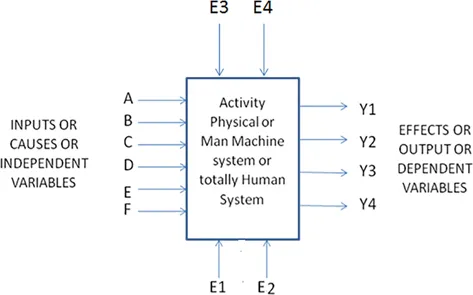
In our life, we come across many more activities. These activities have some environmental systems in which these activities occur. The environment or system can be specified in terms of its parameters – some of which are always constant in their magnitudes, whereas some are variable. The activities are set in action by some parameters, which are considered as causes. These causes interact with parameters of the system; as a result of this interaction, some effects are produced. The above mentioned matter in a diagrammatic form can be presented, as shown in Figure 2.1.
FIGURE2.1 Block diagrammatic representation of an activity.
Figure 2.1 shows a rectangular block where activity along with its nature is written, that is, activity may be physical or it may be a combination of human-directed/-operated physical activity stated as man–machine system or it may be an activity mainly dominated by human being stated in the block as “Totally Human System”. The functioning of an activity is influenced by two sets of parameters: the first set characterizes the features of environment of an activity and the other set characterizes planned parameters or causes, which influence the functioning of the system.
Accordingly, Figure 2.1 shows these parameters. The parameters characterizing features of an environment are E1, E2, E3, E4, and so on. Some of which are permanently fixed, shown as E1, E2, whereas remaining are time variants, shown as E3, E4 on which one has no control. The planned parameters are known as causes shown as A, B, C, D, E, and so on, and the effects of an activity are shown as Y1, Y2, Y3, Y4, and so on.
If one analyzes any activity of society, then one would be able to identify the causes A to E, and so on, system parameters E1 to E4, and so on, and the effects Y1 to Y4, and so on. This may be treated as qualitative analysis of the societal activity. This can be demonstrated by one example of everyday life of man–machine system of our life.
Let us consider a gardener preparing flower beds in a kitchen garden of a conventional house of a slightly upper middle-class family.
Supposing the house owner has to prepare around 6 to 8 flower beds. Each is of the size 3 m in length, 1 m wide, and 0.5 m in depth. The house owner instructs his gardener accordingly. Let us say that gardener decides to start the work from specific day along with his team of 2 to 3 helpers. The tools necessary for this operation are (i) a Kudali (axe), (ii) a phawada (a spade), and (iii) a soil collector a Ghamela. The work would take place in a shift of 8 hours, that is, since 8.00 am in the morning till 5.00 pm in the late afternoon with a rest cum lunch break from 12.30 pm to 1.30 pm. Let us say that it is a team of total three members with one supervisor performing this task. The first member says that A digs the soil, the second member that B collects the dry soil with spade and puts it in ghamela, and the third member says that C carries the soil to the place where heap of soil is made.
The planned sequence of working is A dugs for 10 minutes with rest pause for 3 minutes at the end of every 7 minutes. During this rest pause of 3 minutes collects this duged soil in ghamela and C carries this soil to the heap. Like this, A, B, C workers will work for every 30 minutes in a sequence. During these 3 minutes, the leader...
Table of contents
Cover
Half Title Page
Title Page
Copyright Page
Table of Contents
Preface
Editors
Contributors
Chapter 1 Man–Machine System
Chapter 2 Concept of Field Data Data-Based Modeling
Chapter 3 Scope of Book
Chapter 4 Design of Field Study
Chapter 5 Procedure of Collecting Field Data: Causes, Extraneous Variables, and Effects
Chapter 6 Mathematical Modeling of Operations
Chapter 7 Artificial Neural Network Simulation
Chapter 8 Sensitivity Analysis
Chapter 9 Analysis of Performance of the Model
Chapter 10 Quantitative Analysis of Face Drilling Operation
References
Appendix
Index
Trusted by 375,005 students
Access to over 1.5 million titles for a fair monthly price.
Study more efficiently using our study tools.
Frequently asked questions
Yes, you can cancel anytime from the Subscription tab in your account settings on the Perlego website. Your subscription will stay active until the end of your current billing period. Learn how to cancel your subscription
No, books cannot be downloaded as external files, such as PDFs, for use outside of Perlego. However, you can download books within the Perlego app for offline reading on mobile or tablet. Learn how to download books offline
Perlego offers two plans: Essential and Complete
Essential is ideal for learners and professionals who enjoy exploring a wide range of subjects. Access the Essential Library with 800,000+ trusted titles and best-sellers across business, personal growth, and the humanities. Includes unlimited reading time and Standard Read Aloud voice.
Complete: Perfect for advanced learners and researchers needing full, unrestricted access. Unlock 1.5M+ books across hundreds of subjects, including academic and specialized titles. The Complete Plan also includes advanced features like Premium Read Aloud and Research Assistant.
Both plans are available with monthly, semester, or annual billing cycles.
We are an online textbook subscription service, where you can get access to an entire online library for less than the price of a single book per month. With over 1.5 million books across 990+ topics, we’ve got you covered! Learn about our mission
Look out for the read-aloud symbol on your next book to see if you can listen to it. The read-aloud tool reads text aloud for you, highlighting the text as it is being read. You can pause it, speed it up and slow it down. Learn more about Read Aloud
Yes! You can use the Perlego app on both iOS and Android devices to read anytime, anywhere — even offline. Perfect for commutes or when you’re on the go. Please note we cannot support devices running on iOS 13 and Android 7 or earlier. Learn more about using the app
Yes, you can access Mathematical Modeling and Simulation by P.N. Belkhode, J.P. Modak, V. Vidyasagar, P.B. Maheshwary, P.N. Belkhode,J.P. Modak,V. Vidyasagar,P.B. Maheshwary in PDF and/or ePUB format, as well as other popular books in Mathematics & Mathematical Analysis. We have over 1.5 million books available in our catalogue for you to explore.