Originally published in 1983, this volume is a collection of papers by research workers active at the time. It includes reviews of special areas within the field and discussions of interactions with other behavioral sciences such as psychology, ethology, and sociobiology. Applications to medicine, psychiatry, and education are also considered. Contributors were encouraged to integrate history, present knowledge, and projections for the future. Although the book is not divided into sections there is some grouping of related chapters.
eBook - ePub
Behavior Genetics
Principles and Applications
- 510 pages
- English
- ePUB (mobile friendly)
- Available on iOS & Android
eBook - ePub
Behavior Genetics
Principles and Applications
About this book
Information
1 Fundamentals of Genetic and Evolutionary Theories
State University of New York at Purchase
Behavior genetics—from where do diverse scientific disciplines emerge, develop, and finally coalesce? Psychology, which attempts the description, prediction, and ultimately the understanding of behavior, began in the universities of Europe. One tradition emerged from the 18th- and 19th-century German philosophers as exemplified by Leibniz (Boring, 1950), and was given an experimental basis by Wundt (later in the United States by his student Titchener). The other, emanating from England, was based on the principles of John Locke and the philosophes of the French enlightenment. This Anglo-French influence came to America in 1882 with Herbert Spencer, who was enamored of Charles Darwin’s theory of natural selection. Although these traditions are diffuse they help provide an orientation for understanding the development of psychology and its attempts to provide a firm biological basis for the study of behavior.
Situations in which stimuli could be controlled and responses objectively measured were the foundation of the Wundtian school. The Lockean prescription offered a more comfortable cultural fit to our society, and its view of mental process as the product of nothing but sensation furnished a comfortable ambience for the growth of the pragmatically oriented behaviorist school.
PRINCIPLES OF GENETICS
Mendelian Genetics
Genetics formal beginnings are found in the work of Gregor Mendel (1822–1884) whose elegant experiments with garden peas and mice provided the foundation for the science of genetics. In the garden of a monastery in Moravia (now Czechoslovakia), of which he eventually became abbot, Mendel crossbred varieties of the garden pea that had maintained relatively constant differences in physical characteristics over generations. This hereditary constancy occurred despite the occasional, now fully scientifically explained, disappearance of a given trait during several generations and its subsequent reemergence.
Some of the factors Mendel analyzed were tall versus dwarf plants, red or white colored blossoms, seed color and shape, pod forms, and the position of flowers on stems. He theorized that each plant contained two factors for a particular characteristic such as color (one of each of these factors contributed by each parental plant) and that these units were transmitted to descendants in adherence to statistical predictions. These two factors (now called genes) might be identical, in which case the organism was said to be homozygous for that gene, or they might differ and the organism would be heterozygous.
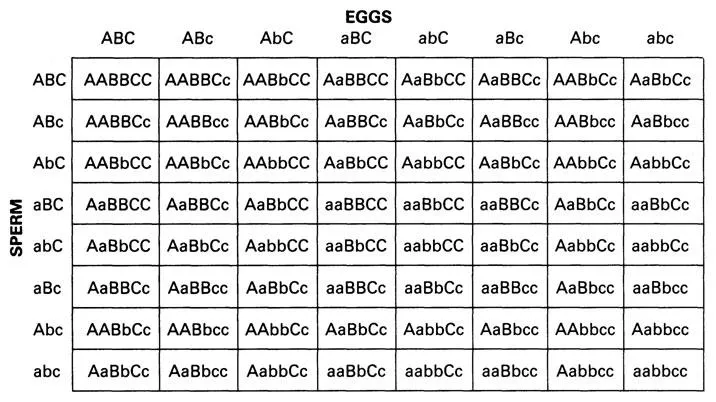
From his plant-breeding experiments and observations, Mendel derived two laws that serve as the foundation, both historically and functionally, of the science of genetics. The first law concerns segregation. Genes are particulate units of inheritance that may exist in two or more variant forms (alleles) at the same position (locus) on a chromosome. Members of a chromosome pair separate when sex cells are produced. If an individual is heterozygous at the A-locus, the gametes will be of two types—A or a. The second law deals with independent assortment of alleles on different chromosomes. When the chromosomes separate to form eggs and sperm, these variant alleles (Aa and Bb, for example) are transmitted independently of one another to the next generation. When one allele is always expressed phenotypically in the organism bearing it, it is called the dominant allele (A); a recessive allele, expressed only when the dominant allele is absent, is designated a. A dominant trait is expressed when one or two dominant alleles are present (AA or Aa) but one can see only the recessive phenotype when both recessives (aa) are present. Some alleles are not expressed as either dominant or recessive but are intermediate, and they produce a phenotype somewhere between the phenotypes of the parents (red, pink, white). Suppose that two individuals differing in genes at only three different loci (genetically active sites on chromosomes) are crossed: AABBCC × aabbcc. The sex cells (gametes) are carrying ABC or abc, whereas the first filial generation (F1) or offspring, is entirely AaBbCc. Each F1 offspring can produce eight different types of gametes: ABC, ABc, AbC, aBC, Abc, aBc, abC, and abc. Figure 1.1 indicates the number of possible genotypes when three genes are involved. For an idea of what occurs when more than three gemes are involved see Table 1.1. Inasmuch as each chromosome has many thousands of genes the number of possible combinations is astronomical.
The word chromosome comes from the Greek chroma, which means color, and soma—body, because these gene-carrying units can be routinely observed microscopically when stained with basic dyes. Genes are arranged in linear order on these chromosomes, which are found in the nucleus of eucaryotic cells. Organisms are classified as eucaryotes if their genetic material is contained in the nucleus of their cells. This includes all life above the level of bacteria and blue-green algae. The latter—called procaryotes—are considered to be earlier stages in the evolution of life on this earth. Procaryotes have no nuclei and their genetic material is distributed throughout their cells. In eucaryotes, each individual of a species has a characteristic chromosome number—46 in humans, 40 in the house mouse, 20 in corn, 48 in the potato,and 8 in the fruit fly, (Drosophila melanogaster).
Sexually reproducing individuals often have two different alleles (are heterozygous) for many of their genes. Thus, the possible combinations of parental genotypes greatly outnumber the actually ever-realized genotypes. The probability of siblings acquiring the same genetic endowment from both or even one of their parents is infinitely small. This probability decreases as more and more pairs of genes are involved. So, each and every human individual (except for identical twins) is and has been genetically unique.
Genotype and Phenotype
The observable physical and behavioral aspects of an organism constitute its phenotype. The phenotype is the joint product of the genes that an organism possesses (its genotype) plus the effects of the environments in which it developed and now lives. It has become increasingly obvious with the predominance of the behaviorist school of psychology throughout the 1950s that the environment is of particular significance in the development of behavioral phenotypes (Beach, 1950).
n GENES | 2n F1GAMETES | F1XF2 4n ZYGOTES | 3n F2GENOTYPES | 2n HOMOZYGOUS F2GENOTYPES | 3n – 2nHETEROZYGOUS F2 GENOTYPES | 2nF2 PHENOTYPES |
1 | 2 | 4 | 3 | 2 | 1 | 2 |
2 | 4 | 16 | 9 | 4 | 5 | 4 |
3 | 8 | 64 | 27 | 8 | 19 | 8 |
4 | 16 | 256 | 81 | 16 | 65 | 16 |
5 | 32 | 1,024 | 243 | 32 | 211 | 32 |
10 | 1,024 | 1,084,576 | 59,049 | 1,024 | 58,025 | 1,024 |
A prime example of how behavior may be altered via the environment is phenylketonuria—a genetic disease more fully discussed elsewhere in this chapter, arising from an inborn error of metabolism. The enzyme that normally breaks down phenylalanine—an essential amino acid—is lowered or missing due to gene malfunction. Unmetabolized phenylalanine accumulates in the brain, and one of the effects is a lowered intelligence quotient (IQ). If the metabolic error is circumvented by a special phenylalanine-free diet, IQ is ostensibly improved.
Chromosomal Genetics
It might be best to consider the nature of the genotype at this point so that genetic principles are understood before we consider the complexities of the effects due to environmental fluctuations. As noted before, the physical bases of heredity are the genes that are borne on the chromosomes carried in cell nuclei. These chromosomes can be observed during mitosis (when the cell divides and reproduces an exact replica of its genetic content, and in meiosis (including reduction division), where the chromosome number is halved to produce the gametes (spermatozoan or ovum) involved in sexual reproduction.
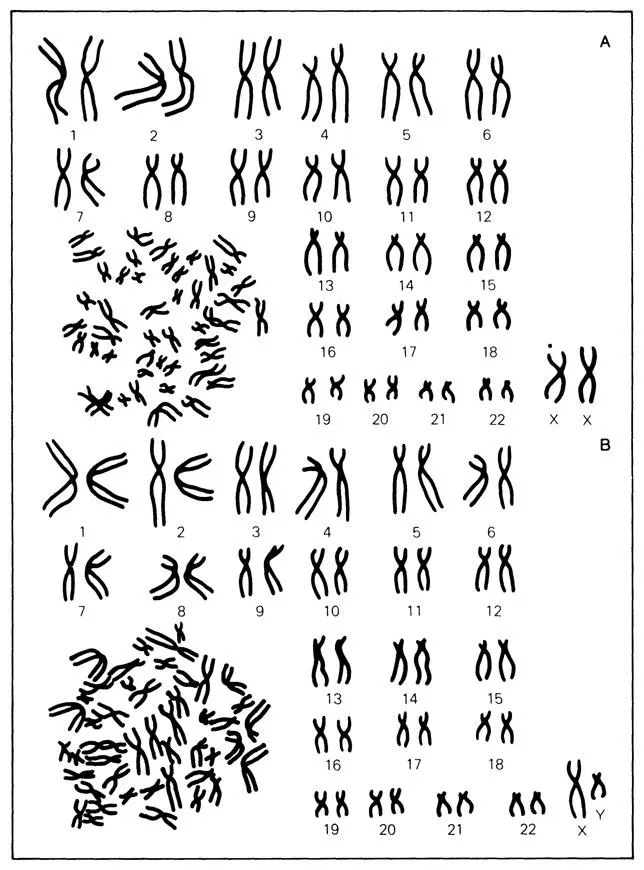
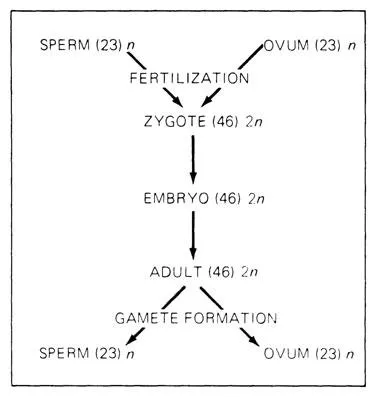
The human species’ 46 chromosomes are arranged in 23 pairs; in females all 23 pairs are homologous (correspond structurally and derivatively); in males, there are 22 homologous pairs plus a nonhomologous X and Y chromosome (Fig. 1.2). The chromosome pairs, when properly stained, differ in length and appearance so that they can be individually recognized, much as one might recognize the familiar face of a friend. During meiosis, when the gametes are formed and the chromosome number is halved, all the chromosomes in a single gamete differ because each gamete has only one member of each chromosome pair. At fertilization, two gametes unite, each containing a set of 23 chromosomes to form the fertilized cell (zygote) with 23 pairs or 46 chromosomes once again. This process is diagrammed in Fig. 1.3. The number of chromosomes contained in gametes (23) is referred to as the haploid number and that of zygotes (2 × 23 = 46) is the diploid number—written as n and 2n, respectively.
The process of meiosis affords a significant opportunity for increasing genetic variability. The most important consistent mechanism of change is crossing over, which takes place during the early phases of meiosis. Homologous chromosomes, lying next to each other, break, exchange equivalent portions of their genes, and reanneal to produce combinations that differ in arrangement from the genetic endowment provided by parents. This phenomenon is omnipresent in the normal meiotic process; when it fails to occur in at least one parent, the resulting organism is often sterile. Crossing over is the most consistent of a number of processes that provide the raw material upon which natural selection may act.
A coarser and more sporadic mechanism is individualized chromosome rearrangement, of which there are four possible types: deletion, duplication, inversion, and translocation. Deletion is the sometimes lethal removal of a gene or sequence of genes. Death may occur because a biochemical sequence has been excised, resulting in an intolerable structural or functional gap in the organism.
Duplication of a chromosome or part of a chromosome may cause an imbalance of gene activity, reducing the viability of an organism. However, because some organisms can tolerate duplications of genetic material, these duplications might play an evolutionary role if part or all of one of the duplications mutated and functioned differently from the original. Indeed, ...
Table of contents
- Cover
- Halftitle
- Title Page
- Copyright Page
- Original Title
- Original Copyright
- Table of Contents
- Preface
- List of Contributors
- 1. Fundamentals of Genetic and Evolutionary Theories
- 2. Genetics of Human Nervous System Functioning
- 3. Genetics of Exploratory Behavior and Activity
- 4. Behavioral Pharmacogenetics
- 5. Medical Genetics, Genetic Counseling, and Behavior Genetics
- 6. Genetics of Schizophrenia
- 7. Genetics and Intelligence
- 8. Ethology and Behavior Genetics
- 9. Genetics of Social Behavior in Nonhuman Animals
- 10. Epimeletic and Et-Epimeletic Behavior in Animals
- 11. The Genetics of Agonistic and Sexual Behavior
- 12. Sociobiology and Behavior Genetics
- Author Index
- Subject Index
Trusted by 375,005 students
Access to over 1.5 million titles for a fair monthly price.
Study more efficiently using our study tools.
Frequently asked questions
Yes, you can cancel anytime from the Subscription tab in your account settings on the Perlego website. Your subscription will stay active until the end of your current billing period. Learn how to cancel your subscription
No, books cannot be downloaded as external files, such as PDFs, for use outside of Perlego. However, you can download books within the Perlego app for offline reading on mobile or tablet. Learn how to download books offline
Perlego offers two plans: Essential and Complete
- Essential is ideal for learners and professionals who enjoy exploring a wide range of subjects. Access the Essential Library with 800,000+ trusted titles and best-sellers across business, personal growth, and the humanities. Includes unlimited reading time and Standard Read Aloud voice.
- Complete: Perfect for advanced learners and researchers needing full, unrestricted access. Unlock 1.5M+ books across hundreds of subjects, including academic and specialized titles. The Complete Plan also includes advanced features like Premium Read Aloud and Research Assistant.
We are an online textbook subscription service, where you can get access to an entire online library for less than the price of a single book per month. With over 1.5 million books across 990+ topics, we’ve got you covered! Learn about our mission
Look out for the read-aloud symbol on your next book to see if you can listen to it. The read-aloud tool reads text aloud for you, highlighting the text as it is being read. You can pause it, speed it up and slow it down. Learn more about Read Aloud
Yes! You can use the Perlego app on both iOS and Android devices to read anytime, anywhere — even offline. Perfect for commutes or when you’re on the go.
Please note we cannot support devices running on iOS 13 and Android 7 or earlier. Learn more about using the app
Please note we cannot support devices running on iOS 13 and Android 7 or earlier. Learn more about using the app
Yes, you can access Behavior Genetics by John L. Fuller, Edward C. Simmel, John L. Fuller,Edward C. Simmel in PDF and/or ePUB format, as well as other popular books in Psychology & History & Theory in Psychology. We have over 1.5 million books available in our catalogue for you to explore.