Clinical Nuclear Medicine Physics with MATLAB®
eBook - ePub

Clinical Nuclear Medicine Physics with MATLAB®

A Problem-Solving Approach

  1. 366 pages
  2. English
  3. ePUB (mobile friendly)
  4. Available on iOS & Android
eBook - ePub

Clinical Nuclear Medicine Physics with MATLAB®

A Problem-Solving Approach

About this book

The use of MATLAB® in clinical Medical Physics is continuously increasing, thanks to new technologies and developments in the field. However, there is a lack of practical guidance for students, researchers, and medical professionals on how to incorporate it into their work.

Focusing on the areas of diagnostic Nuclear Medicine and Radiation Oncology Imaging, this book provides a comprehensive treatment of the use of MATLAB in clinical Medical Physics, in Nuclear Medicine. It is an invaluable guide for medical physicists and researchers, in addition to postgraduates in medical physics or biomedical engineering, preparing for a career in the field.

In the field of Nuclear Medicine, MATLAB enables quantitative analysis and the visualization of nuclear medical images of several modalities, such as Single Photon Emission Computed Tomography (SPECT), Positron Emission Tomography (PET), or a hybrid system where a Computed Tomography system is incorporated into a SPECT or PET system or similarly, a Magnetic Resonance Imaging system (MRI) into a SPECT or PET system. Through a high-performance interactive software, MATLAB also allows matrix computation, simulation, quantitative analysis, image processing, and algorithm implementation.

MATLAB can provide medical physicists with the necessary tools for analyzing and visualizing medical images. It is useful in creating imaging algorithms for diagnostic and therapeutic purposes, solving problems of image reconstruction, processing, and calculating absorbed doses with accuracy. An important feature of this application of MATLAB is that the results are completely reliable and are not dependent on any specific ?-cameras and workstations.

The use of MATLAB algorithms can greatly assist in the exploration of the anatomy and functions of the human body, offering accurate and precise results in Nuclear Medicine studies.

KEY FEATURES

  • Presents a practical, case-based approach whilst remaining accessible to students
  • Contains chapter contributions from subject area specialists across the field
  • Includes real clinical problems and examples, with worked through solutions

Maria Lyra Georgosopoulou, PhD, is a Medical Physicist and Associate Professor at the National and Kapodistrian University of Athens, Greece.

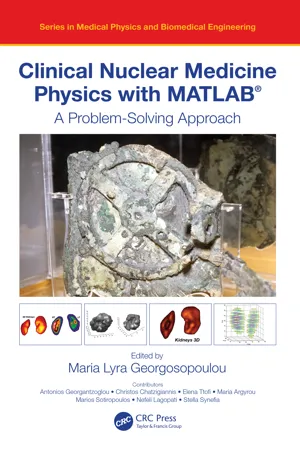
Photo credit: The Antikythera Mechanism is the world's oldest known analog computer. It consisted of many wheels and discs that could be placed onto the mechanism for calculations. It is possible that the first algorithms and analog calculations in mathematics were implemented with this mechanism, invented in the early first centuries BC. It has been selected for the cover to demonstrate the importance of calculations in science.

Frequently asked questions

Yes, you can cancel anytime from the Subscription tab in your account settings on the Perlego website. Your subscription will stay active until the end of your current billing period. Learn how to cancel your subscription.
No, books cannot be downloaded as external files, such as PDFs, for use outside of Perlego. However, you can download books within the Perlego app for offline reading on mobile or tablet. Learn more here.
Perlego offers two plans: Essential and Complete
  • Essential is ideal for learners and professionals who enjoy exploring a wide range of subjects. Access the Essential Library with 800,000+ trusted titles and best-sellers across business, personal growth, and the humanities. Includes unlimited reading time and Standard Read Aloud voice.
  • Complete: Perfect for advanced learners and researchers needing full, unrestricted access. Unlock 1.4M+ books across hundreds of subjects, including academic and specialized titles. The Complete Plan also includes advanced features like Premium Read Aloud and Research Assistant.
Both plans are available with monthly, semester, or annual billing cycles.
We are an online textbook subscription service, where you can get access to an entire online library for less than the price of a single book per month. With over 1 million books across 1000+ topics, we’ve got you covered! Learn more here.
Look out for the read-aloud symbol on your next book to see if you can listen to it. The read-aloud tool reads text aloud for you, highlighting the text as it is being read. You can pause it, speed it up and slow it down. Learn more here.
Yes! You can use the Perlego app on both iOS or Android devices to read anytime, anywhere — even offline. Perfect for commutes or when you’re on the go.
Please note we cannot support devices running on iOS 13 and Android 7 or earlier. Learn more about using the app.
Yes, you can access Clinical Nuclear Medicine Physics with MATLAB® by Maria Lyra Georgosopoulou in PDF and/or ePUB format, as well as other popular books in Technology & Engineering & Radiology, Radiotherapy & Nuclear Medicine. We have over one million books available in our catalogue for you to explore.

Table of contents

  1. Cover
  2. Half Title
  3. Series Page
  4. Title Page
  5. Copyright Page
  6. Contents
  7. Foreword
  8. Contributors
  9. Chapter 1 Introduction
  10. Chapter 2 Image Formation in Nuclear Medicine
  11. Chapter 3 Nuclear Medicine Imaging Essentials
  12. Chapter 4 Methods of Imaging Reconstruction in Nuclear Medicine
  13. Chapter 5 Image Processing and Analysis in Nuclear Medicine
  14. Chapter 6 3D Volume Data in Nuclear Medicine
  15. Chapter 7 Quantification in Nuclear Medicine Imaging
  16. Chapter 8 Quality Control of Nuclear Medicine Equipment
  17. Chapter 9 Introduction to MATLAB and Basic MATLAB Processes for Nuclear Medicine
  18. Chapter 10 Morphology of Human Organs in Nuclear Medicine: MATLAB Commands
  19. Chapter 11 Internal Dosimetry by MATLAB in Therapeutic Nuclear Medicine
  20. Chapter 12 Pharmacokinetics in Nuclear Medicine/MATLAB Use
  21. Chapter 13 Nanotechnology in Nuclear Medicine/MATLAB Use
  22. Chapter 14 CASE Studies in Nuclear Medicine/MATLAB Approach
  23. List of Acronyms