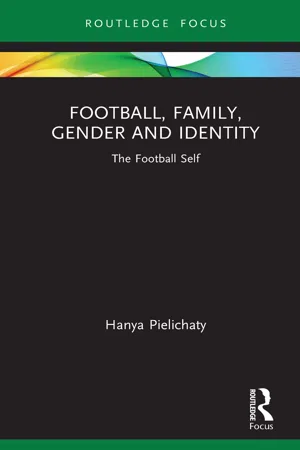
This book presents a cross-disciplinary examination of the lived experiences of girls and women football players using theoretical insights from sports studies, psychology, sociology and gender studies.
It examines the concept of 'the football self' – your own, personal football identity that encapsulates the importance of football to our everyday lives – and what that can tell us about the complex relationships between sport, family, gender and identity. The book draws on in-depth ethnographic research involving players and family members, and offers important new insights into the everyday experiences of those girls and women who play. It breaks new ground in focusing on the significant relationships between player and family with a particular focus on parenting through football. The book brings to the fore key debates around gender identity, barriers to participation, cultural gaps and discrimination. The author also brings a personal perspective to bear, drawing on experience gained over 20 years as a player, adding an extra critical layer to her important empirical research.
This is essential reading for all researchers and students with an interest in football, sport studies or issues around gender, inclusion or the family in sport, and fascinating reading for anybody generally curious about football.
I was the first girl in the history of my primary school to play on the boys’ football team. This had no significance to me at the time but it did create some interesting social situations. One of which took place at an awards ceremony following a tournament victory. My team and I were stood in a row waiting patiently for a man to put medals around our necks to symbolise our achievement. After each medal placement the man shook a player’s hand before moving on to the next recipient. It was finally my turn; I proudly waited for my medal and handshake, even positioning my right hand out in front of me ready. But what followed wasn’t a handshake at all… My parents described the next move to me (years later) as an almost falling backwards; I prefer to think of it as a ‘Neo style’ hyper-extension of the back, dodging bullets, akin to The Matrix film. It wasn’t bullets that came towards me though, but rather the medal man had attempted to kiss me on the cheek! My response to which was to fling my face and body out of the way in a desperate scuttle to evacuate the area to much amusement from the parent spectators. As a nine year old footballer, the last thing you want is a kiss on the cheek! Where was my handshake?
My childhood bedroom walls were covered with centre-piece programme pull-outs of Andy Booth and Ronnie Jepson rather than more typical tributes to Take That and the Spice Girls. Growing up in the 90s in the English East Midlands, with a strange sounding last name, and a love for Huddersfield Town and all things football was not the classic formula for British girlhood.
Around the age of nine I seemed to do nothing but kick a ball about. I didn’t think much of being the first ever girl to be selected for the boys’ football team at primary school: I just wanted to play. The relationship between school and football is extremely important (see Emmanuel, 2017; Clark and Paechter, 2007; Swain, 2000). My love for football continued into my later school years. The step up to secondary school is significant in terms of child development and sustaining participation in sport. In general, from late childhood, girls’ and boys’ opportunities to participate in mixed sports lessons become limited. There are schools in the UK that continue to segregate PE lessons on the basis of gender, even though they are not required to do so, a potential legacy from the Victorian era (Lawson, 2013). As Stirling and Schulz comment, ‘whatever strides are gained become lost as soon as the girls commence secondary school, due to the absence of football from the curriculum’ (Stirling and Schulz, 2011, 53). Only 47% of schools within the Union of European Football Associations (UEFA) member associations have football on the curriculum for girls (FIFA, 2014).
The Football Association’s (FA) 2020–2024 strategy for girls’ and women’s football seeks to directly address this and create opportunities for all girls to access football (FA, 2020). My experiences of secondary school football were all positive but looking back there were structural issues to overcome. I had to set up the first ever girls’ football team at secondary school (assisted by a female French teacher) because at that time the FA no longer permitted girls over the age of 11 to play with boys. Sixty-three per cent of the Fédération Internationale de Football Association (FIFA) member associations now offer mixed football (FIFA, 2019). Arguably, this FA ruling stunted the progress of girls’ and women’s football in England, having negative ramifications for decades to come.
The reason my footballing experience at school was so positive and impactful was because of my inspirational Physical Education (PE) teacher: Mr Curry (now Dr Curry). Mr Curry found ways to encourage my football participation and gave me confidence to play. We would talk endlessly about football, and on one occasion he gave me a signed Huddersfield Town poster, a gift from Kevin Gray, a Huddersfield Town defender and former pupil of Mr Curry. I remember during my time in 6th Form Mr Curry took a sabbatical; he later returned with his PhD thesis (concerning the origins of football) for me to read, labelled ‘homework’ – I was pleased to return the favour to him 16 years later with my own. I am still in contact with Dr Curry now, we exchange emails about academia and he even delivered a guest lecture to some of my first years not so long ago. The impact a teacher has on a child’s life is fundamental to their future growth and potential; teachers maintain privileged positions.
During my school years I played district- and county-level football and for Lincoln City Ladies FC Reserves. Playing for Lincoln was my first experience of ‘serious’ football, and I am still friends with many of the players today. The coaching team at Lincoln was excellent and did everything possible to progress me as a player and to develop the game locally. My entry into the first team at Lincoln, however, coincided with my departure for university so I waved goodbye to the city of Lincoln (for the time being) (Figure 1.1).
Figure 1.1 Lincoln City Ladies FC Reserves circa 2000.
I went to the University of Warwick to study Psychology and Philosophy. Whilst there, I scored over 90 goals; a personal highlight was scoring three hat tricks in one game. Immediately after Warwick I went to study my Master’s degree at the University of Sheffield in Sport and Recreation Management. At the end of my one season with the Sheffield university team I was awarded Players’ Player and Player of the Year awards.
After university I played for two seasons with West Bromwich Albion (WBA) Women FC (mostly Reserves), an amazing experience I will never forget. I moved to the West Midlands for work, and football provided me with a route into friendship and a new community. Dave Smith, the Assistant Coach at WBA, had a profound impact on me personally and my playing ability. He believed in me as a player and person; his confidence gave me confidence. He was academically minded, so we would spend time discussing pedagogy and analysing football, and he compared football to the Samba, meaning each move had rhythm and a sequence to it. I desperately wanted to play well at WBA but became so disheartened when my mind prevented me from being ‘free’ to enjoy the game. Dave knew that my analytical side was a challenge, and so he offered to coach me for an extra hour every Thursday evening. So my two-hour training session became three hours whereby Dave would coach me through shooting drills away from the other players. I was very grateful for his help at the time but even more so now, realising that Dave had decided to spend additional time, after work to volunteer and help me. The people serving grassroots football really are phenomenal. The extra training worked, and I gained in confidence and also became noticed more by the first team management. At this point, however, my work contract was nearly up and I wanted to move back ‘home’. When I returned to the East Midlands I briefly dabbled with retirement but then played for two more seasons with Nettleham Ladies before properly retiring during the 2015/2016 season. By the time I had stopped playing football I had clocked up over two decades of consistent and dedicated participation, paying to play a sport I loved.
But why is any of this important? Well, it’s important because football books do not normally platform girls’ and women’s voices, and certainly not the voices of everyday players: the ones that battle on undulating pitches and where the subs have to run the line. And also, my voice as a female author, academic and former footballer is here pulling together my own personal stories alongside those of the players that will feature in this book. This is an activist book, framed by feminism and understood through a lens of ‘gender justice’ (Watson and Scraton, 2017; Pielichaty, 2021a, 2021b), allowing me to combat the ‘silencing of the female ethnographer in sport research’ (Richards, 2015, 393) which can and does occur. This leads me to the book’s purpose: to examine gender, identity and family relationships within girls’ and women’s football. The concept of the ‘football self’ is important to this book and can be understood as the meaning football has to those that play, the position it takes within their lives. This book is personal, and as a departure from other academic texts I will be using my own standpoint epistemology (Sprague, 2016) and football experiences to position and understand the historical and contemporary landscape of girls’ and women’s football in England.
There has been a significant increase in participation rates in women’s football (Woodward, 2017), and FIFA (2018, 10) aspires to ‘double the number of female players to 60 million by 2026’. In 2018 the FA ensured all 11 teams within the Women’s Super League (WSL) were full-time and professional in status and had an academy feeder club. An influx of sponsorship also helped to fuel the professional status of women’s football, an example being VISA partnering with the Union of European Football Associations on a seven-year deal (UEFA, 2018). Furthermore, England finished fourth in the FIFA Women’s World Cup in 2019 and it has been agreed that the 2023 Women’s World Cup tournament will expand to accommodate 32 teams (FIFA, 2020).
Despite these positive shifts and numerical changes it is more difficult to see whether there has been a cultural change in society’s view towards girls and women in and around football (see Pielichaty, 2020; Woodhouse et al., 2019). Dunn and Welford (2015) explain that women’s football is isolated from the normative construction of what football ‘is’ to the masses, namely a sport for men to play and enjoy. The first report on women footballers’ working conditions stated that 50% of ‘professional’ players globally do not get paid to play the game, with the majority negotiating their participation alongside study or another job (FIFPro, 2017). FIFA (2018, 4) themselves understand that there is still much more work to be done reporting that ‘the game is both in rude health and in need of fundamental change’. Furthermore, the Covid-19 pandemic is anticipated to significantly impact elite women’s football with the cancellation of the 2919/2020 WSL season and concerns over the uncertainty of the women’s game (Clarkson et al., 2020). Financial assistance of over one million pounds has been granted by the Premier League to help the WSL and the Women’s Championship to recover from the pandemic (Daniels, 2020).
It seems women’s football is enduring a time of concomitant narratives: one of progress and one of cultural stagnation (see Woodward, 2017). This highlights another important purpose of this book, and that is to provide a critical and contemporary view of girls’ and women’s football from the perspective of those who play amidst this contradictory backdrop. An increase in participation numbers does not directly correlate to a change in social attitudes towards girls’ and women’s appropriateness to football. This examination will continue in Chapter 2 in much more depth and considers global perspectives.
The premise of this book is to provide you, the reader, with an insight into how girls and women experience football participation alongside other facets of their lives. Stone (2007, 170) explained ‘it is in the everyday life that football culture is primarily perpetuated, expressed and experienced’, and it is the everyday aspect that will be of importance to this book. The heart of this text is about a love for football and the meaning that the sport has to those who play. As such, the chapters are structured in a way to encourage story-building, each chapter feeding in and out of the next in an attempt to understand the importance and placement of football within the lives of the players and their families. Even though the chapters have been organised into discrete areas, this does not mean to reflect an isolation and/or clean separation of the topics discussed. As always, the themes of gender and identity are complex, nuanced and murky, blurring in and out of each other like ink on blotting paper.
As already highlighted the following chapter will provide an in-depth and critical look at the current state of girls’ and women’s football from across the globe. Furthermore, previous football studies and their methodological approaches will be considered in order to understand the ways girls’ and women’s experiences have been viewed and explored before. Chapter 3 will delve into the notion of the ‘football self’, an original concept presented in my earlier empirical work which depicts the meaning of football to a particular player (see Pielichaty, 2019). The football self in connection with identity will be examined and underpinned by socio-psychological approaches to identity. The Football Self Continuum also outlined in previous work (Pielichaty, 2019) will be presented as a heuristic device to understand the fluidity and mobility of identities through participation. It is important to first have discussed identities per se before moving onto gender as placed in Chapter 4. The outdated but maintained gender boundaries connecting to girlhood and football participation will be explored through the voices of players ...
Table of contents
Cover
Half Title
Series Page
Title Page
Copyright Page
Dedication
Table of Contents
List of figures
1 Introducing me and football
2 The girls’ and women’s footballscape
3 The football self
4 Gender and the binary evolution
5 Football families
6 Parenting in girls’ and women’s football
7 Gendered parenting
8 Gender justice and social change: beyond the football self
Index
Trusted by 375,005 students
Access to over 1.5 million titles for a fair monthly price.
Study more efficiently using our study tools.
Frequently asked questions
Yes, you can cancel anytime from the Subscription tab in your account settings on the Perlego website. Your subscription will stay active until the end of your current billing period. Learn how to cancel your subscription
No, books cannot be downloaded as external files, such as PDFs, for use outside of Perlego. However, you can download books within the Perlego app for offline reading on mobile or tablet. Learn how to download books offline
Perlego offers two plans: Essential and Complete
Essential is ideal for learners and professionals who enjoy exploring a wide range of subjects. Access the Essential Library with 800,000+ trusted titles and best-sellers across business, personal growth, and the humanities. Includes unlimited reading time and Standard Read Aloud voice.
Complete: Perfect for advanced learners and researchers needing full, unrestricted access. Unlock 1.5M+ books across hundreds of subjects, including academic and specialized titles. The Complete Plan also includes advanced features like Premium Read Aloud and Research Assistant.
Both plans are available with monthly, semester, or annual billing cycles.
We are an online textbook subscription service, where you can get access to an entire online library for less than the price of a single book per month. With over 1.5 million books across 990+ topics, we’ve got you covered! Learn about our mission
Look out for the read-aloud symbol on your next book to see if you can listen to it. The read-aloud tool reads text aloud for you, highlighting the text as it is being read. You can pause it, speed it up and slow it down. Learn more about Read Aloud
Yes! You can use the Perlego app on both iOS and Android devices to read anytime, anywhere — even offline. Perfect for commutes or when you’re on the go. Please note we cannot support devices running on iOS 13 and Android 7 or earlier. Learn more about using the app
Yes, you can access Football, Family, Gender and Identity by Hanya Pielichaty in PDF and/or ePUB format, as well as other popular books in Social Sciences & Gender Studies. We have over 1.5 million books available in our catalogue for you to explore.