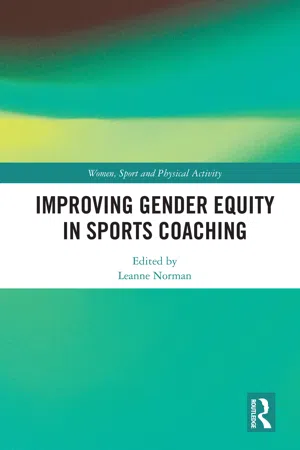
The sport coaching profession has historically been and continues to be a White male-dominated occupation and this remains a global issue. This imbalance persists despite an improvement in wider social attitudes and legislation towards equality and diversity within many societies, and despite the action by sporting organisations and national governing bodies. Within the research literature, the underrepresentation of women in sport coaching is a well-documented issue with a number of research studies highlighting the experiences and impact of being in the minority for women coaches. The issue of gender inequity in sport coaching is a long-standing one and shows little sign of changing significantly anytime soon. Therefore, a new approach is needed, one that draws on the knowledge and evidence we have to create actionable, sustainable, deep-rooting interventions that challenge the issue of gender equity at its very core. The overall purpose of Improving Gender Equity in Sports Coaching is to take an action or forward-thinking approach about what works, or could work, to improve the recruitment, development, or promotion of women sport coaches. The book brings together a global group of esteemed scholars working in this subject area. In this book, we have brought together not just the insight but also a collection of strategies and recommendations as to how this research could be or has been utilised to make our sport coaching envrionment places where all coaches feel as though they belong. As such, this ground-breaking book is a must read not just for students and researchers of gender equity in sport but also for policy and decision-makers working in sport.
- 256 pages
- English
- ePUB (mobile friendly)
- Available on iOS & Android
eBook - ePub
Improving Gender Equity in Sports Coaching
About this book
Information
Part I
Setting the Scene
How Gender Inequity Manifests Itself in Sport Coaching Contexts and Why Change Is Needed
1 The Glass Cliff, Gender, and Sport Leadership
A Narrative Review and Meta-Analysis
Introduction
Although women constitute a major segment of workforces around the world, they are under-represented in key leadership positions. Consider, for example, that in 2019, 46% of all workers in the United States were women (World Bank, 2020). Nevertheless, they constituted just 22.5% of all board executives and 6.6% of all chief executive officers in Fortune 500 firms (Connley, 2019). In fact, the 33 women at the helm of the firms in 2019 constituted an all-time high (Connley, 2019), showing the persistent nature of inequality.
These trends are also evident in sport and physical activity. Among national sport organisations around the world, women constitute 16.3% of the chief executives (Adriaanse, 2016). In the United States, those figures are even lower, as just 5% of all chief executives of national governing bodies are women (Gaston et al., in press). At the Olympic level, women represented 45% of all athletes in 2016 (Crockett, 2016) but just 19.7% of the National Olympic Committee board positions (Ahn & Cunningham, 2017). These numbers mask the magnitude of inequality: one-in-twenty NOC boards had all men, while nearly one-in-five had fewer than 10% women. The under-representation of women in key leadership roles is also evident in other areas of sport, including the amateur ranks, such as intercollegiate athletics in the United States. Even though women represent 44% of nearly 500,000 intercollegiate athletes, they represent just 24% of all head coaches (Cunningham, 2019).
Collectively, these figures show that, even though they have better representation in other areas, such as employees or athletes, women sparsely occupy upper echelons, whether as coaches, board members, or chief executives. This lack of diversity is important for a number of reasons. First, the disparate numbers point to access discrimination (Greenhaus et al., 1990), or a form of bias that limits people’s ability to obtain employment and that a number of researchers have identified in the coaching context (Darvin, 2020; Norman, 2010). Furthermore, the data seemingly suggest that key coaching roles in sport are suited best for men, thereby thwarting aspirations of current and future women leaders (Norman, 2014; Walker & Bopp, 2011). A lack of diversity also hurts team culture and all involved with the team. As evidence, LaVoi (2016; see also LaVoi & Dutove, 2012), in articulating her integrated framework, showed how women in leadership can serve as role models; lend support to other women in the sport industry; bring varied vantage points to discussions that historically men historically dominate; and are likely to behave in more civil, just ways than men. Furthermore, organisational strategies designed to enhance gender equality and inclusion are likely to benefit all people, women and men alike (LaVoi, 2016).
Consequently, a number of researchers have examined factors that influence women’s representation in sport leadership roles, whether as coaches or administrators. Multilevel models offer one way of organising the burgeoning scholarship, with factors at the societal, organisational and intergroup, and personal levels (Burton, 2015; Cunningham, 2008, 2019; LaVoi & Dutove, 2012). Societal factors include laws and ordinances, institutional norms and expectations, and the influence of powerful actors; organisational and intergroup factors include bias among decision-makers, the culture of the team and sport organisation, socio-political and power dynamics, and diversity and inclusion strategies; and individual factors include people’s investments in their human and social capital, and their self-limiting behaviours. In addition to coalescing the empirical research in the area, the multilevel approach captures the theories that scholars have used to understand women’s career opportunities and experiences (Cunningham, 2016; Gearty et al., 2016).
A review of the extant scholarship shows a focus on how, why, and under what conditions women lack access to key coaching roles. Largely missing from this analysis, though, is consideration of the coaching positions women do obtain, the quality of those roles, and the subsequent outcomes. If, for example, women only have access to undesirable positions, then they are set up to fail, and the long-term prospects of their success in sport, whether as a coach or chief executive, are unfavourable. Therein rests the benefit of adopting a glass cliff perspective, or the notion that women are more likely than men to secure precarious and risky leadership positions (Ryan & Haslam, 2007; Ryan et al., 2016). In this case, women may have cracked the glass ceiling (or the real but invisible barrier prohibiting their ascension to top leadership roles; Norman et al., 2018), but in doing so, obtained an unenviable role that does not bode well for long-term success. In short, the glass cliff represents another form of gender bias, ultimately privileging men within the work context. The purposes of this chapter are as follows: (1) to overview the glass cliff perspective, including the primary tenets, possible antecedents, and potential outcomes; (2) to summarise the findings from a meta-analysis of glass cliff studies, including those in sport; (3) to apply the meta-analytic findings to the sport context; and (4) to offer theoretical and practical implications.
The Glass Cliff
Key Tenets
The primary premise undergirding the glass cliff is that women are most likely to secure leadership roles that are undesirable—those where there is a history of underperformance, chaos, or volatility. Ryan and Haslam (2005) initially uncovered evidence of the glass cliff in their analysis of the Financial Times Stock Exchange (FTSE) 100 firms listed on the London Stock Exchange. They found that women’s appointment as chief executive was not related to subsequent company performance. Of particular interest were the additional findings: among companies that appointed men, the previous firm performance was stable, but those companies that chose a woman as the new chief executive experienced volatile, poor stock performance in the period leading up to that decision. Thus, the quality of the roles into which women and men stepped were markedly different. Subsequent work among Fortune 500 companies revealed similar trends: women were most likely to assume a chief executive position when the companies had experienced crises (Brady et al., 2011) or when the stocks had been performing poorly (Cook & Glass, 2014a). The patterns are evident outside of major corporations, too. In the world of UK politics, Ryan et al. (2010) found that women were most likely to run for seats that were difficult to win (based on the wide margin by which the incumbent had won in the previous election).
Of note, however, is the research evidence that points to another pattern of findings, thereby resulting in equivocal overall results. Adams et al. (2009) found no gender differences in the quality of appointment among Fortune 500 companies (see also Gupta et al., 2017). In a longitudinal study of Fortune 500 firms, Cook and Glass (2014b) observed that broad diversity was associated with the appointment of a woman as chief executive, but company performance was not. Hennessey et al. (2014) also failed to find support for the glass cliff in their analysis of Canadian businesses.
There are two studies in the sport realm that directly assessed these predictions. First, Ahn and Cunningham (2020) interviewed women who had completed FIFA’s women’s leadership development training. The programme started around the same time as FIFA’s bribery scandal broke, and about half of the study participants drew parallels between the crisis-ridden status of the organisation and the decision to further develop women for leadership roles. In another study, Wicker et al. (2019) collected 11 years of archival data from NCAA women’s soccer teams competing in the major athletic conferences, totalling 695 observations. They found that 59 head coaching changes took place over that time, and women took the helm in 15 of them (25.4%). In line with the glass cliff, women were more likely than men to secure a coaching position for a team with poor performance, as measured by wins and winning percentage. Thus, women were unlikely to guide the women’s soccer teams, and when they were, they stepped into roles where the team was on a downward performance slide.
Antecedents
Additional researchers have examined why the glass cliff might occur, with considerable empirical support for stereotypes and the desire for organisations to signal change. On the other hand, there is less support for the notion that women are more willing to take precarious jobs than are men.
Stereotypes
As part of the cognitive domain of bias (Cuddy et al., 2008), stereotypes represent “the attitudes, beliefs, and behaviours people assign to others—that is, those characteristics they believe embody another individual or group of individuals” (Cunningham & Ahn, 2019, p. 84). They are socially constructed, and time bound, such that prevailing stereotypes in one context and at one point in time are likely to change. Stereotypes give rise to other forms of bias, including prejudice and discrimination.
In the leadership context, Schein (1973, 1975) showed how the stereotypes people have for managers align closely with those they hold for men in general. That connection, though, is not apparent for women. As a result, Schein noted the presence of the “think manager–think male” association, and it is present today (Koenig et al., 2011). Within the sport context, the “think manager–think male” connection influences how people rate women and men for athletic administrative positions in the United States (Burton et al., 2009), manager positions in Turkish sport organisations (Koca & Öztürk, 2015), and intercollegiate coaches (Walker et al., 2011).
The glass cliff extends this thinking to include also the “think crisis–think female” stereotype. According to Ryan et al. (2016), this association stems from the communal stereotypes that people frequently associate with women, including the belief that women are warm, understanding, caring, and so on. A number of authors have also shown these patterns exist in assessments of women coaches (Cunningham & Ahn, 2019; Madsen et al., 2017; Sartore & Cunningham, 2007). These are the very characteristics people seek when undergoing a stressful or chaotic time. In support of this connection, Ryan et al. (2011, Study 2) asked participants about the characteristics that leaders should possess when an organisation is unsuccessful, and they found these attributions corresponded with beliefs about women but not those people held for men. In other words, “the qualities that women are seen to possess are often also associated with companies that are...
Table of contents
- Cover
- Half Title
- Series
- Title
- Copyright
- Contents
- List of Figures
- List of Tables
- About the Contributors
- Acknowledgements
- Introduction: Bringing About Sustainable Change to Improving Gender Equity in Sport Coaching
- Part I Setting the Scene: How Gender Inequity Manifests Itself in Sport Coaching Contexts and Why Change Is Needed
- Part II Strategies for Supporting a More Gender-Inclusive Sport Coaching Workforce
- Part III From Research to Practice: Evidence of Impactful Research That Has Contributed to More Gender-Inclusive Sport Coaching Contexts
- Index
Trusted by 375,005 students
Access to over 1.5 million titles for a fair monthly price.
Study more efficiently using our study tools.
Frequently asked questions
Yes, you can cancel anytime from the Subscription tab in your account settings on the Perlego website. Your subscription will stay active until the end of your current billing period. Learn how to cancel your subscription
No, books cannot be downloaded as external files, such as PDFs, for use outside of Perlego. However, you can download books within the Perlego app for offline reading on mobile or tablet. Learn how to download books offline
Perlego offers two plans: Essential and Complete
- Essential is ideal for learners and professionals who enjoy exploring a wide range of subjects. Access the Essential Library with 800,000+ trusted titles and best-sellers across business, personal growth, and the humanities. Includes unlimited reading time and Standard Read Aloud voice.
- Complete: Perfect for advanced learners and researchers needing full, unrestricted access. Unlock 1.5M+ books across hundreds of subjects, including academic and specialized titles. The Complete Plan also includes advanced features like Premium Read Aloud and Research Assistant.
We are an online textbook subscription service, where you can get access to an entire online library for less than the price of a single book per month. With over 1.5 million books across 990+ topics, we’ve got you covered! Learn about our mission
Look out for the read-aloud symbol on your next book to see if you can listen to it. The read-aloud tool reads text aloud for you, highlighting the text as it is being read. You can pause it, speed it up and slow it down. Learn more about Read Aloud
Yes! You can use the Perlego app on both iOS and Android devices to read anytime, anywhere — even offline. Perfect for commutes or when you’re on the go.
Please note we cannot support devices running on iOS 13 and Android 7 or earlier. Learn more about using the app
Please note we cannot support devices running on iOS 13 and Android 7 or earlier. Learn more about using the app
Yes, you can access Improving Gender Equity in Sports Coaching by Leanne Norman in PDF and/or ePUB format, as well as other popular books in Biological Sciences & Gender Studies. We have over 1.5 million books available in our catalogue for you to explore.