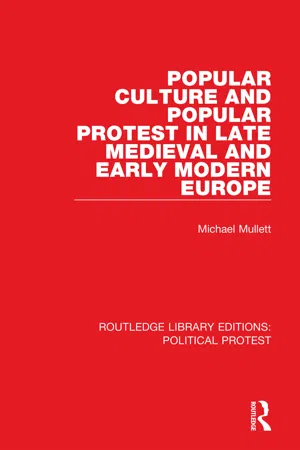
This book, first published in 1987, looks at the culture of the masses and at the political language and actions of the crowd. It examines the enduring traits of a European demotic culture that was largely non-literate, and it then goes on to show how the political outlook of the lower classes arose from the moral attitudes contained in their culture, a culture that was deeply suffused by Christianity. Unlike upper-class culture, popular culture is resistant to change and has to be studied over a long period – in this case the fourteenth through the seventeenth centuries. Because its themes – popular social values, riot and revolt – are pervasive over both time and space, the book's geographical coverage is extensive, taking in most of western and central Europe.
eBook - ePub
Popular Culture and Popular Protest in Late Medieval and Early Modern Europe
- 184 pages
- English
- ePUB (mobile friendly)
- Available on iOS & Android
eBook - ePub
Popular Culture and Popular Protest in Late Medieval and Early Modern Europe
About this book
Information
1
Introduction: Popular Culture and Popular Protest in Late Medieval and Early Modern Europe
This study is partly about popular protest in Europe in the later Middle Ages and the early modern period. We shall be dealing mostly with the fourteenth, fifteenth, sixteenth and seventeenth centuries. This forms the great age of European popular insurgency, a phase which opens in the fourteenth century and has a secondary peak in the sixteenth and seventeenth centuries. Europe — chiefly western Europe — is the focus of our study, concentrating on France, England, Italy, the Low Countries, Bohemia and Germany, and dealing with lower-class protest and insurrection in town and countryside, and the links that bound the protests of the lower orders in both urban and rural areas. At the very beginning, we shall need to spend some time in this introduction considering and establishing the importance of the town as well as of the country, and to underline the significance, particularly the cultural significance, of towns in what sometimes appears to have been an overwhelmingly rural society.
One argument in this book is that, with some exceptions, there was not a revolutionary, but only a reformist mentality underlying the lower-class protests of our period. Our lower orders — we shall attempt some definition of them below — often reacted forcibly, but pragmatically, to deteriorations in their living standards which they could blame on human agencies; they did not generally have alternative social structures to propose. It is true that there were movements like that of the Drummer of Niklashausen in Germany in 1476 which called for the complete equalisation of society. Such movements tended to be heavily influenced, or indeed created, by the ideas of religious visionaries and unofficial charismatics. There were also serious millenarian protest movements, drawing their inspiration from the eschatology at the heart of the Christian message and envisaging the replacement of existing society by paradise on Earth. Some of the most serious movements we shall consider, however, either harnessed some social radicalism with political deference towards kingship, as did the English Peasant Revolt of 1381, or combined both social and political conservatism in programmes that aimed not to have existing society swept away but rather controlled by moral, and specifically Christian, values: such, broadly speaking, was the great German Peasants’ Revolt of 1525. Popular protest used the assumptions and language of a phenomenon we shall attempt to define — popular culture.
We need some initial definitions of the popular classes (we shall be talking later about urban and rural elites) and we begin with that vast category known as the peasantry. Some historians, especially, perhaps, English historians, seem to encounter a little difficulty in defining the word ‘peasant’. This difficulty may have arisen because England has lost its peasantry: perhaps a Frenchman would have less difficulty with the word paysan, an Italian with contadino, a German with Bauer. For the purposes of this book, the following definition of a peasant will be implied: a small-scale farmer directly tilling the soil for family subsistence and/or market production and normally owing certain financial and/or labour obligations in return for occupying the land. Not all rustic plebeians were peasants, of course: the countryside contained numerous artisans such as blacksmiths, and also, especially from about the sixteenth century onwards in such areas as the Netherlands and England, quite large numbers of people whose livelihoods came in whole or in part from rural industrial work, particularly in textiles. None the less, we shall use the figure of the peasant farmer as our archetype of the rural plebeian. The other section of our ‘lower classes’ comprises the urban lower orders. For our purposes, these are made up primarily of those townsmen and their families who relied mostly on wages, and sales of their manufactured and processed goods for their livelihood. Working peasants and townsmen, then, will be the main foci of our study, though we shall also take into account the more ‘marginal’ elements of urban and rural society — vagrants and the ‘criminal classes’.
Incidentally, I assume that social class existed in the past. Some historians have quite persuasively argued that since the word ‘class’ was not used in the medieval and early modern periods, then class consciousness, and therefore class itself, did not exist, but only ‘orders’ and ‘status groups’.1 This seems to me to be akin to saying that the circulation of the blood did not take place before Harvey discovered it. I accept that ‘status groups’ dependent only partly on economic differentiation, such as the nobility, were predominant in subjective medieval and early modern social analyses. I would argue, however, that the status groups generally coincided with wealth and poverty and this means that objectively they at least resembled social classes, since class is based in the first instance on economic distinctions. There was in fact some class consciousness, and there was certainly class conflict.2 Indeed, it is a theme of this book.
Such conflict had active insurgency as its most dramatic form of expression, and insurrection on a greater or lesser scale, from riot on individual estates to nation-wide rebellions, will be our main concern in dealing with popular protest. Action, concentrated and indeed violent action, formed the language of those generally denied constitutional means of self-expression. Increasingly in the early modern period, written manifestos appeared in revolts and gave them coherence: both the English Pilgrimage of Grace, 1536-7, and the German Peasants’ Revolt of 1525, had a multiplicity of lists of grievances and demands. However, an apparently well-organised and exceptionally serious revolt like that of the English rising of 1381 lacked such a coherent literate formulation.
The truth is that the popular revolt was itself the method — no doubt clumsy, and generally unsatisfactory — of drawing attention to complaints. A revolt was often a kind of mobilised petition, directed at the king as an idealised arbiter, typically between peasants and lords. Most peasant revolts were defeated, at least on the face of it. Some popular revolts were, however, followed by some improvements in the condition of the lower orders, especially peasants. In many cases such improvements were doubtless inevitable, and might have come about anyway because of long-range demographic and economic factors. It is also possible, though, that when improvements came about in the wake of popular revolts, those gains might have been made because landlords and political authorities had been made freshly aware of the limits to which peasants in particular could be pushed. This was an underlying function of many popular revolts — to re-adjust, but not always to re-cast, society, often quite conservatively.
Yet we are forced to ask the question, if revolt was protest, why was revolt not permanent in late medieval and early modern Europe? I ask this question because some would see in the European social system of those centuries one massive apparatus of exploitation by lords and governments directed against peasants and workers. Part of the answer to my question is supplied by Braudel, who implies that there was indeed a continuous social war, through banditry and murder, in parts of Mediterranean Europe.3 In addition, throughout Europe, and identifiably in Germany, there was deliberate unpunctuality, inefficiency and absenteeism over labour services, flight from estates, sabotage and arson of lords’ property.4 In much of northern Europe, too, there were periods of recurrent, and indeed endemic, revolt in certain countries and areas, if not quite a state of permanent revolt.
Such periods and areas include Germany from the late fifteenth century to 1525, and France from about 1580 to about 1640. Particularly in France in that period the lower classes were the victims of, and were responding to, aggression from landlords, from the state and from aristocracies fighting civil wars. Such intensified pressure, along with climatic deterioration coinciding with population increase, probably altered the terms of peasant existence from the tolerable to the intolerable. Depending on soil types, given reasonable weather, favourable population balances, hard work and good sized holdings, most European peasants could normally expect to feed their families more or less adequately, pay various reasonable dues to lord, church and state and perhaps even improve their houses, diets and general living standards.5 They always tended to resent labour services, if only because these took them away from work on their own holdings and at the times they most needed to do it themselves. As we shall see, they tried to control community relations, weather, crops, sickness and death through religion, in the more extensive sense of that term.6 The main determinants of their lives — weather and long-range population trends — were of course beyond any human control, though from the seventeenth century onwards, public authorities may have been instrumental in influencing population levels through checking illegitimacy, trying to guarantee food supplies and taking precautions against epidemics.7
Conversely, human intervention in peasants’ lives, on the part of the state or of landlords, could also make hitherto tolerable situations insupportable. When the dues, labour services, estate obligations, rents and taxes that peasants paid were increased, when war was waged over their holdings, when access to supplementary food and fuel supplies in woods and waste land was curtailed, then a precarious hold on subsistence, or even on modest prosperity, was threatened or lost. Revolt was the result, and was a response to ‘aggression’ on the part of others. As we shall see, peasants were not fools. Each failed revolt, ingrained into the folk memory, must have acted as a warning of the risks of rebellion. Peasants in revolt were not generally revolutionaries initiating action but were largely reacting to changes introduced, to their disadvantage, by their social and political superiors — deleterious changes whose effects were exacerbated in periods of crisis and depression such as the first half of the seventeenth century.
There were times when revolt was indeed the outcome of absolute desperation. There was clearly a mood amongst the French peasantry at various times between the fourteenth and seventeenth centuries when they felt that revolt was the only way out of the sheerest misery.8 There were also millenarian revolutions, like that in Bohemia in and after 1419, when peasants and workers took the offensive so as to destroy and re-cast society. At other times and in other places insurgent manifestos tell us two things about a widespread peasant mentality: first, there was a feeling that society was either basically benign or basically unchangeable; and second, that within society there was a line between justice and injustice which should not be crossed by lords or the state.
The concept of justice in society had been incorporated into the peasants’ mental world as the effect of centuries of accumulated Christian preaching. The medieval Christian social ethic had its ultimate origins in the teaching of Jesus with its suspicion of wealth and the wealthy and its exaltation of the poor. From New Testament beginnings, developed especially by the medieval scholastic theologians, a social morality was built up. According to this morality, the virtues of justice and charity were supposed to be upheld in a Christian society which was seen as an organic whole, divided into estates, each making its contribution to the welfare of the whole. All forms of undue exploitation were foreign to this social balance. Lending money at interest was uncharitable, prices should be fixed according to the ability of the buyer to pay and the just rewards of the producer, and the rich had an inescapable duty to aid the deserving poor. Injustice occurred, not in the fundamental structure of society, which was created like all things by God, but when its equilibrium was upset by the acquisitiveness of any particular group or individual. Such social ethics were reflected in many of the manifestos of popular insurrections, as we shall see. They were implanted in the first place through a transfer from the social teaching of the Christian Church to the popular mind, chiefly through sermons.9
Marx thought that the medieval social order — to him basically one in which the many served the few — was propped up ideologically by the social attitudes of the Christian Church,10 and in its essential structures, it was. This social order was, however, legitimated by an ideological system — Christian doctrine — which had its origins before the creation of the feudal order in a minority sect alienated from the Roman world. Even when it appeared least critical of the medieval world ...
Table of contents
- Cover
- Half Title
- Title Page
- Copyright Page
- Original Title Page
- Original Copyright Page
- Epigraph
- Dedication Page
- Table of Contents
- Preface
- 1. Introduction: Popular Culture and Popular Protest in Late Medieval and Early Europe
- 2. Social and Cultural Groupings in Late and Early Modern Europe
- 3. Language and Action in Peasant Revolts
- 4. Preachers, Popular Culture and Social in Late Medieval Europe
- 5. Conclusion: Social Control and Popular in Early Modern Europe
- Select Bibliography
- Index
Trusted by 375,005 students
Access to over 1.5 million titles for a fair monthly price.
Study more efficiently using our study tools.
Frequently asked questions
Yes, you can cancel anytime from the Subscription tab in your account settings on the Perlego website. Your subscription will stay active until the end of your current billing period. Learn how to cancel your subscription
No, books cannot be downloaded as external files, such as PDFs, for use outside of Perlego. However, you can download books within the Perlego app for offline reading on mobile or tablet. Learn how to download books offline
We are an online textbook subscription service, where you can get access to an entire online library for less than the price of a single book per month. With over 1.5 million books across 990+ topics, we’ve got you covered! Learn about our mission
Look out for the read-aloud symbol on your next book to see if you can listen to it. The read-aloud tool reads text aloud for you, highlighting the text as it is being read. You can pause it, speed it up and slow it down. Learn more about Read Aloud
Yes! You can use the Perlego app on both iOS and Android devices to read anytime, anywhere — even offline. Perfect for commutes or when you’re on the go.
Please note we cannot support devices running on iOS 13 and Android 7 or earlier. Learn more about using the app
Please note we cannot support devices running on iOS 13 and Android 7 or earlier. Learn more about using the app
Yes, you can access Popular Culture and Popular Protest in Late Medieval and Early Modern Europe by Michael Mullett in PDF and/or ePUB format, as well as other popular books in Politics & International Relations & Politics. We have over 1.5 million books available in our catalogue for you to explore.