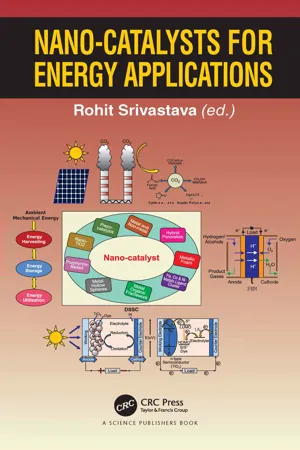
This book comprises of chapters based on design of various advanced nano-catalysts and offers a development of novel solutions for a better sustainable energy future. The book includes all aspects of physical chemistry, chemical engineering and material science. The advances in nanoscience and nanotechnology help to find cost-effective and environmentally sound methods of converting naturally inspired resources into fuels, chemicals and energy. The book leads the scientific community to the most significant development in the focus research area. It provides a broad and in-depth coverage of design and development advanced nano-catalyst for various energy applications.
- 200 pages
- English
- ePUB (mobile friendly)
- Available on iOS & Android
eBook - ePub
Nano-catalysts for Energy Applications
About this book
Information
CHAPTER 1
Strategies in Nanocatalyst towards Water Splitting and Reduction of CO2
Utilization of heterogeneous catalysis for energy applications is an important research field in nanoscience and nanotechnology. Recently, nanostuctured materials due to their enhanced properties are in the focus of the scientific community. The involvement of nanotechnology has broadened the scope of the field of catalysis. Oxygen Evolution Reaction (OER) and Hydrogen Evolution Reaction (HER) are important for the water splitting process, whereas Carbon Dioxide (CO2) Reduction Reaction (CDRR) takes place along with OER in the electrochemical CO2 reduction process. Nanohybrids are comprised of organic and inorganic components that are linked together by covalent and noncovalent bonds at the nanoscale while nanocomposites are the materials that incorporate nanosized particles into a matrix of standard materials. In this chapter, the nanostructured electrocatalysts with two broad contexts as ‘nanocomposites’ and ‘nanohybrids’ were explained that showed efficient catalytic activity for OER, HER and CDRR. The electrochemical reductions of CO2 and to generate hydrogen (H2) by water splitting with novel synthetic strategies of electrocatalyst are discussed. The challenges and issues of CO2 reduction and hydrogen production are also highlighted.
Introduction
Nanoscience and nanotechnology research fields are an effective boost for reconstructing the nature on the atomic and molecular level related to the design, characterization, fabrication and applications of materials, devices and systems by controlling the shape and size at the ‘nanoscale’. The fundamental properties of matter such as mass, weight, volume, density, etc., change at the nanoscale. The physical and chemical properties of nanomaterials can be quite different from those of larger particles of the same substance. These materials also have enhanced kinetics due to shortened diffusion pathways and large surface to volume ratios, favoring high power densities. For the growing concern on environmental pollution and its effects on the living system, nanotechnology can be a breakthrough. The use of smaller portions of potential nanomaterials and its highly precise manufacturing will break the tie between economic activity and resource use (Friends of Earth 2010, Subhra Jana 2015, Hao Ren et al. 2014).
Energy is considered as being of great value in this modern world due to the depletion of nonrenewable assets and extensive environmental pollution. This has enforced a look for an opportunity to supply and preserve the known asset of the word ‘Energy’ for future use in an ecofriendly manner. Utilization of fossil fuels by burning them for our energy needs, energy related industrialization, burning of wastes and deforestations are the primary concerns of growing attention of atmospheric CO2 that leads to environmental pollution and severe greenhouse effect. The continuous increase of CO2 in the atmosphere is found as a major cause for the process of global warming. Thus decarbonization of energy delivered with the aid of using the opportunity for alternative clean, sustainable and renewable energy needed for future energy sustainability and global security. Closing the carbon cycle by the way of means of making use of CO2 as a feedstock for currently used commodities, in order to displace a fossil feedstock is an appropriate intermediate step towards a carbon-free future (Subramani et al. 2018, Murugananthan et al. 2015, Furat et al. 2020). Converting CO2 into fuels through renewable power sources is a capacitive approach of mitigating future resource extraction and decreasing our global carbon footprint. Using electrolysis to drive the reduction of CO2 is particularly appealing given the widespread use of electrolyzers for commodity chemical production (Yang et al. 2016, Jingfu et al. 2017a). Hydrogen will be the main source for energy use in future which can be considered as clean energy with high energy content as compared to hydrocarbon fuels (Ilgi and Fikret 2006). Steam reforming and water electrolysis are the methods in trend to produce H2. Steam reforming has a major disadvantage over water electrolysis in that it produces CO2 along with H2 and hence is not ecofriendly. Water electrolysis is carried out by two half-cell reactions; reduction of H+ ions, i.e., HER and oxidation of water, i.e., OER (Sengeni et al. 2016). On the other hand, CO2 reduction has many challenges as it needs an efficient catalyst to mediate multiple electron and proton transfers without resorting to excessive reducing potentials; reducing CO2 in the presence of H2O; and selectively producing one main possible byproduct. The possibility of an electrochemical reduction process depends on thermodynamic value as well as kinetic properties (Yihong et al. 2012, Jinhui Hao and Weidong 2018). Reduction of CO2 results in formyl, methylene and methyl groups coupled with a generation of new C-N, C-C and C-O bonds in the presence of N-, C- and 0-nucleophiles which enlarges the range of compounds directly obtained from CO2 (Xiao-Fang et al. 2018).
___________
1 Catalysis Research Lab, School of Petroleum Technology, Pandit Deendayal Petroleum University Gandhinagar- 382421, Gujarat, India.
2 School of Nano Science and Technology, Shivaji University, Kolhapur-416009, Maharashtra, India.
* Corresponding author: [email protected]
A number of compounds with a wide range of nanostuctures have been synthesized and studied for energy applications. In this chapter, some common synthesis strategies of nanostructured materials such as nanocomposites and nanohybrids electrocatalyst for H2 production and CO2 reduction have been described. Moreover, the electrochemistry for HER, OER and CDRR were overviewed. Nanostructured electrocatalysts are reviewed on the basis of the parameters such as overpotential, current density and the Tafel slope Finally, the challenges and future prospects for H2 production and CO2 reduction are discussed.
Various methods of CO2 reduction
Various types of nanomaterials-based catalysts have been developed for the reduction of CO2 by the physical, chemical or biological route. The efficiency of conversion of CO2 into various products like carbon monoxide (CO); primary, secondary or tertiary hydrocarbons by a suitable highly efficient nanocatalyst depends on various parameters such as size, shape, porosity and reactivity (Guodong et al. 2018, Shulin et al. 2019, Sheng et al. 2014). Utilization of these nanocatalyst materials in the reduction process of CO2 can be carried out by using various pathways. Each pathway may result into a different product. A source of energy or reagent depends on the selection of the pathway and the requirement of the final product. The resultant products c...
Table of contents
- Cover
- Title Page
- Copyright Page
- Preface
- Acknowledgment
- Table of Contents
- 1. Strategies in Nanocatalyst towards Water Splitting and Reduction of CO2
- 2. Hybrid Perovskite Photocatalysis for Energy Harvesting and Energy Saving
- 3. Porphyrins Based Nanostructured Material for the Conversion of CO2 into Value Added Products
- 4. Application of Metallic Foam in Solar Power System
- 5. Valorization Chemistry: A Compendium on Photoreduction of CO2 to Biofuels Over Nano TiO2
- 6. Concept of Nanocatalyst and Its Application in the Energy Domain
- 7. Recent Advancement of Electrocatalyst System in CO2 Reduction: Insights of Fe, Co and Ni Metallo-ligand Clusters in Homogeneous Molecular Level
- 8. Design of Alloy Electrocatalysts for Oxygen Reduction Reaction from First-Principles Viewpoint
- 9. Metal-Organic Frameworks Catalyst for Energy Applications
- 10. Piezoelectric Energy Harvesting and Piezocatalysis
- 11. Metal Hollow Spheres as Promising Electrocatalysts in Electrochemical Conversion of CO2 to Fuels
- index
Trusted by 375,005 students
Access to over 1.5 million titles for a fair monthly price.
Study more efficiently using our study tools.
Frequently asked questions
Yes, you can cancel anytime from the Subscription tab in your account settings on the Perlego website. Your subscription will stay active until the end of your current billing period. Learn how to cancel your subscription
No, books cannot be downloaded as external files, such as PDFs, for use outside of Perlego. However, you can download books within the Perlego app for offline reading on mobile or tablet. Learn how to download books offline
Perlego offers two plans: Essential and Complete
- Essential is ideal for learners and professionals who enjoy exploring a wide range of subjects. Access the Essential Library with 800,000+ trusted titles and best-sellers across business, personal growth, and the humanities. Includes unlimited reading time and Standard Read Aloud voice.
- Complete: Perfect for advanced learners and researchers needing full, unrestricted access. Unlock 1.5M+ books across hundreds of subjects, including academic and specialized titles. The Complete Plan also includes advanced features like Premium Read Aloud and Research Assistant.
We are an online textbook subscription service, where you can get access to an entire online library for less than the price of a single book per month. With over 1.5 million books across 990+ topics, we’ve got you covered! Learn about our mission
Look out for the read-aloud symbol on your next book to see if you can listen to it. The read-aloud tool reads text aloud for you, highlighting the text as it is being read. You can pause it, speed it up and slow it down. Learn more about Read Aloud
Yes! You can use the Perlego app on both iOS and Android devices to read anytime, anywhere — even offline. Perfect for commutes or when you’re on the go.
Please note we cannot support devices running on iOS 13 and Android 7 or earlier. Learn more about using the app
Please note we cannot support devices running on iOS 13 and Android 7 or earlier. Learn more about using the app
Yes, you can access Nano-catalysts for Energy Applications by Rohit Srivastava in PDF and/or ePUB format, as well as other popular books in Technology & Engineering & Biology. We have over 1.5 million books available in our catalogue for you to explore.