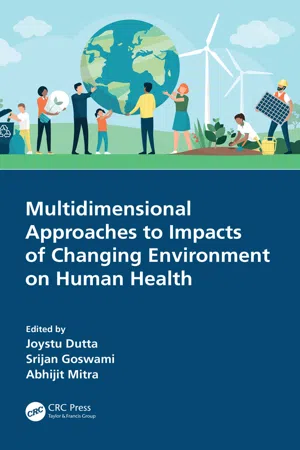
The book discusses the indispensable connection between the environment and health via all possible aspects, focussing on human interactions with the environment. The multi-dimensional field of environmental and human health perspectives with emerging issues and current trends is illustrated through supporting case studies, reviews, research reports and examples. It also covers crucial areas of research such as vector control in a tropical climate, influence of climate change on human health and so forth, including proliferation of microbial diseases. Environmental, health and safety guidelines are discussed as well. Aimed at graduate students and researchers in environmental and medical sciences, health and safety, and ecology, this book Highlights interdisciplinary aspects of environmental changes and associated health risks Explains different aspects of environmental pollution and health risks Includes dedicated chapters on global epidemics and biomedical and municipal waste Contains case studies pertaining to different health and safety issues.
eBook - ePub
Multidimensional Approaches to Impacts of Changing Environment on Human Health
- 448 pages
- English
- ePUB (mobile friendly)
- Available on iOS & Android
eBook - ePub
Multidimensional Approaches to Impacts of Changing Environment on Human Health
About this book
Information
Unit II
Impact of Increasing Environmental Pollution on Human Health
3
Airborne Staphylococcus aureus and its Impact on Human Health
A Review in an Indian Context
Madhuri Singh*, Maneet Kumar Chakrawarti, Himani Kumari, Sonali Rajput and Kasturi Mukhopadhyay*
Contents
3.1 Introduction
3.2Prevalence of S. aureus and MRSA in the Indoor Air of Indian Hospitals
3.3Prevalence of Airborne S. aureus in Non-Hospital Environments of India
3.4Transmission of S. aureus Through Air
3.5Environmental Factors Affecting S. aureus Survivability in the Air
3.6Health Impacts of Airborne S. aureus Exposure
3.7Bioaerosol Collection Methods for Airborne S. aureus
3.8Selective Growth Medium Used for Isolation of S. aureus and MRSA
3.9Culture-Independent Identification of Airborne S. aureus
3.10Current Air Decontamination Against S. aureus
3.11Guidelines to Reduce Airborne S. aureus and MRSA
3.12Conclusion
References
3.1 Introduction
Staphylococcus aureus (S. aureus) is an opportunistic pathogen, which persistently colonizes the nares of 20% of the human population, while the rest of the population carries it intermittently throughout their lifetime (Van Kampen, Hoffmeyer et al. 2016). Persistent carriers of S. aureus are the potential source of spreading infections, particularly in hospitals. Therefore it is frequently isolated from the hospital environment, including air (Naruka, Gaur et al. 2014) and frequently touched surfaces (Price, Cole et al. 2017; Dancer, Adams et al. 2019). S. aureus infections are associated with high mortality and morbidity, particularly in patients with weaker immunity such as children, those in old age, having open wounds, or suffering from immunity disorders and cancer. Approximately 50% of S. aureus isolates from hospitals (Kang, Jung et al. 2016; Latha, Anil et al. 2019) as well as non-hospital environments are identified as methicillin-resistant S. aureus (MRSA) (David and Daum 2010; Lin, Lin et al. 2016; Lee, de Lencastre et al. 2018).
S. aureus strains developed resistance to penicillin G soon after its introduction in the 1940s by acquiring ß-lactamase plasmids harboring blaZ gene, which could neutralize the ß-lactam ring of penicillin (Hiramatsu, Katayama et al. 2014a). In 1959, methicillin was introduced to kill ß-lactamase/penicillinase-containing S. aureus strains. Soon after introduction, in 1961, the first clinical isolate of MRSA was reported from a hospital in UK, and by the 1990s it had disseminated in community settings (Jevons 1961). MRSA was derived from methicillin-sensitive S. aureus (MSSA) after acquiring mecA gene by horizontal gene transfer mediated by a mobile genetic element, staphylococcal cassette chromosome (SCC) (Ito, Katayama et al. 1999). The SCC element carries a mecA gene encoding for an altered cell wall-synthesizing enzyme called penicillin-binding protein 2a (PBP2a), and a ccr gene complex for the mobility of the entire SCCmec element. The SCCmec element is highly diverse and has been classified into several types based on the different combination of mec and ccr gene complexes and J region (Hiramatsu, Ito et al. 2013). So far, four homologues of mec gene have been identified among methicillin-resistant staphylococci (MRS); these are mecA, mecB, mecC, and mecD (Lakhundi and Zhang 2018). To date, the SCCmec elements have been classified into 13 different types (Lakhundi and Zhang 2018). SCCmec typing is highly prevalent all over the world for MRSA molecular typing and epidemiological and evolution studies (Zhang, McClure et al. 2012).
Most alarmingly, MRSA strains have rapidly acquired resistance to multiple agents from different groups, including vancomycin and other new antimicrobial agents against MRSA (Hiramatsu, Cui et al. 2001; Hiramatsu, Katayama et al. 2014b; Watkins, Holubar et al. 2019). Such multidrug-resistant S. aureus (MDR-SA) are invincible as regards existing antibiotics and the new antimicrobial approaches are the need of the hour (Hiramatsu, Katayama et al. 2014a; Shariati, Dadashi et al. 2020). Although MRSA treatment is decided by clinical indication, currently MRSA strains are treated with vancomycin, clindamycin, daptomycin, linezolid, tedizolid, dalvabancin, tigecycline, etc. (Turner, Sharma-Kuinkel et al. 2019). Among many novel antimicrobials that are in the pipeline to tackle rising antimicrobial resistance (AMR) in MRSA, the development of host-defense peptides as anti-MRSA agents is very promising (Hancock and Sahl 2006). Our lab has been engaged in the development of alpha-melanocyte-stimulating hormone (alpha-MSH) against MRSA for over a decade and we have successfully confirmed the anti-MRSA activity of alpha-MSH mainly through membrane pore formation (Madhuri, Tahsina et al. 2009; Singh and Mukhopadhyay 2011, 2014; Singh, Mumtaz et al. 2020).
Apart from the increasing AMR in MRSA the other physiological and epidemiological properties remain the same between MSSA and MRSA, therefore, all the research regarding the S. aureus transmission cycle between infection and health workers and the environment is also relevant to MRSA (Dancer 2008).
S. aureus and MRSA are majorly responsible for nosocomial infections such as hospital-acquired pneumonia (HAP), bacteremia, surgical site infections, and skin an...
Table of contents
- Cover
- Half Title
- Title Page
- Copyright Page
- Dedication
- Contents
- Preface
- About the Editors
- List of Contributors
- Unit I Impacts of Changing Environment on Human Health
- Unit II Impact of Increasing Environmental Pollution on Human Health
- Unit III Climate Change and Human Health: A Perspective
- Unit IV Industrial Safety and Occupational Health Issues
- Unit V Food Safety and Impacts on Health and Environment
- Unit VI Successful Models of Waste Management
- Unit VII Pandemics: Challenges and Way Forward
- Unit VIII Perspectives on Environmental and Human Health Management
Trusted by 375,005 students
Access to over 1.5 million titles for a fair monthly price.
Study more efficiently using our study tools.
Frequently asked questions
Yes, you can cancel anytime from the Subscription tab in your account settings on the Perlego website. Your subscription will stay active until the end of your current billing period. Learn how to cancel your subscription
No, books cannot be downloaded as external files, such as PDFs, for use outside of Perlego. However, you can download books within the Perlego app for offline reading on mobile or tablet. Learn how to download books offline
Perlego offers two plans: Essential and Complete
- Essential is ideal for learners and professionals who enjoy exploring a wide range of subjects. Access the Essential Library with 800,000+ trusted titles and best-sellers across business, personal growth, and the humanities. Includes unlimited reading time and Standard Read Aloud voice.
- Complete: Perfect for advanced learners and researchers needing full, unrestricted access. Unlock 1.5M+ books across hundreds of subjects, including academic and specialized titles. The Complete Plan also includes advanced features like Premium Read Aloud and Research Assistant.
We are an online textbook subscription service, where you can get access to an entire online library for less than the price of a single book per month. With over 1.5 million books across 990+ topics, we’ve got you covered! Learn about our mission
Look out for the read-aloud symbol on your next book to see if you can listen to it. The read-aloud tool reads text aloud for you, highlighting the text as it is being read. You can pause it, speed it up and slow it down. Learn more about Read Aloud
Yes! You can use the Perlego app on both iOS and Android devices to read anytime, anywhere — even offline. Perfect for commutes or when you’re on the go.
Please note we cannot support devices running on iOS 13 and Android 7 or earlier. Learn more about using the app
Please note we cannot support devices running on iOS 13 and Android 7 or earlier. Learn more about using the app
Yes, you can access Multidimensional Approaches to Impacts of Changing Environment on Human Health by Joystu Dutta, Srijan Goswami, Abhijit Mitra, Joystu Dutta,Srijan Goswami,Abhijit Mitra in PDF and/or ePUB format, as well as other popular books in Technology & Engineering & Public Health, Administration & Care. We have over 1.5 million books available in our catalogue for you to explore.