This comprehensive reference text discusses the fundamental concepts of artificial intelligence and its applications in a single volume.
Artificial Intelligence: Fundamentals and Applications presents a detailed discussion of basic aspects and ethics in the field of artificial intelligence and its applications in areas, including electronic devices and systems, consumer electronics, automobile engineering, manufacturing, robotics and automation, agriculture, banking, and predictive analysis.
Aimed at senior undergraduate and graduate students in the field of electrical engineering, electronics engineering, manufacturing engineering, pharmacy, and healthcare, this text:
Discusses advances in artificial intelligence and its applications.
Presents the predictive analysis and data analysis using artificial intelligence.
Covers the algorithms and pseudo-codes for different domains.
Discusses the latest development of artificial intelligence in the field of practical speech recognition, machine translation, autonomous vehicles, and household robotics.
Covers the applications of artificial intelligence in fields, including pharmacy and healthcare, electronic devices and systems, manufacturing, consumer electronics, and robotics.
Virinder Kumar Singla, Vibha Aggarwal Priyanka, and Sandeep Gupta
College of Engineering and Management
Contents
1.1 Introduction
1.2 Utility of Artificial Intelligence
1.2.1 AI in Scanning Probe Microscopy
1.2.2 Nanosystem Design
1.2.3 Nanoscale Simulation
1.2.4 Nanocomputing
1.3 Food Science
1.4 Nanobots in Medicine
1.5 Summary
References
1.1 Introduction
Current technological and scientific progress is increasingly dependent on three technologies, namely, biotechnology, information technology, and nanotechnology. The idea of integrating bioscience, artificial intelligence (AI), and nanotechnology will foster yet another revolution in the field of science and technology, which has lingered for more than a decade. Nevertheless, the planned integration of multidisciplinary research is still developing.
Nanotechnology incorporates an understanding of engineering and physical sciences; it’s one of the most important emerging technology sectors, and it is used in diverse areas such as medical, engineering, and agriculture.
AI is an approach to inculcate human-like thinking into an electronic gadget of any scale. This is an analysis of how human brain—as it attempts to solve problems—thinks, learns, decides, and works. It is heavily inspired by biological anatomy for the development of prevalent and most effective models, viz., artificial neural networks (ANNs) and other such algorithms. An important AI goal is to improve machine functions related to human intelligence, such as reasoning, thinking, and problem-solving. AI has been deployed in a steadily expanding set of fields: not only within itself, where the fields of machine learning, deep learning, and ANNs are now effective methods in their own right, but also in the number of areas and industries in which it now prevails. The adoption of AI together with the Internet of Things (IoT) and other developing sectors has already revolutionized many manufacturing and monitoring processes across the various industries, and is still growing.
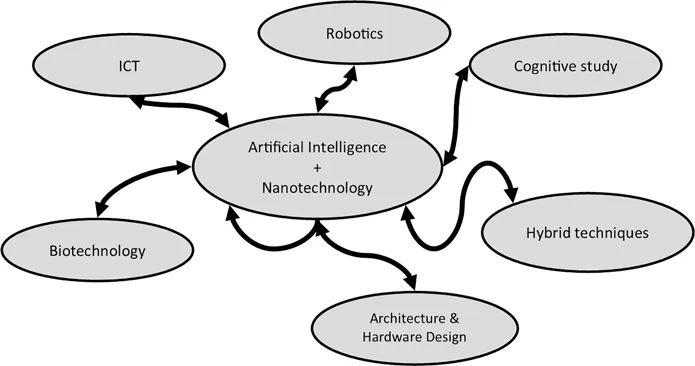
Nanotechnology mostly comprises complex systems that are not always consistent with the different aspects of AI. However, it has been believed that AI will use nanotechnology as a tool to converge to oneness. Though such a vision still seems futuristic, a similar harmonization has started to unveil in the modern technology. A combination of these two fields can result in great breakthroughs from the fast-paced AI-assisted nanotechnology research, to creating the state-of-the-art materials, to expand the application area of AI using nanotechnology-based computing devices. Besides merging the two technologies, a combined research can also give a thrust to the study in each discipline, possibly leading to all sorts of new methods to gain insights and communication technologies. The “convergence” is subjected to being part of wider political and social discourses on biotechnology, cognitive study, nanotechnology, robotics, AI, information and communication technology (ICT), and the sciences concerned with such subjects (Figure 1.1).
FIGURE 1.1 Artificial intelligence, nanotechnology, and other techniques converging together for the better.
Meanwhile, numerous initiatives have employed AI technologies in the field of nanoscience research, viz., to analyze the investigational methods and to aid in the design process of new nanodevices and nanomaterials. There are several reasons why nanoresearch uses the AI paradigms. Nanotechnology grieves from the instinctive boundaries of the scale of work; here, governing physical laws are altogether dissimilar from those otherwise applicable normally. Hence, the correct elucidation of the outcomes attained from any such system is one of the glitches that nanotechnology needs to address (Ly et al. 2011). To make things worse, several components in many systems influence the signal heavily. The development of theoretical approximations is challenging in these situations, and simulation techniques have been utilized to obtain precise elucidations of the investigational results. Here, various AI machine learning paradigms can become a handy tool in both generating research outcomes and developing nanoapplications in the future. Such techniques are very effective in dealing with several interrelated parameters in parallel and can well state and simplify complex/unknown data or functions (Mitchell 1997; Bishop 2006). Machine learning approaches such as ANNs, a set of weighed connected nodes, and the link weights are used to study these kinds of functions, using the monitored or unmonitored algorithm, which will be highly useful. Various optimization and search problems can be resolved by other AI techniques. There are many machine learning techniques that either involve single or a combination of methods, comprising decision trees, support vector machines, Bayesian networks, etc., that can be deployed in nanotechnology research for the multifaceted classification, prediction, correlation, data mining, clustering, and other control problems.
Also, a few studies have been carried out on how AI techniques could harness the computational power boost offered by future nanomaterials, developed by nanoscience, to be used for fabricating nanodevices, and nanocomputing will offer the powerful dedicated architectures for applying machine learning techniques.
The next section ponders upon this bidirectional relationship between AI and nanotechnology by means of various exemplary uses and applications.
1.2 Utility of Artificial Intelligence
1.2.1 AI in Scanning Probe Microscopy
Scanning probe microscopy (SPM) is the commonly used imaging technique in the nanoworld. Numerous strategies that obtain images by the interaction between a pattern and a probe fall beneath this concept. Characterization of the pattern topography is accomplished by using the tunneling current between the pattern and the probe through their interaction. Several techniques have been developed by varying interactions among the tip and the sample, after the invention of nanoscope. SPM is likewise an effective tool for an atomic-scale manipulation.
Challenges regarding the interpretation of the microscopic signals still remain, even though many efforts were made to enhance the decision and the capacity to manipulate atoms. The probe–sample interactions are not easy to apprehend and depend on many parameters. AI strategies may be an extraordinary rescue to solve such issues.
Further progress in the multimodal SPM imaging for obtaining extra complementary information (approximately the pattern), in recent times, produced a huge amount of information, therefore making it even more tough to interpret specific properties of the sample. To cope with this issue, a method has been developed called functional identification imaging (FR-SPM), which seeks a direct identity of local behaviors measured from spectroscopic responses and the usage of neural networks educated on examples provided by means of an expert.
Cellular genetic algorithm (cGA), a Gas subclass, is totally based on the evolutionary optimization algorithm, which is used to automate the imaging procedure in SPM with software capable of improving the precise state of the probe and the associated control parameters. Superior atomic resolution pictures are hence obtained with no human intervention except preparing samples and tips (Huy et al. 2009; Woolley et al. 2011).
ANNs are extensively used for the categorization of various behavioral, structural, and physical properties of nanomaterials on the nanoscale, which are used in plenty of applications, viz., CNT (carbon nanotube), quantum-dot semiconductor optics and devices, chemical technology, and production industry.
1.2.2 Nanosystem Design
Recently, ANNs have been used inside the transparent conductive oxide deposition process to determine the nonlinear relationship between input variables and output responses. This form of thin film has currently been used as an electrode in optoelectronic devices such as solar cells, organic LED, and flat-panel displays (Bhosle et al. 2006).
Evolutionary optimization was also used to develop better structures for nano-antennas, which outperform the best available radio-wave type of reference antennas. Using GA, the fittest antenna geometry suggests that it merges the characteristics of the fundamental magnetic resonance of the split-ring with the electrical one among the linear dipole antennas (Feichtner et al. 2012). This approach will refine nano-antenna architectures for special purposes and adequately deliver new layout techniques by carefully studying the operating principles of the resulting geometries.
GAs have also observed their uses inside the nano-optics field. In diverse nano-optics applications, such as optical manipulators, solar cells, plasmon-enriched photodetectors, modulators, or nonlinear optical devices, a vigilant design of nanoparticle mild concentrators will have a big impact.
1.2.3 Nanoscale Simulation
One of the major issues which scientists have to face when working at the nanoscale is related to the tool simulation being studied as actual optical pictures at the nanoscale cannot be achieved. Images must be interpreted at this scale, and numerical simulations are once in a while the best technique to get an accurate scheme of what is present in the image. Nonetheless, they are still tough to apply in many conditions, and lots of parameters need to be taken into account on the way to get a reasonable system depiction. Here, AI can be useful in enhancing the simulations’ performance and making them simpler to collect and interpret.
The use of ANNs in numerical simulations has been proven to be beneficial in various approaches when operating at the nanoscale. First, the software program can be manually modulated to control the stability between numerical exactness and physical implication. Another use of ANNs in simulation software is to lessen the complexity of configuration related to them (Castellano-Hernández et al. 2012).
1.2.4 Nanocomputing
There is a vast diversity of applications that emerge from the mixture of AI and current and upcoming nanocomputing methods (Service 2001; Bourianoff 2003). AI paradigms have been used for the various levels of modeling, designing, and building prototypes of nanocomputing gadgets since the beginning of nano-computers. Machine learning tactics implemented with the aid of nano-hardware to a certain extent to semiconductor-based hardware can also provide a foundation for a new technology of less costly and transportable era that can comprise high overall performance computing, including programs, sensory facts processing, and control tasks (Uusitalo et al. 2011; Arlat et al. 2012).
The best expectations from the nanotechnology-enabled quantum computing and storage can considerably boost our capacity to clear up very complicated NP-whole optimization dilemma. Such sorts of issues arise in many unique contexts, but mainly those in Big Data that requires “computational intelligence” (Ladd et al. 2010; Maurer et al. 2012).
Natural computing normally takes place in distinctive techniques in this context. Techniques inclusive of DNA computing or quantum computing are properly studied at the present apart from other natural computing procedures being followed (Darehmiraki 2010; Razzazi and Roayaei 2011; Ortlepp et al. 2012; Zha et al. 2013).
In DNA computing, a lot of variables are in use. This is a scenario in which DNA computing AI strategies are useful for purchasing an ultimate result from a minor preliminary data set, preventing the usage of all candidate solutions. Evolutionary and GAs are another options that may be considered.
Eventually, the design of nanocomputing systems—few are bioinspired—i...
Table of contents
Cover
Half Title
Title Page
Copyright Page
Table of Contents
Preface
Editors
Contributors
Chapter 1 Artificial Intelligence and Nanotechnology: A Super Convergence
Chapter 2 Artificial Intelligence in E-Commerce: A Business Process Analysis
Chapter 3 ABC of Digital Era with Special Reference to Banking Sector
Chapter 4 Artificial Intelligence in Predictive Analysis of Insurance and Banking
Chapter 5 Artificial Intelligence in Robotics and Automation
Chapter 6 Artificial Intelligence: An Emerging Approach in Healthcare
Chapter 7 Artificial Intelligence and Personalized Medicines: A Joint Narrative on Advancement in Medical Healthcare
Chapter 8 Nanotechnology and Artificial Intelligence for Precision Medicine in Oncology
Chapter 9 Applications of Artificial Intelligence in Pharmaceutical and Drug Formulation
Chapter 10 Role of Artificial Intelligence for Diagnosing Tuberculosis
Chapter 11 Applications of Artificial Intelligence in Detection and Treatment of COVID-19
Chapter 12 Internet of Things-Powered Artificial Intelligence Using Microsoft Azure Platform
Chapter 13 Load Balancing in Wireless Heterogeneous Network with Artificial Intelligence
Chapter 14 Applications of Artificial Intelligence Techniques in the Power Systems
Chapter 15 Impact of Artificial Intelligence in the Aviation and Space Sector
Chapter 16 Artificial Intelligence for Weather Forecasting
Chapter 17 Molecular Mining: Applications in Pharmaceutical Sciences
Index
Trusted by 375,005 students
Access to over 1.5 million titles for a fair monthly price.
Study more efficiently using our study tools.
Frequently asked questions
Yes, you can cancel anytime from the Subscription tab in your account settings on the Perlego website. Your subscription will stay active until the end of your current billing period. Learn how to cancel your subscription
No, books cannot be downloaded as external files, such as PDFs, for use outside of Perlego. However, you can download books within the Perlego app for offline reading on mobile or tablet. Learn how to download books offline
Perlego offers two plans: Essential and Complete
Essential is ideal for learners and professionals who enjoy exploring a wide range of subjects. Access the Essential Library with 800,000+ trusted titles and best-sellers across business, personal growth, and the humanities. Includes unlimited reading time and Standard Read Aloud voice.
Complete: Perfect for advanced learners and researchers needing full, unrestricted access. Unlock 1.5M+ books across hundreds of subjects, including academic and specialized titles. The Complete Plan also includes advanced features like Premium Read Aloud and Research Assistant.
Both plans are available with monthly, semester, or annual billing cycles.
We are an online textbook subscription service, where you can get access to an entire online library for less than the price of a single book per month. With over 1.5 million books across 990+ topics, we’ve got you covered! Learn about our mission
Look out for the read-aloud symbol on your next book to see if you can listen to it. The read-aloud tool reads text aloud for you, highlighting the text as it is being read. You can pause it, speed it up and slow it down. Learn more about Read Aloud
Yes! You can use the Perlego app on both iOS and Android devices to read anytime, anywhere — even offline. Perfect for commutes or when you’re on the go. Please note we cannot support devices running on iOS 13 and Android 7 or earlier. Learn more about using the app
Yes, you can access Artificial Intelligence by Cherry Bhargava, Pradeep Kumar Sharma, Cherry Bhargava,Pradeep Kumar Sharma in PDF and/or ePUB format, as well as other popular books in Computer Science & Artificial Intelligence (AI) & Semantics. We have over 1.5 million books available in our catalogue for you to explore.