This book intends to develop cyber awareness and technical knowledge in anyone who is interested in technology by looking at subjects and experiences the average person will have come into contact with in their life. This book aims to provide a complete and comprehensive analysis, technological inputs and case studies for the readers to build their awareness and knowledge, but in a meaningful way which will stay relevant. There are books available on the market, but they primarily discuss theory, and no industry connection or current state-of-the-art technology is presented. By discussing subjects and experiences that all readers will be familiar with, this book will aid understanding and comprehension of how cyber threats can be noticed, avoided and understood in everyday life. As well as case studies, this book also contains plentiful illustrations and supplementary videos, which will be available via YouTube to complement the information.
Giri Govindarajulu is a Chief Information Security officer for Cisco Asiapac and is a 20-year Cisco veteran.
Shyam Sundar Ramaswami is the Lead Threat Researcher with the Cisco Talos Threat Intelligence group. Shyam is a two-time TEDx speaker and a teacher of cybersecurity.
Dr. Shriram K. Vasudevan is currently working as Dean of K. Ramakrishnan College of Technology. He has authored/co-authored 42 books for reputed publishers across the globe and 122 research papers in revered international journals, plus 30 papers for international/national conferences.
We live in an era where change is quick and inevitable. Some are questioning the traditional values, which sometimes make us feel inefficient, and in some cases, redundant. The fundamental thought comes to our mind on why such practices even exist. The amount of change in the past 2–3 decades has been exponentially high. It has not given us the time to analyse what is right and what is wrong. Most of us may even feel pushed to evolve without necessarily understanding the nuances behind the changes.
1.1.1 Problem solvers
Let us start with a few examples of how we excel as problem solvers.
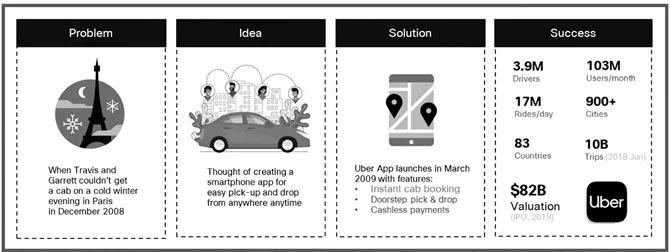
The first example revolves around two friends in 2008, Travis Kalanick and Garrett Camp when attending the LeWeb Annual Technical Conference in Paris. They were unable to find a cab during the conference. They thought of creating an app or a simple interface to enable timeshare of the limo. The simplicity of ordering the limo soon became ordering anything, using one’s location through GPS. Through proximity and digital payments, service providers were able to supply faster and more effectively. What began as an idea to fix this problem quickly grew into a global brand, ‘UBER.’ (Figure 1.1).
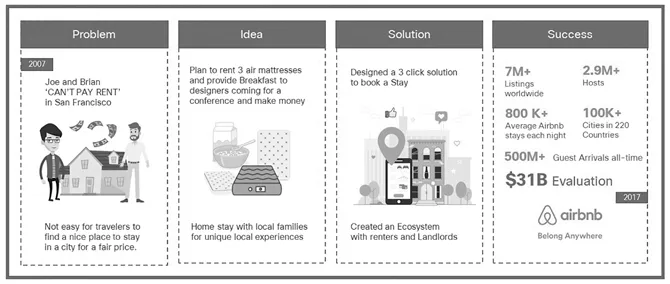
The second example involves Brian Chesky and Joe Gebbia trying to establish themselves in San Francisco. They were struggling to pay their monthly rent of $1,150. So, the necessity for survival drove them to come up with innovative ways to find money. They looked at the issue of shortage of hotel rooms in San Francisco during big events. For instance, during the Industrial Designers Society of America conference, they took the opportunity to try their idea to rent out some space in their apartment for $80 a night. They called this idea ‘AirBed & Breakfast.’ They promoted it on blogs with advertisements highlighting some of the apartment’s features, like its ‘design library.’ In just a few days, three customers had made bookings. These bookings made it clear that there is a market for this idea. They created the leading collaborative consumption platform called Airbnb. In the process, they found a source of income. They made a platform for thousands of others to generate money with their resources (Figure 1.2).
Figure1.1 The Uber story.
Figure1.2 The Airbnb story.
We, as humans, are problem solvers. We always look at ways to make things better. As human beings we evolve and change or influence a change, but in some exceptional cases, we create a mindset to accept status quo and move on. The world looks at the agents who bring meaningful and noteworthy changes as heroes, which is a powerful motivation and incentive.
1.1.2 Pace of innovation
In 2007, Steve Jobs of Apple announced a new product: a device that combines an iPod, a standard phone, and an internet navigator. This device, named iPhone, revolutionized the technology landscape beyond anyone’s imagination. This innovation removed lots of challenges associated with older phones, including small keyboards, additional sync-up software, etc. The iPhone paved the way for a faster and better way of doing things, including using the same device for multiple purposes. Every release of the iPhone included newer capabilities that provided a tremendous user experience. The past decade had changed the landscape of how we communicate.
GPS is an excellent feature that knows the device’s physical location and identifies resources based on proximity. While the desktop required users to traverse complicated steps, the iPhone abstracted them into one “red pin” on the map. This location-based feature has resulted in a significant improvement in user experience and geometric accuracy. However, this particular innovation has also led to many issues related to privacy and how we use the data about others. The challenges associated with this were the reason behind creating a new geolocation privacy and surveillance act. This act would further forbid private businesses from sharing customer location data without the individual’s explicit consent. The act would cover all types of location data, including real-time tracking data and previously acquired historical location data.
As we evolve and change, our focus is on solving the existing problem and making it easier and better for everyone. Often, the newer solution also considers the time to market and the positive impact on the community. The depth of the challenges that the new solution causes is not evident from the get-go. This change can be a distraction many times. As can be seen from history, mankind has learnt from its mistakes and evolved. The BIG question is how much and how many errors are required to be in an ideal state.
The transformation that is happening around us is not going to stop anytime soon. If so, where do we draw the line about what is happening around us? How far should we adapt to the new changes to ensure that we are not left out and stay behind in these evolutions? How can we be sure that we take calculated risks in being current while not paying the cost for taking a risk and feeling bad later?
How far we change is a constant struggle that everyone goes through. When we look at digital transformation, it is more evident that we have a massive spectrum of laggards to early adaptors.
Where do we start? How do we prepare ourselves to balance the risk and the evolution? There will be pros and cons in anything that we do. The risk appetite varies from people to people. The complexity increases with other factors, including age, dependencies, maturity, etc. We will discuss few of the changes that have a significant implication in our digital world and how we need to be prepared to handle them with care.
1.2 Evolving technology
Broadly speaking, the human race has only accepted those changes that have helped them evolve towards a better and different living experience. The technology evolution in the past four decades has heavily impacted the common man. The advent of the browser and the Worldwide Web seemed to be a great idea with many possibilities. Even though access to the internet was slow and challenging in the early days, it has become inevitable these days. Every evolution has an ecosystem of changes that make it impactful.
The digital revolution officially had its origins in the late 1950s and marked the beginning of the information age. Mass production and widespread use of digital logic, MOSFETs (MOS transistors), an integrated circuit (IC) chips along with their derived technologies, including computers, microprocessors, cellular phones, and the internet, are core to this evolution. Traditional production lines have been transformed significantly due to these technological innovations and business techniques.
There were many waves of disruption that have happened with the digital revolution. The first wave was more focused on digitising media like photos, videos, rental, etc. The second wave significantly impacted print media, travel, HR, TV, etc., which got access to information faster and higher quality. The third wave got a massive effect on many fields, particularly in retail, healthcare, automotive, education, food, banking, etc.. The final wave left nothing as IoT, AI, cognitive, etc., have integrated and made quite a few things possible.
1.2.1 Data/information
In 2014, Tesla first introduced a hardware suite in its vehicles. The advanced assisted driving program features included Autosteer, Autopark, and Traffic-Aware Cruise Control (TACC). The software continuously evolved into more advanced features through over-the-air software updates until the first meaningful ‘Autopilot Update’ in October 2015 with the release of v.7.0 of Tesla OS.
Early 2020, when the COVID-19 pandemic started spreading worldwide, governments and private companies partnered to apply real-time data analytics to understand and flatten the curve of infections. The research communities have mobilised to address COVID-19 and give this data analysis to the healthcare system leaders and public health officials to make evidence-based decisions that could save lives. This information had a long-lasting impact on understanding and managing the crisis. Data continue to play a huge role in measuring the effect of the infection and the effectiveness of the vaccine, and the prevention methodologies.
Data is the new currency. People are looking at the information that they can consume and make sense out of it. Before digitalisation, people who know and can share information with others become the primary way of communicating and connecting the world. Few were gifted and talented or put in their efforts to share the data. People regarded them as the elite and the knowledgeable. The mode of knowledge sharing was either through in-person sessions or through their writings.
The availability of technology to share and access information freely by anyone has made the paradigm shift. Crowdsourcing of the information has made everyone a possible author and creator of the information. These possibilities have increased data availability. You can search on Google on any topic, and there is content available for you to consume. Encyclopedias used to be an essential collection in people’s homes a few years back. Now sources like Wikipedia help keep the content more accurate with dynamic updates and with more references. The notion of unlimited information exists today and one could share and acquire knowledge much more easily than ever.
Data availability has helped make meaningful decisions—a description of what is happening, diagnose why it is happening, predict what will happen, and prescribe what you should do. So, the data helps make decisions using analytics and not just capturing current transactions. Newer fields of artificial intelligence and machine learning can take things to the next level in identifying behaviours and trends by continuously learning from the datasets using different algorithms.
Almost every sector has started harvesting the data in their domain and started integrating other information to make it relevant and impactful for the services they provide. The visibility and availability of the data have also helped companies understand the behaviour, fine-tune their offerings, and explore newer areas to grow their businesses.
1.2.2 Experience
In September 2009, Starbucks launched an app that combined its loyalty program and its mobile payment solution enhancing the digital engagement with its customers. The app catered to the customers’ needs by helping them order their favourite food or beverage before they even get into the café. They also provided cool features like creating their own Spotify playlist to manage payments. The Starbucks app is one of the best user experience app providing both an inviting and innovative experience, much like the coffee chain itself. This experience had paid huge dividends to the company. A recent study said that 48% used the loyalty rewards app had become the ‘must-have, must use’ app.
In June 2011, United Airlines launched an app that helps customers book tickets, check flight timings, etc. It also had tons of services that you may need before your flight. To augment, it also integrated the in-flight experience with entertainment. Ideally, you do not need to talk to any rep to find details as everything, including alerts, and status is available at your fingertips.
The digital revolution enables the availability of services anywhere, anytime. The concept of on-demand vs. timely availability of the information is crucial. The experience in banking earlier was to go to a bank during office hours and deal with a lengthy paperwork process navigating different counters. The digitisation has made the info available at your fingertips when you want it. The ability to get alerts when things change makes sure you validate things without waiting and processing time.
New technology has created a must-have experience in many areas. The significant domain is the payment industry. The way financial transactions are made easy is a huge game-changer. Everything that you do has something to do with money. Money continues to be an essential driver. With the digital transformation, it has become easier to check your financials than before while reducing the need to carry cash. Just pick up your phone or laptop to check your balance or to transfer money to someone e...
Table of contents
Cover
Half Title
Title Page
Copyright Page
Table of Contents
Foreword
Authors
1 Digital world
2 It is your money
3 Your socially, social media
4 Knock, knock, anybody there?
5 Power up and ready to strike
6 The guardians of the Internet
7 Need of the hour: The tech fundamentals
8 It is your data
9 Sensors, software, and severities
10 The cyber laws
11 How to build a career as a digital detective
Index
Trusted by 375,005 students
Access to over 1.5 million titles for a fair monthly price.
Study more efficiently using our study tools.
Frequently asked questions
Yes, you can cancel anytime from the Subscription tab in your account settings on the Perlego website. Your subscription will stay active until the end of your current billing period. Learn how to cancel your subscription
No, books cannot be downloaded as external files, such as PDFs, for use outside of Perlego. However, you can download books within the Perlego app for offline reading on mobile or tablet. Learn how to download books offline
Perlego offers two plans: Essential and Complete
Essential is ideal for learners and professionals who enjoy exploring a wide range of subjects. Access the Essential Library with 800,000+ trusted titles and best-sellers across business, personal growth, and the humanities. Includes unlimited reading time and Standard Read Aloud voice.
Complete: Perfect for advanced learners and researchers needing full, unrestricted access. Unlock 1.5M+ books across hundreds of subjects, including academic and specialized titles. The Complete Plan also includes advanced features like Premium Read Aloud and Research Assistant.
Both plans are available with monthly, semester, or annual billing cycles.
We are an online textbook subscription service, where you can get access to an entire online library for less than the price of a single book per month. With over 1.5 million books across 990+ topics, we’ve got you covered! Learn about our mission
Look out for the read-aloud symbol on your next book to see if you can listen to it. The read-aloud tool reads text aloud for you, highlighting the text as it is being read. You can pause it, speed it up and slow it down. Learn more about Read Aloud
Yes! You can use the Perlego app on both iOS and Android devices to read anytime, anywhere — even offline. Perfect for commutes or when you’re on the go. Please note we cannot support devices running on iOS 13 and Android 7 or earlier. Learn more about using the app
Yes, you can access It’s Your Digital Life by Giri Govindarajulu,Shyam Sundar Ramaswami,Shriram K. Vasudevan,Shyam Sundar,Shriram Vasudevan in PDF and/or ePUB format, as well as other popular books in Computer Science & Digital Marketing. We have over 1.5 million books available in our catalogue for you to explore.