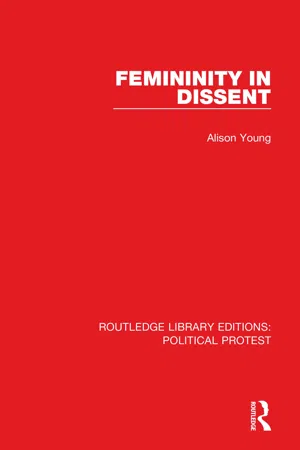
This book, first published in 1990, takes a challenging look at the images constructed by the Press of women's political protest. Focusing on the peace camp at Greenham Common, Alison Young analyses in detail the way in which women protestors are represented in the press as deviant and criminal. Arguing that the criminal justice system and the media rely on each other's definitions of deviance, she investigates in detail how those definitions are constructed and encoded. In the course of her analysis she utilizes concepts of narrative structure, metaphor, the body, the cultural unconscious, and mental as well as social instability. The first and only full-length study of its kind, Femininity in Dissent takes an interdisciplinary approach, questioning traditional methods of criminology and sociology of deviance, and drawing on literary theory, women's studies and social theory. In articulating cultural forms of regulation and social control, the author provides an analysis of discourse and deviance.
- 198 pages
- English
- ePUB (mobile friendly)
- Available on iOS & Android
eBook - ePub
Femininity in Dissent
About this book
Information
Chapter One
Introduction: Reading, Women, Deviance
The 1980s will be remembered as the decade in which disarmament and nuclear policy constituted the central issues of the age. From the renaissance enjoyed by peace protest groups to the historic signing of a treaty to abolish medium range missiles, nuclear policy came to dominate political thought and practice. In the 1980s, the issue of disarmament could win or lose elections (for example, in Britain the Conservative Party victory in 1983 was owed mainly to its own defence policy combined with the Labour Party’s perceived failure to take a united stance on the issue). In the same year, President Reagan sent Cruise missiles to Britain as part of NATO’s international defence strategy in Europe. In addition, protest movements opposed to nuclear warfare were increasing in number. The most famous in Britain was the Campaign for Nuclear Disarmament (CND), but a myriad of smaller-scale groups also came into existence. In Britain we find Women Oppose the Nuclear Threat (WONT), Oxford Mothers for Nuclear Disarmament, Babies Against the Bomb, Families Against the Bomb and Journalists for Peace. The phenomenon was also occurring internationally: examples are German Women for Peace, the Women’s Pentagon Action in the United States and the Shibakusa protesters of Japan.
Amid these varied groups there is one which was the most influential throughout the decade. The Greenham Common peace camp is a protest by women outside a Cruise missile base in Berkshire, England. It began in August 1981 and (at time of writing) it continues today. Its unique dynamic was a demand for disarmament yoked to an analysis of patriarchy. Men were seen to be representatives of the nuclear madness which supported the potential for global destruction while women were thought to be able to eradicate nuclear weapons through protest and struggle. Their idiosyncratic methods of protest won them an international following appropriate to such an international issue (the presence of American missiles in England as part of NATO’s European policies). Support for the camp was immense. Women from many different countries travelled thousands of miles to visit the camp. The Greenham women themselves travelled throughout the Pacific nations and the United States. At least two other peace camps in other countries were inspired by the Greenham Common camp (at Seneca Falls in the United States and at Pine Gap in Australia) while dozens of permanent and temporary camps have been set up in Britain (for example, at Aldermaston) to follow the Greenham example.
In Britain, the Greenham Common protest came to epitomise peace politics, both for sympathetic supporters and for more hostile observers. Thousands of women joined in their demonstrations. Hundreds lived at the camp. Thousands more were made aware of the issues surrounding disarmament through a combination of the Greenham women’s own very efficient information network and the media reporting of the protest For several years the news media established the Greenham protest as the focal point in their coverage of peace politics. However, the protest came to represent much more than this. The women were alternately ridiculed, revered, castigated, humiliated and reviled. In later years they were simply ignored. The media created a mythology around the peace camp which centred on the fact that the protesters were women, the mythology elaborated various aspects of this womanhood into an account of the protesters’ deviance. It is my aim in this book to recount how a women’s peace protest could be represented as a criminal activity, a witches’ coven, a threat to the state, the family and the democratic order. Such a trajectory is neither natural nor inevitable. A critical reading of the media coverage must ascertain how such representations came about.
My concern with the creation of discourse of deviance brings this project within the sociology of crime. The information coded within the news stories employs dichotomies such as criminal/law-abiding, mad/sane and good/evil in order to describe and evaluate social phenomena. The Greenham protest was represented through such oppositional constructs; it was accorded a position within the cultural order which established its deviant nature within a variety of registers. It is my aim in what follows to elucidate the means through which the media (specifically, the press) created such a position for the protest within its news discourse. As a result, it will be possible to understand more clearly how definitions of criminality and deviance, which we build upon through the criminal law and the criminal justice system, are brought into being and given meaning.
My choice of the Greenham protest as the ‘object’ of representation within the press discourse was no haphazard decision, but arose from several important considerations. My interest exists firstly at the most pragmatic and basic level and relates to the fact of its being reported over a period of years. Thus a large discursive site is created for excavation. At other, more crucial levels, my interest in this protest was formed in a number of ways. First, I wished to demonstrate the powerful ability of such a protest or event or phenomenon as the Greenham protest to expose the acute instability of the monolith of press presentation. The individual facets of the protest (women-only, anti-nuclear, encampment, non-hierarchical, permanent) forced questions that, within the press, reveal the lines of division conventionally drawn within contemporary society: normal/abnormal, criminal/law-abiding, good/evil, mad/sane, for example. The press reactions to the Greenham protest seemed therefore to offer a useful point of access for an examination of the insistence on, and consequences of, these divisions.
Focusing upon an anti-nuclear protest as the ‘object of representation’ for the press also acknowledges the attrition of the century. The encroachment of the millennium entangles with the post-Oppenheimer inability to feel certain of the future, of any future for the world. There is, then, a certain urgency in the need to take part, as I have tried to in this thesis, in a ‘nuclear criticism’, to examine not just ‘nukespeak’ (Aubrey, 1982) but all the forms of ‘nuclear discourse’ which obey rhetorical constraints, submit to forms of censorship, exploit narrative and tropological devices in order to persuade and convince and comfort.
As well as offering an opportunity to deal with the ‘terms’ of the instability of existence (since one can never ‘come to terms’ with the prospect of global obliteration), the Greenham protest presented itself as the expression of the recognition of another crisis: that of sexual difference. The Greenham women seem to me to combine an activism against the inertia of the fear of destruction with a commitment to a confrontation of the dissymmetry between the sexes. These two issues are constituted by the critical questions of the late twentieth century: the use of force in global terms, the links between mass violence and First World domination, the expansion of the military-industrial complex, the inequalities between men and women, the repression of sexual difference, the exercise of power in psychical, social, political and global terms. While, of course, answers to these could not be presented in this book, apd neither does it seek to provide them, recognition of them inflects every inch of its terrain.
My concern is therefore to recount and analyse the media coverage of the Greenham Common protest throughout the 1980s. Within the general coverage of the media I have dealt solely with the discourse produced by the newspapers. This discursive field was chosen for a number of reasons. First: ‘(t)he confusions which occupy us arise when language is like an engine idling, not when it is doing work’ (Wittgenstein, 195S: para. 132). The ‘idle language’ of the press discourse is a consummate example of cultural commonplaces, the powerful, banal truths which structure and inform the organisation of social life. Second, as a result of its tangible, written form, the newspaper coverage of a continuing event builds up over time into a discrete corpus which shows distinct evolutionary features not found in most other forms of the media. The newspaper coverage therefore affords particular opportunities for mapping, annotating and analysing the development of a news story. The structural constraints of this representational form provided a third reason for focusing on the press. The encoding of an event as a news report involves a process of entextualisation which operates at several obvious removes from both the audience and the object of representation. This object may be able to communicate directly with a journalist in an effort to influence reporting or readership, but the insertion of a distance effected fay the time between event and reading allows power relations to be adjusted, affirmed, augmented.
Reading Criminology
The capacity of the Greenham protest within the press discourse, mentioned above, to reveal the conventional lines of division between terms deemed to be in opposition (mad/sane, good/evil, normal/abnormal) links this project to the sociology of crime and also demands an assessment of the status of the notion of ‘deviance’. This project is institutionally located within a certain space calling itself ‘criminology’ and concerning itself with the analysis of criminality, deviance and abnormality. Bottoms writes:
Criminology inevitably involves analysis of social values and normative choices. Part of this is a sociological enterprise, trying to understand sociologically the particular features of value choices made in various official proscriptions and state policies.
Part of this task of analysing values is the discovery of the grounds for making various value choices in the definition of crime and deviance. At this point ‘criminology’ inserts itself into this project The ‘analysis of social values and normative choice’ does indeed feature in this book; however, I have not made any attempt to discover ‘the grounds for making various value choices’ within a framework of simple cause-and-effect attribution, or classification of behaviours in a moral matrix. The ‘existence’/’creation’/’discovery’ of ‘deviance’ should not be construed, as it generally is, according to an unreflexive conceptual structure whereby attention is fixated on the notion of ‘those who deviate’, without any attempt to understand or critique the process by which the self-evidence of such a phenomenon is created.
Heidensohn (1985), dealing with ‘images of women’s deviance’, points out that sociologists have become over-fascinated with the ‘deviant’. Her complaint, however, that the aspect ignored is the production of conformity, provides merely the reverse side to this binary pair, as ‘deviance’ is overturned to highlight ‘conformity’. This binary analysis in no sense approaches what seems to me to be the most commanding task of criticism: to put the actual values inhering to a definition or decision about ‘deviance’ into question (criticism: calling into crisis). Questioning deviance (not in the sense of identifying and counting, a game of causes and effects with always-already given definitions) should mean inquiring into the status and valuation of the definitional decision, in terms of its production of oppositional notions of right and wrong, good and evil, law-abiding and criminal. This putting ‘deviance’ into question, putting questions into ‘deviance’, unhooks the process of self-constitution and self-definition from its naturally and morally given appearance, thereby also problem-atising its social functions.
Questioning ‘deviance’ should avoid any analytic dilution to the extent where ‘deviance’ has become so relativistic as to have little theoretical meaning and its critique no political point, this uselessness is exemplified in a paper by Sagarin and Kelly, who write:
Deviance embodies and reflects changing social values and attitudes... (W)hether persons or activities will be considered deviant is unpredictable because it depends on an infinite number of situations, on the subcultures in a heterogeneous society, and on a social system that is constantly in flux.
‘Deviance’ is here conceptualised as a conduit in a social ex-pressivist thesis where material and moral conditions are defined as so infinitely variable that the analytic task becomes one of generalising to the highest common denominator. My analysis of the press representation of the Greenham Common women’s ‘deviance’ will take place neither at this level of vagary, nor at the level of Heidensohn’s structuralist polarisation. Instead, neither one nor the other, I am looking for a way to say something different, without advocating an abandonment of ‘deviance’ either as an heuristic tool or as an object of study, but with a recognition of the consequences of utilising such concepts without quotation marks. (When ‘deviance’ becomes deviance, object of analysis, definition of behaviour, moral condemnation, it captures us in its hierarchical structuration, implies us in its operation.) The role of the Greenham protest in relation to this strategy has to this extent been a productive one: their uncomfortable and ambivalent position as ‘deviants’ within the popular culture of the newspaper discourse prohibits any straightforward or uncritical involvement with criminology.
Let me repeat the gesture of difference: ‘deviance’ should be conceived as a category, not of such shifting relativism as to be instantly transformable according to the external historical moment, but a contingency which is ahvays-already undecidable, a contingency whose self-evidence and naturalness it should be the aim of critical analysis to unmask and suspend, to this extent, this project can be said to relate to ‘deviance’; and it is located in this (insecure, uncomfortable) space in ‘criminology’, sculpted by a scepticism about dogmatic unities and universal schemes. To constitute it as anything other than sceptical - definitive, or final -re-draws lines in oppositions, reformulates possibilities as certainty, recuperates openings into closure.
In the analysis of deviance, Sumner’s notion of censures provides a useful step towards its conceptualisation as an ontological category. He writes of censures:
Their typical function is not an adequate account of social conduct but rather the distinguishing of ‘offenders’ from ‘non-offenders’. They mark off the deviant, the pathological, the dangerous and the criminal from the normal and the good. As such they are clearly moral and political in character.
In this project the general notion of censure has functioned to encourage a questioning of the commonplace notion of the designation of deviance. However, I have employed it in paradoxically both a modified and an intensified manner. I have modified it in that I see the existence of a censure providing, as well as condemnation of its objects, by implication an affirmation of the desired ‘way of life’ itself. This dualistic process and double functioning must be the centre of any reading of a censure in discourse.1 Intensification comes through a focus on gender. Instead of pointing out instances of the labelling of deviant activity or of deviant individuals, I have argued that the censure of the Greenham women took root at the very fact of their womanhood. The press representation demonstrates through different manoeuvres how existence on the feminine edge of sexual difference becomes operationalised as a means to cens...
Table of contents
- Cover
- Half Title
- Title Page
- Copyright Page
- Original Title Page
- Original Copyright Page
- Front Matter
- Table of Contents
- Preface
- 1 Introduction: Reading, Women, Deviance
- 2 The Writing of Bodies: Greenham Common as Political Protest
- 3 Dramatis Feminae: The Female Body at Greenham Common
- 4 The Metaphorical Threat
- 5 Greenham Common as News Narrative
- 6 Politics and the News Discourse: an Institutional Scaffold
- 7 The Time of a Conclusion
- Appendix: On methodology: discourse, feminism, representation
- Notes
- Bibliography
- Index
Trusted by 375,005 students
Access to over 1.5 million titles for a fair monthly price.
Study more efficiently using our study tools.
Frequently asked questions
Yes, you can cancel anytime from the Subscription tab in your account settings on the Perlego website. Your subscription will stay active until the end of your current billing period. Learn how to cancel your subscription
No, books cannot be downloaded as external files, such as PDFs, for use outside of Perlego. However, you can download books within the Perlego app for offline reading on mobile or tablet. Learn how to download books offline
Perlego offers two plans: Essential and Complete
- Essential is ideal for learners and professionals who enjoy exploring a wide range of subjects. Access the Essential Library with 800,000+ trusted titles and best-sellers across business, personal growth, and the humanities. Includes unlimited reading time and Standard Read Aloud voice.
- Complete: Perfect for advanced learners and researchers needing full, unrestricted access. Unlock 1.5M+ books across hundreds of subjects, including academic and specialized titles. The Complete Plan also includes advanced features like Premium Read Aloud and Research Assistant.
We are an online textbook subscription service, where you can get access to an entire online library for less than the price of a single book per month. With over 1.5 million books across 990+ topics, we’ve got you covered! Learn about our mission
Look out for the read-aloud symbol on your next book to see if you can listen to it. The read-aloud tool reads text aloud for you, highlighting the text as it is being read. You can pause it, speed it up and slow it down. Learn more about Read Aloud
Yes! You can use the Perlego app on both iOS and Android devices to read anytime, anywhere — even offline. Perfect for commutes or when you’re on the go.
Please note we cannot support devices running on iOS 13 and Android 7 or earlier. Learn more about using the app
Please note we cannot support devices running on iOS 13 and Android 7 or earlier. Learn more about using the app
Yes, you can access Femininity in Dissent by Alison Young in PDF and/or ePUB format, as well as other popular books in Social Sciences & Sociology. We have over 1.5 million books available in our catalogue for you to explore.