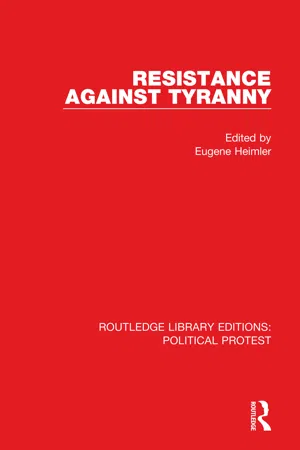
This book, first published in 1966, focuses on the stories of ordinary people who have stood up to tyrants around the world. A German opposes Hitler; a Rabbi in South Africa protests apartheid; an Algerian lawyer remains true to the law; a Polish writer fights the Nazis, and the Communists; an Irish playwright is caught up in the fight against the British; and a Hungarian Jewish poet recites poetry in concentration camps. Together they form an examination of political opposition, and a testimony.
- 180 pages
- English
- ePUB (mobile friendly)
- Available on iOS & Android
eBook - ePub
Resistance Against Tyranny
About this book
Information
SOUTH AFRICA
André Ungar
The spiritual grandeur of man’s courage in the face of oppressive evil manifests itself in many ways in the Republic of South Africa. The perennial and universal theme of resistance unfolds itself within the specific and inimitable tones, rhythm and key of the land and the age. In the 1960s the drama of South Africa is reaching its inevitable climax, though its precise date and outcome is not yet discernible. But the three centuries’ encounter between colonising exploitative settler and indigenous African culture clearly indicates the direction of matters. Three million whites, prosperous and, among themselves, still willing to play out at least a façade of democratic procedure, attempt to hold away, and push further and further apart and down, twelve million non-white inhabitants of their country. This majority is fourfold and by now consists of thoroughly and irreversibly detribalised Africans, Cape Coloureds and Indians, completely transformed outwardly and inwardly through industrial, educational and religious development. Parallel with the growing rigour and hysteria of white overlordship, there is not only a heightening of resentment, but also of organisation, leadership and purposeful dedication on the part of the deprived. The tension is becoming almost intolerable. It is most pathetic in those instances where it is blandly denied. Also, the African continental setting where the thirty-fifth independent black state has just come into existence, does little to mitigate the starkness of the situation.
By its very nature resistance follows two distinct patterns, both in its origin and forms of expression. On the one hand there is resistance by the non-white population. What makes their opposition typical is the fact that the master race’s pretence of democratic procedure does not apply to them, and the circumstance that in struggling against their oppressors they are fighting for their own personal and communal emancipation. On the other hand, the all too few white men who show any manner of resistance are partially protected (and the paradox is obvious) by their pale pigmentation; they, in contrast to the former, are doing what they do clearly against the hostile wall of their own social matrix and, at least in the short run, against their own interests. But some strands of resisting behaviour deserve to be examined separately, and in some detail.
§
My own personal story is not an exceptionally dramatic one. Yet perhaps its very commonplaceness can help focus some characteristics of the South African predicament as well as the more dramatic contours of some others’ confrontations.
Late in 1954 I was ordained as rabbi in London and shortly afterwards I accepted an invitation to the pulpit of Temple Israel in Port Elizabeth, South Africa. While there, I found myself involved in the racial conflict. I spoke from my pulpit about matters of such a nature; published a few articles locally and overseas; I had fairly wide social contact with non-whites; I addressed a number of public meetings of protest against apartheid. Near the end of 1956 I was served a deportation order by the Minister of Interior, and at the beginning of 1957 I left the country. I feel that some of the social and psychological aspects of this rather fleeting episode revealed, to me at any rate, strange and important depths. Circumstances also brought me into touch with men and women who embodied types and triumphs of resistance worth examining.
From the distance of a decade it is difficult to recall precisely the subtle shadings of thought and feeling that mottled my mind at that time; God knows it is hard enough to be objective in introspection even at the time of the impact itself. I was twenty-five years old, my doctorate from London University and my rabbinic ordination certificate hardly dry on the paper yet, my daughter just nine months old. During the immediately preceding few years, I had been struggling to complete my training, keep the financial wolf from the door, do justice to a position as Assistant Rabbi with a large congregation, and come to terms with a none too perfect marriage. The invitation to Port Elizabeth seemed to offer a great deal. For one thing, the tension of impending examinations was forever over. I should be in charge of a congregation of my own, given more responsiblity and at the same time be free from the generous but nagging domination of a senior colleague. Material cares would be banished. Perhaps a new setting would put things right between my wife and myself too. There was a great deal of hope. Also pride: the chance to mould a community according to a pattern I considered worth while. Anxiety, too. What if I fail? My personal life would be in the focus of public attention, and what in the grey homogeneity of London could pass unseen would be pinpointed by provincial curiosity in South Africa. Perhaps the type of sermonising I seemed to be successful with in England would fall flat in my new location. Altogether, perhaps I should not measure up to the demands of ultimate leadership; the snotty-nosed kid will be unmasked, laughed at, driven out with eternal ignominy. Yet, on the other hand there was a contrary fear too. I might succeed too well, succumb to the fleshpots, grow flabby and blend into the scenery for the rest of my life. What some considered a promising career would flatten into a dusty, dreary function behind God’s back and, equally bad, behind civilisation’s back. No theatres, no concerts, no decent libraries—at first I would suffer, later (infinitely more shameful) come to accept it gladly.
There was also some vague, uncertain anticipation of the country’s racial and political complexion. I had been following the daily and weekly press in London fairly systematically during my student years. Father Trevor Huddleston’s article in The Observer I remember shook me up profoundly; I had not imagined that such unashamed racialism could have survived in the world, and especially under the Union Jack. My general attitude towards Negroes had been a naïve one. Until the age of eighteen when I left my native Hungary I had never seen a non-white person in the flesh. It seemed a little suspect, and ludicrous, when I heard that some people were black. Black as boots? Or beetles? Nonsense—maybe a bit sunburnt, that is all. A silly exaggeration. But then, in photographs and films, I did see them. Tarzan films and their like: lithe naked bodies, with grass skirt and spears, boiling missionaries for lunch. If such creatures really existed surely they were hardly human. Then, coming to London, my world became somewhat more polychromatic. I saw Indians and Chinese and Negroes walking up and down the Edgware Road and Gower Street. Then I sat next to them at lectures, in theatres, in cafeterias. We talked, became friends, argued, fought, made up. Pigmentation simply faded away in my awareness. While at first I stared with popping eyes at every coloured person—not in hostility, only in curious incredulity—before long I ceased to notice the difference. It simply didn’t matter. Yet, coming to Africa, many of my old questions were revived. Black men may after all be different in their natural environment than when moving along the Strand in King’s College blazers with an umbrella and a copy of Sartre as their load. I was hungry for, and a bit scared of, the exoticism of the Dark Continent. And spasmodically jerked by the news of the apartheid régime down there. I wanted to see for myself and, if possible, deny the cheap journalistic distortion of facts—or else, if (hard to believe) they proved true, see what I could do in combating it. To tell the truth, I did have a qualm or two about going at all for these racial reasons. If the reports which blamed the white population for its oppressiveness were accurate, I would be joining that spineless crowd myself by going. To sell out my own ideals, and to risk my own child’s growing up as a racist seemed too high a price to pay for vocational advancement and some sightseeing. If, on the other hand, I were to set myself against the dominant pattern, I should inevitably be a flop in my work, and quite possibly bring dire consequences on my wife and child as well. Either way a sobering prospect. But sobriety was rather far removed from my mood just then. I was filled with the excitement of the journey, the honour, the challenge of it all. And if it included, among other good things, a manly fight, all the better. A heady young exuberance and perhaps an innate delight in battle blurred my remaining London days rather pleasingly.
On arrival, too many novel things surrounded me to spare thought for the racial situation. My congregation showed a spontaneous warmth and hospitality that no chilly English middle-class synagogue would ever be capable of—a disarming reception indeed. The physical aspect of matters (parks, gardens, buildings, and homes) was lavish and lovely beyond imagining. My own position appeared to be a much more significant one than I had anticipated. A whirl of social and official engagements took up most of my time. The only Negroes I saw were courteous servants in the homes and colourful figures in the street briefly glimpsed while one drove by. The total aspect of things was relaxed, mellow and quite peaceful and happy. I caught myself a little relieved as well as disappointed that the renowned béte noire was a myth. No Loch Ness monster to harpoon. Racial persecution? Some desperate newspapermen’s and clergymen’s fancy.
After a few weeks, the pleasant surface of things began to crack up; chinks of inconsistency and uneasiness appeared. Through the subdued stylised terminology of the papers, the face of reality began to be discernible. Encounters in the street, in shops and elsewhere became puzzling, then disturbing and soon enough quite outrageous. Out of sheer curiosity at first, I wanted to see where the ‘natives’ lived. There was a forbidding disapproval in my white friends’ features. Nothing to see. Oh, just like any other working-class district in Europe. Or, terribly dangerous. Might get killed. Police would get the wrong idea, and so on and so forth. At last I decided to take the initiative myself and drove my Austin to New Brighton. Then to Korsten. I still don’t know what was more heartbreaking: the dreary infinity of tiny grey concrete boxes that was planned and proudly proclaimed by the authorities as the most up-to-date housing project for natives on the whole continent, or the reeking shantytown of packing crates, rusty corrugated iron and draped rags of sacking and newspapers in a sea of dust and mud. And then human contacts grew too, with a couple of whites who knew and cared, and with some Indian, Cape Coloured and African people who could tell me—and much more dramatically, show me—the truth about South Africa. I found that our own genteel white leisure and wealth was a thin veneer over a vast mass of coloured suffering; and that the distinction was artificially created, maintained and, since the Nationalist victory of 1948, deliberately worsened day after day.
A welter of sentiments surged within me as I gradually learned this. I was bitterly ashamed that I had come to Africa at all: I ought to have known, I should not have fallen victim to too cunning enticement and, worse still, to my own greed and ambition and vanity. I was pained as I contemplated my own new neighbours and friends: they were hypocrites, or ‘schizophrenics’—so much gentleness and kindness towards me and to one another and such callous uncaring towards the majority of their own countrymen?
There was also a strand of sentiment that shamed me most of all. One part of my being rejoiced at what I saw. I delighted in being part of an aristocracy, a privileged élite. Back in Hungary I had, as a child, often wondered with envy what it would have felt like to be born the son of a Baron: rich, gentile, a silver spoon in my mouth. Well, here I suddenly found I had it all. Without any effort of my own, I was granted membership in a most select club. And, yes, in a way I liked it, and found it perfectly right. So it must be, I caught something inside me preen, it is the divine and natural order of things. It gave a sense of security, of reassurance, of noble elevation. Perhaps the Indian caste system, and Aldous Huxley’s brave new hierarchy, expressed the ultimate wisdom of society. Hurrah for the top dog. . . especially as I too am the top dog here.
And another part of myself feared for my sanity and decency at the realisation of such sentiments. Idiot, I kept telling myself, by this stand of selection every whiteskinned cretin, Nazi, criminal is your fellow-aristocrat. I squirmed at the thought of that company. Besides, it demanded no effort at all. The worth of my degrees, I reflected, could be measured by the sum total of time and effort I invested in their acquisition. All my student years I mumbled dark contemptuous dismissals at honorary degrees and their holders. To be given privilege simply on account of my pale epidermis was, ultimately, an insult to me. It seemed to imply: the only excellence I can claim is the colour of my skin ... nothing of the mind or soul or person. This somehow managed to stifle the glee of the unearnt accolade.
But perhaps most powerfully throbbing in me was the instinctive analogy between European Hitlerism and South African apartheid. I grew up in the shadow of German Nazism. At the age of fifteen, when the Germans occupied Hungary, I went into hiding with my family. For a year I stayed indoors, with the constant threat of apprehension and immediate execution all around us. All the anger and hatred of my youth was focused on Nazis and Nazism. We narrowly escaped discovery a couple of times: I saw their eyes and uniforms from close up, smelled the drink and madness on their breath. Evil and Nazism were made synonymous in the most personal and direct manner. While no expression could of course be given to this burning hatred at that time, it was very real and, in a strange way, pleasurable. To hate evil, wholeheartedly, with all one’s being, somehow felt like fighting against it already, and thus gave one a profound joy, both sensual and spiritual. Here, in South Africa, racist tyranny suddenly disclosed itself as just another façade for the selfsame monster. This was not a reasoned conclusion, though of course one could—and had to—find full rational confirmation of the social and psychological and moral kinship between German Nazism and South African apartheid. It came with the force and spontaneity of an instinctive identification. What was done to blacks in southern Africa was, except for the plan of actual extermination, parallel to what Nazis did to Jews and gypsies in Europe. The motivation, the mood, the methods were similar: in fact, in many cases directly copied from the northern archetype. As if to revenge myself for my Jewish impotence during the ‘40s, I felt I had to atone by active participation in fighting the same evil there and then. A trembling impatience ran through me whenever an instance of remembered or directly witnessed wrong come to my notice, or when an opportunity of swinging a stick against the detested foe presented itself. It was this passionate personal involvement that underlay each one of the episodes that my own modestly significant tale comprises. In opposing apartheid, I was getting my own back on Hitler and Szalasi, the Hungarian Nazi leader. I was destroying a vile cheap temptation within my own soul... and fighting a good fight, good in its own right, in the context of African mid-twentieth century reality. Newcomer, outsider though I was, I had a duty as a human being, as an ethnic and religious Jew, as a rabbi, that is, teacher of prophetic Judaism and its moral implications. My personal vendetta—for it was that in a way —was only part of a much broader and, I believe, objectively warranted range of endeavour.
* * *
The first significant question that arises is: who resists ... and why? How does the decision emerge in a person to pit his pitifully limited strength against a government, against a social structure as a whole?
The why and how, in this case, are inseparable from and depend entirely upon the who. Each person’s background as well as his individuality determine whether he will accept the social situation happily or at least unmurmuringly, or whether, in some manner or another, he will express some protest against it. Some are quite literally brought up to be resisters. Others drift into it slowly. With some it is the upshot of an agonising reappraisal of attitudes and values. To some it comes like an act of conversion.
In Dennis Brutus’ case the process was slow. Teacher, poet, international sportsman, he was shot by the South African police in the streets of Johannesburg in October 1963 and sentenced to eighteen months’ imprisonment in January 1964. A man in his late thirties, married with seven children, a graduate in English and Psychology of Fort Hare College, risked his liberty and life in an attempt to breach the armour of racist tyranny by a clever levering of the Olympic standards of sportsmanship. Some years ago he was ousted from his job as teacher, later he was placed under the ‘ban’ which the Minister of the Interior is authorised to pronounce over any person, without either trial or appeal, to deprive him of any political or personal effectiveness in the country. Brutus is a man who was—educationally, economically, socially—as high in the non-white community as any. He had a great deal to lose. Yet he took a chance, and lost. Why and how did such a process take place in his development? One can only guess, but certain elements of the story seem open for legitimate conjecture. A highly sensitive man, the impact of injustice probably impinged on his consciousness very early. But passive resentment is a long way from active resistance. He may have started with schoolboy explosions, or harmless harangues at parties in woozy hours of night. There must have been the recurring temptation to accept, lie low, be silent, compromise, to make the best one can within the unfair existing framework rather than engage in the pretty hopeless effort to breach it or remould it entirely. For a man of great talent like him, alternative channels of draining frustration were always present. Like many others, he could drug himself with a sensual, hedonistic preoccupation. Or he could surrender himself to the protective wall of Bach, Gide, Saint Thomas and Paul Klee: fanatical aestheticism is some people’s answer (black and white alike) to the raging ghastliness of social iniquity. Forms of mystical withdrawal, ranging from the crude to the subtle, abound in South Africa. You may smoke dagga or attend seances or become intoxicated with Saint John of the Cross; many do just that. Besides, in his own specific position, he was an enviable and highly respected man. The eight pounds or so a week that he earnt teaching made him seem immensely rich to most African or Cape Coloured wage earners or the teeming unemployed. He was known, quoted in the newspapers, unquestionably among the social and cultural élite—almost a white man, in fact. There was no social pressure from his own community to thrust him into a fighting posture; by and large, Cape Coloureds—or is it simply human nature in general?—prefer to wait for trouble to pass of itself, whether or not it shows indications of any such tendency. But gradually, the impetus of his own thinking, a systematic victory over many doubts and hesitations, drew him towards moderate, lawful and yet very brave action. A deliberateness and circumspection which often exasperated more impulsive friends characterised Brutus’ resistance. He knew what he wanted, limited his endeavours to that single area, and set about achieving it. Until his escape, he did not break the tiniest technicalities of the suffocating South African body of law. Within it, but defying its mood and makers, he came close to tweaking the tail of racist fanaticism. And now he is paying the penalty whose eventual advent he never doubted.
Nevertheless, in the simplest, truest sense of the term, it was self-interest that impelled Brutus—and drives many others—to show opposition to apartheid. Dennis Brutus hopes, and with reason, that whenever he is freed from prison (and for that matter, his homeland as well) he will live as a truly free man. He will be allowed to vote and be elected to office, attain any position in society that his worth entitles him to. He wants to write and speak and publish as he pleases. He wants to be a citizen, wholly so, of the country of which he is native. And whatever chances of such realisation objectively await him, he wants such basic human rights and dignities to be granted to his own people. He wants his seven children to be educated for enlightenment, not for enslavement—and their lives to be fuller, happier than his own fathers’ were. Brutus is fighting for himself and for his own. Even if he never lives to see the fulfilment of his dreams, they will have been natural, honourably selfish, elemental aspirations.
One might say that on the very opposite point of the spectrum precisely the same considerations occasionally apply. Take Bernard Johnson, for instance, He is an engineer, has a fine position, a pleasing house, wife, three children, two cars. But he knows that the position is untenable. With justification, he feels that he too belongs to South Africa. For generations the Johnsons have lived there. And he realises that unless a peaceful and speedy transformation takes place, the white man’s right and chance to survive in Southern Africa will be forfeited. Although he could emigrate, he does not want to. He loves his country, and has every right to do so. Despite the problems surrounding him, he wants his two sons and daughter to grow up and bring up children of their own there. For his own sake and for his offspring he resists what he understands to be a suicidal policy. There is nothing soft-headedly noble about his attitude. Primarily, he wants to maintain a place for the white man under the African sun. But he is aware that such a place can only be reserved—earnt—by helping, rather than trying to hinder, the forces which inexorably are shaping the pattern of tomorrow. In doing this, he arouses much hatred from his fellow whites. It is the presence of Johnsons which persuades the rising African leadership as well as their more and more courageous and numerous followers, that the struggle (in spite of all too tempting appearances) is not between white and black as such, but between oppressors and lovers of freedom, whatever their colour might be. If the white man is to be given any share in the future’s South Africa at all, it will have been achieved by the rare Johnsons. Long-term, well-understood selfishness is the first motive for resistance, among white and non-white South Africans alike.
Next one must mention ideals, frankly, unashamedly. Dennis ...
Table of contents
- Cover
- Half Title
- Title Page
- Copyright Page
- Original Title Page
- Original Copyright Page
- Table of Contents
- The Contributors
- Editor’s foreword
- Tunisia and Algeria
- South Africa
- Germany
- Poland
- Eire
- Hungary
Trusted by 375,005 students
Access to over 1.5 million titles for a fair monthly price.
Study more efficiently using our study tools.
Frequently asked questions
Yes, you can cancel anytime from the Subscription tab in your account settings on the Perlego website. Your subscription will stay active until the end of your current billing period. Learn how to cancel your subscription
No, books cannot be downloaded as external files, such as PDFs, for use outside of Perlego. However, you can download books within the Perlego app for offline reading on mobile or tablet. Learn how to download books offline
Perlego offers two plans: Essential and Complete
- Essential is ideal for learners and professionals who enjoy exploring a wide range of subjects. Access the Essential Library with 800,000+ trusted titles and best-sellers across business, personal growth, and the humanities. Includes unlimited reading time and Standard Read Aloud voice.
- Complete: Perfect for advanced learners and researchers needing full, unrestricted access. Unlock 1.5M+ books across hundreds of subjects, including academic and specialized titles. The Complete Plan also includes advanced features like Premium Read Aloud and Research Assistant.
We are an online textbook subscription service, where you can get access to an entire online library for less than the price of a single book per month. With over 1.5 million books across 990+ topics, we’ve got you covered! Learn about our mission
Look out for the read-aloud symbol on your next book to see if you can listen to it. The read-aloud tool reads text aloud for you, highlighting the text as it is being read. You can pause it, speed it up and slow it down. Learn more about Read Aloud
Yes! You can use the Perlego app on both iOS and Android devices to read anytime, anywhere — even offline. Perfect for commutes or when you’re on the go.
Please note we cannot support devices running on iOS 13 and Android 7 or earlier. Learn more about using the app
Please note we cannot support devices running on iOS 13 and Android 7 or earlier. Learn more about using the app
Yes, you can access Resistance Against Tyranny by Eugene Heimler in PDF and/or ePUB format, as well as other popular books in Politics & International Relations & Politics. We have over 1.5 million books available in our catalogue for you to explore.