Do Evangelical Protestants and Roman Catholics share a common orthodoxy, as promoted by initiatives such as Evangelicals and Catholics Together? Or do the profound differences between Evangelical and Catholic theology and how they view the doctrines of Christ, the Church and salvation mean they actually hold to very different gospels?
Same Words, Different Worlds explores whether Evangelicals and Catholics have the same gospel if they have core commitments that contradict. It lays out how the words used to understand the gospel are the same but differ drastically in their underlying theology.
With keen insight, Leonardo de Chirico looks at various aspects of Roman Catholic theology - including Mary, the intercession of the saints, purgatory and papal infallibility - from an Evangelical perspective to argue that theological framework of Roman Catholicism is not faithful to the biblical gospel. Only by understanding the real differences can genuine dialogue flourish.
Same Words, Different Worlds will deepen your understanding of the differences between Evangelical and Catholic theology, and how the Reformation is not over in the church today.
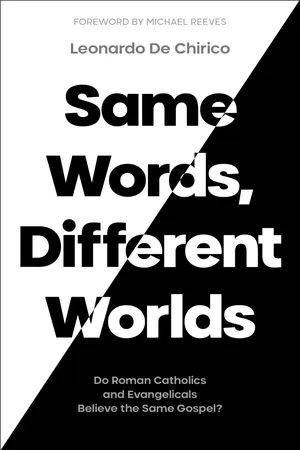
eBook - ePub
Same Words, Different Worlds
Do Roman Catholics and Evangelicals Believe the Same Gospel?
- English
- ePUB (mobile friendly)
- Available on iOS & Android
eBook - ePub
Same Words, Different Worlds
Do Roman Catholics and Evangelicals Believe the Same Gospel?
About this book
Information
1
Same words, same world? Questioning some common viewpoints
In our time, marked as it is by ecumenical friendliness and a general dislike for theological precision, there are a number of common views regarding Roman Catholicism and the evangelical Protestant faith that are quite widespread, both within and outside of the church. The prevailing impression is that the differences of the past are no longer as relevant as they have been for centuries. They are less stark and more nuanced than in times past. They are not black and white issues; they can be thought of as representing different shades of grey.
After all, do not evangelicals and Catholics share the bulk of the Christian faith, the Scriptures of the Old and the New Testaments (although with the difference of the deuterocanonical books), and the essential core of the gospel (superficially understood), while having remaining differences that do not preclude significant degrees of reconciliation and fellowship? There are people who actually argue that while evangelicals and Catholics have been divided in the past, they nonetheless share the ‘same future’.1
These assumptions seem to be growing in plausibility and are gaining support from a variety of church circles. It is important to notice that they are built around a cluster of common ecumenical ideas that support one another, resulting in a convincing cumulative argument. In this chapter an attempt will be made to single them out (at least the most common ones) and to begin questioning them one by one biblically, historically and theologically. Although arguing from different angles and highlighting various elements, we will see that the thread that weaves all these common viewpoints together is the use of the same words of the Christian fa ith. The impression is that the shared vocabulary is a strong pointer for the closeness of the Roman Catholic account of the gospel to the evangelical Protestant account.
Common viewpoint 1: Evangelicals can embrace most of the Roman Catholic Catechism
Understanding Roman Catholicism is high on the agenda of contemporary evangelical theologians. A lot of things are happening in the relationship between evangelicals and Catholics worldwide, leaving many observers perplexed and feeling the need to reflect theologically on the changing scenario. The widely acclaimed book Is the Reformation Over? An evangelical assessment of Roman Catholicism by Mark Noll and Carolyn Nystrom2 focuses on this issue mainly in a North American context and traces the stunning developments that have taken place in recent decades, from the widespread anti-Catholic attitude of many evangelicals until the 1960s, to the growing convergence reflected in many bilateral dialogues between the Roman Church and different Protestant bodies from the late 1960s onwards. The North American ‘Evangelicals and Catholics Together’ (ECT) initiative is but one instance of such a historical turn.3 In the light of the current situation, the authors ask themselves whether the Reformation is over and whether a new season of ecumenical rapprochement can be envisaged.
In order to do that, Noll and Nystrom highlight the contents of the 1992 Catechism of the Catholic Church. Surveying the exposition of what Rome believes in this codified form, the authors argue that ‘evangelicals can embrace at least two-thirds’ of it.4 This alleged consensus stems from ‘common orthodoxy’ based on the ancient trinitarian and Christological creeds: the triune nature of God, the incarnation of Jesus Christ as the God-man, the need for salvation, the reality of the church, the hope of eternal salvation and so on. The basic words of the gospel are the ‘same’ as those in the Catechism; for example, ‘God’, ‘Jesus Christ’, ‘Bible’, ‘sin’, ‘faith’, ‘salvation’.
However, there is another side of the coin. As honest scholars, Noll and Nystrom later admit that when the Catechism speaks of Christ, it interweaves him with the church to the point of making them one,5 which is unacceptable for evangelicals who consider the exaltation of a created reality an instance of idolatry. On this extension of the meaning of ‘Christ’ in the Catechism (i.e. the prolongation of his incarnation in the church), Rome builds its self-understanding of being a church endowed with the authority of Christ the King, the priesthood of Christ the Mediator and the truth of Christ the Prophet. But this is not what the gospel teaches. This is an inflated view of the church based on a defective view of Christ. On the one hand, then, there is an apparent ‘common orthodoxy’ based on the ‘same’ vocabulary of the seemingly shared trinitarian theology; on the other, there is a profound difference on the doctrine of Christ (and therefore the Trinity) which is the ground for the Church of Rome to claim the prerogatives of Christ in administering grace (through the sacraments), in exercising authority (through the hierarchical institution) and in teaching the truth (through the official teaching of popes, councils, etc.). The Catechism gives voice to this account of the Christian faith.6
The question that needs to be raised is: how can it be said that evangelicals can accept ‘two-thirds’ of the Catechism if this document speaks of the (Roman Catholic) church whenever it speaks of Christ, the Spirit and, by extension, the Trinity? Are we sure that the real difference between evangelicals and Catholics lies in ecclesiology, given that the Roman Catholic view of the church is argued for in Christological and pneumatological (i.e. related to the Holy Spirit) terms? Is the Christ of the Catechism the Jesus Christ of the Bible or the Christ of the Roman Church? Of course, there is a sense in which Rome confesses the historical Jesus Christ, as the Son of God become man. Yet, it is also true that Rome appeals to the same ‘Christ’ to support other doctrines and practices that are not biblical.
A similar problem can be seen with the US-based initiative Evangelicals and Catholics Together, whose 1994 founding document is referenced by Noll and Nystrom. In reading that text, one has the impression that there is significant doctrinal commonality between the two constituencies represented in the dialogue. However, as Jun Vencer (the then General Secretary of the World Evangelical Fellowship) has rightly pointed out in critically evaluating the document, ‘the use of common language does not mean that the meanings are the same’.7 In other words, the mere act of subscribing to a declaration is no indication of a genuinely recovered unity if each party attributes substantially different nuances to the agreed text. The only outcome of using the same words pretending they mean the same thing is to blur the meaning of the word ‘Christian’,8 introducing ambiguity to a degree that becomes detrimental to true agreement.
Common viewpoint 2: This is a new era for evangelicals and Catholics
Another sentiment that is often expressed in the present-day ecumenical setting is along these lines: ‘We are living in a new era; the controversies of the past are over, and we should strive to reconcile Rome and the Protestant Reformation.’ So, is it true that we are living in a ‘new era’? To give an answer, we need to place this question in a wider historical and theological context, because otherwise we risk reducing everything to the here and now. This preliminary observation about method is always valid, but even more so when analysing Roman Catholicism, which is an institution that boasts a doctrinal, institutional and cultural heritage that spans two thousand years of history. Roman Catholicism has to be assessed using macro-categories able to hold together the largest possible number of elements. Failing to do this will lead to a collection of fragments, just pieces of Catholicism, which will not allow for a real understanding of its dimensions, depth, connections and projects. A ‘spiritual’ assessment cannot ignore the fact that while we are dealing with a system made up of people, they are in fact people within a framework that expresses itself in a history, a doctrine, a bond to the sacraments, a political commitment, a financial system, popular piety, a plurality of spiritual expressions and so on, all of which are nonetheless connected to an institutional centre and a theological heart. To speak of a ‘new era’ it is important to remember that throughout the course of its history Catholicism has known some particularly significant eras. Following is a brief summary.9
The era of imperial Catholicism
In the fourth century – between the Edict of Milan issued by the Roman emperor Constantine which granted religious freedom to all his subjects (ad 313) and the Edict of Thessalonika under Theodosius which proclaimed Christianity as the state religion (ad 380) – Catholicism quickly transformed itself into a religious empire, forged in the institutional mould of the empire and animated by an imperial ideology. From the ashes of the Roman Empire rose an imperial church that assumed a pyramidal institutional structure and clothed itself with Christian language and symbols. The imperial hubris of Roman Catholicism (that is, its desire to be both church and state) is its original sin – one which has never been seriously questioned, let alone refuted internally. The orthodoxy of primitive Christianity has been gradually broadened in the attempt to assimilate new beliefs and new practices, causing the Christian faith to become self-contradictory. The desire to represent all of humanity has moved the point of entry into the church from conversion to Christ to the baptism administered by the church, leading to the establishing of a church composed of baptized people and not of believers. Biblical revelation has in fact been relativized due to the growing role of the church’s tradition. The church has become a nominal church made up of baptized people who are not necessarily believers. The grace of God has become the property of a religious institution that claims it can administer and dispense God’s grace through its sacramental system. The imperial era gave rise to an imperial DNA that Catholicism has never laid aside. During this era, all biblical renewal movements were either fought against or assimilated through a policy of domestication to the imperial ideology. Niches of different forms of spirituality were carved out so as to be inoffensive and lifeless, and thus maintain the status quo.
The era of oppositional Catholicism
The second great age of the Catholic Church was that of the Counter-Reformation, structured around two central moments: the Council of Trent (1545–63) and the First Vatican Council (1869–70). The Roman Catholic Church’s long trajectory is characterized by a doctrinal trend which is at the same time abrasive, dulling, and interested in affirming the centrality and superiority of the church. It is the age in which the modern Catholic doctrine based on the prerogative of the church as alter Christus (another Christ) is formed; it is the age in which the doctrine of the two sources of revelation is expressed: Scripture and Tradition; it is the age in which the church elevates itself to the point of thinking that its imperial structure is the divine will of God. Confronted with the Protestant Reformation, which invited the church to rid itself of its self-referentiality and rediscover the gospel of God’s grace, Rome reacted with a strengthened sacramental system that explicitly positioned the church as the mediator of divine grace. Confronted with modernity, which pushed for a review of the prerogatives of the church over society and people’s consciences, Rome elevated its main institution (the papacy) to an even more accentuated role, as well as dogmatizing some Marian beliefs without any biblical support whatsoever. This recovery of a robust identity also led to a missionary expansion of Catholicism and the development of mystical and Marian forms of spirituality.
The era of a compliant and captivating Catholicism
The model of the oppositional era led to isolation and a marginalized role for Roman Catholicism. A change took place with Vatican II (1962–5). Here a new era began, when instead of siding against the modern world, Rome changed strategy, choosing instead to assimilate modernity, to penetrate it from within without changing its own essence. Now Rome had adopted the method of ‘updating’: adjustment without structural reform, incorporation without loss or cost, expansion of the system without purification, development without renunciation of tradition, a continuous adding without subtracting anything. Reflecting on the outcomes of Vatican II, the Waldensian Italian theologian Vittorio Subilia has rightly spoken of the ‘new catholicity of Catholicism’, expressed as a different posture, a new style, a new language.10 This updating takes place in every direction, however: in the direction of theological liberalism, making room for a critical reading of the Bible and universalism of salvation; in the evangelical direction, learning the linguistic code of evangelical spirituality (having a personal relationship with Christ, etc.); in the direction of Marian theology, traditionalism, ecumenism and so on. The result is a 360-degree expansionary catholicity, one that still maintains the sacramental, hierarchical, devotional and imperial structures (certainly made more discreet but definitely still present) – all of which revolve around an abnormal and dilated ecclesiology and around the fundamental pillars of traditional doctrine.
The question for us
Without quoting its documents often, Pope Francis incarnates the catholicity of Vatican II: open to dialogue, merciful, pleasing, but without paying any dogmatic, theological or spiritual price. The imperial and Counter-Reformation framework of the former ages remains, only ‘updated’ to the new requirements of the contemporary global world. Francis speaks all languages – evangelical, ecumenical, interreligious, secular, charismatic, traditional. He seems to draw close to everyone without actually moving. He seems to reach out to everyone without going very far. And then, the fact that many people (from secularists to Muslims, and including liberal Protestants and evangelicals) consider him close to them must make us ask: is he really near to anyone? In other words, the strategy of the ‘polyhedron’ seems to be the instrument of catholicity that has its roots in Vatican II and that fulfils it: all have to relate to a Roman church which has axes of various lengths in orde...
Table of contents
- Foreword
- Acknowledgments
- Abbreviations
- Introduction
- 1
- 2
- 3
- 4
- Conclusion
- Appendix 1
- Appendix 2
- Appendix 3
- Bibliography
- Notes
Trusted by 375,005 students
Access to over 1.5 million titles for a fair monthly price.
Study more efficiently using our study tools.
Frequently asked questions
Yes, you can cancel anytime from the Subscription tab in your account settings on the Perlego website. Your subscription will stay active until the end of your current billing period. Learn how to cancel your subscription
No, books cannot be downloaded as external files, such as PDFs, for use outside of Perlego. However, you can download books within the Perlego app for offline reading on mobile or tablet. Learn how to download books offline
Perlego offers two plans: Essential and Complete
- Essential is ideal for learners and professionals who enjoy exploring a wide range of subjects. Access the Essential Library with 800,000+ trusted titles and best-sellers across business, personal growth, and the humanities. Includes unlimited reading time and Standard Read Aloud voice.
- Complete: Perfect for advanced learners and researchers needing full, unrestricted access. Unlock 1.5M+ books across hundreds of subjects, including academic and specialized titles. The Complete Plan also includes advanced features like Premium Read Aloud and Research Assistant.
We are an online textbook subscription service, where you can get access to an entire online library for less than the price of a single book per month. With over 1.5 million books across 990+ topics, we’ve got you covered! Learn about our mission
Look out for the read-aloud symbol on your next book to see if you can listen to it. The read-aloud tool reads text aloud for you, highlighting the text as it is being read. You can pause it, speed it up and slow it down. Learn more about Read Aloud
Yes! You can use the Perlego app on both iOS and Android devices to read anytime, anywhere — even offline. Perfect for commutes or when you’re on the go.
Please note we cannot support devices running on iOS 13 and Android 7 or earlier. Learn more about using the app
Please note we cannot support devices running on iOS 13 and Android 7 or earlier. Learn more about using the app
Yes, you can access Same Words, Different Worlds by Leonardo De Chirico in PDF and/or ePUB format, as well as other popular books in Theology & Religion & Christian Denominations. We have over 1.5 million books available in our catalogue for you to explore.