The clearest and most up-to-date account of the achievements—and setbacks—of the European Union since 1945.
Europe has been transformed since the Second World War. No longer a checkerboard of entirely sovereign states, the continent has become the largest single-market area in the world, with most of its members ceding certain economic and political powers to the central government of the European Union. This shift is the product of world-historical change, but the process is not well understood. The changes came in fits and starts. There was no single blueprint for reform; rather, the EU is the result of endless political turmoil and dazzling bureaucratic gymnastics. As Brexit demonstrates, there are occasional steps backward, too. Cutting through the complexity, Richard Pomfret presents a uniquely clear and comprehensive analysis of an incredible achievement in economic cooperation.
The Economic Integration of Europe follows all the major steps in the creation of the single market since the postwar establishment of the European Coal and Steel Community. Pomfret identifies four stages of development: the creation of a customs union, the deepening of economic union with the Single Market, the years of monetary union and eastward expansion, and, finally, problems of consolidation. Throughout, he details the economic benefits, costs, and controversies associated with each step in the evolution of the EU. What lies ahead? Pomfret concludes that, for all its problems, Europe has grown more prosperous from integration and is likely to increase its power on the global stage.
- 273 pages
- English
- PDF
- Available on iOS & Android
eBook - PDF
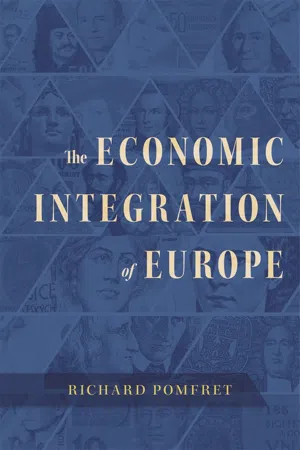
The Economic Integration of Europe
About this book
Information
Table of contents
- Cover
- Title Page
- Copyright
- Contents
- Preface
- 1. A Brief History of European Union
- 2. The Customs Union: Setting European Integration in Motion (1957–1982)
- 3. Deep Integration: Creation of the European Union (1982–1993)
- 4. Deeper and Wider: From Maastricht to Lisbon (1993–2007)
- 5. Post-Lisbon Challenges and Responses (2007–2019)
- 6. The European Union in the 2020s
- Abbreviations
- List of Boxes, Tables, and Figures
- Notes
- References
- Index
Trusted by 375,005 students
Access to over 1.5 million titles for a fair monthly price.
Study more efficiently using our study tools.
Frequently asked questions
Yes, you can cancel anytime from the Subscription tab in your account settings on the Perlego website. Your subscription will stay active until the end of your current billing period. Learn how to cancel your subscription
No, books cannot be downloaded as external files, such as PDFs, for use outside of Perlego. However, you can download books within the Perlego app for offline reading on mobile or tablet. Learn how to download books offline
We are an online textbook subscription service, where you can get access to an entire online library for less than the price of a single book per month. With over 1.5 million books across 990+ topics, we’ve got you covered! Learn about our mission
Look out for the read-aloud symbol on your next book to see if you can listen to it. The read-aloud tool reads text aloud for you, highlighting the text as it is being read. You can pause it, speed it up and slow it down. Learn more about Read Aloud
Yes! You can use the Perlego app on both iOS and Android devices to read anytime, anywhere — even offline. Perfect for commutes or when you’re on the go.
Please note we cannot support devices running on iOS 13 and Android 7 or earlier. Learn more about using the app
Please note we cannot support devices running on iOS 13 and Android 7 or earlier. Learn more about using the app
Yes, you can access The Economic Integration of Europe by Richard Pomfret in PDF and/or ePUB format, as well as other popular books in Business & Business General. We have over 1.5 million books available in our catalogue for you to explore.