- English
- ePUB (mobile friendly)
- Available on iOS & Android
eBook - ePub
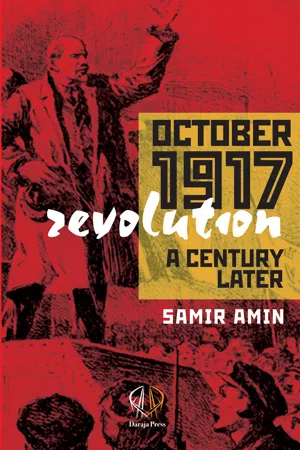
October 1917 Revolution, a century later
Information
2
The October 1917 Revolution began the transformation of the world
The aim of this chapter, written especially for the 100th anniversary of the October 1917 Revolution, is certainly not to denigrate this first gigantic socialist project that echoed the glorious Paris Commune (1871), both of them being parties to the ‘storming of the skies’. Humanity owes an enormous debt to the Soviet Union that resulted from this revolution as it was the Red Army, and it alone, that put the Nazi hordes to rout. The model of the Soviet Union, which was a plurinational state based on the support of those both the more and the less destitute, continues to be unequal even today. The support of the Soviet Union to the national liberation struggles of the peoples of Asia and Africa at that time forced the imperialist powers to retreat and to accept a polycentric globalization that was less unequal and more respectful of the sovereignty of nations and of their cultures.
However, neither is the objective of this study to be a nostalgic looking back on this historic event. On the contrary I shall try to identify the mistakes and weaknesses of the original construction and then describe the drift away from it that led to efforts for its reform. And I show how, when these failed and led to the brutal restoration of capitalism, an end was put to this first great wave of humanity’s progress towards socialism.
Soviet leaders facing the challenge of history
Lenin, along with the Bolshevik leaders within the old Russian Workers Social Democratic Party, then Stalin, shaped the history of the October revolution followed by the construction of the USSR. In the following period Khrushchev, Brezhnev and finally Gorbachev and Yeltsin accompanied the decline of that system until its fall. As leaders of revolutionary communist parties and then later as leaders of revolutionary states, the builders were confronted with the problems faced by a triumphant revolution in countries of peripheral capitalism and forced to “revise” (I deliberately use this term, considered sacrilegious by many) the theses inherited from the historical Marxism of the Second International. Lenin and Bukharin went much further than Hobson and Hilferding in their analyses of monopoly capitalism and imperialism and drew this major political conclusion: the imperialist war of 1914-1918 (they were among the few, if not the only ones, to anticipate it) made necessary and possible a revolution led by the proletariat.
With the benefit of hindsight, I will indicate here the limitations of their analyses. Lenin and Bukharin considered imperialism to be a new stage (“the highest”) of capitalism associated with the development of monopolies. I question this thesis and contend that historical capitalism has always been imperialist, in the sense that it has led to a polarization between centres and peripheries since its origin (the sixteenth century), which has only increased over the course of its later globalized development. The nineteenth century pre-monopolist system was not less imperialist. Great Britain maintained its hegemony precisely because of its colonial domination of India. Lenin and Bukharin thought that the revolution, begun in Russia (“the weak link”), would continue in the centres (Germany in particular). Their hope was based on an underestimate of the effects of imperialist polarization, which destroyed revolutionary prospects in the centers.
Nevertheless, Lenin quickly learned the necessary historical lesson. The revolution, made in the name of socialism (and communism), was, in fact, something else: mainly a peasant revolution. So what to do? How can the peasantry be linked with the construction of socialism? By making concessions to the market and by respecting newly acquired peasant property; hence by progressing slowly towards socialism? The NEP implemented this strategy.
Yes, but…. Lenin, Bukharin, and Stalin also understood that the imperialist powers would never accept the Revolution or even the NEP. After the hot wars of intervention, the cold war was to become permanent, from 1920 to 1990. Soviet Russia, even though it was far from being able to construct socialism, was able to free itself from the straightjacket that imperialism always strives to impose on all peripheries of the world system that it dominates. In effect, Soviet Russia delinked.
The imperialist West, like the Nazis, could not tolerate the very existence of the Soviet Union. For their part Lenin then Stalin did all they could to reassure the West that they did not intend to ‘export’ their revolution. They sought peaceful coexistence through all the diplomatic channels available to them.
Between the two world wars Stalin tried desperately to ally the Western democracies against Nazism but the Western powers did not respond to his invitation. On the contrary, they tried to push Hitlerian Germany into making war on the Soviet Union. This was evident, from the tragic 1937 Munich agreement to their refusal to accept the hand that Stalin held out to them.
Fortunately he managed to foil the strategy of the ‘democratic’ powers by reaching a last-minute agreement with Germany just after the invasion of Poland. Later on, when the United States entered the war, Stalin renewed his attempts to base a durable alliance with Washington and London in the post-war period. He was never to give up. But, again, the coexistence and peace policy pursued by the Soviet Union was defeated by the unilateral decision of Washington and London to end the wartime alliance by initiating the cold war just after the Potsdam agreement, when the United States had the monopoly of nuclear weapons. The United States and their subaltern allies in NATO systematically carried out their ‘roll-back’ policy from 1946 to 1990, and thereafter. NATO, presented to naïve public opinion as a defensive measure against the aggressive intentions attributed to Moscow, revealed its true nature when it annexed eastern Europe and when this aggressive organization carried out new missions in the Middle East, the Mediterranean, Caucasia, South-East Asia and then Ukraine. (See Geoffrey Roberts, Stalin’s Wars: from World War to Cold War, 1939-1953.)
So what to do now? Attempt to push for peaceful coexistence, by making concessions if necessary and refraining from intervening too actively on the international stage? But at the same time, it was necessary to be armed to face new and unavoidable attacks. And that implied rapid industrialization, which, in turn, came into conflict with the interests of the peasantry and thus threatened to break the worker- peasant alliance, the foundation of the revolutionary state.
Since 1947, the United States of America, the dominating imperialist power of that epoch, proclaimed the division of the world into two spheres, that of the ‘free world’ and that of ‘communist totalitarianism’. The reality of the Third World was flagrantly ignored: it was felt privileged to belong to the ‘free world’, as it was ‘non-communist’. ‘Freedom’ was considered as applying only to capital, with complete disregard for the realities of colonial and semi-colonial oppression. The following year Jdanov, in his famous report (in fact, Stalin’s), which led to the setting up of the Kominform (an attenuated form of the Third International), also divided the world into two, the socialist sphere (the USSR and Eastern Europe) and the capitalist one (the rest of the world). The report ignored the contradictions within the capitalist sphere which opposed the imperialist centres to the peoples and nations of the peripheries who were engaged in struggles for their liberation.
The Jdanov doctrine pursued one main aim: to impose peaceful coexistence and hence to calm the aggressive passions of the United States and their subaltern European and Japanese allies. In exchange, the Soviet Union would accept a low profile, abstaining from interfering in colonial matters that the imperialist powers considered their internal affairs. The liberation movements, including the Chinese revolution, were not supported with any enthusiasm at that time and they carried on by themselves. But their victory (particularly that of China, of course) was to bring about some changes in international power relationships. Moscow did not perceive this until after Bandung, which enabled it, through its support to the countries in conflict with imperialism, to break out of its isolation and become a major actor in world affairs. In a way, it is not wrong to say that the main change in the world system was the result of this first ‘Awakening of the South’. Without this knowledge, the later affirmation of the new ‘emerging’ powers cannot be understood.
The Jdanov report was accepted without reservation by the European communist parties and of those of Latin America of that era. However, almost immediately it came up against resistance from the communist parties of Asia and the Middle East. This was concealed in the language of that period, for they continued to affirm “the unity of the socialist camp” behind the USSR, but as time went on resistance became more overt with the development of their struggles for regaining independence, particularly after the victory of the Chinese revolution in 1949. To my knowledge, no-one has ever written the history of the formulation of the alternative theory, which gave full rein to the independent initiatives of the countries of Asia and Africa, later to crystallize at Bandung in 1955 and then in the constitution of the Non Aligned Movement (from 1960 defined as Asian-African, plus Cuba). The details are buried in the archives of some communist parties (those of China, India, Indonesia, Egypt, Iraq, Iran and perhaps a few others).
Nevertheless I can bear personal witness to what happened, having been lucky enough, since 1950, to participate in one of the groups of reflection that brought together the Egyptian, Iraqi and Iranian communists and some others. Information about the Chinese debate, inspired by Zhou Enlai was not made known to us by Comrade Wang Hue (the link with the journal Révolution, whose editorial committee included myself) until much later, in 1963. We heard echoes of the Indian debate and the split that it had provoked, which was confirmed afterwards by the constitution of the CPM. We knew that debates within the Indonesian and Filipino communist parties developed along the same lines.
It is possible, then, to understand the equivocations of Lenin, Bukharin, and Stalin. In theoretical terms, there were U-turns from one extreme to the other. Sometimes a determinist attitude inspired by the phased approach inherited from earlier Marxism (first the bourgeois democratic revolution, then the socialist one) predominated, sometimes a voluntarist approach (political action would make it possible to leap over stages). Finally, from 1930-1933, Stalin chose rapid industrialization and armament (and this choice was not without some connection to the rise of fascism).
Collectivization was the price of that choice. Here again we must beware of judging too quickly: all socialists of that period (and even more the capitalists) shared Kautsky’s analyses on this point (Kautsky’s Agrarian Question, published in 1889 was considered as the Bible on that issue by the Second International and even Lenin), and were persuaded that the future belonged to large-scale agriculture. It was a long time before the idea that modernized family farming is more effective than large-scale exploitation was recognized. Agronomists (particularly in France) understood before the economists that the extreme division of labour of the industrial model was inappropriate in agriculture, as the farmer has to deal with the requirements of various tasks that are difficult to anticipate. Anyway the break in the worker-peasant alliance that this choice implied lay behind the abandonment of revolutionary democracy and the autocratic turn.
The Chinese communists appeared later on the revolutionary stage. Mao was able to learn from Bolshevik equivocations. China was confronted with the same problems as Soviet Russia: revolution in a backward country, the necessity of including the peasantry in revolutionary transformation, and the hostility of the imperialist powers. But Mao was able to see more clearly than Lenin, Bukharin, and Stalin. Yes, the Chinese revolution was anti-imperialist and peasant (anti-feudal). But it was not bourgeois democratic; it was popular democratic. The difference is important: the latter type of revolution requires maintaining the worker-peasant alliance over a long period. China was thus able to avoid the fatal error of forced collectivization and invent another way: make all agricultural land state property, give the peasantry equal access to use of this land, and renovate family agriculture.
Mao provided a different response to the agrarian question, based on renewed small-scale family exploitation without private ownership, which reduced the migratory pressure towards the towns. This made it possible to associate the strategic aim of food sovereignty with the construction of a complete and modernized national industrial system. As for a general treatment of the agrarian question, see Chapter 5 of my book Ending the Crisis of Capitalism or Ending Capitalism? This formula is certainly the only possible response to the agrarian question in all the countries of the contemporary Global South, although the political conditions required for implementing it have occurred only in China and Vietnam.
Thirty years of critique of Sovietism
– 1 –
Except for individuals with a natural disposition to prophesy, nobody can pretend not to have been somewhat taken aback by the sudden and total collapse of the political systems of Eastern Europe and the USSR. Now that the surprise factor is gone, it is useful to look back at the analyses of these systems that were produced some thirty years before the final fall. At the risk of sounding pretentious, I may say that since 1960 I have been part of a small current on the left that had broadly foreseen what came to a climax between 1989 and 1991. Of course, the collapse we thought highly likely was not the only possible outcome of the crisis of the Soviet system. I do not believe in any unfailing linear determinism in history. The contradictions running through every society always find their resolution in diverse responses according to their class content. It was always possible that the Soviet regime might fall to the right (as happened) or evolve (or fall) to the left. The latter possibility has been ruled out for the immediate future but remains on the agenda of history, not only because there is never an end to history but also because I doubt that the right-wing solution in the making will stabilize the societies of the East, even in the medium term.
The period following Stalin’s death in 1953, and especially from the Twentieth Congress in 1956 to the fall of Khrushchev in 1964, was marked by a first attempt claiming to recover from Stalinism and by the open ideological and political dispute between Moscow and Beijing. The next period of so-called Brezhnev glaciation (immobilist strategy) lasted until the arrival of Gorbachev in 1985. Gorbachev’s attempt at perestroika after 1985 ended within a few years in the collapse from 1989 to 1991.
The evolutions and successive phases had to be articulated on those operating at a world level. This meant capitalist expansion and the building of the European Union. It meant military balances between the two superpowers and political responses in the arms race. In the Brezhnev period, it meant Soviet initiatives toward the Third World and conflict with China on the one hand, and U.S. Cold War strategies, including Star Wars preparations after 1980, on the other. Internal options and international policies were intertwined during these thirty years.
After 1960, certainly, and even after 1957, I ceased to consider Soviet society as socialist or that the power of the workers was “deformed by bureaucracy,” in the famous Trotskyist expression. I had from the beginning regarded the ruling exploiting class (and I do mean class) as a bourgeoisie. This class, the nomenklatura, saw itself in the mirror of West it aspired to replicate. This is what Mao had perfectly expressed when he was addressing cadres of the Chinese Communist Party in 1963: “You [meaning the Chinese party cadres like those of the USSR] have constructed a bourgeoisie. Do not forget: the bourgeoisie does not want socialism, it wants capitalism.”
I drew the logical conclusions from this analysis of the Party and the attitude of the masses toward the authorities. To me it was obvious that the masses did not recognize themselves in the authorities, although they continued to proclaim themselves socialist, but they saw them, rather, as their true social adversaries—and rightly so. In these circumstances, the Party was a long-moldering corpse that had become an instrument of social control over the masses exercised by the exploiting ruling class. The Communist Party, crowning the work of the repressive institutions such as the KGB, organized a network of clients among the people, through control and distribution of all social benefits, even the slightest, thus paralyzing their potential revolt.
This kind of party in no way differs from the many one-party systems in the Third World that play the same role (such as Nasserism, the Algerian FLN, the Ba’ath, and the long train of parties in office in Mali, Guinea, Ghana, Tanzania, and others, all who fall under the label of radical nationalism, or in countries, such as the Ivory Coast, who openly opt for capitalism). It is a general p...
Table of contents
- Cover
- Title Page
- Copyright
- Table Of Contents
- Introduction
- The October 1917 Revolution began the transformation of the world
- Reading Capital, reading historical capitalisms
- Revolutions and counter-revolutions from 1917 to 2017
- The sovereign popular project: The alternative to liberal globalization
- The agrarian question, a century after October 1917
Trusted by 375,005 students
Access to over 1.5 million titles for a fair monthly price.
Study more efficiently using our study tools.
Frequently asked questions
Yes, you can cancel anytime from the Subscription tab in your account settings on the Perlego website. Your subscription will stay active until the end of your current billing period. Learn how to cancel your subscription
No, books cannot be downloaded as external files, such as PDFs, for use outside of Perlego. However, you can download books within the Perlego app for offline reading on mobile or tablet. Learn how to download books offline
Perlego offers two plans: Essential and Complete
- Essential is ideal for learners and professionals who enjoy exploring a wide range of subjects. Access the Essential Library with 800,000+ trusted titles and best-sellers across business, personal growth, and the humanities. Includes unlimited reading time and Standard Read Aloud voice.
- Complete: Perfect for advanced learners and researchers needing full, unrestricted access. Unlock 1.5M+ books across hundreds of subjects, including academic and specialized titles. The Complete Plan also includes advanced features like Premium Read Aloud and Research Assistant.
We are an online textbook subscription service, where you can get access to an entire online library for less than the price of a single book per month. With over 1.5 million books across 990+ topics, we’ve got you covered! Learn about our mission
Look out for the read-aloud symbol on your next book to see if you can listen to it. The read-aloud tool reads text aloud for you, highlighting the text as it is being read. You can pause it, speed it up and slow it down. Learn more about Read Aloud
Yes! You can use the Perlego app on both iOS and Android devices to read anytime, anywhere — even offline. Perfect for commutes or when you’re on the go.
Please note we cannot support devices running on iOS 13 and Android 7 or earlier. Learn more about using the app
Please note we cannot support devices running on iOS 13 and Android 7 or earlier. Learn more about using the app
Yes, you can access October 1917 Revolution, a century later by Samir Amin in PDF and/or ePUB format, as well as other popular books in Politics & International Relations & Communism, Post-Communism & Socialism. We have over 1.5 million books available in our catalogue for you to explore.