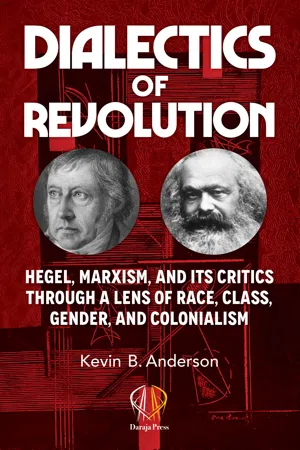
eBook - ePub
Dialectics of Revolution
Hegel, Marxism, and its critics through a lens of race, class, gender, and colonialism
- English
- ePUB (mobile friendly)
- Available on iOS & Android
eBook - ePub
Dialectics of Revolution
Hegel, Marxism, and its critics through a lens of race, class, gender, and colonialism
Information
II
Marxism and Hegel
2
Dialectics in brief
Kevin B Anderson and Peter Hudis
While its roots go back to the Socratic dialogues, dialectics as social theory begins with G. W. F. Hegel, and extends—through Karl Marx—to today, and to the future.[1]
With Hegel, the dialectic takes the form of a double negation. Ideas or social forms face negativity from within. If the process deepens, the old idea or form is overthrown. However, such a first (or bare) negation remains a “formless abstraction” unless it develops some determinateness or specificity (Hegel 2010: 87). This requires going beyond “the first negation” (which is “only abstract negativity”) to “the second negation … which is concrete, absolute negativity” (p. 89). This absolute negativity creates, for example, a new idea or social form in place of the old. Then the process may resume, with negation growing again within what has been newly created. Some have erroneously described this process as one of thesis-antithesis-synthesis, an expression Hegel himself never used (Pinkard 2000).
Against such formulaic notions, Hegel’s dialectic is deeply rooted in historical and social development, especially the period from the Enlightenment through the French Revolution. These form the backdrop to all of his major works. As against the earlier Socratic dialectic, conflict and dialogue take place between real social forces, as well as between ideas. In ThePhenomenology of Spirit (1807), Hegel traces the development of consciousness and knowledge, from the ancient Greco-Roman world to his own time. Successive forms of consciousness are negations of previous ones.
For example, in the dialectic of the master and the slave (literally, domination and servitude [Herrschaft und Knechtschaft]), slaves in the Greco-Roman world acquire a more developed form of self-consciousness, as part of a struggle for recognition, than their masters. The wrenching experience of capture and enslavement unmoors human selfhood and engenders reflexivity, as “everything fixed has quaked within it” since the self has experienced “absolute negativity” (Hegel 2018a: 80). But the fact that the slave performs physical labor and achieves recognition through this process, while the master enjoys an indolent life of leisure, points in the direction of another kind of second (or absolute) negation for the enslaved consciousness: For “it is precisely in its labor, wherein it seemed to have only an alienatedmind, that it acquires a mind of its own” (p. 81). In Hegel’s narrative, the human spirit thus grows and advances through the mind of the slave, not the master, who remains at the level of an unreflective “natural consciousness” marked by “self-will” or stubbornness (p. 81). This leads in turn to a new form of consciousness, Stoicism, which Hegel portrays as a further advance. Alluding to the fact that several prominent Stoics were manumitted slaves, however, Hegel also stresses the socio-historical limits placed upon the progress of human consciousness when he characterizes the Greco-Roman world as “a time of universal fear and bondage” (p. 83).
Hegel develops a number of other dialectical categories, including identity, difference, and contradiction. He writes that although identity between two forms also includes of necessity some sort of difference, difference also has to involve some identity, a common set of terms or a framework through which they can express that difference. This could include a common language, for example. The impasse is overcome in a third stage, that of contradiction. Expanding the notion of contradiction from the sphere of ideas to that of social life, Hegel concludes that “All things are in themselves contradictory” and “contradiction is the root of all movement and life” (Hegel 2010: 381, 382).
Hegel’s negations and contradictions create ground for a radical form of subjectivity, and he enjoins us to grasp reality “not as substance but just as much as subject” (Hegel 2018a: 10). He sees a drive for freedom as the overarching theme of human history, although this involves contradiction, and even sometimes retrogression. As humanity strives for the universal, for an absolute liberation, internal barriers to its realization repeatedly manifest themselves. Prominent among these are abstract universals, which lack particularity or concreteness. The French Revolution, especially in its Jacobin phase, was marked by universals of “pure abstraction,” which “lacked a filling and a content,” thus lapsing into the “sheer horror of the negative that has nothing positive in it” (p. 608). However, Hegel’s system ends not here, but with a series of absolutes in which freedom is concretized, ultimately as the idea “engenders and enjoys itself as absolute Mind” (Hegel 2007: 276).
Marx attacks the conservative side of Hegel’s social and political philosophy, for example, in his 1843 critique of the anti-democratic Philosophy of Right. At the same time, Marx takes over the dialectic. In his “Critique of the Hegelian Dialectic” in the unpublished Economic and Philosophic Manuscripts of 1844, he characterizes Hegel’s “outstanding achievement” as “the dialectic of negativity as the moving and creative principle” (Marx, in Fromm 1961: 176). Marx also distances himself from some aspects of Hegel’s idealism: “For Hegel, human life . . . is equivalent to self-consciousness” (p. 179). In this sense, the problem with Hegel’s master-slave dialectic would be his focus on the growth of self-consciousness on the part of the slave, as opposed to the quest for actual liberation from bondage, as in the great Roman slave uprisings. Thus, consciousness, albeit rooted in the experience of human labor, is privileged over the fullness of human praxis, both mental and manual. Nonetheless, many core principles of Hegel’s dialectic—negation of the negation, contradiction, the concrete universal, transformation into opposite, subject-object reversal, etc.—are retained in the Marxian dialectic. Nor is idealism rejected in toto. A year later, in the 1845 “Theses on Feuerbach,” Marx writes that many forms of materialism lack the subjective element and are too contemplative: “Hence, in contradistinction to materialism, the active side was set forth abstractly by idealism” (MECW 5: 3).
With Marx, the notion of contradiction migrates to the sphere of political economy, where social change is driven by class struggle, as he and Engels maintain in The Communist Manifesto (1848). Change also occurs when, due to social development, “the material productive forces of society come into contradiction with the existing production relationships,” as he writes in the preface to Critique of Political Economy in 1859 (Marx, in Fromm 1961: 218). Eight years later, in Volume 1 of Capital, Marx confirms his debt to Hegel by writing “the Hegelian ‘contradiction’ . . . is the source of all dialectics” (Marx 1976: 744).
In the first chapter of Capital, Marx recasts the Hegelian notion of subject-object reversal [Verkehrung] in his discussion of commodity fetishism, wherein human relations take on “the fantastic form of a relation between things” (p. 165) because that is “what they are” in the upside-down world of capitalism (p. 166). In the closing pages of Volume 1 of Capital, Marx uses the Hegelian negation of the negation to frame a discussion of the possible demise of capitalism. Here, in the section on “primitive accumulation,” Marx analyzes the expropriation of the English peasantry during the agricultural revolution as “the first negation of individual private property.” Driven into the cities, the peasantry eventually becomes the working class. Capitalism later “begets… its own negation,” however, the revolt of the working class, a class that it has called into existence. “This,” Marx concludes, “is the negation of the negation” (pp. 929–30). Elsewhere, as in the 1873 preface to a new edition of Capital, Marx criticizes “the mystificatory side of the Hegelian dialectic,” and writes, “It must be inverted, in order to discover the rational kernel within the mystical shell.” Nonetheless, Marx avows himself “the pupil of that mighty thinker” (pp. 102–03). In a letter to Engels dated January 16, 1858, Marx expresses the desire to publish an essay on what was rational in Hegel’s dialectical method, this after he reviewed Hegel’s Logic while in the process of writing the Grundrisse (MECW 40: 249). He never did so.
Engels—who defines dialectics as “the science of universal inter-connection” (Engels 2012: 17)—writes, “[Marx] was the first to have brought to the fore again the forgotten dialectical method, its connection with Hegelian dialectics and its distinction from the latter, and at the same time to have applied this method in Capital to the facts of an empirical science, political economy” (Engels 2012: 49).
In his Ludwig Feuerbach and the End of Classical German Philosophy (1886), Engels develops two schemata that are embraced to this day by more orthodox currents within Marxism. First, Engels writes that Hegel’s “system” was conservative, while his “dialectical method” was revolutionary, thus discouraging the deep study of Hegel. Second, he divides all of philosophy into “two great camps,” idealism and materialism, with the latter the progressive and revolutionary one (MECW 26: 363, 366). It was in this spirit that Georgi Plekhanov coined the term “dialectical materialism” five years later. Engels also enunciates three “laws” of dialectics: (1) transformation of quantity into quality, (2) interpenetration of opposites, and (3) negation of the negation.
Until the publication of the 1844 Manuscripts in German in 1932 (a Russian edition appeared in 1927), Marx’s concept of dialectic and its relation to that of Hegel was obscured. Some Marxists delved directly into Hegel, however. In his 1914-15 Notebooks on Hegel’s Logic, Lenin returns directly to Hegel’s writings, modifying some aspects of the dominant form of dialectical materialism at the time. Having absorbed the Hegelian notion of consciousness, Lenin writes that “cognition not only reflects the objective world, but creates it” (LCW 38: 212). Lenin also expresses reservations about Engels and Plekhanov, going beyond the rigid divide between idealism and materialism by attacking not only abstract idealism but also “vulgar materialism” (LCW 38: 114). Lenin kept these reflections on the dialectic mostly private, which facilitated the very “vulgar materialism” he had critiqued. However, Lenin did on occasion refer publicly to his new grasp of the dialectic, and this is evident in his post-1915 writings on imperialism, national liberation, and the state and revolution.
In History and Class Consciousness (1923), Georg Lukács recovers the Hegelian dialectic for Marxism, taking as one of his cues Lenin’s call to become “materialist friends of the Hegelian dialectic” (Lukács 1971: xlv). Lukács accuses Engels of confusing “the scientific experiment” with “praxis in the dialectical, philosophical sense” (p. 132). Moreover, he attacks Engels for neglecting the element of subjectivity in his three laws of dialectic: “But he does not even mention the most vital interaction, namely the dialectical relation between subject and object in the historical process.” The mere recourse to “fluid” concepts does not solve this problem, Lukács holds (p. 3). He also develops a concept of concrete totality, which allows a move from the factory—“in concentrated form the whole of capitalist society” (p. 90)—to the concept of fetishism or reification. The first to point to commodity fetishism as the core of Marx’s critique of capital, Lukács also extends reification from the factory to the entire human condition under capitalism: to the white-collar worker or the scientist for example. In so doing, Lukács incorporates Max Weber’s theory of rationalization. Later, Lucien Goldmann (1969) discusses Lukács in relation to sociological metho...
Table of contents
- Cover
- Title Page
- Copyright
- Table Of Contents
- Acknowledgements
- Introduction
- Marxism and Hegel
- Dialectics today
- Index
Trusted by 375,005 students
Access to over 1.5 million titles for a fair monthly price.
Study more efficiently using our study tools.
Frequently asked questions
Yes, you can cancel anytime from the Subscription tab in your account settings on the Perlego website. Your subscription will stay active until the end of your current billing period. Learn how to cancel your subscription
No, books cannot be downloaded as external files, such as PDFs, for use outside of Perlego. However, you can download books within the Perlego app for offline reading on mobile or tablet. Learn how to download books offline
Perlego offers two plans: Essential and Complete
- Essential is ideal for learners and professionals who enjoy exploring a wide range of subjects. Access the Essential Library with 800,000+ trusted titles and best-sellers across business, personal growth, and the humanities. Includes unlimited reading time and Standard Read Aloud voice.
- Complete: Perfect for advanced learners and researchers needing full, unrestricted access. Unlock 1.5M+ books across hundreds of subjects, including academic and specialized titles. The Complete Plan also includes advanced features like Premium Read Aloud and Research Assistant.
We are an online textbook subscription service, where you can get access to an entire online library for less than the price of a single book per month. With over 1.5 million books across 990+ topics, we’ve got you covered! Learn about our mission
Look out for the read-aloud symbol on your next book to see if you can listen to it. The read-aloud tool reads text aloud for you, highlighting the text as it is being read. You can pause it, speed it up and slow it down. Learn more about Read Aloud
Yes! You can use the Perlego app on both iOS and Android devices to read anytime, anywhere — even offline. Perfect for commutes or when you’re on the go.
Please note we cannot support devices running on iOS 13 and Android 7 or earlier. Learn more about using the app
Please note we cannot support devices running on iOS 13 and Android 7 or earlier. Learn more about using the app
Yes, you can access Dialectics of Revolution by Kevin B Anderson in PDF and/or ePUB format, as well as other popular books in Politics & International Relations & Communism, Post-Communism & Socialism. We have over 1.5 million books available in our catalogue for you to explore.