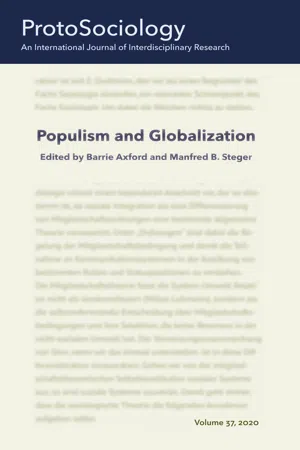
The narrative of populism as a "rising tide" has enjoyed currency at least since the election of Donald Trump in 2016 and the success of the "Leave" campaign in the UK referendum on membership of the EU earlier in that year. And yet, on the eve of what proved to be President Trump's election defeat some four years later, the British journalist Nick Cohen felt able to muse "(w)e're endlessly told why populism works. Now see how it might fail" (October 10, 2020). So, one might be forgiven for thinking that what goes around must eventually come around. However, things are not that simple, and the runes are harder to read.
- 238 pages
- English
- ePUB (mobile friendly)
- Available on iOS & Android
eBook - ePub
About this book
Information
Concepts and Contexts
Defining Populism and Fascism
Relationally: Exploring Global
Convergences in Unsettled Times
Paul James
Abstract
What is the relationship between right-wing populism and contemporary fascism? How has fascism changed since the 1920s? And how do the answers to these questions concern a global shift that can be called the Great Unsettling—including a postmodern fracturing of prior modern ‘certainties’ about the nature of subjectivity, political practice and meaning, deconstructing the consequences of ‘truth’? This essay seeks to respond to these questions by first going back to foundational issues of definition and elaborating the meaning of populism and fascism in relation to their structural ‘moving parts’. Using this alternative scaffolding, the essay argues that right-wing populism and an orientation to postmodern fascism represented by Donald Trump and Jair Bolsonaro have converged. The context of this convergence is a globalizing shift that now challenges democratic politics.
What rough beast is this thing called ‘populism’? And how, if at all, does it relate to authoritarian nationalist movements and fascisms? If we can immediately say that like those far-right phenomena, contemporary populism gains strength from civic conditions of upheaval and uncertainty, then a further question arises. What are the particular globallocal uncertainties that now give rise to contemporary right-wing populism and fascism? Some commentators have turned back to W.B. Yeats’ poem ‘The Second Coming’ (1919) to register the momentousness of the widening upheaval: ‘And what rough beast, its hour come round at last, / Slouches towards Bethlehem to be born?’ However, even this slumping evocation does not help directly. Yes, Yeats was writing during the civil chaos of his homeland and in the wake of the first global war, but his primary lament is the modern assault on the stability of tradition, faith and truth. Yes, just as the ontological form of classical fascism was modern, contemporary populism has a modern constitutive layer, but confounding any simple characterization, contemporary populisms at the same time both generate new postmodern uncertainties and speak in the name of rooted values or tradition. They seek both to globalize their cause and to project the enhancement of ‘their’ nation against the world. And they both undermine epistemologies of modern and traditional truth, while claiming to voice matters of deeper verity.1
This essay seeks to define contemporary populism and fascism in the face of these convergences and contradictions, woven around four propositions. First, across the past few years we have been witnessing the consolidation of a new right-wing national populism which has clear associative connections with the content and form of the authoritarian nationalist populism that characterized 1920s to 1930s’ fascism. The concept of ‘associative connections’ is important here. Contrary to Frederico Finchelstein’s argument that ‘Modern populism was born out of fascism’ (2017: xxxiii), I am not suggesting that they have an intertwining historical genealogy except contingently and to the extent that fascism characteristically uses a populist form of address.2 And coming from a different angle, I am certainly not suggesting that contemporary right-wing populism is the soft masking of a deeper continuous history of fascism, even if contemporary populism in some of its guises and expressions can be fascist. Fascism is not a continuous brown thread twisting its way through modern history. Both populism and fascism are sensibilities and practices which arise because of people acting under very particular conditions.
The second proposition emphasizes a core temporal change. Despite a family resemblance, the new fascisms and populisms are based on bundling together very different kinds of constituency than either classical fascism of the 1920s–1940s or the populisms of the early twentieth century. This constituency cannot be understood predominantly in terms of the classical modern subjectivities of followership, loyalty and character. Rather they are clusters of persons formed through the tension between modern identity formation and postmodern projective individualism. This constituency of individuals tends to follow leaders contingently rather than with brown-shirt discipline. They think of themselves as informed political actors, often using the Internet to research circumstantial connections (a.k.a. conspiracy theories) that explain the tortured ties that bind their enemies. Third, this changed constituency makes the present ‘fascist turn’ of contemporary right-wing populism more uneven, more jagged and inconsistent than earlier formations, and thus more fragile than classical fascism—though potentially just as dangerous. Fourth, despite its anti-globalization rhetoric, the latest round of populist/fascist expressions have been fueled by intensifying processes of disjunctural globalization.
Taking these as points of orientation rather than as propositions to be developed in themselves, the essay is structured around an attempt to set out a list of moving parts of populism and fascism, and to set up useful working definitions. These two tasks are not the same thing, though the second should in theory become easier having explored the first. Nor are these two tasks simple: ‘populism’ and ‘fascism’ are essentially contested terms with countless definitions—most of which have problems. Nevertheless, to begin to discuss how contemporary populism and fascism might relate, it is necessary to at least establish the definitional ground for distinguishing between them. What are the criteria for a good definition? For one, a definition does not operate as an ideal type or pure form. Isaiah Berlin called such an approach ‘the Cinderella complex’:
that there exists a shoe—the word ‘populism’—for which somewhere there must exist a foot. There are all kinds of feet which it nearly fits, but we must not be trapped by these nearly fitting feet. The prince is always wandering about with the shoe; and somewhere, we feel sure, there awaits a limb called pure populism. This is the nucleus of populism, its essence (Berlin 1967, 8).
In short, a definition does not name a pure essence. However, having identified this definitional problem, it needs to be quickly added that evoking the Cinderella trope has all too often been used to avoid the difficult task of defining this complex constellation of phenomena (Canovan 1981; Fuentes 2020; cf. Tarchi 2013). For example, in a book that is supposed to lay foundational groundwork of understanding two basic phenomena, fascism and the far right, Peter Davies and Derek Lynch (2002) discuss problems of definition, and they include a glossary that seems to define everything else associated with those core concepts, but they perpetually defer defining ‘fascism’ and ‘far right’ as concepts in themselves.
More than that, there is consistent confusion in the literature based on conflating the two tasks of definition and characterization: a list of moving parts or orientations (characterization) does not automatically translate into a good definition, and nor should it. We still need to name the foundational features of a phenomenon (definition), if only to distinguish it from other things. In other words, the false reasonableness of invoking the Cinderella complex cannot be used as an excuse for embarking on the path around Kafka’s castle, circling round and round the phenomena without ever settling on what it actually is. All too often, writers fall back on either the Wittgensteinian notion of ‘family resemblance’, using that concept without the care it requires, or alternatively listing a series of characteristics or possible features to stand in for a definition.3 They suggest that when you find enough of these variable features you have found the thing. This has its own problems. For example, David Arter writes: ‘There is general agreement in the comparative literature that populism is confrontational, chameleonic, culture-bound and context-dependent’ (2010, 490). Given that all political phenomena align with at least two of those characteristics— culture-bound and context-dependent—and many with the other two as well, this is not a very helpful list.
We certainly need a set of orienting characteristics, but its elements should have meaningful specificity while allow for historical and geographical variation. That is our first task. Working definitions will follow. Here definitional nuance is intended to give us a fine-grained account of two movements within the tangled changes of contemporary globalization. In particular, the essay treats these phenomena within a global shift towards the emergence of a postmodern unsettling (Steger and James, 2019). That is, more than offering (just) a useful and novel exegesis of the concepts, this essay is intended as a contribution to understanding the disjunctures and convergences of our world-in-common.
What is Populism?
It does not matter much where we start in our quest to list a basic set of working parts relevant to populism. To begin with an obvious but often overlooked point, the term ‘populist’ in contemporary usage tends to be applied politically and analytically to others, usually by those who are deemed the enemies of ‘good’ populists: journalists, academics, establishment politicians, and other elites. Although occasionally a populist leader will provocatively acknowledge the term as relevant to defining their politics, there are now no self-identified national populist movements, and certainly no self-proclaimed global populist movements. This does not mean that there are no national or globalizing populist movements. It means, in the first instance, that naming a practice or ideology as populist does not suggest that its proponents will necessarily identify themselves as such. Taken from a different angle, it also implies that a definition should be normatively open enough for those who are identified by that name to potentially identify with it—even if they never do.4
This point can be added to our criteria for a good definition, but it is also relevant to the nature of populism: it tends not to name itself as such, and when it does, at least contemporarily, it leans towards doing so as an act of irony or provocation. Marine Le Pen, leader of the French National Rally (Rassemblement national), once famously responded to journalists saying, ‘If [populism] means a government of the people, by the people and for the people, well then, I am a populist (Le Pen 2013).5 The obvious problem here is that Le Pen is disingenuously skewing a well-known definition of democracy towards naming populism. The loose resemblance depends upon her fudging the populist meaning of the concept of ‘people’. Populism, as distinct from democracy, does not inclusively address ‘all the people’ in a political community; it separates out some of those people as the Others to its core rassemblement.
Here, in this simple example, we arrive at a second and third elemental characteristic of all populisms, including national, right-wing and left populism. The second: populism gathers its ‘people’ by excluding some: in particular, those it explicitly names as Others. For the Right this group of Others variously includes outsiders, elites, technocrats, or establishment figures, as well as those who would intrude across the boundaries of the nation-state: refugees and uninvited migrants. Left populism is rhetorically more inclusive in addressing ‘the people’, but nevertheless does define its Others, albeit in class or kindred terms. The third: populists work around a core ideological invocation of the will of the people or some variation—even if this ideology is loosely developed and often contradictorily applied. This characteristic of invoking and speaking to the aspirations of ordinary people against others, ushers in a further dimension: the active tendency to identify its counter-expressions—its enemies. As Victor Órban (2020) intoned during his 2020 State of the Nation speech: ‘Enemies all around us. This meant political quarantine, economic isolation, debilitated national defence, cultural solitude and spiritual loneliness.’ He then characteristically identifies the enemy as producing a long struggle: ‘So, we hunkered down and set our sights on survival. We knew we had to wait: wait until the enemy state formations weakened, and the key was duly given to us.’ And thus, the speech moves to a further dimension—projected hope and redemption. Órban continues: ‘This is what happened. Legend has it that one hundred years ago, Apponyi also said that although Hungary’s grave had been dug, we Hungarians would be there at the funerals of our gravediggers.’
Towards a List of the Moving Parts of Populism
Instead of elaborating upon this discussion of the characteristics of populism, which others have done with much more depth and acuity (Wiles 1969; Müller 2016; Axford 2021), drawing upon those writings and others we can now lay out the combinate orientations of populism. Ten categories have been chosen in order to facilitate a meaningful comparison with fascism in the next section; it could have been many more, but ten is a classic number of sufficient complexity to cover what we need:
1. Appellation: a tendency not to name itself as such.
2. Constituency: an amorphously defined but (assumed) politically related community of individuals, excluding specified Others such as ‘elites’. This constituency is variously ‘the people’ or ‘the nation’, as distinct from all citizens of a nation-state in the formal universal sense or denizens in the broad geographical sense.
3. Communication: a politics of spectacle and hope, addressing ‘the people’, and appealing to those who are frustrated, humiliated, frightened, or who at least are either seeking some kind of future redemption or return to a stronger past. An evocative and concrete use of language, drawing upon stories and images expressing the hopes of ordinary people. An amplification of the voice and face of the leader through extended communications technologies that are managed so as to emphasize the unmediated and the authentic.
4. Ideology: a variable set of framing ideas depending upon context and time, sometimes thick with associative connections to nationalism and anti-globalism, sometimes thin.
5. Subjectivity: a culture of heroism, focussing on the individual who becomes strong by acting in concert with others. A variable orientation to gender and ethnic relations (at least in relation to those who are part of ‘us’), though tending to follow mainstream understandings for good and ill.
6. Leadership and followership: an exaltation of the strong leadership of an outsider to mainstream politics, thus involving a contradictory advocacy of popular elitism, without that leader necessarily being skilled at the art of governance. ...
Table of contents
- Table of Contents
- Editorial: The Globalization of Populism
- Part I Concepts and Contexts
- Part II Global and (G)local incursions
- On Contemporary Philosophy
- Contributors
- Imprint
- Subscription – eBooks and Books on Demand
- Book Publications of the Project
- Copyright
Trusted by 375,005 students
Access to over 1.5 million titles for a fair monthly price.
Study more efficiently using our study tools.
Frequently asked questions
Yes, you can cancel anytime from the Subscription tab in your account settings on the Perlego website. Your subscription will stay active until the end of your current billing period. Learn how to cancel your subscription
No, books cannot be downloaded as external files, such as PDFs, for use outside of Perlego. However, you can download books within the Perlego app for offline reading on mobile or tablet. Learn how to download books offline
Perlego offers two plans: Essential and Complete
- Essential is ideal for learners and professionals who enjoy exploring a wide range of subjects. Access the Essential Library with 800,000+ trusted titles and best-sellers across business, personal growth, and the humanities. Includes unlimited reading time and Standard Read Aloud voice.
- Complete: Perfect for advanced learners and researchers needing full, unrestricted access. Unlock 1.5M+ books across hundreds of subjects, including academic and specialized titles. The Complete Plan also includes advanced features like Premium Read Aloud and Research Assistant.
We are an online textbook subscription service, where you can get access to an entire online library for less than the price of a single book per month. With over 1.5 million books across 990+ topics, we’ve got you covered! Learn about our mission
Look out for the read-aloud symbol on your next book to see if you can listen to it. The read-aloud tool reads text aloud for you, highlighting the text as it is being read. You can pause it, speed it up and slow it down. Learn more about Read Aloud
Yes! You can use the Perlego app on both iOS and Android devices to read anytime, anywhere — even offline. Perfect for commutes or when you’re on the go.
Please note we cannot support devices running on iOS 13 and Android 7 or earlier. Learn more about using the app
Please note we cannot support devices running on iOS 13 and Android 7 or earlier. Learn more about using the app
Yes, you can access Populism and Globalization by Barrie Axford, Manfred Steger in PDF and/or ePUB format, as well as other popular books in History & World History. We have over 1.5 million books available in our catalogue for you to explore.