This is the first book to fully adapt the principles of agility for government leaders who want to make their organizations more effective and nimble while better serving their public mission. This practical resource will equip government leaders at all levels with evidence-based, hands-on guidance for transforming their organizations, enabling them to better serve the public and their customers. While many books focus on organizational agility for leaders of for-profit companies, this is the first one tailored to the unique requirements government leaders face. They must find a way to accomplish their mission while navigating constant change. Government leaders at all levels must maneuver their organizations through new, often complex challenges, ranging from new laws that impact their agencies, new technologies, changes in leadership, and unexpected events. By explaining how to manage and organize work differently, this guide will help leaders weather the storm of that constant change so they can help their agencies realize their missions and serve the public interest.
eBook - ePub
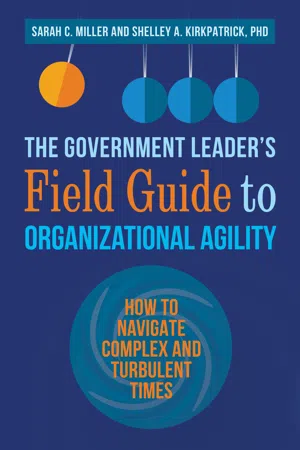
The Government Leader's Field Guide to Organizational Agility
How to Navigate Complex and Turbulent Times
- 288 pages
- English
- ePUB (mobile friendly)
- Available on iOS & Android
eBook - ePub
The Government Leader's Field Guide to Organizational Agility
How to Navigate Complex and Turbulent Times
About this book
Information
ONE
Constant Change Requires a Different Way of Organizing
Let’s start with a story about a leader named Blair, who realizes that her organization and team face many challenges. She knows that the changes will not go away. In fact, the number and pace of changes will only increase, resulting in more complex and unexpected changes to deal with. Blair is just starting to see the need to find a different way of approaching work.
Blair, a mid-level manager in the acquisition department of a large government agency, gets settled in her home office. Some days Blair works remotely to give her space for deep, focused work; other days she heads into the office for face-to-face meetings. To start her workday, she thinks about her plan for the day. She logs into email, checking to see which problems will likely consume her day and take her away from the project she’s been trying to launch. A message from her boss, Ms. Barton, catches her eye—it’s a memo to their department of about a thousand employees. Ms. Barton has just attended a virtual contracting conference and has decided that the department needs to become “more agile” to meet increasing demand for the department’s contracting services. Blair shakes her head, muttering, “Whatever that means!” Reading between the lines of the email, she starts to think about how this coming change will be just another way to squeeze more hours out of her and her staff. There certainly will be no increases to their budget, and her department is already understaffed, with several unfilled positions.
Still, she agrees with her boss; they do need to speed up the acquisitions process, because it’s the only way to meet the demands of the program managers while also responding to constantly changing program needs. Being new to this job—she’d held a similar role in another agency until taking this position a month ago—Blair hasn’t even settled into a routine yet. She’d heard that this department had challenges before she applied, but she’s finding that the difficulties are more than just annoyances. They are obstacles to any kind of predictable productivity. In addition to the layers of regulations they have to legally adhere to in meeting-acquisition requests, her team is dealing with a lot of turbulence. The agency programs that they support have needs that are different from those in the past. The team’s make-up is also changing, as team members now transfer from other parts of the agency instead of staying in acquisition for their entire career as they used to do. As a result, team members typically have less expertise in acquisition but also more understanding of the agency’s mission. Team members are now working from home frequently too, so they might need new technologies to help them be more productive. She’s even hearing about new acquisition tools coming soon that use artificial intelligence to draft contracts. But it’s hard to stay on top of every new tool that’s out there. And while it used to be a rare snowstorm that disrupted the team’s work for a day or two, now it seems their work is disrupted for more reasons than ever—political factors, social unrest, pandemics. Add in all of the changes in the agency—new policies, changing regulations, major and minor restructurings, leaders coming and going—and it feels like a constant swirl of disruption.
And now, her boss wants her to make this dysfunctional organization “more agile”?!
Like Blair, you might find yourself saying that you just need to get ahead of the curve or that, if things would only slow down, your team would be able to reach its potential. Maybe you’ve found time to create a plan to examine how your team is approaching its work, only to find that the situation is more complex than you realized or that there’s no time to put the plan into place because unforeseen events constantly pop up.
TOOL 1.1: How Does Your Team Experience Change?
Let’s start with a quick check-in to see how complex and uncertain change generally affects your team. In the list of items below, place an X or checkmark along the line in the “Your Response” column to indicate how you and your team are experiencing change.
How Does Your Team Experience Change?
Item | Your Response | |
My team can’t keep up with the pace of change. |  | |
Does not describe my situation | Completely describes my situation | |
My team often feels that we’re behind the curve. |  | |
Does not describe my situation | Completely describes my situation | |
My team doesn’t have enough time to plan its work. | | |
Does not describe my situation | Completely describes my situation | |
Unexpected changes just keep coming. | | |
Does not describe my situation | Completely describes my situation | |
When we do develop plans, they are quickly outdated when the situation changes. | | |
Does not describe my situation | Completely describes my situation | |
The way we’re approaching our work is not getting us the results we need. | | |
Does not describe my situation | Completely describes my situation | |
Our workload keeps growing, yet we don’t have more resources. | | |
Does not describe my situation | Completely describes my situation | |
The demands on my time never seem to end. | | |
Does not describe my situation | Completely describes my situation | |
Despite all of the changes going on around us, my team is still expected to perform. | | |
Does not describe my situation | Completely describes my situation | |
Simply working harder or more hours isn’t enough to deal with all of the changes that affect my team. | | |
Does not describe my situation | Completely describes my situation | |
If most of your checkmarks are toward the right side of the line, then you are experiencing an unending number of demands on your time, budget, and staff that are compounded by rapid and unexpected change. Even if you believe in your employees, your boss, and your colleagues, and you are committed to your organization’s mission, you may not be getting the results that you want because the world around you keeps changing in ways that you don’t expect.
Unfortunately, our world is not likely to slow down or become less complex. The changes that you are experiencing are not likely to become more straightforward or easier to understand. If anything, changes are likely to come at you faster, in an even less predictable way.
If you were leading an organization a hundred years ago, things might not have been so chaotic. As the Industrial Revolution changed trade into business in the eighteenth and nineteenth centuries, decisions were made at the top of the organization for a reason: it was efficient to centralize authority. Leaders acquired the information they needed to make good decisions, which they then communicated to those who were required to follow them. Employees could, with relative ease, be quickly taught to carry out their part in a process; if one person left, another could be quickly trained to replace that person. In a stable environment, leaders had time to gather information, make an effective decision, communicate it, and expect that it would be followed.
Today, traditional organizational principles, such as command-and-control, centralized decision-making, and siloed departments, don’t always work well because the modern world’s expectations of authority have changed. Instead, in today’s constantly evolving environment, you need to find ways to help your colleagues and stakeholders adapt to changes while still being effective and efficient. That is, your organization needs to find a way to be more agile. We define organizational agility as being able to sense and respond to changes in both a timely and effective manner. Let’s explore this definition a bit more.
Everyone in your organization—all employees, those in leadership roles as well as individual contributors—should know what is going on in the world around them that might affect their work. We call this sensing. You might be paying attention to changes outside the organization—new laws or policies, societal trends, advances in technology, customers with new needs, or even naturally occurring events such as a pandemic or natural disaster—as well as changes from within the organization—reorganizations, leadership changes, policy changes, and budget or resource changes.
Once you know what’s going on around you, you can figure out what these changes mean to your mission and work. We call this interpreting. For example, you might read an article about a new software package and wonder if it could be used to do your work more efficiently; you could find another article to read, schedule a demo with the software company, and begin a conversation with your organization’s technology experts as well as with senior staff whose work might be impacted.
After figuring out that changes in your environment could affect the organization in unpredictable ways, you need to figure out what to do about it. We call this responding. You might decide to continue to keep an eye out to see if something that might change actually does. For example, you might attend a demonstration of the new software package and find out that it doesn’t do exactly what you need right now but that the developer plans to add features in the next version. So you ask your technology experts to let you know when the new version comes out.
On the other hand, you might decide that a certain change really isn’t something you need to worry about—it won’t affect the organization in any material way, so you don’t need to figure out how to respond. An example of this might be a new policy that updates certain regulations. You might read a memo that explains the update ...
Table of contents
- Cover
- Title Page
- Copyright Page
- Dedication
- Contents
- List of Tools
- Preface
- Chapter 1 | Constant Change Requires a Different Way of Organizing
- Chapter 2 | Build a Foundation of Psychological Safety
- Chapter 3 | Lead with Agility
- Chapter 4 | Make Decisions at the Right Level
- Chapter 5 | Promote Collaborative Learning
- Chapter 6 | Create Stability
- Chapter 7 | Create Flexibility
- Chapter 8 | Encourage the Routines
- Chapter 9 | Invest in People
- Chapter 10 | Putting It All Together
- Appendix: Organizational Agility Framework
- References
- Acknowledgments
- Index
- About the Authors
- About the Contributors
Trusted by 375,005 students
Access to over 1.5 million titles for a fair monthly price.
Study more efficiently using our study tools.
Frequently asked questions
Yes, you can cancel anytime from the Subscription tab in your account settings on the Perlego website. Your subscription will stay active until the end of your current billing period. Learn how to cancel your subscription
No, books cannot be downloaded as external files, such as PDFs, for use outside of Perlego. However, you can download books within the Perlego app for offline reading on mobile or tablet. Learn how to download books offline
Perlego offers two plans: Essential and Complete
- Essential is ideal for learners and professionals who enjoy exploring a wide range of subjects. Access the Essential Library with 800,000+ trusted titles and best-sellers across business, personal growth, and the humanities. Includes unlimited reading time and Standard Read Aloud voice.
- Complete: Perfect for advanced learners and researchers needing full, unrestricted access. Unlock 1.5M+ books across hundreds of subjects, including academic and specialized titles. The Complete Plan also includes advanced features like Premium Read Aloud and Research Assistant.
We are an online textbook subscription service, where you can get access to an entire online library for less than the price of a single book per month. With over 1.5 million books across 990+ topics, we’ve got you covered! Learn about our mission
Look out for the read-aloud symbol on your next book to see if you can listen to it. The read-aloud tool reads text aloud for you, highlighting the text as it is being read. You can pause it, speed it up and slow it down. Learn more about Read Aloud
Yes! You can use the Perlego app on both iOS and Android devices to read anytime, anywhere — even offline. Perfect for commutes or when you’re on the go.
Please note we cannot support devices running on iOS 13 and Android 7 or earlier. Learn more about using the app
Please note we cannot support devices running on iOS 13 and Android 7 or earlier. Learn more about using the app
Yes, you can access The Government Leader's Field Guide to Organizational Agility by Sarah C. Miller,Shelley Kirkpatrick in PDF and/or ePUB format, as well as other popular books in Business & Government & Business. We have over 1.5 million books available in our catalogue for you to explore.