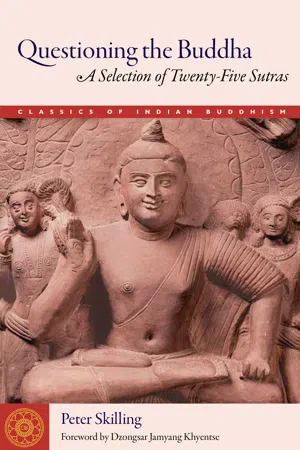
An important new book unlocking the words of the Buddha contained in the vast Tibetan canon, one of the main scriptural resources of Buddhism. In the forty-five years the Buddha spent traversing northern India, he shared his wisdom with everyone from beggar women to kings. Hundreds of his discourses, or sutras, were preserved by his followers, first orally and later in written form. Around thirteen hundred years after the Buddha's enlightenment, the sutras were translated into the Tibetan language, where they have been preserved ever since. To date, only a fraction of these have been made available in English. Questioning the Buddha brings the reader directly into the literary treasure of the Tibetan canon with thoroughly annotated translations of twenty-five different sutras. Often these texts, many translated here in full for the first time, begin with an encounter in which someone poses a question to the Buddha. Peter Skilling, an authority on early Buddhist epigraphy, archaeology, and textual traditions, has been immersed in the Buddhist scriptures of diverse traditions for nearly half a century. In this volume, he draws on his deep and extensive research to render these ancient teachings in a fresh and precise language. His introduction is a fascinating history of the Buddhist sutras, including the transition from oral to written form, the rise of Mahayana literature, the transmission to Tibet, the development of canons, and a look at some of the pioneers of sutra study in the West.Sutras included in this volume are: Four Dharmas Not to Be Taken for Granted; The Benefits of Giving; The Exposition of Four Dharmas; The Merit of the Three Refuges; Four Dharmas Never to Be Abandoned; Advice for Bodhisatva Dharmaketu; Advice for Bodhisatva Jayamati; Sutra Comparing Bodhicitta to Gold; Bodhisatva Maitreya's Question about the Gift of the Dharma; Four Summaries of the Dharma Spoken to the Naga King Sagara; The Stanza of Dependent Arising; The Heart Formula of Dependent Arising; Prediction of the Boy Brahmasri's Future Buddhahood; Ksemavati's Prediction to Future Buddhahood; The City Beggar Woman; An Old Woman's Questions about Birth and Death; The Questions of Srimati the Brahman Woman; The Questions of the Laywoman Gangottara; Brahma Sahampati's Question; Advice to King Prasenajit; Passage to the Next Life; Instructions for King Bimbisara; Instructions for King Udayana; Buddhas as Rare as a Grain of Golden Sand; and Predictions on the Eve of the Great Final Nirvana.
Frequently asked questions
Yes, you can cancel anytime from the Subscription tab in your account settings on the Perlego website. Your subscription will stay active until the end of your current billing period. Learn how to cancel your subscription.
At the moment all of our mobile-responsive ePub books are available to download via the app. Most of our PDFs are also available to download and we're working on making the final remaining ones downloadable now. Learn more here.
Perlego offers two plans: Essential and Complete
Essential is ideal for learners and professionals who enjoy exploring a wide range of subjects. Access the Essential Library with 800,000+ trusted titles and best-sellers across business, personal growth, and the humanities. Includes unlimited reading time and Standard Read Aloud voice.
Complete: Perfect for advanced learners and researchers needing full, unrestricted access. Unlock 1.4M+ books across hundreds of subjects, including academic and specialized titles. The Complete Plan also includes advanced features like Premium Read Aloud and Research Assistant.
Both plans are available with monthly, semester, or annual billing cycles.
We are an online textbook subscription service, where you can get access to an entire online library for less than the price of a single book per month. With over 1 million books across 1000+ topics, we’ve got you covered! Learn more here.
Look out for the read-aloud symbol on your next book to see if you can listen to it. The read-aloud tool reads text aloud for you, highlighting the text as it is being read. You can pause it, speed it up and slow it down. Learn more here.
Yes! You can use the Perlego app on both iOS or Android devices to read anytime, anywhere — even offline. Perfect for commutes or when you’re on the go. Please note we cannot support devices running on iOS 13 and Android 7 or earlier. Learn more about using the app.
Yes, you can access Questioning the Buddha by Peter Skilling in PDF and/or ePUB format, as well as other popular books in Theology & Religion & Buddhism. We have over one million books available in our catalogue for you to explore.
Tshal pa: P 916 (Otani repr. vol. 36, Mdo, zhu), D 250, CK 268. For location in the remaining Tshal pa Kanjurs, see Hackett, Catalogue, under CK 268. In the Them spangs ma it is in Mdo, pa: Stog Palace no. 117, Ulan Bator no. 167. In the Phug brag Kanjur it is in Mdo, na, no. 115.
Sources and Resources
The Caturdharmaka-sūtra, here the Four Dharmas Not to Be Taken for Granted, was translated during the early period. The Lhan dkar ma catalogue records a Sūtra on Four Dharmas (Chos bzi’i mdo) in thirteen ślokas under Hīnayāna sūtras as 306B, while the ’Phang thang ma registers a similar title (Chos bzhi pa’i mdo) under lesser or shorter [Hīnayāna sūtras] as no. 295. Bcom ldan Rigs pa’i ral gri registers a Chos bzhi pa’i mdo under assorted Lesser Vehicle sūtras (Theg pa chung ngu’i mdo sde sna tshogs, no. 7.60). Most probably these records refer to the present sūtra, which belongs to the Śrāvaka tradition or “the first turning of the wheel of the Dharma,” but we take note that other sūtras bear similar titles, and there is no guarantee that these entries refer to this text.340 The Four Dharmas Not to Be Taken for Granted is classified as a sūtra in the Tshal pa, Them spangs ma, and Phug brag Kanjurs. In the Tshal pa Kanjurs it is placed with several other sūtras that have the figure “four” in their titles.
Title
The formal title is Caturdharmaka-sūtra / Chos bzhi pa’i mdo, “Sūtra on Four Dharmas.” The sūtra is not described as a Mahāyāna sūtra in either the Sanskrit or Tibetan titles or in the colophon; the opening expression of “Homage to all buddhas and bodhisatvas” is, however, that which is usually reserved for texts of the Great Vehicle. There is nothing Mahāyānist about the contents. The use of “son or daughter of good family” as the ideal figure is, perhaps, more frequent in Mahāyāna sūtras than in Śrāvaka sūtras, but the phrase is also used in the latter, including in Pali suttas.
Translators
There is no translators’ colophon in either the Tshal pa, Them spangs ma, or Phug brag Kanjurs. Representatives of the Them spangs ma tradition (the Ulan Bator, Stog Palace, and Tokyo manuscripts) state at the end that the text belongs to the “teaching of the first turning of the wheel” (bka’ ’khor lo dang por gtogs pa’o), that is, to the Śrāvaka tradition.341
Sanskrit Versions
No Sanskrit versions are known to survive.
Chinese Translations
There is no Chinese translation.
Citations and References
So far I have not met with any citations or references.
Modern Studies and Translations
Alexander Csoma de Kőrös summarizes the text as follows: “Four things to be avoided by every wise man.”342 Léon Feer published a French translation of the sūtra in 1883.343
Setting
The Fortunate One teaches the discourse to 1,250 monks in Anāthapiṇḍada’s Garden in Prince Jeta’s Grove at Śrāvastī.
Contents
The short sūtra is in prose and verse. The Fortunate One addresses the monks “in a sonorous, deep, sweet, and resonant voice.” This module is used occasionally in sūtra literature, for example in the Arthaviniścaya-sūtra.344 The Buddha’s voice is special, and it is described as sweet or “as sweet as the voice of the lord of the gods.”345 Narratives refer in passing to the Buddha speaking with brahmasvara, the “voice of a Brahmā” or a “divine voice,” as, for example, in the Ratnolka-dhāraṇī.346 As one of the marks of a great male, brahmasvara is often evoked in eulogies of buddhas and is described as having sixty qualities.347
The Buddha explains “four things that an intelligent son of good family should not take for granted as long as he lives.” These are worldly fantasies: to enjoy oneself with women, to enjoy oneself at the court, to be perpetually good-looking, and to be perpetually rich.
At the end, the Sugata delivers two verses. The first summarizes the preceding prose, while the second gives metaphors for impermanence. The two verses occur at the end of the Connected Sūtra on Moral Conduct (Śīlasaṃyuktaka-sūtra) as well. In the Tibetan translation preserved in the Sūtra division of Kanjurs, the verses are nearly identical to those of the present sūtra.348 A Sanskrit version of the Connected Sūtra on Moral Conduct has been published as text 9 in the tenth- to eleventh-century Potala manuscript.349 Both the Sanskrit and the Tibetan versions of this text contain an additional intervening verse that answers the rhetorical questions posed in the first verse. The verses then read:350
How can it be fitting to resort to women?
What joy can there be in the royal palace?
What substance can there be in a water bubble?
How can wealth ever endure?
Women are unsuitable;
there is no pleasure in the exercise of power.
There is no substance in foam;
there are no pleasures that last.
Possessions are like a mountain stream,
house and home are like a boat.
The human body is like a flower,
and life is but a water bubble.
Neither the Sanskrit nor the Tibetan version of the Connected Sūtra on Moral Conduct is described as a Mahāyāna text; like the present sūtra, it is placed in the “Hīnayāna section” of Tshal pa Kanjurs.
Ancient Indian literature privileges the male and the male viewpoint. Composed from the perspective of the male warrior (kṣatriya) caste and of male monastics, Buddhist literature follows suit. Literature responds and speaks to the social situations of its time. This does not mean that texts like the present sūtra consciously or ideologically exclude the female view or role. Far from it: they point out hard realities of the society of the time and of the (largely male) monastic institution. Four Dharmas Not to Be Taken for Granted is addressed to society as a whole rather than monks alone. The Four Dharmas teaches the instability and impermanence of human existence in order to discourage us from grounding our values on a foundation of insubstantial and unattainable goals. It teaches us not to chase after bubbles. For the modern reader, the ideas might be reformulated as, “All relationships, social standings, pleasures, and wealth are unstable and unreliable.”
FOUR DHARMAS NOT TO BE TAKEN FOR GRANTED
Homage to all buddhas and bodhisatvas.
This is what I have heard. Once the Fortunate One was staying in Śrāvastī, at Anāthapiṇḍada’s Garden in Prince Jeta’s Grove, together with a large community of 1,250 monks. At that time, the Fortunate One addressed the monks in a sonorous, deep, sweet, and resonant voice:351
“Monks, there are four things that an intelligent son of good family should not take for granted as long as he lives. What are the four?
“Monks, as long as he lives, an intelligent son of good family should not take for granted the notion that he will perpetually be able to indulge himself with women.
“Monks, as long as he lives, an intelligent son of good family sho...