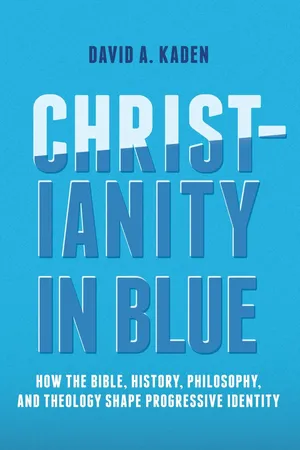
Today's social and political climate often pits conservative or traditional Christianity against "progressive" Christianity. But what is progressive Christianity? What is a progressive Christian? What is a progressive church? Christianity in Blue answers these questions by drawing from biblical scholarship, Christian history, theology, popular culture, philosophy, and cultural anthropology. Kaden shows how socially liberal values and progressive attitudes can be the fruits of taking seriously both the Bible and Christian tradition. But rather than treating these sources as static authorities and the final word on every subject, Kaden argues that they are places to start one's exploration of how to be a Christian in the world. Being a progressive Christian is an ethical exhortation to "uplift human personality," as Martin Luther King Jr. once said. This exhortation structures how progressive Christians receive, interpret, and apply the Bible and Christian tradition to daily life. A robust tradition provides an anchor to avoid the illiberal trends in contemporary society, and a commitment to uplifting human personality provides a check against dehumanizing uses of Scripture and tradition. Christianity in Blue will help both progressive and conservative Christians better understand the importance of the Bible, theology, history, and philosophy for building a loving church for everyone.
eBook - ePub
Christianity in Blue
How the Bible, History, Philosophy, and Theology Shape Progressive Identity
- 200 pages
- English
- ePUB (mobile friendly)
- Available on iOS & Android
eBook - ePub
Christianity in Blue
How the Bible, History, Philosophy, and Theology Shape Progressive Identity
About this book
Information
Topic
Theology & ReligionSubtopic
Christian Denominations1
What Is Progressive in Progressive Christianity?
For centuries, Christianity has been presented as a system of beliefs. That system of beliefs has supported a wide range of unintended consequences, from colonialism to environmental destruction, subordination of women to stigmatization of LGBT people, anti-Semitism to Islamophobia, clergy pedophilia to white privilege. What would it mean for Christians to rediscover their faith not as a problematic system of beliefs, but as a just and generous way of life, rooted in contemplation and expressed in compassion, that makes amends for its mistakes and is dedicated to beloved community for all? Could Christians migrate from defining their faith as a system of beliefs to expressing it as a loving way of life?
—Brian McLaren, The Great Spiritual Migration
A religious community that believes itself to be in possession of “the Truth” is a community equipped with the most lethal weapon of any warfare: the sense of its own superiority and mandate to mastery.
—Douglas John Hall, The Cross in Our Context
“You’re socially liberal and a theologian? How do you reconcile what the Bible says with how you see the world?” My cousin texted this question to me because she wanted clarity. In her mind, and in the minds of many, “liberal” and “what the Bible says” are at odds. For her and many others, “what the Bible says” are the four words guaranteed to shut down all critical thinking. They signal that God is an abusive and militaristic king-in-the-sky, that LGBTQ+ people are an abomination, that climate change is not a concern, that doubt is sinful, that abortion is murder, and that the pages of the Bible are filled with judgmentalism and a host of arcane moral rules. These words suggest that the only point of being a Christian is to enjoy postmortem bliss with angels and harps in heaven, that evolution is wrong, that Christians must be political conservatives, and that tax cuts for the rich are fine because Jesus once said the poor will always be with us. The list goes on and on.
But what if “what the Bible says” is open-ended? What if we viewed the Bible and our Christian tradition as conversation starters instead of as the final words on any topic? What if we decide within a community of fellow faith journeyers what our sacred text and sacred tradition can mean today? What if meaning is not something etched into the stones of the theological past but something living, changing, and always needing to be reforged for new times? What if we treated the Bible and Christian tradition as invitations to question, wonder, think critically, and then act with faith-driven purpose in celebration of our common humanity to change our world for the better?1 My hope is that in reading this book, you will get excited about progressive Christianity, its vision for the world, its compassion for every human being and for all of creation, and its ancient roots in Christian tradition—what poet Christian Wiman calls “this strange, ancient thing.”2 I also hope you will gain a greater appreciation for the Bible, the sacred Christian text. More than just appreciating it, I hope you will feel liberated to doubt it, question it, interrogate it, and learn to read it in new ways.
I realize that in promoting a progressive Christianity, I am swimming against the current of recent writing that has criticized progressive Christianity from multiple directions. Conservatives have asserted that progressive Christianity is a kind of Christianity-lite, which avoids all talk of personal sin and champions superficial love. More radical critics charge that progressive Christianity clings too closely to ancient forms of theology without taking seriously enough the earthshaking significance of writers like Friedrich Nietzsche, Karl Marx, and Sigmund Freud. I also realize that using a category like “progressive Christianity” can be problematic for many reasons. I will address these criticisms and problems in due course, but I remain convinced that there are good reasons to be a progressive follower of Jesus Christ in the twenty-first century—reasons that are rooted and anchored in tradition and sound exegesis of the Bible, that are philosophically sophisticated, politically engaged, and personally and socially liberating.
I once believed that “what the Bible says” was the final word on pretty much every topic from ethics to politics to theology because I believed the Bible was inerrant (without error). The Bible for me was a conversation closer. Ironically, my views changed dramatically at an evangelical seminary where the Bible was revered as inerrant. While researching the doctrine of inspiration (the view that the Bible is inspired by God and thus error-free), I was surprised to discover how widespread the disagreement was among twentieth-century evangelical theologians over the meaning of the word inerrant. I struggled to find even two evangelical theologians who shared identical views on the topic. Some considered the Bible inerrant in its presentation of history, science, ethics, and theology. Others judged it inerrant only in its ethics and theology, since evolution has made a literal interpretation of the Bible’s creation stories impossible, and plenty of discrepancies exist in the Bible’s presentation of history. Still others argued that the Bible is inerrant with respect to its intent, even if its presentation of details is jumbled, while some insisted it was inerrant with respect to its ideas if not its exact words. I soon discovered that the word inerrant was an empty signifier, an identity marker without a stable meaning. As long as one says they believe the Bible is inerrant (in whatever way they choose to define the word), they can be in the evangelical club.3
But I came to believe that if evangelical Christianity was grounded in the belief that the Bible is God’s inerrant word and the professional evangelical theologians couldn’t agree on the meaning of the term, then I could no longer be an evangelical. If the central evangelical doctrine of inerrancy was emptied of meaning, then the entire evangelical edifice was, for me, a house of cards. I graduated from an evangelical seminary with the highest honors but no longer self-identified as an evangelical.
I went on to Harvard Divinity School (a decision that two of my former professors tried to talk me out of), served churches as a minister, and eventually completed a PhD in the academic study of religion at the University of Toronto’s Department for the Study of Religion. In these quite different academic settings, I learned to think critically as a scholar and to deal in a world of evidence-based reasoning, skepticism, uncertainty, the careful application of a method, and clear argumentation. In both schools, I met thoughtful Christians who were critical, open about their doubts and questions, and yet committed to being followers of Christ within the church. One of my advisors at Harvard was an ordained minister in the Swiss Reformed Church and would speak eloquently about his personal faith. Another was a leading feminist theologian and a faithful Catholic. My gospels professor was ordained in the Lutheran Church and a committed Christian who preached regularly in his home church near Boston. One of my professors at U of T had an encyclopedic knowledge of modern Christian theology and remains a dedicated Anglican who leads prayers in his home cathedral. As both critical scholars and serious Christians, they taught me to think for myself and to evolve both as an academic and as a Christian.
In my evangelical seminary days, I was taught that homosexuality was an abomination and that doubt in matters of faith was a sin. But at Harvard and Toronto, I met students who were both committed Christians and openly gay, pursuing ordination in their home denominations. I also met students and faculty who took solace in liberal thinkers such as Paul Tillich, a theologian notable for being honest about doubt and serious about faith. Meeting these “liberal” Christians, listening to their stories, hearing about their personal testimonies, and reading their books and articles were completely eye-opening. These people became human beings to me, Christian human beings with flesh-and-blood stories. They were not the heretics that I had been warned about. They were not objects to be despised and sneered at. They were people. Followers of Christ who digested Scripture, albeit critically; prayed fervently; attended church regularly; and changed my life.
Like Ati, the protagonist in Boualem Sansal’s novel 2084 whose life was transformed when he realized that there was a whole other world beyond the borders of his narrow, conservative religious one, I had an experience of irrevocable liberation. “A bird that leaves its cage, even just for a single flap of its wings,” Sansal writes, “cannot return.”4
I went on to teach in colleges and universities in Canada and the United States but felt a pull back to the church. I am now a minister in the United Church of Christ (UCC)—one of America’s most progressive Christian denominations. I am a committed progressive Christian and an academic who has fled the cage of conservatism. I study the Bible with the critical eye of a scholar and with the openness of a believer, and I serve a church in a college town.
I am a UCC minister in Ithaca, New York. Ithaca is named after the kingdom of Odysseus, the Greek hero of the Homeric epic, and is home to Cornell University and Ithaca College. Ithaca is also a haven of natural beauty—gorges, waterfalls, Cayuga Lake, sweeping landscapes—each the result of sliding glaciers from the last ice age some ten thousand years ago. “Ithaca is gorges” is a common slogan here. As a college town isolated by hills, gorges, and lots of water (or, as some snidely call it, “ten square miles surrounded by reality”), Ithaca is a teeming hive of wineries, microbrew pubs, sports bars, theaters, local mom-and-pop stores, hemp stores, coffee shops, farmers’ markets, tattoo parlors, and two of the groups most hostile to organized religion: millennials and ex-hippie baby boomers. I sometimes joke with my clergy friends that if a church can thrive here in Ithaca, it can thrive anywhere. Ithaca is a town where there is a good chance the local barista has a PhD, a geologist lives next door to you, and people will hang rainbow flags instead of American flags on their front porches (or sometimes hang both flags next to each other). But it is also a town of straitlaced lawyers and business types, professors, students, and small-business owners. Ithaca is eclectic.
My church is as eclectic as Ithaca itself. Our membership includes Cornell and Ithaca College professors and students, university and college administrators, school teachers, shop managers, lawyers, retirees, stay-at-home dads and moms, doctors, bankers, employees of nonprofits, librarians, museum curators, social workers, quilters, potters, scientists, vegans, Shakespeare scholars, real estate agents, art historians, economists, musicians and singers, novelists, painters, LGBTQ+ advocates, peace and justice activists, ex-clergy, retired clergy, recovering evangelicals, recovering Catholics, practicing Catholics, doubters, atheists, agnostics, practicing Jews, and even Buddhists. Our worship is traditional, as are our prayers and liturgies, but our theology is not. Our Christian tradition, like our Bible, is a conversation starter and not the final word on any topic. As a progressive Christian church, we proudly wave a rainbow flag on our front lawn, talk about God as a “She” or “Mother,” critically read passages in the Bible against each other, and openly acknowledge our doubts and questions. We take seriously the fact that each one of us is on our own spiritual journey—a journey that will twist and turn over sometimes rocky, craggy terrain and is as unpredictable as life itself.
In spite of this up-and-down reality of the faith journey, one thing we all share in common in our church—and I include myself in this “we all” because I too have doubts and questions and struggle at times with skepticism and uncertainty on my journey of faith—is that we value our Christian heritage, our sense of rootedness in a deep, rich tradition. We sing old hymns, we regularly recite the ancient Lord’s Prayer, and we appreciate the homiletic challenge of the sermon that updates our Christian tradition for today. In the spirit of the earliest Christians, we share dish-to-pass meals and care for those in need. In the spirit of the Hebrew prophets, we work for justice in our town and world. In the spirit of Jesus, we try to treat everyone we meet as a beloved child of God. In the spirit of people of faith all over the world, we believe there is more to life than the bland, bourgeois materialism that forces us to grind out a daily existence to pay bills and save for retirement wh...
Table of contents
- Cover
- Title Page
- Copyright Page
- Contents
- Acknowledgments
- 1. What Is Progressive in Progressive Christianity?
- 2. Of God and Bubbles
- 3. Pictures of Jesus
- 4. Saint Paul the Progressive
- 5. Designing a Loving and Progressive Church Where No One Is Out
- Recommended Resources
- Bibliography
- Index
Trusted by 375,005 students
Access to over 1.5 million titles for a fair monthly price.
Study more efficiently using our study tools.
Frequently asked questions
Yes, you can cancel anytime from the Subscription tab in your account settings on the Perlego website. Your subscription will stay active until the end of your current billing period. Learn how to cancel your subscription
No, books cannot be downloaded as external files, such as PDFs, for use outside of Perlego. However, you can download books within the Perlego app for offline reading on mobile or tablet. Learn how to download books offline
Perlego offers two plans: Essential and Complete
- Essential is ideal for learners and professionals who enjoy exploring a wide range of subjects. Access the Essential Library with 800,000+ trusted titles and best-sellers across business, personal growth, and the humanities. Includes unlimited reading time and Standard Read Aloud voice.
- Complete: Perfect for advanced learners and researchers needing full, unrestricted access. Unlock 1.5M+ books across hundreds of subjects, including academic and specialized titles. The Complete Plan also includes advanced features like Premium Read Aloud and Research Assistant.
We are an online textbook subscription service, where you can get access to an entire online library for less than the price of a single book per month. With over 1.5 million books across 990+ topics, we’ve got you covered! Learn about our mission
Look out for the read-aloud symbol on your next book to see if you can listen to it. The read-aloud tool reads text aloud for you, highlighting the text as it is being read. You can pause it, speed it up and slow it down. Learn more about Read Aloud
Yes! You can use the Perlego app on both iOS and Android devices to read anytime, anywhere — even offline. Perfect for commutes or when you’re on the go.
Please note we cannot support devices running on iOS 13 and Android 7 or earlier. Learn more about using the app
Please note we cannot support devices running on iOS 13 and Android 7 or earlier. Learn more about using the app
Yes, you can access Christianity in Blue by David A. Kaden in PDF and/or ePUB format, as well as other popular books in Theology & Religion & Christian Denominations. We have over 1.5 million books available in our catalogue for you to explore.