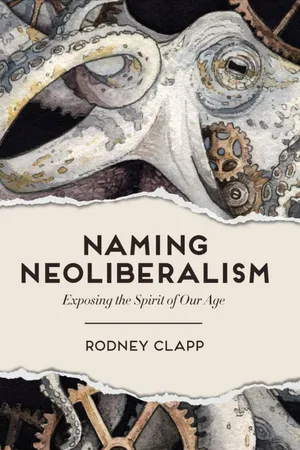
Neoliberalism is the reigning, overarching spirit of our age. It consists of a panoply of cultural, political, and economic practices that set marketized competition at the center of social life. The model human is the entrepreneur of the self. Though regnant, neoliberalism likes to hide. It likes people to assume that it is a natural, deep structure--just the way things are. But in neoliberalism's train have come extreme inequality, economic precariousness, and a harmful distortion of both the individual and society. Many people are waking up to the destructive effects of this order. Anthropologists, economic historians, philosophers, theologians, and political scientists have compiled considerable literature exposing neoliberalism's pretensions and shortcomings. Drawing on this work, Naming Neoliberalism aims to expose the order to a wider range of readers--pastors, thoughtful laypersons, and students. Its theological base for this "intervention" is apocalyptic--not in the sense of impending doom and gloom, but in the sense of centering on Christ's life, death, and resurrection as itself the creation of a new and truer, more hopeful, and more humane order that sees the principalities and powers (like neoliberalism) unmasked and disarmed at the cross. The book carefully lays out what neoliberalism is, where it has come from, its religious or theological pretensions, and how it can be confronted through and in the church.
- 200 pages
- English
- ePUB (mobile friendly)
- Available on iOS & Android
eBook - ePub
About this book
Information
Topic
Theology & ReligionSubtopic
Christian Theology1
AFTER LIBERALISM
What are people? According to liberalism, people are first, foremost, and finally individuals. They are best understood and appreciated in distinction from any social or political ties they may have or that might bind, possess, grasp, or define them. They are constituted atomistically, apart from their families, countries, faith communities, classes, ethnicities, sexes, vocations, or places in the flow of history.
And what are people for? According to liberalism, individuals exist for freedom. The freedom that engages them is one of choice. They are to strive for autonomy, for liberating themselves from any external authorities (religions, ways of life, customs) that would place or constrain them. “Sapere aude!” cried the early liberal philosopher Immanuel Kant: “Think for yourself!”1 The freedom liberalism seeks preeminently to guard is a negative freedom, a freedom from the interference of or dependence on others.
From roughly the seventeenth century until today, liberalism has developed as a political philosophy and way of life. Since it builds from the autonomous individual, liberalism has had both to ensure that individual freedom remains sacrosanct and to account for individuals acting communally—that is, politically. Its premier thinkers have sought to do so by positing the state as the agent that coordinates individual interests and rescues humanity from a war of all against all (Thomas Hobbes), by presenting and upholding the primacy of private property (John Locke), and by proposing that individuals sometimes find it in their interests to socially contract with one another (Jean-Jacques Rousseau).
How has liberalism brought its theories down to earth? Its politics have been enacted through the boots of soldiers, as with America’s Revolutionary War (John Locke was easily the favorite philosopher of the Founding Fathers), and its economics have been realized through the work boots of men—and women and children—herded into its factories over the course of the Industrial Revolution. Liberalism has grown up alongside and in symbiosis with capitalism.
CAPITALISM IS NOT NATURAL
Ask the typical man or woman on the street about economics, and you will get the impression that capitalism is simply a natural phenomenon. Like a mushroom in loamy soil, it arose more or less benevolently, following the laws of nature. But capitalism did not spring into existence full blown as a glittering department store. Nor was it free of (debatable and hotly debated) human intention. It has a history. Recognizing this history means that we denaturalize capitalism. When we naturalize and see capitalism as purely a fact of nature, we place it beyond any criticism. A hurricane cannot be critiqued; it simply is, and humans affected by it can only respond to it as and after it happens. But recognizing that capitalism has a history opens it to both positive and negative criticism—and change. “As Ursula Le Guin recently urged science fiction writers to consider, ‘We live in capitalism. Its power seems inescapable. So did the divine right of kings.’”2
In England, where the Industrial Revolution centered, incipient capitalism needed laborers in great number. There was a problem. The English masses lived in largely self-sufficient communities, dependent on a commons. The commons consisted of pasture and forests shared by all who lived in the community. Livestock of various families grazed on the commons. Besides fodder for stock, pasture and forest provided fuel and bedding. Rural people larded their tables by hunting, fishing, and fowling in the shared countryside.
This is not to say markets didn’t already exist. But they were small, supplemental, and embedded within the communities. The creation of an overarching market, what would come to be called the free market, with trade across (and beyond) the nation, was another matter. That required industrialization, dependent on manufactures and factories filled with workers. But the potential workers were not ready and willing to leave their community-based way of life for longer workdays and sparse compensation under another’s employ. Put otherwise, the common men and women did not enter the “free” market freely.3
Flying in the face of their professed laissez-faire principles, classical political economists urged and achieved state intervention to push (potential) workers out of their small-scale economies into one overarching capitalist economy. By law and state force, the commons were broken up and enclosed. The gentry and other comparatively wealthy classes acquired pieces of what had been the commons and fenced them off. So much for the shared pastures where the ordinary families’ cattle, sheep, goats, and pigs had grazed.4
And not only were the commoners denied pastures; they were also denied the forests. Beginning in 1671 and ranging into the nineteenth century, the game laws forbade hunting and fishing on gradually enclosed lands. Eventually, the game laws prohibited all but about 1 percent of the population from hunting. Here the interests of the gentry and capital coincided. The gentry could enjoy the prestige of hunting, with no interloping “poachers.” Capitalists would benefit from crushing the potential subsistence living by the commoners, forcing the commoners to accept wage labor and file into the factories. As a journalist lamented in 1826, it was “difficult to make an uneducated man appreciate the sanctity of private property in game [when] . . . the produce of a single night’s poach was often more than the wages of several weeks’ work.”5
Indeed, it was a bare and undignified subsistence level of life planned for these early working people. Various thinkers and activists were starkly clear that only poverty would thrust them into the factories, and ongoing poverty (though not outright starvation, which would of course eliminate workers) was their lot. The political economist Adam Smith estimated that “for one very rich man, there must be at least five hundred poor, and the affluence of the few supposes the indigence of many.” As one Charles Hall put it in 1805, “If they were not poor, they would not submit to employments.” Police magistrate Patrick Colquhoun, in 1815, elaborated: “Poverty is therefore a most necessary and indispensable ingredient in society, without which nations and communities could not exist in a state of civilization. . . . It is the source of wealth, since without poverty, there could be no labour; there could be no riches, no refinement, no comfort, and no benefit to those who may be possessed of wealth.” To skip for a moment out of the English context, consider Benjamin Franklin’s candid appraisal: “No man acquainted with political and commercial history can doubt [that] Manufactures are founded in poverty. It is the multitude of poor without land in a country, and who must work for others, at low wages or starve, that enables undertakers to carry on a manufacture.” And again, more concisely, “Great Establishments of Manufacture require great Numbers of Poor to do the work for Small Wages.”6
SLAVERY, THEFT, AND THE GROWTH OF CAPITALISM
What economic historians call the primitive accumulation of capital took centuries. It included not only the enclosures and game laws but outright violent force, as state agencies of the police and military quashed strikes and other means of resistance from the commoners.7 Let us now leap an ocean and a couple of centuries to the nineteenth-century United States.
The institution of chattel slavery was based on three gross immoralities: kidnapping, torture, and theft. The kidnapping is obvious. Millions of Africans were abducted from their homes and removed to a distant country. The torture is both obvious and not so obvious. Its obviousness shows through the whips brandished on human beings, as if they were so much livestock. The less obvious—but no less profoundly real—torture requires reflecting on the mental anguish of people ripped from their homes, families, and cultures; denied their given names and languages; then mercilessly worked to an early death. This torture was the deprivation of a slave’s past (home, family, name) and future (which was crushed by unremunerated, onerous labor—slaves called the cotton fields “hell without fires”8—and the ongoing separation of slave parents from their children).
Theft was the fundamental and encompassing immorality of slavery. Kidnapping, after all, is a form of theft. And the emotional, spiritual torture I have just mentioned was a theft of the slave’s past and future. That slaves were not remunerated can be reasonably seen as a theft of (due) wages or wealth. The control or indisposition of the slaves’ bodies and hopes was a theft of their very selves. So it is not for nothing that the slaves used the language of “stealing” to describe most basically what had happened to them.9
The massive theft that was slavery is the tainted wellspring of American capitalism. In the United States, capital—accrued for the wealthiest over generations—was built on the lacerated backs of Black people. To appreciate the magnitude of this, we must remember that cotton was the material center of the maturing Industrial Revolution. What oil and computerization are to our current economy, cotton was to the nineteenth-century industrial economy. As the historian Edward Baptist summarizes,
In the span of a single lifetime after the 1780s, the South grew from a narrow coastal strip of worn-out plantations to a subcontinental empire. Entrepreneurial enslavers moved more than 1 million enslaved people, by force, from the communities that survivors of the slave trade from Africa had built in the South and in the West to vast territories that were seized—also by force—from their Native American inhabitants. From 1783 at the end of the American Revolution to 1861, the number of slaves in the United States increased five times over, and all this expansion produced a powerful nation. For white enslavers were able to force enslaved African-American migrants to pick cotton faster and more efficiently than free people. Their practices rapidly transformed the southern states into the dominant force in the global cotton market, and cotton was the world’s most widely traded commodity at the time, as it was the key material during the first century of the industrial revolution.10
Baptist estimates that more than $600 million, almost half of the economic activity in the United States in 1836, rested directly or indirectly on the cotton market. And in the 1850s, southern cotton production doubled, from two million to four million bales. The world’s consumption of cotton exploded from one and a half billion to two and a half billion pounds, some used in the US North and South but most going to western European factories.11
Note that the free North as well as the enslaving South were largely dependent on cotton production. In the North, cotton mills were established in and spread from Massachusetts and Rhode Island. “By 1832, . . . f...
Table of contents
- Cover
- Title Page
- Copyright Page
- Dedication
- Contents
- Introduction
- 1. After Liberalism
- 2. The Special Case of Neoliberalism
- 3. After Apocalypse
- 4. Freed from the Overweening Market, Freed for Covenant
- 5. Freed from Nationalism, Freed for Catholicity
- 6. Freed from the Exploitation of Nature, Freed for Solidarity with Creation
- 7. Freed from the Fear of Death, Freed for Life as Gift
- Epilogue
- Acknowledgments
- Bibliography
- Index
Trusted by 375,005 students
Access to over 1.5 million titles for a fair monthly price.
Study more efficiently using our study tools.
Frequently asked questions
Yes, you can cancel anytime from the Subscription tab in your account settings on the Perlego website. Your subscription will stay active until the end of your current billing period. Learn how to cancel your subscription
No, books cannot be downloaded as external files, such as PDFs, for use outside of Perlego. However, you can download books within the Perlego app for offline reading on mobile or tablet. Learn how to download books offline
Perlego offers two plans: Essential and Complete
- Essential is ideal for learners and professionals who enjoy exploring a wide range of subjects. Access the Essential Library with 800,000+ trusted titles and best-sellers across business, personal growth, and the humanities. Includes unlimited reading time and Standard Read Aloud voice.
- Complete: Perfect for advanced learners and researchers needing full, unrestricted access. Unlock 1.5M+ books across hundreds of subjects, including academic and specialized titles. The Complete Plan also includes advanced features like Premium Read Aloud and Research Assistant.
We are an online textbook subscription service, where you can get access to an entire online library for less than the price of a single book per month. With over 1.5 million books across 990+ topics, we’ve got you covered! Learn about our mission
Look out for the read-aloud symbol on your next book to see if you can listen to it. The read-aloud tool reads text aloud for you, highlighting the text as it is being read. You can pause it, speed it up and slow it down. Learn more about Read Aloud
Yes! You can use the Perlego app on both iOS and Android devices to read anytime, anywhere — even offline. Perfect for commutes or when you’re on the go.
Please note we cannot support devices running on iOS 13 and Android 7 or earlier. Learn more about using the app
Please note we cannot support devices running on iOS 13 and Android 7 or earlier. Learn more about using the app
Yes, you can access Naming Neoliberalism by Rodney Clapp in PDF and/or ePUB format, as well as other popular books in Theology & Religion & Christian Theology. We have over 1.5 million books available in our catalogue for you to explore.