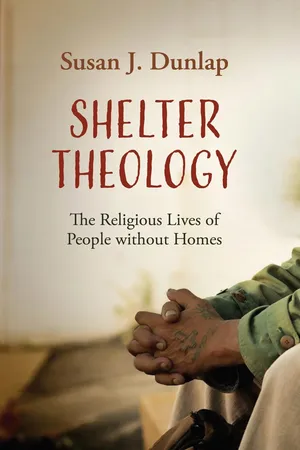
Susan J. Dunlap offers the theological fruits of time spent working as a chaplain with people without homes. After depicting the local history of her small southern city, she describes the prayer service she co-leads in a homeless shelter. Clients offer words of faith and encouragement that take the form of prayer, sayings, testimony, song, and short sermons. Dunlap describes both these forms of expression and their theological content. She asserts that these forms and beliefs are a means of survival and resistance in a hostile world. The ways they serve these purposes are further demonstrated in life stories told as testimonies, incorporating scripture, sayings, oral tradition, and popular culture. Dunlap concludes that white supremacy and neoliberalism have produced the problem of homelessness in America and are forms of idolatry. The faith and practices shared at the shelter are spiritual and theological resources for people in the grip of and seeking freedom from this idolatry. Claiming that only God can free us from bondage to idolatry and that to draw close to the poor is to draw close to God, Dunlap calls for proximity to people living without homes who are practicing their faith amid poverty.
- 165 pages
- English
- ePUB (mobile friendly)
- Available on iOS & Android
eBook - ePub
About this book
Trusted by 375,005 students
Access to over 1.5 million titles for a fair monthly price.
Study more efficiently using our study tools.
Information
Topic
Theology & ReligionSubtopic
Christian MinistryChapter 1
Wounds of Poverty
Leaving the homeless shelter at night, I see a remarkable sight that captures a truth about my home. Ahead of me on the right is the sparkling new Durham Performing Arts Center, built in 2008. The entire front wall is glass, and when a performance is beginning or ending, I see people walking back and forth on three levels, going up and down on the staircases diagonally between these levels. Into the dark night, there is a blaze of light that discloses not only living people but also large posters of artistic performances of the past and present. The transparent glass walls reveal the presence of bodies in motion even as the art posters speak of performances that reveal truths of life and love, good and evil, the tragedies and triumphs of the world.
On the left side of the street rises another wall, taller and wider, made up of large expanses of unperforated white cement. Interrupting this expanse are horizontal rows of slits, from which no light escapes, and larger rows of outdoor hallways encased in fencing, lit by greenish-yellowish light. No human bodies are visible, and the building bears no adornment. This building is the county jail. One of these edifices is open and disclosing; the other is sealed and enclosing. When built in 2003, the jail was the largest capital investment the Durham, North Carolina, community had ever made.
The performing arts center represents the start of downtown Durham’s rebirth. We have always had a developed counterculture, with multiple nonprofit social justice organizations and a corpus of people who are devoted to the Durham Bulls and our colorful Ninth Street shopping area. In the last couple of decades, our edginess has expanded as the arts flourished, and our IT and biotech firms have multiplied. Now Durham is growing rapidly, with thousands of high-end residences newly built downtown and trendy restaurants and boutiques moving in. Originally defined by tobacco, Durham is now a center of creative, cultural, and scientific developments.
On the other side of the street, the jail represents the part of Durham that our city and nation have failed. The criminal justice system and poverty interact in complicated ways.1 As I work with people who are living without shelter, I learn that the jail is the largest deliverer of mental health care, it may be the only place of refuge during the coldest months, and it houses a disproportionate number of impoverished people who cannot afford court fines and fees, as well as people I know who have committed minor crimes trying to survive. This other Durham consistently deals with higher poverty rates than the average rate of poverty in North Carolina. The percent of Durham residents living below the poverty line is 17.1, and 7.8 percent live in deep poverty, with incomes less than $13,000 for a family of four.2 Poverty is mapped onto race in Durham: there are very roughly equal numbers of Blacks and whites in Durham, yet there are three times as many Blacks living in poverty as there are white people living in poverty. We live in an economically, culturally, and racially divided city.
Durham, North Carolina
Like in many cities in America, it is possible to arrange one’s life in complete oblivion to poverty in one’s community. This oblivion is not necessarily because of geographic distance. For example, I worship at a downtown church, one-half block from Urban Ministries of Durham (UMD), the homeless shelter and community café, which offers “food, shelter, and a future to neighbors in need.” Yet there is an invisible line at my church’s border that most members of my church rarely cross. I go just over that line when I go to UMD, but it was only recently that I went farther past that line on foot. A man from the addiction recovery program invited me and my friend and cochaplain Missionary Richey to walk deeper into the area past UMD. As we walked along a main street, lined with small homes and public housing, he began to point out landmarks. Gesturing into the cluster of buildings in the public housing development, he pointed to a large pile of rocks, saying, “Lots of drug deals there. You can hide when the police show up.” On the other side of the street, he pointed out the small house where Latino men go to pay for sex and then to the one where Black men go for the same purpose. As we walked, I pointed to a house and asked a question. Our guide quickly told me to stop pointing because it put us in danger, for reasons I did not understand. He was quite adamant about it, as I found out because I kept forgetting his warning.
When we came to the railroad tracks, he pointed out a mattress in the distance, in the weeds under a railroad bridge, where the common mixture of crack use and sex is found. As we continued our walk, our guide showed us the house where white men go to find sex workers, and at that moment, two white women came out, chatting, smiling. Our guide told us that they were a mother and daughter who worked there. I was shaken by the realization that this world is merely blocks from the church where my daughter was baptized, where we go every week for worship, where she leaves for church camp, where our renovated sanctuary hosts the Ciompi Quartet from Duke University, where our pipe organ plays Bach, Beethoven, Widor, and Rutter. In other urban settings, such as Washington, DC, or New York, such juxtapositions of plenitude and poverty are perhaps more visible. But it is rarer in our small city, and the proximity of the two worlds was a jarring reminder of the gross inequalities that characterize Durham.
It would be false to claim that there are literally two self-contained, homogeneous Durhams that can be distinguished and described accurately. It would diminish the complexity of both, elide the overlapping networks, and hide generations of exploitive relations between the two. It would also erase the sizable Latino population in Durham. Yet speaking of two Durhams highlights the fact of both inequality and separate spheres of daily living. My family and I live, work, shop, and worship in one part of Durham, and three mornings a week, I work in a very different Durham at UMD.
In this other Durham, people also live, work, shop, and worship, yet many of us live as if this other one did not exist. I am particularly interested in describing the lives of people living in extreme poverty, which is half the poverty rate. In the United States, forty million people live in poverty, which is an annual income of roughly $26,000 for a family of four. However, the population I will focus on lives in extreme poverty, which is $13,000 or less per year for a family of four, or about $6,000 for an individual.3 Even more specifically, I wish to lift up the religious lives of people living under these circumstances of extreme poverty. People engage in religious practices and make religious utterances in a particular context. In order to understand the meaning and function of the religious language and practices of the people in the shelter, it is necessary to surface the context in which it emerges.
As I drive by, each building holds hundreds of people. I assume the gap between them has never been crossed—people in the jail have never attended the performing arts center, and people enjoying an evening at the theater have never been inside the jail. These two worlds rarely meet in Durham, and this scene vividly illustrates that.
Poverty in Durham
When I first started working at the shelter, I would look at the groups of people congregated outside, or at the roughly two hundred people eating in the café, and I would wonder, How did this happen? How did it happen that in a portion of our city, there are people who simply have nothing to eat and no place to sleep? The group of men who gathered just across the street, sitting at the base of a parking lot fence, day after day, how did they end up there? How does a town evolve to the place where this is how a portion of its population lives?
Durham is not a typical southern city. It did not endure the Civil War as did Atlanta, Richmond, and New Orleans. Rather, at the end of the Civil War, we were just a railroad stop among scattered buildings and farms between Raleigh and Hillsborough. But our brightleaf tobacco proved to be very popular with Union troops who stopped here for the large-scale surrender of Confederate troops at Bennett Place, and when they got back home up North, they wanted more. That is how Durham became the home of Bull Durham tobacco and the Duke family’s American Tobacco.
Around the same time, newly emancipated Blacks came from rural areas to Durham looking for jobs. Within a few decades, people formerly enslaved and their children and grandchildren were able to build a thriving, culturally rich, and socially interconnected area known as Hayti. The location of the area was defined by strict laws of segregation, which meant Blacks had only one place to spend their money, and so they spent it in the Black-owned stores, movie theater, hotels, barbers, and so on. The more prosperous citizens of Hayti—the Moores, Merricks, and Spaldings—built neoclassical mansions along Fayetteville Street. The educational precursors of North Carolina Central University provided an educational and cultural center, and close-knit social groups flourished. Not only did W. E. B. Du Bois visit Durham in the early twentieth century, but he wrote a favorable article for the monthly publication the World’s Work called “The Upbuilding of Black Durham: The Success of the Negroes and Their Value to a Tolerant and Helpful Southern City.”4 About Durham, he said,
To-day there is a singular group in Durham where a black man may get up in the morning from a mattress made by black men, in a house which a black man built out of lumber which black men cut and planed; he may put on a suit which he bought at a colored haberdashery and socks knit at a colored mill; he may cook victuals from a colored grocery on a stove which black men fashioned; he may earn his living working for colored men, be sick in a colored hospital, and buried from a colored church; and the Negro insurance society will pay his widow enough to keep his children in a colored school. This is surely progress.5
Durham’s Hayti was on the national map for being a thriving, prosperous, culturally developed community.
From Hayti and other parts of Durham, Blacks worked jobs in textiles and tobacco, which provided most of the lower-wage payroll. My friend and cochaplain tells me about going to the tobacco factory where her grandmother came out with a scarf on her head, smelling like tobacco, and every Thursday she got a Popsicle. The jobs were menial, but they provided a steady wage. One former tobacco worker, Mr. Horace Higgins, said, “From 1945 on, Liggett and Myers paid good wages, and American (too). . . . You could get a good living. . . . Colored folks got good jobs, got to be foremen.” In those early years, the work was hot, dirty, smelly, loud, and sometimes dangerous. Mrs. Roxie McCullough said, “Back then, the foremen, they were all white [and] we were all black. The white people were in another part (in the factory). Stemming was dirty, dusty, sweaty and it paid way down lower than what whites got.” Mr. William Preston (Pratt) Edwards said, “They’d give the white man six cents and the black man three cents. . . . I was angry all the time.”6 The jobs were neither just nor easy, but tobacco jobs formed the backbone of the economy and of Black wages.
However, there were strong forces inhibiting Hayti’s further economic development. Like many cities in America, redlining consigned to decay parts of the city occupied by Blacks.7 One of the redlining maps in Durham marked an area considered less valuable with the assessment “This was formerly a good white residential street, but negroes are gradually taking up the area.”8 I currently live in an area that was given an A designation on the map created in the 1930s, which me...
Table of contents
- Cover
- Title Page
- Copyright Page
- Dedication
- Contents
- Preface
- Acknowledgments
- 1. Wounds of Poverty
- 2. Form Matters
- 3. Living Beliefs
- 4. Resistance Narratives
- 5. Theology in Proximity to the Margins
- Bibliography
- Index
Frequently asked questions
Yes, you can cancel anytime from the Subscription tab in your account settings on the Perlego website. Your subscription will stay active until the end of your current billing period. Learn how to cancel your subscription
No, books cannot be downloaded as external files, such as PDFs, for use outside of Perlego. However, you can download books within the Perlego app for offline reading on mobile or tablet. Learn how to download books offline
Perlego offers two plans: Essential and Complete
- Essential is ideal for learners and professionals who enjoy exploring a wide range of subjects. Access the Essential Library with 800,000+ trusted titles and best-sellers across business, personal growth, and the humanities. Includes unlimited reading time and Standard Read Aloud voice.
- Complete: Perfect for advanced learners and researchers needing full, unrestricted access. Unlock 1.5M+ books across hundreds of subjects, including academic and specialized titles. The Complete Plan also includes advanced features like Premium Read Aloud and Research Assistant.
We are an online textbook subscription service, where you can get access to an entire online library for less than the price of a single book per month. With over 1.5 million books across 990+ topics, we’ve got you covered! Learn about our mission
Look out for the read-aloud symbol on your next book to see if you can listen to it. The read-aloud tool reads text aloud for you, highlighting the text as it is being read. You can pause it, speed it up and slow it down. Learn more about Read Aloud
Yes! You can use the Perlego app on both iOS and Android devices to read anytime, anywhere — even offline. Perfect for commutes or when you’re on the go.
Please note we cannot support devices running on iOS 13 and Android 7 or earlier. Learn more about using the app
Please note we cannot support devices running on iOS 13 and Android 7 or earlier. Learn more about using the app
Yes, you can access Shelter Theology by Susan J. Dunlap in PDF and/or ePUB format, as well as other popular books in Theology & Religion & Christian Ministry. We have over 1.5 million books available in our catalogue for you to explore.