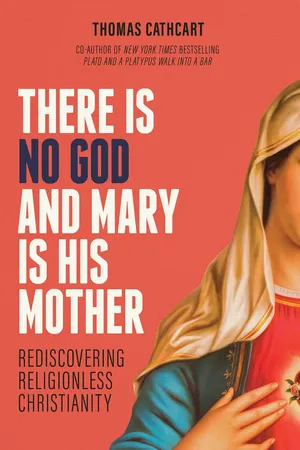
Is the Western world really post-Christian, or does Christianity simply need a reinterpretation? What did Dietrich Bonhoeffer mean by "religionless Christianity"? Is it passé? Or was it perhaps ahead of its time? In an era of dramatically increased religious pluralism and the emergence of large numbers of people identifying as "spiritual but not religious," so-called "religionless Christianity" can speak to those who find both biblicism and "belief-based" religion irrelevant. In this personal, witty, and timely book, New York Times bestselling author Thomas Cathcart takes readers on a journey into belief and unbelief and leads them through to the other side. Drawing from deep philosophical and theological wells, There Is No God and Mary Is His Mother demonstrates the meaningfulness of being a Christian in a secular age. Cathcart shows that, even absent traditional theological formulas and doctrines, Christianity can be a credible, meaningful, and practical means of negotiating worldly existence and experience. For Christians, There Is No God and Mary Is His Mother offers encouragement. For ex-Christians, it presents a different way of being a Christian than the one they've rejected. For atheists, it shows how Christianity can be an ally in affirming the here and now. Religionless Christianity is possible and desirable wherever and whenever it awakens personal and social transformation.
eBook - ePub
There Is No God and Mary Is His Mother
Rediscovering Religionless Christianity
- 160 pages
- English
- ePUB (mobile friendly)
- Available on iOS & Android
eBook - ePub
About this book
Information
Topic
Theology & ReligionSubtopic
Atheism1
So What?
Why should I care about Christianity or the Christian life? Why should anybody? Who needs it? After all, it’s a full life. There are adventures to be had, relationships to form, kids to raise, careers to build, and much, much more. That’s enough, isn’t it?
For an increasing number of people with a philosophical turn of mind, the response is, “Why religion indeed?” For even more people, it’s not even a question. The subject isn’t even on their screens.
As it happens, there has been a spate of books in recent decades about the supposed “plus side” of Christianity, books that concede that Christianity as a religion is outmoded but argue that it still has some other usefulness for individuals and society.
Often these books find ethical value in the teachings of Jesus: the Golden Rule, love and justice for all, humility, forgiveness, and so forth. In his book Living the Secular Life, Phil Zuckerman says that most contemporary secular people live by the Golden Rule: treat others as you would like to be treated. In fact, he calls it the bedrock of secular morality. He also points out, correctly, that some variant of it occurs in many ancient texts from several different religions and secular sources. None of these versions, he says, requires a God; they just require basic, human empathy.
Harvey Cox, a professor of theology at Harvard Divinity School, for many years taught a popular course for undergraduates called Jesus and the Moral Life, and he has written about it in his book When Jesus Came to Harvard: Making Moral Choices Today. The book and the course are not a rejection of Christianity as a religion, although Cox has a nuanced view of that looming possibility and doesn’t find it distressing, but they do emphasize the moral dimension of Christianity. Cox uses the life and teachings of Jesus as a way to challenge his students to consider the moral issues of our day and, more importantly, to reflect on what it means to reason morally and what the implications are for moral conviction and moral courage.
Another nuanced view of Christianity’s supposed “plus side” is that of French philosopher André Comte-Sponville in his charming and beautifully written book The Little Book of Atheist Spirituality. Comte-Sponville was raised Roman Catholic and lost his faith at the age of eighteen. However, he affirms his personal religious history, as well as the Judeo-Christian history of the Western world, for creating and instilling what are—with horrible, historical exceptions, of course—humane values, such as honesty, courage, generosity, gentleness, compassion, justice, and love. He simply thinks these values can be maintained and passed on without any reference to God. He therefore calls himself a “faithful atheist.”
Zuckerman, Cox, and Comte-Sponville are surely right that Christianity has moral and cultural value, but that is not what this book is about.
Rather, it is about how Christianity can still have spiritual value and the power to transform lives, power that inspires us to not only live morally but also face the anxiety of being an existing human being and search for ways to make that transformation real in the real world.
Christianity has always had to reinvent itself, and it always will. That is the so-called Protestant principle. And perhaps Christianity is on the verge of reinventing itself as something not explicitly “Christian,” something in which the historical figure of Jesus plays a minor or even nonexistent role. That remains to be seen. But the response of this book to the question “Why should we care?” is this: we should care because we are human beings, and something inside us—or inside some of us, anyway—seeks healing and transformation and some sort of reconciliation.
As it happens, there are two recent books outside the Christian tradition that come closer to our thread. They have little in common with each other except that they both make us wonder if we are “hardwired” in a way that often expresses itself religiously.
Robert Wright’s thought-provoking book Why Buddhism Is True argues that the Buddha’s diagnosis of the human condition reflects the psychological evolution of the human species. Natural selection, Wright says, has “designed” the human brain in a way that misleads us and enslaves us. The “goal” of natural selection is to get our genes into the next generation, and the most efficient way to do that is to delude us into thinking that the pleasures of life will not fade. We throw ourselves unreservedly into eating, having sex, impressing our peers, and beating out our rivals because the subset of people in prior generations who were genetically predisposed to pursue these goals had the best shot at passing on their genes.
The Buddha taught us that the underlying principle of our pursuit of pleasure—that it will not fade—is an illusion. Living a life of pleasure will always disappoint us because the unbridled pursuit of pleasure inevitably leads to pain, whether it be ennui or obesity or anxiety or addiction or guilt or a sense of meaninglessness or some other form of alienation. The Buddha teaches us to liberate ourselves from the illusion that pleasure will not have a price—through mindfulness, arrived at by meditation. When we become clear that we are not in charge of our own behavior, we can let go and achieve self-realization or, in more Buddhist terms, realize that we are “not-self.” As Wright says, the truth of both Buddhism and evolutionary psychology is that our CEO is MIA: we are not in charge.
So Wright’s answer to the question of why we should care about Buddhism is that we are hardwired for self-destruction and Buddhist practices offer a path to transcend that wiring. In chapter 3, “What is Wrong with You? (If Anything),” we will look at the Christian correlate of the Buddha’s vision.
Another extraordinary account of hardwiring is Jill Bolte Taylor’s My Stroke of Insight as well as her TED talk based on the same events. The book is good, but the YouTube video of the TED talk is mind-blowing. It is not surprising that at one point it was the second most-viewed TED talk of all time.1
In December of 1996, Dr. Taylor, a neuroanatomist working at Harvard’s brain research center, woke up to find herself in the throes of a massive stroke. The left hemisphere of her brain shut down, leaving her unable to walk, talk, read, write, or recall anything from her life. Instead, she experienced only the functioning of her right brain.
The right brain, she explains, experiences only this moment and all that is going on in it: sights, sounds, smells, all the information of our senses, in one holistic experience. It thinks in pictures and knows itself as an “energy-being,” connected to every other energy-being in the universe. In the right brain, we are the entire human family, and we are “perfect, whole, and beautiful.”
The left brain, by contrast, thinks methodically and linearly. Its concern is not the present moment; its concern is how to connect the present moment to the past and future. The left brain takes the right brain’s picture of Now!, picks out details, organizes all the information, and tries to connect it to everything in the past we have ever learned and project it onto the future. Most importantly, it says, “I am. I am an individual, contained in a particular body, and not just a flood of energy that flows into all the other energy in the universe.”
As her left brain shut down to nearly zero, she realized that she was no longer the choreographer of her life, and she knew, This is Nirvana! I am still alive, and I am in Nirvana! And if I can step to the right of my left brain and experience the overwhelmingly beautiful euphoria of Nirvana, everyone can do it!
Perhaps there are connections here to Christian experience. Can the vision of the “kingdom of God,” for example, or “eternal life” be right-brain phenomena and the creeds and other “beliefs” left-brain interpretations? Could it be that hardwiring for religious experience resides in the separation of the two hemispheres of our brains? Could it be that the answer to the question of why we should care about religion is that we are hardwired for it? If religion, as anthropologists once thought, is a “cultural universal,” our hardwired brains could be a possible explanation.
In a 1970s interview with the BBC, the Black civil rights icon, theologian, and university pastor Howard Thurman put it this way: “Religious experience is dynamic, fluid, effervescent, yeasty. But the mind [left brain?] can’t handle these, so it has to imprison religious experience in some way, get it all bottled up. Then when the experience quiets down, the mind draws a bead on it and extracts concepts, notions, dogmas, so that religious experience can make sense to the mind.”2
Why should we care about Christianity, even a “religionless” Christianity? Wright, Taylor, and Thurman each in their own way speak of an innate, human dimension, a spiritual dimension, that is fundamental to our existence. Their experiences and observations transcend orthodox religion while remaining recognizably grounded in it. Wright and Taylor connect their experiences and observations to Theravada Buddhism (which, interestingly enough, is often described as a “religionless religion” because it makes no reference to a god). Thurman traces Christian doctrine to its spiritual roots in human experience. These are three responses to the question of “so what—why should we care?” They also hint at a partial answer to our question of what a religionless Christianity might look like.
2
How Did We Screw This Up So Badly?
First of all, let’s concede that for probably the majority of Christians, Christianity didn’t screw this up at all. Many appear to be perfectly happy with the creeds—those official summaries of Christian doctrine, arrived at by councils of bishops in the early church—and other mainstream Christian beliefs. It is mostly the intellectuals who have been turned off. (I’ll leave out of this account, for now, the reportedly even larger subgroup of the “So Whats,” people who just stopped caring one way or the other about religion.)
Second, before we exclusively blame the creeds, let’s concede that even the first three Gospels, as they appear in the Bible, already contain, in addition to the story, a great deal of analysis and interpretation of the meaning of Jesus’s life, and it is reasonable to assume that strands of the oral tradition must also have contained substantial interpretation. Most mainstream scholars believe that it was the disciples’ uncanny experiences of the living presence of Jesus after his death that changed the narrative from the “Jesus of history” to “the Christ of faith,” as Martin Kähler called it. And with that change came interpretation and “beliefs.”
A Quick Overview of the History of Orthodox Doctrine and Dogma
Already, by the time the Gospels were written, Jesus was no longer simply the prophet of the coming kingdom of God but rather “the Messiah” (anointed one, Christos in Greek) of Jewish expectation, the “Son of God,” the “Risen One,” or the one who was expected to return at the dawn of the new age. Other, more exotic beliefs came about to try to make sense of Jesus’s special status. He was believed to have been conceived in the union of a young virgin and the Holy Spirit. He had supernatural powers and could interfere with nature by calming seas or expanding the on-hand supply of bread. (The healing “miracles” are a special case and will be discussed later.)
There had been plenty of time for these interpretations and beliefs to arise and develop. The first Gospel account to be written, Mark’s, did not appear in its biblical form until probably 66 to 70 CE, over thirty-five years after the events it professes to recount. During that time, various strands of oral tradition had been evolving. After Mark brought his oral sources together and wrote the story down, his Gospel was read and used as a source by both Matthew and Luke. The two of them almost certainly used another common source, a collection of Jesus’s sayings, that has never been found and that scholars call simply “Q” (for Quelle, the German word for “source”). It is for these reasons we speak of the first three Gospels together; they are the “synoptic” Gospels, meaning they share a point of view.
In any event, after the Easter experiences—whatever we are to make of them—Jesus’s followers began to develop “beliefs” about his status and significance, and these beliefs are already represented in the synoptic Gospels.
The author of the fourth Gospel, John, and the apostle Paul greatly expanded the mythology of the new community. For John, Christ was a preexisting figure who had come to earth to lead us into eternal life. John sounds like a theologian. And Paul made Christ part of a cosmic drama in which the first Adam brought about sin and death while Christ, the “second Adam,” overcame them both with his sacrificial death.
In Egypt and elsewhere, various Gnostic communities, some of them identifying as Christian, developed. These communities claimed mystical access to secret knowledge (gnosis), and Christian Gnostics produced their own gospels with names like the Gospel of Thomas, the Gospel of Mary Magdalene, the Gospel of Mary, the Gospel of Philip, and the Gospel of Truth. Some of them preserved a few of the traditions found in the synoptic Gospels, but some of them did not, and they all varied in significant ways from the Synoptics, as well as from John and Paul. The Gnostic gospels emphasize acquiring spiritual enlightenment rather than being saved from sin. Their cosmology posits an evil demiurge, or half-god, as the creator of the material world, thus discarding the benevolent, creator God of the Old Testament who pronounced his creation good. The Gnostic gospels are also more likely to honor feminine spirituality and mythology. And they grant enlightened persons the same status as Christ himself. In brief, they often sound more like Hinduism than emerging orthodox Christianity. (Some scholars have even explored the possibility that one of the apostles—Thomas is the usual suspect—may have visited India and been exposed to the Hindu scriptures.)
I remember that Danny and I were both enthralled by the Gnostics we read about in Tillich’s course on the religions and philosophies of the Hellenistic period. It was 1960, and although we didn’t know it yet, it was the predawn of the Age of Aquarius. Zen Buddhism was being taught at Harvard, of all places. Four years later, we’d both be living with our wives in Woodstock, New York, where our neighbor Bob Dylan was about to announce that the times were a-changin’, and Timothy Leary in nearby Millbrook was telling the world that LSD was revelatory.
Elaine Pagels, Karen King, and other scholars now consider the Gnostic gospels to be sources that add to the richness of Christianity, but early Christian writers like Irenaeus and Tertullian found them threatening and insisted on stamping out the Gnostic beliefs and reemphasizing the beliefs of the developing biblical canon and the emerging mainstream tradition.
The formal, official creeds did not follow until the fourth century. The emperor Constantine, after his conversion to Christianity, gathered the Council of Nicaea in 325 CE. At that time, the problem, as Constantine saw it, was that there were several versions of the Christian message circulating in the Roman Empire and beyond. He was concerned, not about the Gnostics, but about controversies among those who each claimed to represent the orthodox point of view, and he felt it his duty as head of the empire to resolve the conflicts and present a unified understanding of the faith to its new Roman adherents. In particular, he insisted on resolving one outstanding issue: the so-called Arian controversy.
Arius was a presbyter, a church leader, in Alexandria who taught that, although Jesus was the “Son of God,” he came into being at a particular point in time as the first and most perfect of...
Table of contents
- Cover
- Title Page
- Copyright Page
- Dedication
- Contents
- Acknowledgments
- Introduction
- 1: So What?
- 2: How Did We Screw This Up So Badly?
- 3: What’s Wrong with You? (If Anything)
- 4: Some Terminology and Some Loose Ends
- 5: God Is Good?
- 6: Envisioning a Kingdom of God
- 7: How Holy Is the Holy Spirit?
- 8: The Gift
- 9: Christ in Me?
- 10: Bringing It All Back Home
- Further Reading
- Notes
Trusted by 375,005 students
Access to over 1.5 million titles for a fair monthly price.
Study more efficiently using our study tools.
Frequently asked questions
Yes, you can cancel anytime from the Subscription tab in your account settings on the Perlego website. Your subscription will stay active until the end of your current billing period. Learn how to cancel your subscription
No, books cannot be downloaded as external files, such as PDFs, for use outside of Perlego. However, you can download books within the Perlego app for offline reading on mobile or tablet. Learn how to download books offline
Perlego offers two plans: Essential and Complete
- Essential is ideal for learners and professionals who enjoy exploring a wide range of subjects. Access the Essential Library with 800,000+ trusted titles and best-sellers across business, personal growth, and the humanities. Includes unlimited reading time and Standard Read Aloud voice.
- Complete: Perfect for advanced learners and researchers needing full, unrestricted access. Unlock 1.5M+ books across hundreds of subjects, including academic and specialized titles. The Complete Plan also includes advanced features like Premium Read Aloud and Research Assistant.
We are an online textbook subscription service, where you can get access to an entire online library for less than the price of a single book per month. With over 1.5 million books across 990+ topics, we’ve got you covered! Learn about our mission
Look out for the read-aloud symbol on your next book to see if you can listen to it. The read-aloud tool reads text aloud for you, highlighting the text as it is being read. You can pause it, speed it up and slow it down. Learn more about Read Aloud
Yes! You can use the Perlego app on both iOS and Android devices to read anytime, anywhere — even offline. Perfect for commutes or when you’re on the go.
Please note we cannot support devices running on iOS 13 and Android 7 or earlier. Learn more about using the app
Please note we cannot support devices running on iOS 13 and Android 7 or earlier. Learn more about using the app
Yes, you can access There Is No God and Mary Is His Mother by Thomas Cathcart in PDF and/or ePUB format, as well as other popular books in Theology & Religion & Atheism. We have over 1.5 million books available in our catalogue for you to explore.