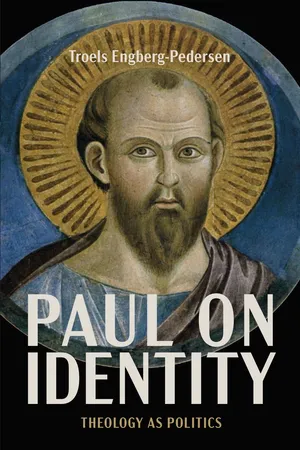
Paul on Identity shows the inner connection in Paul's view of three distinct issues that all focus on identity: What defines the fundamental "Christ identity" for which Paul argues? How is it related to all other identities--of being a Jew or a non-Jew, a man or a woman, a master or a slave? How does Paul's understanding of the Christ identity inform his own way of writing to his addressees? The book raises the question of which among Paul's many teachings we may or may not accept. Finally, the book directly addresses the political relevance of Paul's thought for an American audience. Paul on Identity is written for non-experts and experts alike. By quoting liberally from Paul himself, Engberg-Pedersen brings him to life in the twenty-first century.
- 225 pages
- English
- ePUB (mobile friendly)
- Available on iOS & Android
eBook - ePub
About this book
Information
Topic
Theology & ReligionSubtopic
Biblical Studies1
Paul’s Agenda
The New Creation
In this chapter, we will look at the foundational part of Paul’s central concerns, which is his view of what God had done to human beings when he sent Jesus Christ down on earth. The theme here is specifically Paul’s “theology”: about God, Christ, and the (vertical) relationship of human beings to them. In the next chapter, we will look at Paul’s “ethics”: the (horizontal) relationship of human beings to one another as seen in the light of the theology.
A New Creation through Dying to the Fleshly World
In Galatians, Paul articulates his central concern in the following way, which we already know from the introduction (T0.6, Gal 6:12, 14–15):
(T0.6) 12those who want to make a good showing in the flesh. . . . 14I on my side: may I never boast of anything—except the cross of our Lord Jesus Christ, by which the world has been crucified to me, and I to the world. 15For neither circumcision nor uncircumcision means anything; but a new creation does.
In this text, Paul introduces a radical dualism. On the one side, we have the “flesh” and the world at large. On the other side, we have Jesus’s cross—and Paul, who makes a confession to that. In this construction, the cross stands for a total rejection of the flesh and the world (Paul has been “crucified” to them), and that makes sense. If the death of Jesus Christ on a cross is meant to be all that matters, something to which one is wholly directed, then one’s own body and in general the whole ordinary world become completely indifferent. But why on earth should anybody make a confession to Jesus’s death on the cross? Paul’s answer in this passage is that in Jesus’s case, “the cross” stands, not just for his death, but also through that means for something altogether new and positive: a new creation, which includes the idea of a new life. How so? Answer: God created something wholly new when he let Jesus die and be raised again from the dead to a new life. Admittedly, Jesus’s resurrection is not explicitly mentioned here, but it is elsewhere, as we will see. That is what turned Jesus’s death into a new creation. (By contrast, a sheer death on a cross is not a new creation!) The same thing then also holds for Paul himself when he makes a confession to this combination of Jesus’s death on the cross and his resurrection. For him, too, there is something altogether new and positive: a wholly new creation, a new life.
We will consider as we go along a number of aspects of how Paul understands this radical dualism. Here let us note what he means by the flesh and the world. When he speaks in the present context of the flesh, he is almost making a joke. His opponents want to make a good showing in the flesh, he says. They concretely aim to perform circumcision on the poor Galatian men (and then, says Paul, to boast about it to their Jewish compatriots). Circumcision, of course, takes place in the flesh—in fact, in a very sensitive piece of flesh. In this way, the “flesh” (Greek sarx) stands directly for the body. But in Paul, sarx also stands for everything that happens in our ordinary, earthly world and is focused on our bodies. For instance, the kind of recognition that Paul’s opponents aim to acquire from their compatriots is a social relationship. In Paul, this too falls under sarx. We will later consider what his rationale was for this. Basically, the idea is that the human body carries a certain self-awareness, which implies a certain self-directedness, and that this self-awareness and self-directedness are also involved in a phenomenon like social recognition. Thus Paul’s idea of the sarx is at the same time both very concrete and narrowly focused on the body itself—and also much broader, though still with a basis in the body. In fact, as he himself says in the present passage, the sarx covers the whole world, to be understood as everything that takes place in our world with a basis and starting point in our bodies: everything that is not seen to be connected with Jesus’s death and resurrection.
Against sarx stands, in Paul’s world, the “spirit” (Greek pneuma). The radical dualism that he articulates in the passage is also one between sarx and pneuma. Paul speaks extensively of the pneuma earlier in the letter, as we will see later, but he leaves it out here. The most likely reason is that he now wishes to balance two things in his confession. There is Jesus’s death on the cross, which means that the rest of the world also dies (for Paul, that is), and there is also something entirely new: a completely new creation. Later, we will see that the pneuma is in fact an instrument for this new creation: it helps bring it about. Right here, however, what is in focus for Paul is the idea itself of a wholly new creation through Jesus’s death, a creation that through that means has turned its back completely on the bodily world.
Thus what is expressed in the passage is a movement in a person (here Paul himself) from the (“sarkic,” earthly) world that is based on the body and its concomitant self-awareness and self-directedness via an exclusive mental focus on Jesus’s death on the cross (and his resurrection), which makes one turn one’s back on the bodily world, to a completely new creation—and hence a new life. We must evidently develop further what this new creation actually consists in. In a way, that is what the rest is all about, both in Paul himself and in this book.
Since we are here specifically interested in Paul’s understanding of identity, it is worth quoting from an important text earlier in the letter, to which we will come back in chapter 3. The text belongs at the end of chapter 2 of Galatians, but as soon as one attempts to grasp the overall structure of the letter, one will see that it points directly forward to the passage at the end of the letter that we have just considered. In the text from chapter 2, Paul describes his own identity in a striking manner that he will then precisely take up in T0.6 and generalize to the idea of a new creation. Paul says this of himself (Gal 2:19–20, see in T3.3):
(T3.3) 19I, by contrast [i.e., Paul himself as opposed to his colleague Peter] have died to the law through the law, so that I might live to God. I have been crucified with Christ; 20and it is no longer I who live, but it is Christ who lives in me. To the extent that I now live in the flesh, I live in faith, faith in the Son of God, who loved me and gave himself for me.
A few verses earlier, Paul describes how he and Peter came to realize that “righteousness” (Greek dikaiosynȇ, normally translated as “justice”), which is the proper relationship with God, could come about not through following the law of Moses but only through Christ faith (2:16). (We will consider the meaning of this in detail later.) In 2:19–20, he then applies this specifically to himself and begins to speak of being “dead” to something and “alive” to something else. The language is striking: Paul has been “crucified” together with Christ and himself “no longer” lives. What is expressed in these ways is Paul’s conception of his own identity, of who he himself is. He is one who is defined by one thing alone: faithfulness (Greek pistis) in relation to Christ and specifically to Christ’s death on his own behalf. Paul is nothing other than this. All the other things one might mention (compare “to the extent that I now live in the flesh”) are wholly irrelevant to this identity. It is this change of identity away from attaching any significance whatsoever to the fleshly values of the world that Paul brings out by means of his metaphorical statements that he has been “crucified” together with Christ and “no longer” lives. At the end of the letter, then—in T0.6—he makes it explicit that being crucified with Christ is also being crucified to the whole world—and that this means an altogether new creation, a wholly new life.
The movement that we noted in T0.6 (from the world via Jesus’s death to a new creation) is found in another striking passage: 2 Corinthians 5:14–17.
T1.1 14For the love of Christ constrains us, because we have concluded that one has died for all—therefore all have died. 15And he died for all, so that those who live [in spite of the fact that they, too, are dead—namely, to the world] might live no longer for themselves, but for him who died and was raised for them. 16From now on, therefore, we know no one according to the flesh. Even though we may have known Christ according to the flesh, we know him no longer in that way. 17So if anyone is in Christ, there is a new creation: everything old has passed away; see, something new has been generated!
“Everything old has passed away”: Paul was genuinely a revolutionary. For he actually meant it. In this text, we again meet the idea of a focus on Jesus’s death on the cross, which means that one is, in one’s self-understanding, dead to anything else in the world. One may of course continue to live, but even then, one lives no longer—as Paul explicitly says—for oneself but only for Christ, who both died and (here Paul is wholly explicit about it) was resurrected for one’s own sake. From 5:16 onward, the text spells out how such a life should be understood. One no longer “knows” anybody according to the flesh—that is, one no longer attaches any importance whatsoever to any person’s bodily based, self-aware, and self-directed (“sarkic”) character. The same is true even of Christ, as Paul dares claim in an outburst that verges on hubris. Not even him does one “know” according to the flesh. Of course, Christ (in the shape of Jesus) was by now physically dead. But here Paul is almost saying that even if the earthly Jesus had been alive, one would not have “known” him so as to attach any importance to him. He would have been completely indifferent in comparison with all the radical things that have in fact already happened: if somebody is “in” Christ—that is, in the risen Christ—then there is a wholly new creation, then one only “knows” the risen Christ. It is difficult to find a stronger way of expressing Paul’s radical dualism: to die with Christ in such a manner that one no longer lives for oneself but lives in a wholly new creation only for the risen Christ.
In what way may one be “in” Christ? We will consider that in a moment. Some scholars have spoken of a “Christ mysticism” here. That, however, is just as mystical as what it is intended to elucidate. In addition, it is, to my mind, false. As we will see, there is nothing mystical about Paul’s idea. Instead, it is wholly concrete.
The perspicacious reader may have noted that in the two quoted passages from Galatians (T0.6 and T3.3), Paul focuses on Jesus’s death but does not speak so clearly about his resurrection and the new life that this implies. That only happens in the passage from 2 Corinthians (T1.1). The reason is purely contextual and rhetorical. In the Galatians passages, Paul aims to emphasize what one dies away from in being directed toward Jesus’s death (and resurrection). In the Corinthians passage, by contrast, he aims to bring out what one comes to live for in being directed toward both Jesus’s death and his resurrection. Paul no doubt had both sides in mind in all three passages (after all, in T3.3, he speaks of “living to God”). He just handles the conglomerate of death and resurrection differently depending on his contextual agenda.
So far, we know that Paul operated with a radical dualism between the world based in bodies with individual self-awareness and self-directedness and the new creation (including that of human beings) that God had brought about through the death on the cross and resurrection of Jesus Christ. We need to have this central understanding in place before we can go on to ask exactly how it relates to all those other identities (of being Jews or non-Jews, masters or slaves, men or women, etc.) that continue to be present in the bodily based world of human beings. For even if Christ believers do die to these identities so as not to attach any importance whatsoever to them, they will continue to live as individual human beings without having left them completely behind. Those other identities will continue to be there. We will come back later (from chapter 3 onward) to the question of the relationship between these two types of identity.
The Function of the Pneuma in the Future
When and how can we speak of a new creation of Christ-believing human beings? With regard to when, the answer—as so often in Paul—is a double one: both now (in Christ faith) and in the future (at the resurrection on the day of judgment). Paul speaks extensively about the latter in...
Table of contents
- Cover
- Title Page
- Copyright Page
- Dedication
- Contents
- Preface
- Introduction
- 1. Paul’s Agenda
- 2. Paul’s Agenda
- 3. The Opposition
- 4. The Opposition
- 5. The Persuasion
- 6. The Persuasion
- Conclusion
- Literature
- Ancient Texts
Trusted by 375,005 students
Access to over 1.5 million titles for a fair monthly price.
Study more efficiently using our study tools.
Frequently asked questions
Yes, you can cancel anytime from the Subscription tab in your account settings on the Perlego website. Your subscription will stay active until the end of your current billing period. Learn how to cancel your subscription
No, books cannot be downloaded as external files, such as PDFs, for use outside of Perlego. However, you can download books within the Perlego app for offline reading on mobile or tablet. Learn how to download books offline
Perlego offers two plans: Essential and Complete
- Essential is ideal for learners and professionals who enjoy exploring a wide range of subjects. Access the Essential Library with 800,000+ trusted titles and best-sellers across business, personal growth, and the humanities. Includes unlimited reading time and Standard Read Aloud voice.
- Complete: Perfect for advanced learners and researchers needing full, unrestricted access. Unlock 1.5M+ books across hundreds of subjects, including academic and specialized titles. The Complete Plan also includes advanced features like Premium Read Aloud and Research Assistant.
We are an online textbook subscription service, where you can get access to an entire online library for less than the price of a single book per month. With over 1.5 million books across 990+ topics, we’ve got you covered! Learn about our mission
Look out for the read-aloud symbol on your next book to see if you can listen to it. The read-aloud tool reads text aloud for you, highlighting the text as it is being read. You can pause it, speed it up and slow it down. Learn more about Read Aloud
Yes! You can use the Perlego app on both iOS and Android devices to read anytime, anywhere — even offline. Perfect for commutes or when you’re on the go.
Please note we cannot support devices running on iOS 13 and Android 7 or earlier. Learn more about using the app
Please note we cannot support devices running on iOS 13 and Android 7 or earlier. Learn more about using the app
Yes, you can access Paul on Identity by Troels Engberg-Pedersen in PDF and/or ePUB format, as well as other popular books in Theology & Religion & Biblical Studies. We have over 1.5 million books available in our catalogue for you to explore.