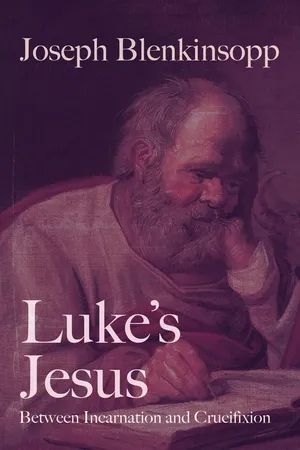
The third evangelist tells the story of Jesus in clear, dramatically compelling, and humanly moving terms. His Jesus is a man of great power, a deep sense of mission, and profound compassion for those on the outskirts of society. And Luke's Gospel has the best stories--that is, parables--including a number that are unique to him. Luke's story fills in the gap between "born of the virgin Mary" and "suffered under Pontius Pilate" in the Apostles' Creed. While it is usually important for those who write biography to report how the lives of their subjects began and ended, Luke's story of Jesus's birth differs from Matthew's version, and the conclusion to Luke's account of Jesus's life ends neither with his death nor with his resurrection but with his being taken up from the earth to the heavens. The Gospel of Luke is historical in its approach, for which there are no apologies: a historical reading follows necessarily from the Christian doctrine of the incarnation, which teaches that God has entered the history of humanity through Jesus. At the same time, Luke's approach is theological: together with the other evangelists, Luke intends to show his readers that in the person of Jesus of Nazareth, God has drawn near to humanity in an inexpressible and unique way.
- 135 pages
- English
- ePUB (mobile friendly)
- Available on iOS & Android
eBook - ePub
About this book
Information
Topic
Teología y religión1
The Author
Luke
The Gospel of Luke is preeminent among the Gospels both canonical (Matthew, Mark, and John) and noncanonical. For our purposes, the most important among the latter is The Gospel of Thomas, a collection of sayings of a mystagogical or gnostic nature attributed to Jesus and discovered in Upper Egypt in 1945. In the first place, Luke’s Gospel is a self-consciously structured literary and biographical work, recognizable as a life of Jesus. It is preeminent on the teachings of Jesus, conspicuously on the theme of wealth and poverty, the rich and the poor, the subject to which we will give special attention in our reading of this Gospel. It also has the best parables, including six major narrative parables to be found only in Luke, ending with the incomparable story of the rich man and Lazarus. For these and other reasons, we would like to be better acquainted with the author, but unfortunately, as with so many of the texts dealing with the beginnings of the Christian movement, obtaining solid information is not easy. Unlike some of the Pauline Epistles, the Gospels are not self-referential, though the author of the third Gospel at least speaks in the first person in the prologue to both the Gospel (Luke 1:1–4) and Acts of the Apostles (Acts 1:1–3), his second volume, but does so without giving his name. This two-volume work—the Gospel according to Luke and the Acts of the Apostles—would together make up the longest unit in the New Testament.
From the author’s introduction to the Gospel, we gather that he was an educated man familiar with the conventions of Greek historiography and that his work was addressed to contemporary fellow Christians, especially proselytes like the Theophilus mentioned in both prologues. He mentions his sources—perhaps with a touch of depreciation for predecessors common in contemporary Greek historiography and biography. Among these many sources known to us, the best known are the Gospel of Mark and the source behind the matter common to both Matthew and Luke, the so-called Q (from the German Quelle, meaning “source”). Scholars usually list whatever in Luke cannot be traced to these two sources under the siglum L, meaning source material proper to Luke, though we know practically nothing about its place of origin and time of composition. Since these sources do not amount to the “many” of the prologue, we assume that the author had access to other sources of information about which we can only speculate. We know at least from his second volume that Luke had good information about the Judaic-Christian community in Jerusalem under the leadership of Peter, who acted as its spokesman, and James, brother of Jesus (Acts 12:17; 15:13; 21:18; Gal 1:19; 2:9, 11–12).
Behind these “many have undertaken to compile a narrative of the things which have been accomplished among us” (Luke 1:1) are the contemporaries of Jesus, the eyewitnesses and servants of the gospel, guardians and transmitters of the primordial tradition about Jesus. Building on this base, the author claims to have investigated everything from the beginning, which for him meant from the birth of John the Baptist followed soon afterward by the birth of Jesus, and to have proceeded from that point in an orderly manner. The prologue to Acts (1:1–3), Luke’s second volume, is somewhat different. In referring to the author’s first volume, it traces the narrative from the beginning of Jesus’s public activity, ending not with his death and resurrection but with his “translation,” or his final departure from his followers narrated in Acts 1:6–11 corresponding to the final paragraph in Luke’s Gospel (24:50–52).1 To sum up, though at a second or third remove from the lifetime of Jesus, the author of the third Gospel is, nevertheless, well informed and confident in his ability to undertake his self-appointed task.
As far as we know, questions about authorship began to be seriously addressed only in the second century CE, when curiosity about Christian origins was beginning to spread. Irenaeus, bishop of Lyons (ca. 130–200 CE) identified the author as Loukas (the Greek version of Luke), companion of Paul, mentioned in the Letter to Philemon verse 24 together with other disciples, including a colleague called Mark. Luke is also named in Colossians 4:14, where he is described as Paul’s physician and dear friend. From about the same time as Irenaeus comes the earliest list of New Testament writings, known as the Muratorian Canon, so called because it was discovered in the Ambrosiana Library in Milan by a certain Father Muratori, an Italian priest. Published in 1740, it identifies Luke as the author. This was confirmed by the same name appearing at the end of the earliest extant manuscript of the Gospel, the papyrus codex cataloged as Papyrus Bodmer XVI. This could be the Luke who was the only one left with Paul during his captivity, probably in Rome (2 Tim 4:11). This appears to be the majority opinion, but some commentators have chosen instead to argue in favor of Loukios, identified as one of the leaders of the church in Antioch (now Antakya in Turkey), where, as some commentators maintain, Luke was born and educated. Finally, we have the “We” sections in the Acts of the Apostles, which suggest that the author of this work accompanied Paul on a hazardous sea journey from Troas, arriving eventually in Rome (Acts 16:10–17; 20:5–8, 13–15; 21:1–18; 27:1–28:16).
Without pursuing this further, we can say that the evidence for Luke as a companion of Paul is strong, though it is doubtful whether in speaking about “my gospel” in Romans 2:16, Paul was referring to the Gospel according to Luke, as some have suggested. In any case, these bits of information tell us little about the author apart from his name. We note that in writing to the Christian church at Colossae in Asia Minor, Paul added greetings from “Luke the beloved physician” (Col 4:14), which many have concluded is a reference to the author of the third Gospel. This may be so, but this conclusion—about the author as a physician—has not been confirmed by a close study of Luke’s two-volume work.2 A close relationship with Paul during his missionary journeys certainly arouses interest, but the author of the third Gospel does not seem to be closely familiar with any of the Pauline Epistles, and what is said about the law of Moses in the Gospel does not sound very Pauline. To go beyond this minimum, there is no alternative to a careful and close reading of the Gospel according to Luke and the Acts of the Apostles, and this is what we propose to do with what the first volume of Luke’s two-volume work has to say, especially on issues of wealth and poverty, the rich and the poor, referring to the second volume as the occasion warrants.
Following Luke’s brief summary of his work in the prologue, we will start “from the beginning” with an account of the birth and career of John, commonly called the Baptist;3 the birth of Jesus presented in parallel with that of John, his cousin; and their close relationship with each other, which ended with the execution of John by Herod Antipas, son of Herod “the Great.” There follows the preparatory time spent by each in the Judean wilderness; the Galilean ministry of Jesus, himself a Galilean; his encounters with different people friendly or hostile; and his healings, exorcisms, and miracles. This will serve as an introduction to his “Sermon on the Plain” (Luke 6:12–49) and other examples of his teaching addressed to those he encounters, also to his disciples and, indirectly, to fellow Christians of Luke’s own generation. Finally, to those of us of a much later time who are willing to read, listen to the evangelist’s voice, and learn.
Telling stories in the form of parables was, and perhaps also remains, one of the most powerful means of teaching by example how to live a good and productive life in the presence of God. The second section of the book will consist of a close reading of the six major parables unique to Luke, ending with the most memorable, the parable of the rich man and Lazarus (Luke 16:19–31).
2
The Subject
Jesus
First Impressions
The Gospel story is the story of Jesus told from different perspectives and at a certain distance from the events by authors for whom it had the greatest importance. Luke’s version begins with a related story, that of John, known as the Baptist or Baptizer, who was a member of the same extended family as Jesus—probably a cousin, since John’s mother, Elizabeth, was closely related to Mary, the mother of Jesus (in view of the difference in age, probably as aunt to niece).1 Jesus enters the public sphere proclaiming the same message as John, the same message verbatim according to Matthew’s Gospel, about the need to reconsider and change the direction of one’s life—in other words, to repent.
Jesus acts with the assurance of a sleepwalker. He does the most amazing things in a matter-of-fact way, sometimes with anger not entirely suppressed, sometimes with pity or even a touch of dry humor. He tells cripples to get up and walk, and by God, they walk, maybe for the first time in their lives. He gently touches the eyes of the blind and they begin to see, either gradually or instantaneously. He has a passion for, and rage on behalf of, the poor and destitute and scorn or pity for those who spend their lives accumulating wealth. He can even walk on water. He said it: all you need is to believe, to really believe, and you can move mountains, you can change reality, create a new reality, beginning with yourself. Peter tried walking on water: he nearly made it, but when he began to have second thoughts, he started to go under. The story of our lives!
Jesus was not afraid to challenge authority. He was not cowed. Religious rules—like the Sabbath law, dietary matters, who you may or may not be at table with—are good and necessary insofar as they serve human needs, but only so far. It was this amazing freedom that led some in his circle of followers to believe that he was no ordinary religious leader, meaning that he must have a special relationship with God. Starting from this belief, it was not difficult for some of his followers to conclude that he had a unique relationship with God and, eventually, a shared identity. What they took this to mean was that who or what we call God could penetrate Jesus so fully, he was so transparent to God, that through him God could do what we all want our God to do: to heal our wounds and the wounds of others, to heal our pain and the pain of others, to reconcile ourselves to ourselves and others, and to forgive our sins. This, I believe, is the starting point of Christian theology and specifically of the doctrine of the Trinity articulated in the great church councils in a language no longer readily intelligible today. It is what another enthusiastic disciple of Jesus would mean when he said that God was reconciling the world to himself through Jesus (2 Cor 5:19). Perhaps it is still possible for us not only to believe this but even to reproduce some of the enthusiasm of Paul and other early witnesses to Jesus.
As for the miracles, they cannot be adequately described simply as Jesus doing something to a person, something inexplicable to those who witnessed it and perhaps even to us, who know so much more. A miracle of healing, for example, cannot be just a shortcut to a medical procedure. Perhaps all miracles are in some way transactional. Perhaps it wasn’t just a case of acting directly on the afflicted subject. Perhaps Jesus had the capacity to awaken something in subjects so that those subjects could respond and contribute to their own healing and so act cocreatively. We note that in most if not all miracles, there is a demand for faith or at least a presumption of faith. Often, in fact, the faith or belief of the subject in Jesus is explicit. In the case of the Gerasene demoniac, the blind beggar, the leper, or whoever, Jesus had the capacity to coax something out of the subject, which, in turn, enabled the subject to cooperate with Jesus and, in so doing, change their life, often in unforeseeable ways.
The Early Years of John and Jesus
Luke’s Jesus story begins with the birth and early years of John and then Jesus, often referred to as “Jesus of Nazareth,” told along parallel lines.2 For Luke, the Jesus story as a whole is closely interwoven with the appearance, public activity, and fate of John. Jesus was baptized by John (Luke 3:21–22) and, like John, he prepared for his life’s work by spending some time in the wilderness (1:80; 4:1–13). According to the fourth Gospel, Jesus recruited his first disciples from John’s followers—first Andrew and then his brother Simon, renamed Cephas, meaning “the Rock” (John 1:35–42). It is not beyond belief that Jesus himself was, for a time, a disciple of his cousin. There may be a suggestion of deliberate ambiguity in the way John identifies Jesus as “the one who comes after me” (Mark 1:7; Matt 3:11), which, in addition to temporal sequence, could be understood as “the one who follows me as a disciple follows his master.” The ambiguity lies in the phrase “after me” (Greek: opiso mou); compare the statement of Jesus later in the Gospel: “Anyone wishing to come after me [opiso mou] must renounce self, take up his cross, and follow me” (Luke 9:23, my translation).3
At any rate, Mark’s Gospel records that Jesus initiated his itinerant mission in Galilee only after John was imprisoned and therefore removed from the scene (Mark 1:14–15). According to the same source, Jesus began to predict his own violent death only after John had been executed by Herod Antipas, son of Herod the Great, and the news of the execution had been brought to Jesus (6:17–32; 8:31–38). The long and detailed account of the execution of John in the Gospel according to Mark, a Gospel notably sparing of details, indicates that this event was a turning point in the public life of Jesus (6:17–29). It was only then that Jesus took pity on “sheep without a shepherd,” meaning “the sheep deprived of a shepherd” (6:34), with reference to John. It seems that Jesus took over from John the role of public prophet, though the followers of John and Jesus eventually went their separate ways. The “Johannines” were ascetical, in contrast to the disciples of Jesus (Luke 7:33–34). In keeping with John’s original message (Luke 3:7–9), they preached a strongly eschatological and judgment-oriented message of salvation—“the wrath to come . . . the axe . . . laid to the root of the trees” and similar language (3:7–9)—while for Jesus, the first stage toward salvation was to enable those shunned by society (especially on account of leprosy4) to rejoin society and, in general, for those with various disabilities, including and especially disabling poverty, to live a good and productive life here and now. As Jesus pointed out to the disciples sent by John, who apparently was no longer sure of the identity and role of Jesus, “The blind receive their sight, the lame walk, lepers are cleansed, and the deaf hear, the dead are raised up, the poor have good news preached to them” (Luke 7:22). We shall see that many of the miracles of Jesus have their rationale in the achievement of this salvific goal.
The importance for Luke of this earliest stage in the life and activity of John is emphasized by the way he places it in the larger historical and political framework of the Roman Empire: the birth of John during the reign of Herod, king of Judaea (37–4 BCE); the birth of Jesus during the reign of the emperor Augustus (27 BCE to 14 CE); and more fully, the appearance of John in the wilderness of Judaea in the fifteenth year of the reign of Tiberius (14–37 CE). At that time, Pilate was procurator of the Roman province of Judaea (26–36 CE), and Annas and Caiphas were the senior temple priests.
As for the birth date of Jesus, on the assumption that the Gospels are correct in placing this event during the lifetime of Herod (e.g., Luke 1:5), Jesus was born no later than the death of Herod in 4 BCE and very probably a few years earlier. Our distinction between BC and AD (or BCE and CE) we owe to the calculations of a Russian monk called Dionysius Exiguus (Denis the Little), who got it wrong by a few years.
The Law of Moses in Luke 1–2
Obedience to a written law was an important aspect of moral conduct at the time of Jesus, as it still is today for many Jews, Christians, and Muslims. It will therefore be necessary to bear this in mind in our investigation of what Luke has to say in his Gospel about moral issues, especially those connected with the theme of wealth and poverty. It is interesting that the law of Moses is more clearly in evidence in Luke’s account of the birth and early years of John and Jesus in the first two chapters than it is in the rest of the Gospel. The first thing we learn about John’s parents, the priest Zachariah and his wife Elizabeth, is that they conducted their lives according to all the commandments and precepts of the Lord God (Luke 1:6). Jesus is circumcised in keeping with immemorial customs confirmed by the law (2:21; Lev 12:3). Mary, his mother, undergoes the rite of postpartum purification and offers the gift prescribed by the law for those of modest means (2:22–24; Lev 12:1–9). As firstborn, Jesus is presented in the temple according to the law (Luke 2:27; Num 18:15–16), and in concluding this first phase of the story of Jesus, Luke tells us that “the parents brought in the child Jesus, to do for him according to the custom of the law” (Luke 2:27–29).
We may assume further that the family of Jesus was also exemplary in keeping the great...
Table of contents
- Cover
- Title Page
- Copyright Page
- Contents
- Preface
- Principal Abbreviations
- 1. The Author: Luke
- 2. The Subject: Jesus
- 3. Family, Social Status, and Wealth: The Families of Jesus
- 4. John and Jesus: Preparation in the Wilderness
- 5. Jesus the Miracle Worker
- 6. Jesus the Galilean
- 7. Jesus the Teacher
- 8. Jesus the Storyteller: Four Parables
- 9. Two Parables about Rich Men
- 10. Summary
- Suggestions for Further Reading
- Notes
Trusted by 375,005 students
Access to over 1.5 million titles for a fair monthly price.
Study more efficiently using our study tools.
Frequently asked questions
Yes, you can cancel anytime from the Subscription tab in your account settings on the Perlego website. Your subscription will stay active until the end of your current billing period. Learn how to cancel your subscription
No, books cannot be downloaded as external files, such as PDFs, for use outside of Perlego. However, you can download books within the Perlego app for offline reading on mobile or tablet. Learn how to download books offline
Perlego offers two plans: Essential and Complete
- Essential is ideal for learners and professionals who enjoy exploring a wide range of subjects. Access the Essential Library with 800,000+ trusted titles and best-sellers across business, personal growth, and the humanities. Includes unlimited reading time and Standard Read Aloud voice.
- Complete: Perfect for advanced learners and researchers needing full, unrestricted access. Unlock 1.5M+ books across hundreds of subjects, including academic and specialized titles. The Complete Plan also includes advanced features like Premium Read Aloud and Research Assistant.
We are an online textbook subscription service, where you can get access to an entire online library for less than the price of a single book per month. With over 1.5 million books across 990+ topics, we’ve got you covered! Learn about our mission
Look out for the read-aloud symbol on your next book to see if you can listen to it. The read-aloud tool reads text aloud for you, highlighting the text as it is being read. You can pause it, speed it up and slow it down. Learn more about Read Aloud
Yes! You can use the Perlego app on both iOS and Android devices to read anytime, anywhere — even offline. Perfect for commutes or when you’re on the go.
Please note we cannot support devices running on iOS 13 and Android 7 or earlier. Learn more about using the app
Please note we cannot support devices running on iOS 13 and Android 7 or earlier. Learn more about using the app
Yes, you can access Luke's Jesus by Joseph Blenkinsopp in PDF and/or ePUB format, as well as other popular books in Teología y religión & Crítica e interpretación bíblicas. We have over 1.5 million books available in our catalogue for you to explore.