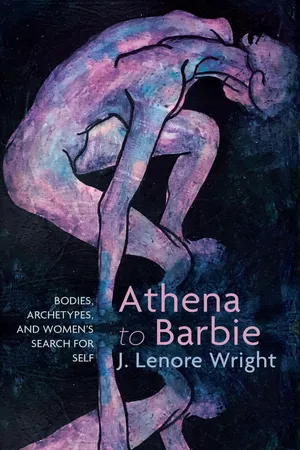
Athena to Barbie explores the vexed nature of being a woman. It maps the four corners of impossible choice a female faces because of the female body--her body as spiritual space (Mary), as political space (Athena), as erotic space (Venus), and as materialist space (Barbie). The book tracks the difficulty women face in understanding themselves as someone who has, but is not only, a body. The question of identity is particularly fraught and complicated when it comes to women--because the ability to bear children is a double-edged sword. Across time (including right now), having a womb has shaped how women are viewed and treated in negative ways, and women's childbearing abilities have been used to stereotype, oppress, and constrain them. Pregnancy is powerful, but the possibility of pregnancy comes with impossible pressures and choices. This book takes on the task of reconciliation--how women can understand themselves in light of their bodies--through an intense dive into history, art, literature, theology, and, particularly, philosophy.
- 235 pages
- English
- ePUB (mobile friendly)
- Available on iOS & Android
eBook - ePub
About this book
Information
1
Delivering Mary
Womb as Sacred Space
Hail Mary, full of grace. Our Lord is with you. Blessed are you among women and blessed is the fruit of your womb, Jesus.
—The Hail Mary
Mary is remembered and revered for her womb.1 Her powerful performance of pregnancy looms large in theological imaginings. Yet she transcends theological readings to take on a central archetypal role of the feminine in the Western world. She signs woman as womb, a source of sanctifying activity. She places the female body in a spiritual field of meaning, defying reductive readings of wombs and the women who carry them. She makes wombs sacred: wombs perform a divine act. They (re)produce and birth children of God, uniting divinity and humanity. Yet even within this Marian archetype, embodied feminine performances create a normative equivalency between womanhood and motherhood, one that women are right to resist. A woman is not just a womb. Nor is she fundamentally an object, an opening, an Other, though she has become these things.2 Mary’s body teems with cultural meanings that enable and disable forms of female agency that women need to live fruitfully.3 Attending to Mary’s womb opens up a fertile space for feminist reflection on the reproductive body, a space that may deliver Mary from a narrow reading of female subjectivity. Reading Mary’s womb through a feminist lens serves to reconceive femininity without its embedded, motherly ideals and reimagine the womb as a generative space that produces female practices (and recodes femininity) in literal and metaphoric ways.4
Mary is an important archetype of woman because she so thoroughly embodies the paradoxical poles of wombed subjectivity: bodily immanence and miraculous transcendence. She is and is not her womb. She is and is not a conventional woman. She can and cannot control her lived experience. Mary reflects the reality of female personhood: women are and are not their pregnant bodies. Women no longer need to argue they are more than a womb. But in what sense more is yet to be realized. Conventional views of the feminine—the idea of a distinguishing quality, nature, or essence of woman or a defining, distinctive feature of female experience—retreat from dated scientific tropes. Although woman is not biologically “The Sex” any longer, contemporary performances of femininity retain an essentialist edge: woman is a material and semiotic body that reproduces male power. She is already and always defined by cultural readings of her anatomy, by the significations of her bodily parts and the cultural uses and disciplining of her anatomy—for aesthetic pleasure, sexual gratification, and domestic labor, most especially human reproduction. She has yet to fully realize herself as more than a subjugated category of persons: a female person (woman) differentiated from a male person (man) by bodily function (pregnancy) and presentation (femininity). She has yet to fully experience personhood as a subject rather than an object: as an autonomous, rational, moral, and spiritual agent who can deliver herself from subjugation by resignifying what and who she is apart from her reproductive capacity and feminine identity. She has yet to fully activate her womb, a site of literal and figurative creative activity, as a source of self-identity.5
Pregnancy exposes a submerged and powerful truth about female body-subjects: women’s bodies perform personhood in ways that men’s bodies do not.6 Bodies with wombs are circumscribed by their wombed activity (and inactivity). Identifying woman with womb and signifying womb as a sacred and fundamental source of female agency produce an enigmatic tension within pregnant subjectivity—a dual attribution of pregnancy as a passive, generically female, bodily phenomenon and a powerful, feminine, individuating, spiritual activity.
Reading Mary’s performance of pregnancy as a sacred, sacrificial act both reinforces and challenges the cultural conception of woman as womb. The signification of womb as sacred authorizes repressions of female sexuality and restrictions on women’s reproductive choice. The evangelical Protestant and Roman Catholic espousal of chastity, opposition to abortion, repression of female authority, and conflation of pregnancy with motherhood codify marriage as an essential pathway for female flourishing and a necessary marker of femininity. Marriage’s sanctity—the ordination of marriage by God—preserves the womb’s divinity.7 Alternatively, coding womb as sacred thwarts readings of woman as a passive, generic vessel for male occupation and domination. Rereading Mary as a spiritual mother whose womb supports a refusal of oppression recasts pregnancy as an agential phenomenon—as a nonobjectifying element of womanhood and a meaningful component of women’s personal identity.8
The womb’s warrant of female agency resignifies the female body (normatively treated as threatening, sinful, and inferior) as stable, good, and powerful. Active wombs enable women to challenge extant power structures by establishing an authentic ground for opposition to female oppression (pregnancy and motherhood decrease the perceived threat to male power). Active wombs authorize women to speak authoritatively about experiences of injustice despite normative compliance.9 Motherhood thus permits, rather than forbids, feminist activism. Mary’s model of woman as mother and activist motivates a reimagination of pregnant subjectivity: wombed persons as self-directing subjects of their corporeal and spiritual activities.
Feminist inquiries into female subjectivity must grapple with Mary’s performance of pregnancy. By shying away from theological imaginings of the womb, we overlook the powerful force Mary exerts on the lives of women, mothers and nonmothers alike. Mary exposes important ontological and psychological tensions that inform our understanding of womanhood and shape the cultural status of women: woman as feminine object (a passive, generic, bodily vessel) versus woman as subversive agent (an active—and activist—mother figure). Her dual prescriptive and transgressive performance of womanhood complicates female subjectivity. But it also provides good reason to reconceive pregnancy’s role in grounding women’s agency and forging personal identity. Feminists will betray not just Mary but all women if they refuse her model of woman and signification of womb out of hand. Forsaking Mary undermines the very subjectivity she authorizes by ruling out agential forms of motherhood and spiritual significations of feminine labor.10
Mary as Passive Vessel
Mary, or Miriam, the Jewish mother of Jesus of Nazareth, is mentioned infrequently in the New Testament. We know almost nothing about her personal history.11 She is a necessary but ancillary figure in biblical Scripture and Christian theology.12 The Gospel of Matthew describes her as an unexpectant but willing young mother whose maternity threatens the political order of the day: she is the Theotokos (God-bearer), the woman who dares to undermine royal power by birthing the ruler of a counter-kingdom.13 The Gospel of Luke expands her roles beyond mother to include those of disciple and prophet.14 John’s Gospel and the book of Acts elevate her standing among Jesus’s followers, foreshadowing her motherhood of the church.15 Mary becomes the New Eve (or Second Eve), the woman who accepts God by implanting the fruit of the Holy Spirit in her womb. Eve, by contrast, rejects God; she eats the fruit.16
Despite the sparse biblical information about her historic reception, Mary is highly conspicuous within the Abrahamic traditions.17 She is recognized by Jews as a fellow sufferer, venerated by Roman Catholics for her intimacy with God, and honored by Protestants for her redemptive character.18 The Qur’an dedicates an entire sura to Mary (Maryam), the only chapter devoted to a woman. Late medieval descriptions of her reflect a myriad of Marian names, images, and associations: “mirror of justice,” “house of gold,” and “gate of heaven” among them.19 Modern books, buildings, art objects, and countless other artifacts pay homage to her life.20 Mary is a venerated and complex figure—saint, prophet, teacher, servant, humble Jewish woman. She is a global and eternal figure, all because of her womb.21
Mary codifies the idea of woman as vessel, a literal and figurative container for the creation and sustenance of others. Moreover, her container is pure: she is a virgin at least through conception.22 These intertwined Marian concepts—woman as womb and woman as pure—produce uncompromising performances of womanhood.23 Contemporary purity movements in conservative Roman Catholic and evangelical Protestant circles appropriate Mary’s purity as a lifestyle guide. Purity advocates not only read Mary along a binary—woman is either pure and passive or worldly and agential—they ascribe the restrictive attributes (purity and passivity) to her character, which constrain her subjectivity and prohibit a more diverse and complex embodiment. Purity advocates also conflate purity and passivity with chastity and proclaim chasteness a cardinal Christian virtue. Mary’s virginity is, therefore, read in literal terms. Hence one must be celibate to mirror Mary.24
“Purity rings” and “sexual sobriety chips” outwardly signify and honor girls (and boys, though they are peripheral to the movement) who commit themselves to sexual abstinence.25 Virginity, understood as biological, is aspirational, since God favored it in the example of Mary. Because Mary is a female exemplar, virginity is taken to be a uniquely feminine marker of virtue; that is, to be a “good girl” is to be chaste. Women who explore sexuality outside of the proper bounds of marriage are degraded: they are “slutty,” “easy,” “fast,” and “loose.” Beyond that, they are regarded as the source of male sin, like Eve before them, who is seen as the first and worst sinner.26 Right-leaning prescriptions of womanhood help explain conservative attitudes toward female embodiment.27 Beyond the social judgment and alienation one or one’s family may experience because of violative sexual behavior, conservatives regard sexual impropriety as a major stumbling block for salvation.28 So sexuality is carefully circumscribed: intercourse is permissible in the confines of heterosexual marriage for the primary purpose of procreation and emotional connection.29
For conservative Roman Catholics and Protestants, Scripture supports opposition to abortion by signifying the womb as divine:
For it was you who formed my inward parts;
you knit me together in my mother’s womb.
I praise you for I am fearfully and wonderfully made.
Wonderful are your works;
that I know very well.
Psalm 139:13–14
The psalmist’s underlying claim is that a woman’s womb is not her own. She cannot declare meaningful ownership over her reproductive processes nor integrate them into her self-identity because God is the activator and agent of her wombed activity. The child...
Table of contents
- Cover
- Title Page
- Copyright Page
- Contents
- Preface
- Introduction
- 1. Delivering Mary: Womb as Sacred Space
- 2. Conquering Athena: Womb as Political Space
- 3. Subduing Venus: Womb as Erotic Space
- 4. Playing Barbie: Womb as Material Space
- Conclusion
- Notes
- Bibliography
- Index
Trusted by 375,005 students
Access to over 1.5 million titles for a fair monthly price.
Study more efficiently using our study tools.
Frequently asked questions
Yes, you can cancel anytime from the Subscription tab in your account settings on the Perlego website. Your subscription will stay active until the end of your current billing period. Learn how to cancel your subscription
No, books cannot be downloaded as external files, such as PDFs, for use outside of Perlego. However, you can download books within the Perlego app for offline reading on mobile or tablet. Learn how to download books offline
Perlego offers two plans: Essential and Complete
- Essential is ideal for learners and professionals who enjoy exploring a wide range of subjects. Access the Essential Library with 800,000+ trusted titles and best-sellers across business, personal growth, and the humanities. Includes unlimited reading time and Standard Read Aloud voice.
- Complete: Perfect for advanced learners and researchers needing full, unrestricted access. Unlock 1.5M+ books across hundreds of subjects, including academic and specialized titles. The Complete Plan also includes advanced features like Premium Read Aloud and Research Assistant.
We are an online textbook subscription service, where you can get access to an entire online library for less than the price of a single book per month. With over 1.5 million books across 990+ topics, we’ve got you covered! Learn about our mission
Look out for the read-aloud symbol on your next book to see if you can listen to it. The read-aloud tool reads text aloud for you, highlighting the text as it is being read. You can pause it, speed it up and slow it down. Learn more about Read Aloud
Yes! You can use the Perlego app on both iOS and Android devices to read anytime, anywhere — even offline. Perfect for commutes or when you’re on the go.
Please note we cannot support devices running on iOS 13 and Android 7 or earlier. Learn more about using the app
Please note we cannot support devices running on iOS 13 and Android 7 or earlier. Learn more about using the app
Yes, you can access Athena to Barbie by J. Lenore Wright in PDF and/or ePUB format, as well as other popular books in Social Sciences & Phenomenology in Philosophy. We have over 1.5 million books available in our catalogue for you to explore.