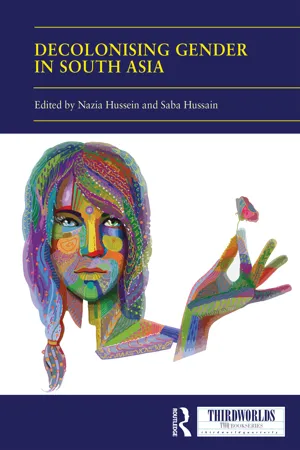
Decolonising Gender in South Asia
eBook - ePub

Decolonising Gender in South Asia

  1. 160 pages
  2. English
  3. ePUB (mobile friendly)
  4. Available on iOS & Android
eBook - ePub

Decolonising Gender in South Asia

About this book

Decolonising Gender in South Asia is the first full-length compilation of cutting-edge research on the challenging debates around decolonial thought and gender studies in South Asia. The book elaborates on various ways of thinking about gender outside the epistemic frame of coloniality/modernity that is bound to the European colonial project.

Following Walter Mignolo, the book calls for epistemic disobedience using border thinking as the necessary condition for thinking decolonially. Borders in this case are conceptualised not just as geographical borders of nation states, they also signify the borders of modern/colonial world, epistemic and ontological orders that the gendered and racialised populations of ex-colonies inhabit. Dwelling, thinking and writing from these borders create conditions of epistemic disobedience to coloniality/modernity discourses of the West. The contributors to this collection, all ethnic minority women from South Asia and the South Asian diaspora, write from and about these borders that challenge the colonial universality of thinking about gender. They are writing from, and with, subalternised racial/ethnic/sexual spaces and bodies located geographically in South Asia and South Asian diasporic contexts. In this way, when coloniality/modernity is shaping universalist understandings of gender, we are able to use a broader canon of thought to produce a more pluriversal understanding of the world.

The chapters in this book were originally published as a special issue of Third World Thematics.

Frequently asked questions

Yes, you can cancel anytime from the Subscription tab in your account settings on the Perlego website. Your subscription will stay active until the end of your current billing period. Learn how to cancel your subscription.
No, books cannot be downloaded as external files, such as PDFs, for use outside of Perlego. However, you can download books within the Perlego app for offline reading on mobile or tablet. Learn more here.
Perlego offers two plans: Essential and Complete
  • Essential is ideal for learners and professionals who enjoy exploring a wide range of subjects. Access the Essential Library with 800,000+ trusted titles and best-sellers across business, personal growth, and the humanities. Includes unlimited reading time and Standard Read Aloud voice.
  • Complete: Perfect for advanced learners and researchers needing full, unrestricted access. Unlock 1.4M+ books across hundreds of subjects, including academic and specialized titles. The Complete Plan also includes advanced features like Premium Read Aloud and Research Assistant.
Both plans are available with monthly, semester, or annual billing cycles.
We are an online textbook subscription service, where you can get access to an entire online library for less than the price of a single book per month. With over 1 million books across 1000+ topics, we’ve got you covered! Learn more here.
Look out for the read-aloud symbol on your next book to see if you can listen to it. The read-aloud tool reads text aloud for you, highlighting the text as it is being read. You can pause it, speed it up and slow it down. Learn more here.
Yes! You can use the Perlego app on both iOS or Android devices to read anytime, anywhere — even offline. Perfect for commutes or when you’re on the go.
Please note we cannot support devices running on iOS 13 and Android 7 or earlier. Learn more about using the app.
Yes, you can access Decolonising Gender in South Asia by Nazia Hussein, Saba Hussain, Nazia Hussein,Saba Hussain in PDF and/or ePUB format, as well as other popular books in Politics & International Relations & Gender Studies. We have over one million books available in our catalogue for you to explore.

Table of contents

  1. Cover
  2. Title Page
  3. Copyright Page
  4. Table of Contents
  5. Citation Information
  6. Notes on Contributors
  7. Introduction – Decolonising gender in South Asia: a border thinking perspective
  8. 1 Prayers to Kāli: practicing radical numinosity
  9. 2 Re-animating Muslim women’s auto/biographical writings: Hayat-e-Ashraf as a palimpsest of educated selves
  10. 3 Pious capital: fashionable femininity and the predicament of financial freedom
  11. 4 ‘Bordering’ life: denying the right to live before being born
  12. 5 Menstruating women and celibate gods: a discourse analysis of women’s entry into Sabarimala temple in Kerala, India
  13. 6 The culinary as ‘border’: perspectives on food and femininity in the Indian subcontinent
  14. 7 A decolonial reading of the Punjabi (m)other in British Asian literature
  15. 8 The (im)possibility of decolonising gender in South Asia: a reading of Bollywood’s ‘new women’
  16. Index