The bestselling author of
The Science of Happiness delivers a book "suffused with genuine wonder and affection for the beauty of particle physics" (
Foreword Reviews).
A single rose suggests the sublime interdependence of all life. A sudden storm points to the world's unpredictability. A marble conjures the birth of the cosmos.
How to Love the Universe shows us how everyday objects and events can reveal some of the deepest mysteries in all of science. In ten eye-opening chapters of lyrical prose, Stefan Klein contemplates time, space, dark matter, and more, encouraging us to fall in love with the universe the same way scientists do: The more we know about twenty-first-century physics, the more enchanting our world becomes. You won't look at a rose the same way again.
"Cosmic inflation and warped space, the measurement of time, and the search for dark energy are all examined in thoughtful, accessible language that brings ideas to vivid life. Klein's latest work encourages readers to think, consider, and give in to scientific fascination." —
Publishers Weekly
"In this finely written book, Stefan Klein brings a poetic and distinctive perspective to some fascinating fundamental questions." —Martin Rees, Astronomer Royal
"Klein sets forth to share the poetry of the universe and succeeds, offering a grounding in the science and beauty that comprises the world around us. The text is easily attainable to casual readers and scientists alike, and will help both to understand the universe better." —
Library Journal
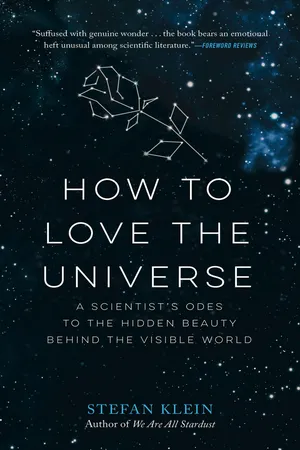
eBook - ePub
How to Love the Universe
A Scientist's Odes to the Hidden Beauty Behind the Visible World
- 242 pages
- English
- ePUB (mobile friendly)
- Available on iOS & Android
eBook - ePub
How to Love the Universe
A Scientist's Odes to the Hidden Beauty Behind the Visible World
About this book
Information
Print ISBN
9781615194865
Subtopic
Philosophy & Ethics in Science1
THE POETRY
OF REALITY
A rose makes us aware
that nothing and nobody stands alone.
The more we know about how things in the
universe relate to each other, the more
mysterious the world seems to us.
universe relate to each other, the more
mysterious the world seems to us.
The more we know about reality, the more mysterious it seems to us. Astonishingly enough, it is sensitive people in particular who dispute that. During a panel discussion, a well-known German poet once remonstrated me, saying that he detested our ever more precise knowledge of genes because decoded man was a bore. And Edgar Allan Poe, the master of the mystery story, called science a predator on poetry:
Why preyest thou thus on the poet’s heart,
Vulture, whose wings are dull realities?
How wrong one can be! Poets are rightly afraid of a world that has lost its magic, but anyone who harbors that fear is confusing research into our world with an Easter egg hunt, in the course of which all the hiding places are eventually plundered. Genuine insight, however, regularly throws up more questions than it can answer.
The great American physicist Richard Feynman was once asked by an artist friend whether a scientist wouldn’t destroy the beauty of a rose if he examined it. Feynman replied that he was able to feel the beauty the artist felt, certainly, but that he saw a deeper beauty, one that only revealed itself through understanding—the beauty, for example, in the fact that flowers acquired color during the course of evolution in order to attract insects. This knowledge, he went on, led to further questions, for example whether insects had any kind of aesthetic sense. Getting to know the flower more closely took away none of its beauty—on the contrary, it added beauty, and made the rose appear even more impressive and mysterious.
Feynman could have gone on to say that the scientist’s sharp eye even revealed beauty in things that at first seem ugly or even repulsive to us. The fading of the rose is a symbol of decline, but if you look closely, you can see the hip growing deep within the withering petals. Each seed in the rose hip is a miracle of its own, because in each tiny kernel, the complete embryo of a rose is waiting for the moment when it can soak up water, expand, break out of the husk, and stretch out its seed-leaves to the sun.
In order to grow, the germinating rose needs light, water, and oxygen. Living beings from long ago have bequeathed it air to breathe. The flower is heir to single-celled organisms that covered the seabed in thick, blue-green mats well over three billion years ago and still live there today. Back then there was almost no oxygen in the atmosphere, and all higher life-forms would have suffocated. The single-celled organisms were only a few thousandths of a millimeter in size. Compared with the rose, these creatures called cyanobacteria seem exceedingly primitive to us and yet they were already masterpieces of nature. Some cyanobacteria can even see! Their bodies have a tiny receptor, a simple camera eye that allows them to distinguish between light and darkness. They avoid the darkness and move toward the light. They use the sunlight in order to acquire energy through photosynthesis, like modern plants. After cyanobacteria had settled in the ancient ocean, they converted the carbon dioxide dissolved in the seawater into oxygen. For a billion years, the oxygen bubbled up from the depths of the ocean. Thus these sighted cyanobacteria created the air that the rose needs to germinate. They made the earth habitable for higher life-forms.
For their part, the cyanobacteria developed out of earlier, even simpler life-forms that could also survive without oxygen. These unknown organisms colonized the earth 3.8 billion years ago. Without them we would never have had a chance to see a rose. Where did this life come from? That we don’t know.
And where does the rose get its water from? That, too, has its own story and goes further back than the story of the air. For a long time, we were content with the observation that in the early period of our planet, steam had come out of the interior of the earth as a gas. But how did the water get into the center of the earth in the first place? It could only have been locked up in there when the earth was formed. 4.5 billion years ago, lumps of stone and dust that were revolving around the sun combined to form the planets; the earth was formed from material that was moving not far from the sun. However, it is practically impossible that this debris was damp enough to make Earth into the blue planet—the heat of the nearby Sun would certainly have dried it up.
So originally the earth was presumably dry, a desert planet. We don’t know precisely how it turned into a world of oceans. The scenario that seems to be the most fantastic of all possible explanations is in fact the most likely one: water came to us from outer space. It arrived in comets or asteroids that, born in the colder regions of the solar system, hit the desert planet Earth like gigantic snowballs. Thus the lakes, rivers, and oceans were filled with the melted ice from the comets. Dewdrops from the cosmos moisten the leaves of the rose.
Finally, the rose owes the strong force its light. The name of this elemental force is actually too modest, for the strong force is far and away the strongest in nature. It holds atomic nuclei together. It is released in the interior of the sun, where the atomic nuclei of hydrogen fuse to become helium, releasing immense amounts of energy that radiate out into space. Hydrogen, that combustible material, is the oldest of all substances. Since the very first minute after the Big Bang, hydrogen has been present throughout the cosmos. All the elements were baked from it in the furnace of the stars, again as a result of the strong force. Everything around us on Earth was once the ash of the stars—the carbon of which the germ bud consists also comes from it. The rose is metamorphosed stardust.
The stars that brought forth the rose, however, were born of clouds of hydrogen. As a result of their own gravitational pull in the cosmos, those clouds became so concentrated that they eventually ignited—the first starlight shone out. Did the stars then give birth to themselves? For a long time that was the assumption. Today we know: The stars, too, needed outside help. The hydrogen in the universe wasn’t sufficient to condense into clouds by means of its own gravitational pull. Left to itself, it would simply have spread evenly over the cosmos, like sugar dissolving in tea. The gases would never have concentrated; not even a single star would ever have shone in the sky. The universe would have remained without form.
Something heavy must therefore have started it all by attracting the hydrogen, causing it to form clouds—something we don’t know. As this something doesn’t shine and also remains otherwise invisible, we call it “dark matter.” What this dark matter consists of, what characteristics it has, we do not know.
Many of these connections were unknown to Richard Feynman, who reflected on the beauty of the rose. One of the most important scientists of the twentieth century, he died in 1988. But in recent years our knowledge of the formation of the world has expanded dramatically. We are now able to trace the history of the universe back to the first millionth of a second after its birth, at least in broad outline. We know of habitable planets outside the solar system; we have discovered a system forty light-years away with seven planets similar to Earth and must assume that the night sky conceals many more planets than the stars that shine. We are aware of physical processes that are contrary to our notions of space and time.
Even very recently, the idea that knowledge of this kind might be possible was still regarded as adventurous speculation. Today it consists of facts that are substantiated by measurements right down to the decimal point.
But our knowledge is merely an island in an ocean of ignorance. And whenever we manage to extend the island, we also lengthen the coastline from which we confront our lack of knowledge. Despite all the spectacular insights we have gained, the questions have not become any fewer, and certainly not simpler. We would love to know what took place in the first millionth of a second after the birth of the universe. And does it make sense to speculate on what might have been going on previously, before the Big Bang? Is there indeed life elsewhere in the cosmos? Are time and space merely illusions? These are the kinds of questions this book deals with. It describes how twenty-first-century physics changes our thinking, the way we see the world. It doesn’t demand any prior knowledge, only the courage to look behind the veil of that which still seems self-evident to us today. Then a world will be revealed to us that “is not only queerer than we suppose but queerer than we can suppose,” as the British biologist J. B. S. Haldane put it. The following pages are an invitation to let yourself be enthralled by the reality in which we live. For a rose is much more than a rose. It is a witness to the genesis of the world.
2
A MARBLE IN
THE COSMOS
The earth rises over the moon and we see
the universe as it is being born. Much greater
spaces are concealed behind the visible cosmos.
Reality is quite different from how it seems to us.
. . . for all knowledge and wonder is an impression
of pleasure in itself.
FRANCIS BACON
In one of my earliest childhood memories, my father is carrying a large cardboard box into the house. He pushes his way in through the door backward, then the box appears, and then finally a friend of my father’s, who has grabbed hold of the other end. “What is it?” my mother asks. “I’ve bought us a television,” he replies. My mother is furious; she doesn’t want such an ugly appliance in the house. My father justifies himself: “They’re flying to the moon.”
My father fetches a saw. He opens the double doors of the dark cupboard in the living room, which we children aren’t allowed to touch because it’s a valuable old piece of furniture. Moreover, it’s used as the liquor cabinet. My father takes out the bottles and gets to work inside the cupboard. He cuts out shelves from the precious cupboard until there’s enough room for the television. When the doors are shut, it disappears.
So the astronauts’ voices came out of the cupboard. What sticks in my mind is the metallic tone in which they rasped out their commands, which were incomprehensible for me. I also remember two images. In one scene, two figures are scurrying across the screen. They’re shining ghostly white and instead of faces, they have a disc at the front of their heads. There’s a flag hanging in the greyness behind them. The ghosts are carrying huge backpacks but they’re skipping and jumping as if they weighed nothing at all. My parents say something about gravity being six times less on the moon; I’d love to try that myself. I’m four years old.
The other scene shows a marble precisely in the middle of the picture, half illuminated, hovering in complete darkness. Even though we had a black-and-white TV at the time, I remember it being such a deep blue that the intensity of the color was almost painful. Clearly photos I saw later on in magazines and books have superimposed themselves on the TV pictures in my memory and added color to them. There are swirls of white shimmering over the blue and on the left-hand side a large, sharply outlined patch of brown can be seen. However, the whole foreground of the image is filled with a desert of monotonous ochre. Hills and craters stretch as far as the horizon of a range of mountains, above which is the marble. It is impossible to imagine that anything has ever lived, or will ever live, in that ochre wasteland.
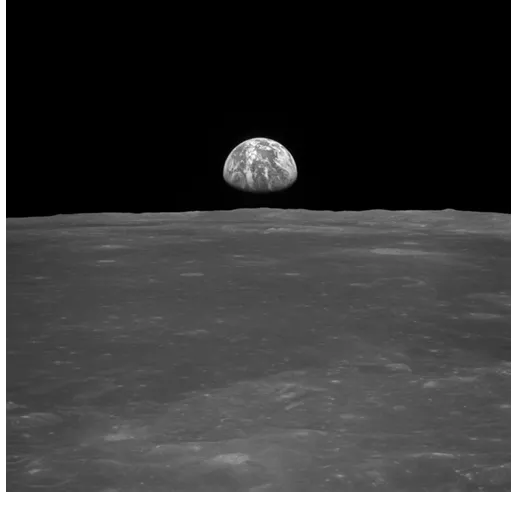
Thus Apollo 11 transmitted the earth rising over the moon to our two-hundred-year-old living-room cupboard. I can’t remember how I reacted when these images flickered across our screen in July 1969, but every time I’ve seen them since, my feelings have grown stronger. So that is our home in the cosmos—a tiny ball, alone in immeasurable night, fragile and beautiful. If you look very closely, you can even see the atmosphere, a filmy halo shimmering in the sunlight: the only home of life we know of, the only place where we can be.
For all that, there is no trace of human activity to be seen on the blue sphere, nothing reminiscent of things that are familiar to us. The view from the moon shows our habitat in a way we never normally consider it—from outside. And yet we immediately feel that this has to do with us. It is precisely this unfamiliar vantage point that gives the “Earthrise” pictures their power. Once you’ve seen them, you can no longer take your own existence for granted. While we feel wrapped up in the monotony of our daily routine, life can certainly seem banal. But can there be anything more astonishing than this life when we realize that far and wide there is no sign of company, that we are lonely passengers on a speck of dust in the cold of the universe? For a deeper appreciation of this insight, we have to abandon our accustomed perspective.
People have repeatedly found that reality is quite different from the way it appears to us. The earth is not flat, nor does the sun revolve round it. The moon is no light in the sky, but a mirror reflecting the rays of the sun. The clouds we can see among the stars through a telescope aren’t mist, but galaxies like our own. Animals and people didn’t appear on the planet in their current form, they developed in the long course of evolution. Each of these insights was at one time considered outrageous. They contradicted everything people were able or willing to imagine. Today we take these outrages for granted. The way we see the world today is based on them.

I have seldom seen this search for a new, more all-embracing view of reality put in a more memorable way than in a mysterious woodcut that appeared in 1888 in a book by the French astronomer Camille Flammarion. The picture, the origin of which is unknown, is generally called “Traveler on the Edge of the World.” It shows a traveler leaving his familiar surroundings behind him to look in amazement on a cosmos of strange beauty. Behind the man we can see the world we are familiar with: gently rising hills with shrubs and trees, a village nestled by a lake on which the setting sun is shining. In the foreground it is already evening, the stars are twinkling in the sky. And it is this starry sky, which comes down to meet the earth, that the traveler has broken through with his upper body. His head is already in another world, a world beyond known phenomena. In it is the sparkle of fantastic swirls, clouds, wheels of fire, rays, lights; the man is stretching out his hand toward the wonders he encounters. But has the traveler really left the world that is familiar to him? A richly decorated frame holds the two parts of the picture together, and it is perhaps not mere chance that the swirls behind the firmament recall the lines of electromagnetic fields. Physicists had discovered these invisible lines of force two decades before the “Traveler on the Edge of the World” was published.
Eyes wide with amazement, the traveler looks on another dimension of our existence. He is observing the phenomena behind familiar appearances—not those of an alien world, however, but of our own everyday one. That connects him with us when we watch the blue Earth rise over the moon.
If I had to choose just one picture of the great discoveries of the twenty-first century, I would also take one from outer space. Admittedly, the star chart that the European space probe Planck sent us, which was published in 2013, is rather more difficult to read than the images of the traveler and the blue marble. At...
Table of contents
- 1 - THE POETRY OF REALITY
- A rose makes us aware that nothing and nobody stands alone. The more we know about how things in the universe relate to each other, the more mysterious the world seems to us.
- 2 - A MARBLE IN THE COSMOS
- The earth rises over the moon and we see the universe as it is being born. Much greater spaces are concealed behind the visible cosmos. Reality is quite different from how it seems to us.
- 3 - RIDING ON A RAY OF LIGHT
- A young man wonders what light is, and his reflections on light explain the world to him. Time and space are revealed. But when Albert Einstein dies, light is still a mystery.
- 4 - THE WORLD SPIRIT FAILS
- A hurricane sweeps across Germany, a storm no one saw coming. Reasons why the world is unpredictable, and praise for the creative universe.
- 5 - A CRIME STORY
- A villainous gang is raiding apartments in London and New York. Although the burglars were not able to arrange things with each other, their raids are perfectly coordinated. Investigator Glock is looking for a secret plan, but cannot find one. His conclusion: All the places in the world are, in reality, one place.
- 6 - IS THE WORLD REAL?
- A hammer hits a thumb. But the hammer, like all matter, consists of emptiness. How can nothingness hurt like that? And then—does the nothingness exist at all?
- 7 - “WHO ORDERED THAT?”
- We live in a shadow world. No matter where we look, there is twenty times more than appears to us. More of what? We have no idea. But without dark energy, without dark matter, we couldn’t exist.
- 8 - HOW TIME PASSES
- A greying beard makes you wonder why the past can never come back. We experience the passing of time because we are not omniscient. The universe is growing older, as well.
- 9 - BEYOND THE HORIZON
- The night is dark because the world had a beginning. Since then the universe has been expanding. Space is bigger than we can imagine. Thoughts on being amazed.
- 10 - WHY WE EXIST
- In each of us one of the most astonishing characteristics of the universe appears: Intelligent life is not only possible but even probable. How can anyone maintain, therefore, that we are meaningless?
- NOTES
- INTERVIEW WITH THE AUTHOR
- ACKNOWLEDGMENTS
- ABOUT THE AUTHOR
Trusted by 375,005 students
Access to over 1.5 million titles for a fair monthly price.
Study more efficiently using our study tools.
Frequently asked questions
Yes, you can cancel anytime from the Subscription tab in your account settings on the Perlego website. Your subscription will stay active until the end of your current billing period. Learn how to cancel your subscription
No, books cannot be downloaded as external files, such as PDFs, for use outside of Perlego. However, you can download books within the Perlego app for offline reading on mobile or tablet. Learn how to download books offline
Perlego offers two plans: Essential and Complete
- Essential is ideal for learners and professionals who enjoy exploring a wide range of subjects. Access the Essential Library with 800,000+ trusted titles and best-sellers across business, personal growth, and the humanities. Includes unlimited reading time and Standard Read Aloud voice.
- Complete: Perfect for advanced learners and researchers needing full, unrestricted access. Unlock 1.5M+ books across hundreds of subjects, including academic and specialized titles. The Complete Plan also includes advanced features like Premium Read Aloud and Research Assistant.
We are an online textbook subscription service, where you can get access to an entire online library for less than the price of a single book per month. With over 1.5 million books across 990+ topics, we’ve got you covered! Learn about our mission
Look out for the read-aloud symbol on your next book to see if you can listen to it. The read-aloud tool reads text aloud for you, highlighting the text as it is being read. You can pause it, speed it up and slow it down. Learn more about Read Aloud
Yes! You can use the Perlego app on both iOS and Android devices to read anytime, anywhere — even offline. Perfect for commutes or when you’re on the go.
Please note we cannot support devices running on iOS 13 and Android 7 or earlier. Learn more about using the app
Please note we cannot support devices running on iOS 13 and Android 7 or earlier. Learn more about using the app
Yes, you can access How to Love the Universe by Stefan Klein in PDF and/or ePUB format. We have over 1.5 million books available in our catalogue for you to explore.