Take a seat—the captain's seat, that is—and relax. You're about to land a Boeing 747. "Brilliant." —
The Sunday Times
A Daily Mail
and Spectator
Best Book of the Year
A Points Guy
Best Book of the Year
The mystery of flight is magical; the
reality even more so—from the physics that keeps a 450-ton vehicle aloft, to the symphony of technology and teamwork that safely sets it down again. Take it from Mark Vanhoenacker—British Airways pilot, international bestselling author, and your new flight instructor. This is
How to Land a Plane.
Vanhoenacker covers every step—from approach to touchdown— with precision, wit, and infectious enthusiasm. Aided by dozens of illustrations, you'll learn all the tools and rules of his craft: altimeters, glidepaths, alignment, and more. Before you know it, you'll be on the ground, exiting the aircraft with a whole new appreciation for the art and science of flying.
"A good choice for anyone who's fantasized about suddenly having to get an aircraft safely down on the ground . . . walks you through some of the basics of flight and landing, from how to recognize a cluster of instruments known as the 'six pack' to knowing what purpose the PAPI lights near the runway serve." —
Popular Science
"A work of humorous and outright poetic travel geekery." —
National Geographic Traveler
- 64 pages
- English
- ePUB (mobile friendly)
- Available on iOS & Android
eBook - ePub
How to Land a Plane
About this book
Information

Chapter 1
Settling In

Hello! Welcome! Honestly, you look surprisingly calm. That’s great to see.
So, this is the cockpit. Have a seat on the left—you’re now the captain, after all, and that’s the captain’s seat. First of all, I have to ask, what do you think of the view? The world-surveying, forward-facing panorama that a cockpit offers is reason enough to become a pilot. You really are in the best seat in the house.
Fasten your seat belt, which pilots must wear whenever they are sitting down. In addition to the usual belt which goes across your lap, there may be shoulder straps or harnesses, as well as what’s delicately termed a “crotch strap.”
Now, in the spirit of a gentlemanly skipper I once flew with (“Priorities, young Mark, priorities!”), order yourself a cup of tea.
I’m joking about the tea, but only a little. One reason I prefer flying to driving is that when you’re driving, whether on a busy highway or a winding country lane, if you were to let go of the wheel you’d probably be only a few seconds away from disaster. Airplanes are different. They are designed to be stable. If a pilot briefly took his or her hands off the controls, a plane would simply carry on doing whatever it had been doing before. For an untrained pilot, “Do nothing” is my first bit of counsel.
So, by all means, have some tea (at the very least it will help you relax). And then, when you’re ready, take a good look around the cockpit. There’s almost certainly a bewildering array of buttons, levers, and switches, and, depending on how modern your aircraft is, lots of digital screens. But for routine flight—including a routine landing—I promise you that a cockpit isn’t as complicated as it looks.
Let’s start by dividing what’s in front of you into controls and instruments. To give a familiar example, in a car you can add power by using a control (the accelerator pedal), and you can monitor the result on an instrument (the speedometer). It’s the same in a plane. The controls allow you to manipulate the aircraft and its systems, while the instruments give you information about the results of your inputs, as well as about the aircraft’s ever-changing relationship to the outside world.
The Controls
The first widebody airliner I learned to fly was the Boeing 747. Compared to many airplanes, it’s both enormous, and enormously complicated. Yet one of my 747 instructors was fond of saying to me, again and again, “Mark, it’s just a big Cessna.” What he meant was that, while technology changes, the basics of flying don’t. So, what are those basics?
A good place to start is with the famous three axes along which a plane can be controlled, as shown here:

Think of a line running through the nose of the plane, down the middle and out the tail. As painful as it is for me to compare the majestic 747 to a rotisserie chicken, you could imagine that the plane is on a spit. A plane can rotate from side to side along this axis. That’s roll.
Add another line, running (roughly) between the wingtips. A plane can rotate along that axis, too, tipping its nose and tail upwards or downwards, as if they were the opposite ends of a seesaw. That’s pitch.
Finally, imagine a vertical line running through the plane from the sky to the earth. A plane can rotate around that, just as if it were on a turntable. That’s yaw.
A pilot has controls at his or her fingertips (and toe tips) to rotate a plane along each of these three axes.
Let’s start with roll. In front of you is something that vaguely resembles the bottom half of a steering wheel. That’s the control wheel (Figure 3). When rotated, it maneuvers panels on the wings that essentially make one wing work better or worse than the other. The temporarily improved wing rises, the other one falls, and the aircraft rolls around its skewer-style nose-to-tail axis. From a window seat behind the wing, it’s easy to see how neatly the plane rolls in response to even very small movements of the panels on the wings—a testament to how much air is flowing over them, and how fast. Rolling can also be called banking, and it’s basically how planes turn in the sky.

Why do planes turn like this? While it’s not a perfect analogy, you might think about how racetracks are often banked or inclined, especially on the curves. Indeed, some racetrack bank angles are just as steep as the bank angles typically used by a turning aircraft. (Another reason why I like the racetrack analogy: the holding patterns that planes sometimes enter when waiting to land are racetrack-shaped, with precisely drawn curves the planes must bank around . . .) You could also think about those little model airplanes you see in toy shops, which are tethered to the ceiling and race around and around in a little circle. Those planes are always turning, and always banking.
Next is pitch—the seesaw-like motion that raises or lowers the angle of the nose in relation to the horizon. Unlike a car’s steering wheel, the control wheel also moves forward and backward on the control column, to which it’s attached (the terms yoke, control wheel, and control column may be used somewhat interchangeably for the combined assembly). The forward-backward motion of the control column moves either the entire horizontal part of the tail, or panels that form part of it. The horizontal part of the tail is basically a mini-wing, and manipulating it so that it works better or worse forces the tail down or up, which in turn changes the pitch (or pitch attitude) of the whole aircraft.
If you push forward on the controls, the nose will lower and (in the most general terms) the aircraft will descend. Pull back, however, and the nose will rise, and the aircraft may climb. My favorite summary (which is adapted from Father Ted—a British TV show from the nineties—and which I couldn’t help but quote in my first book, Skyfaring): “Push the control column forward, cows get bigger. Pull back, cows get smaller.”
On some planes, instead of a control wheel and column, you’ll have a stick right in front of you that performs the same functions. On certain aircraft, including most Airbus jets, you’ll see a sidestick controller off to one side—an incredibly expensive joystick, essentially, that processes pilot inputs in a high-tech manner that’s far removed from the basics we’re discussing here.
So that’s roll and pitch. What about yaw? In front of your feet are rudder pedals. These pedals have a number of functions. Both in flight and on the ground, they control the vertical panel or panels on the tail fin of the aircraft, while on the ground the pedals are typically also used to steer the aircraft via its wheels, as well as to brake, or indeed to steer by applying the brakes. In flight, the effect of the rudder pedals is to yaw, or rotate, the aircraft—again, as if it were on a turntable.
Perhaps you’re wondering here why planes don’t just yaw to turn, instead of rolling. Planes can indeed turn simply by yawing, but for a variety of reasons it’s less effective. To go back to the racetrack analogy, if a curve wasn’t banked, a car going too fast around it would skid off, right? If you simply yaw a plane, then it, too, will “skid” in the direction it was originally traveling.
In fact, the most efficient, polished aerial turns require both banking and a bit of rudder. In a small, basic plane—the kind you might take lessons in—your instructor will drill this coordination of roll and yaw into you from Day One. In airliners, the coordination is typically automated. For today’s limited purposes, on most modern aircraft it’s probably simplest to not use the rudder pedals when turning in flight. Just don’t think of them as anything like the pedals in a car, which they definitely are not.
The other important control you need to find is the power.
The importance of the engine (or engines) might seem obvious. But this is a good excuse to talk about the famous four forces (Figure 4) that, along with the famous three axes we just discussed, are something every aspiring pilot learns about on the first day of ground school.
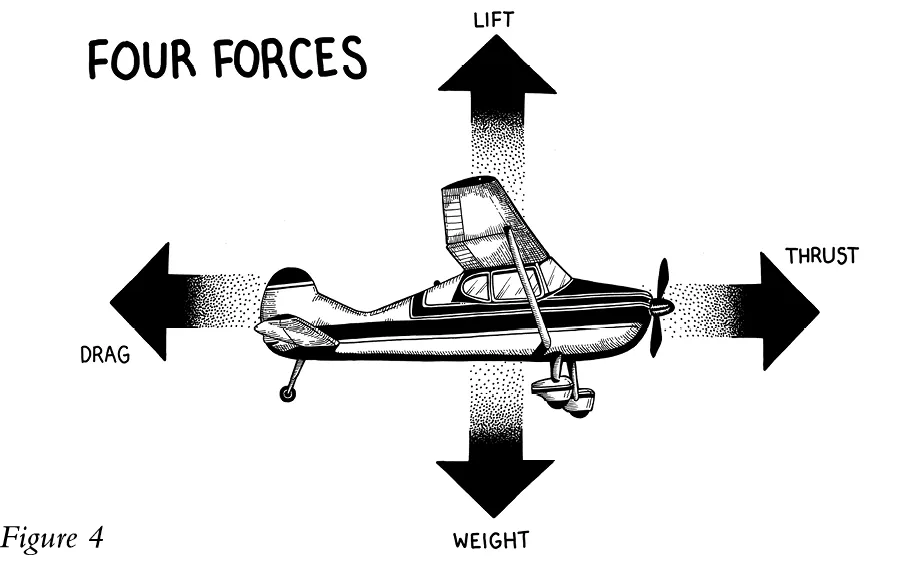
The plane creates lift, primarily from the wings. Sometimes my friends ask me how planes fly. What they usually mean is “How does a wing work?” There are a couple of different ways of explaining it, not all of which, frankly, are very satisfying or intuitive. Perhaps the best answer is the simplest one, and that was given long ago by Wolfgang Langewiesche, one of history’s greatest author-aviators. In Stick and Rudder, first published in 1944, he wrote: “The wing keeps the airplane up by pushing the air down.” That venerable statement grows even more remarkable, as another pilot I know is fond of pointing out, when you see a 450-ton 747 rise into the sky. For thousands of miles and a dozen or more hours, over deserts and mountain ranges and entire oceans, its vast, shining wings are pushing and pushing against nothing more than the invisible air. Lift, then, primarily overcomes the weight of the airplane and of everything it’s carrying into the heavens—you, your breakfast tray, this little book. It even lifts the wings themselves (which is kind of meta and best not thought about too much). Drag is both obvious and really complicated. There are a few different kinds. But in short, drag is what you overcome when you swim, and what...
Table of contents
- Cover
- Contents
- Introduction
- 1. Settling In
- 2. Aviate, Navigate, Communicate
- 3. The Best Laid Flight Plans
- 4. Preparing for the Approach
- 5. Here We Go, or, “I Just Want to Tell You Both, Good Luck. We’re All Counting On You”
- Acknowledgments
- About the Author
Trusted by 375,005 students
Access to over 1.5 million titles for a fair monthly price.
Study more efficiently using our study tools.
Frequently asked questions
Yes, you can cancel anytime from the Subscription tab in your account settings on the Perlego website. Your subscription will stay active until the end of your current billing period. Learn how to cancel your subscription
No, books cannot be downloaded as external files, such as PDFs, for use outside of Perlego. However, you can download books within the Perlego app for offline reading on mobile or tablet. Learn how to download books offline
Perlego offers two plans: Essential and Complete
- Essential is ideal for learners and professionals who enjoy exploring a wide range of subjects. Access the Essential Library with 800,000+ trusted titles and best-sellers across business, personal growth, and the humanities. Includes unlimited reading time and Standard Read Aloud voice.
- Complete: Perfect for advanced learners and researchers needing full, unrestricted access. Unlock 1.5M+ books across hundreds of subjects, including academic and specialized titles. The Complete Plan also includes advanced features like Premium Read Aloud and Research Assistant.
We are an online textbook subscription service, where you can get access to an entire online library for less than the price of a single book per month. With over 1.5 million books across 990+ topics, we’ve got you covered! Learn about our mission
Look out for the read-aloud symbol on your next book to see if you can listen to it. The read-aloud tool reads text aloud for you, highlighting the text as it is being read. You can pause it, speed it up and slow it down. Learn more about Read Aloud
Yes! You can use the Perlego app on both iOS and Android devices to read anytime, anywhere — even offline. Perfect for commutes or when you’re on the go.
Please note we cannot support devices running on iOS 13 and Android 7 or earlier. Learn more about using the app
Please note we cannot support devices running on iOS 13 and Android 7 or earlier. Learn more about using the app
Yes, you can access How to Land a Plane by Mark Vanhoenacker in PDF and/or ePUB format, as well as other popular books in Technology & Engineering & Aviation. We have over 1.5 million books available in our catalogue for you to explore.