Long before Deng Xiaoping's market-based reforms, commercial relationships bound the Chinese Communist Party to international capitalism and left lasting marks on China's trade and diplomacy.
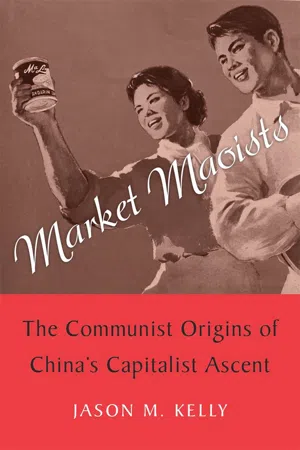
China today seems caught in a contradiction: a capitalist state led by a Communist party. But as Market Maoists shows, this seeming paradox is nothing new. Since the 1930s, before the Chinese Communist Party came to power, Communist traders and diplomats have sought deals with capitalists in an effort to fuel political transformation and the restoration of Chinese power. For as long as there have been Communists in China, they have been reconciling revolutionary aspirations at home with market realities abroad.
Jason Kelly unearths this hidden history of global commerce, finding that even Mao Zedong saw no fundamental conflict between trading with capitalists and chasing revolution. China's ties to capitalism transformed under Mao but were never broken. And it was not just goods and currencies that changed hands. Sustained contact with foreign capitalists shaped the Chinese nation under Communism and left deep impressions on foreign policy. Deals demanded mutual intelligibility and cooperation. As a result, international transactions facilitated the exchange of ideas, habits, and beliefs, leaving subtle but lasting effects on the values and attitudes of individuals and institutions.
Drawing from official and commercial archives around the world, including newly available internal Chinese Communist Party documents, Market Maoists recasts our understanding of China's relationship with global capitalism, revealing how these early accommodations laid the groundwork for China's embrace of capitalism in the 1980s and after.
- 321 pages
- English
- PDF
- Available on iOS & Android
eBook - PDF
About this book
Information
Table of contents
- Cover
- Title Page
- Copyright
- Dedication
- Contents
- Abbreviations
- Introduction
- 1. Opening a Capitalist Window
- 2. Closing the Open Door
- 3. The Korean War and the Fight for Trade
- 4. Commerce in the Making of “Peaceful Coexistence”
- 5. A “Great Leap” in Trade
- 6. Trading for Salvation
- 7. Markets and the Rise and Fall of Redness
- Epilogue
- Abbreviations in the Notes
- Notes
- Acknowledgments
- Index
Trusted by 375,005 students
Access to over 1.5 million titles for a fair monthly price.
Study more efficiently using our study tools.
Frequently asked questions
Yes, you can cancel anytime from the Subscription tab in your account settings on the Perlego website. Your subscription will stay active until the end of your current billing period. Learn how to cancel your subscription
No, books cannot be downloaded as external files, such as PDFs, for use outside of Perlego. However, you can download books within the Perlego app for offline reading on mobile or tablet. Learn how to download books offline
Perlego offers two plans: Essential and Complete
- Essential is ideal for learners and professionals who enjoy exploring a wide range of subjects. Access the Essential Library with 800,000+ trusted titles and best-sellers across business, personal growth, and the humanities. Includes unlimited reading time and Standard Read Aloud voice.
- Complete: Perfect for advanced learners and researchers needing full, unrestricted access. Unlock 1.5M+ books across hundreds of subjects, including academic and specialized titles. The Complete Plan also includes advanced features like Premium Read Aloud and Research Assistant.
We are an online textbook subscription service, where you can get access to an entire online library for less than the price of a single book per month. With over 1.5 million books across 990+ topics, we’ve got you covered! Learn about our mission
Look out for the read-aloud symbol on your next book to see if you can listen to it. The read-aloud tool reads text aloud for you, highlighting the text as it is being read. You can pause it, speed it up and slow it down. Learn more about Read Aloud
Yes! You can use the Perlego app on both iOS and Android devices to read anytime, anywhere — even offline. Perfect for commutes or when you’re on the go.
Please note we cannot support devices running on iOS 13 and Android 7 or earlier. Learn more about using the app
Please note we cannot support devices running on iOS 13 and Android 7 or earlier. Learn more about using the app
Yes, you can access Market Maoists by Jason M. Kelly in PDF and/or ePUB format, as well as other popular books in History & Business History. We have over 1.5 million books available in our catalogue for you to explore.