Antenna and EM Modeling with MATLAB Antenna Toolbox
eBook - ePub

Antenna and EM Modeling with MATLAB Antenna Toolbox

  1. English
  2. ePUB (mobile friendly)
  3. Available on iOS & Android
eBook - ePub

Antenna and EM Modeling with MATLAB Antenna Toolbox

About this book

ANTENNA AND EM MODELING WITH MATLAB ANTENNA TOOLBOX™

An essential text to MATLAB Antenna Toolbox™ as accessible and easy-to-use full-wave antenna modeling tool

Antenna and EM Modeling with MATLAB Antenna Toolbox™ is a textbook on antennas intended for a one semester course. The core philosophy is to introduce the key antenna concepts and follow them up with full-wave modeling and optimization in the MATLAB Antenna Toolbox™. Such an approach will enable immediate testing of theoretical concepts by experimenting in software. It also provides the direct path to research work.

The fundamental families of antennas — dipoles, loops, patches, and traveling wave antennas — are discussed in detail, together with the respective antenna arrays. Using antenna parameters such as impedance, reflection coefficient, efficiency, directivity, and gain, the reader is introduced to the different ways of understanding the performance of an antenna.

Written for senior undergraduates, graduates as well as RF/Antenna engineers, Antenna and EM Modeling with Antenna Toolbox™ is a resource that:

  • Provides 14 video assisted laboratories on using Antenna Toolbox™
  • Includes approximately 50 real-world examples in antenna and array design
  • Offers approximately 200 homework problems
  • Provides multiple ready-to-use standalone MATLAB ® scripts

Frequently asked questions

Yes, you can cancel anytime from the Subscription tab in your account settings on the Perlego website. Your subscription will stay active until the end of your current billing period. Learn how to cancel your subscription.
No, books cannot be downloaded as external files, such as PDFs, for use outside of Perlego. However, you can download books within the Perlego app for offline reading on mobile or tablet. Learn more here.
Perlego offers two plans: Essential and Complete
  • Essential is ideal for learners and professionals who enjoy exploring a wide range of subjects. Access the Essential Library with 800,000+ trusted titles and best-sellers across business, personal growth, and the humanities. Includes unlimited reading time and Standard Read Aloud voice.
  • Complete: Perfect for advanced learners and researchers needing full, unrestricted access. Unlock 1.4M+ books across hundreds of subjects, including academic and specialized titles. The Complete Plan also includes advanced features like Premium Read Aloud and Research Assistant.
Both plans are available with monthly, semester, or annual billing cycles.
We are an online textbook subscription service, where you can get access to an entire online library for less than the price of a single book per month. With over 1 million books across 1000+ topics, we’ve got you covered! Learn more here.
Look out for the read-aloud symbol on your next book to see if you can listen to it. The read-aloud tool reads text aloud for you, highlighting the text as it is being read. You can pause it, speed it up and slow it down. Learn more here.
Yes! You can use the Perlego app on both iOS or Android devices to read anytime, anywhere — even offline. Perfect for commutes or when you’re on the go.
Please note we cannot support devices running on iOS 13 and Android 7 or earlier. Learn more about using the app.
Yes, you can access Antenna and EM Modeling with MATLAB Antenna Toolbox by Sergey N. Makarov,Vishwanath Iyer,Shashank Kulkarni,Steven R. Best in PDF and/or ePUB format, as well as other popular books in Technology & Engineering & Electrical Engineering & Telecommunications. We have over one million books available in our catalogue for you to explore.

CHAPTER 1
Antenna Circuit Model. Antenna Matching. Antenna Bandwidth

SECTION 1 LUMPED CIRCUIT MODEL OF AN ANTENNA. ANTENNA INPUT IMPEDANCE

  • 1.1 Antenna Circuit Model. Antenna Loss
  • 1.2 Maximum Power Transfer to (and from) Antenna
  • 1.3 Antenna Efficiency
  • 1.4 Antenna Input Impedance and Impedance Matching
  • 1.5 Point of Interest: Input Impedance of a Dipole Antenna and Its Dependence on Dipole Length
  • 1.6 Beyond the First Resonance
  • 1.7 Numerical Modeling
  • References
  • Problems

1.1 ANTENNA CIRCUIT MODEL. ANTENNA LOSS

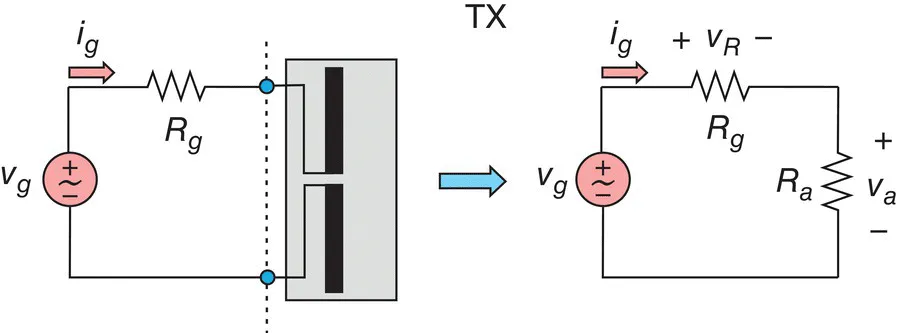
The generic transmitter (TX) circuit with an antenna is shown in Figure 1.1. The generator (g) is modeled as an ideal (sinusoidal or pulse) voltage source Vg in series with the generator resistance Rg, connected to a TX antenna. The typical generator resistance is 50 Ω. This model is known as Thévenin equivalent of the generator circuit. The Norton equivalent may also be used when necessary.
Schematic illustration of a generator (its Thévenin equivalent) connected to an antenna.
Figure 1.1 A generator (its Thévenin equivalent) connected to an antenna.
The portion depicted in the shaded box is an antenna. The antenna in Figure 1.1 is assumed to be resonant, which means that its equivalent impedance, Za, is purely real, i.e.
(1.1)
equation
In order words, the resonant antenna is simply modeled by a resistor Ra.
The antenna resistance Ra includes two parts:
  1. Radiation resistance of the antenna Rr that describes the circuit power loss due to radiation by the antenna into free space.
  2. Loss resistance of the antenna RL that describes the circuit power loss in the antenna itself. Case in point: a long thin wire with a significant ohmic resistance or a helical antenna with a ferrite lossy core.
One thus has
(1.2)
equation
Parasitic antenna resistance RL has the following features:
  1. it is zero for ideal antennas (a metal antenna made of perfect electric conductors);
  2. it is usually relatively small for metal antennas covering the band 0.3–3 GHz (UHF, L‐band, S‐band) where it may be often ignored;
  3. it may be very significant for printed antennas on lossy dielectric substrates and in the vicinity of lossy dielectric (such as FR4, ABS, human body, etc.);
  4. it is vital for very small antennas whose size is much less than the wavelength.

Example 1.1

A small antenna operating at f = 10 MHz uses a thin copper wire with the diameter D of 0.25 mm and with the wire length l of 1 m. Calculate antenna loss resistance RL.
Solution: The DC resistance of the wire is given by
(1.3)
equation
where σ is the material conductivity...

Table of contents

  1. Cover
  2. Table of Contents
  3. Title Page
  4. Copyright Page
  5. Dedication Page
  6. Preface and Text Organization
  7. List of Notations
  8. About the Companion Website
  9. CHAPTER 1: Antenna Circuit Model. Antenna Matching. Antenna Bandwidth
  10. CHAPTER 2: Receiving Antenna
  11. CHAPTER 3: Antenna Radiation
  12. CHAPTER 4: Antenna Balun. Antenna Reflector. Method of Images
  13. CHAPTER 5: Dipole Antenna Family: Broadband Antennas that Operate as Dipoles at Low Frequencies
  14. CHAPTER 6: Loop Antennas
  15. CHAPTER 7: Small Antennas
  16. CHAPTER 8: Patch and PIFA Antennas
  17. CHAPTER 9: Traveling Wave Antennas
  18. CHAPTER 10: Antenna Designer Including Circularly Polarized Antennas
  19. CHAPTER 11: Antenna Arrays
  20. Index
  21. End User License Agreement