A revealing look at French composer and virtuoso Camille Saint-Saëns
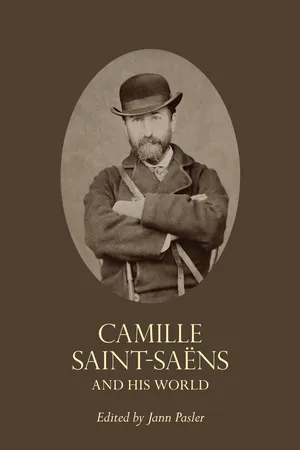
Camille Saint-Saëns—perhaps the foremost French musical figure of the late nineteenth century and a composer who wrote in nearly every musical genre, from opera and the symphony to film music—is now being rediscovered after a century of modernism overshadowed his earlier importance. In a wide-ranging and trenchant series of essays, articles, and documents, Camille Saint-Saëns and His World deconstructs the multiple realities behind the man and his music. Topics range from intimate glimpses of the private and playful Saint-Saëns, to the composer's interest in astronomy and republican politics, his performances of Mozart and Rameau over eight decades, and his extensive travels around the world. This collection also analyzes the role he played in various musical societies and his complicated relationship with such composers as Liszt, Massenet, Wagner, and Ravel. Featuring the best contemporary scholarship on this crucial, formative period in French music, Camille Saint-Saëns and His World restores the composer to his vital role as innovator and curator of Western music.
The contributors are Byron Adams, Leon Botstein, Jean-Christophe Branger, Michel Duchesneau, Katharine Ellis, Annegret Fauser, Yves Gérard, Dana Gooley, Carolyn Guzski, Carol Hess, D. Kern Holoman, Léo Houziaux, Florence Launay, Stéphane Leteuré, Martin Marks, Mitchell Morris, Jann Pasler, William Peterson, Michael Puri, Sabina Teller Ratner, Laure Schnapper, Marie-Gabrielle Soret, Michael Stegemann, and Michael Strasser.
- 440 pages
- English
- ePUB (mobile friendly)
- Available on iOS & Android
eBook - ePub
Camille Saint-Saëns and His World
About this book
Information
Publisher
Princeton University PressYear
2021Print ISBN
9780691155562
9780691155555
eBook ISBN
9781400845101
PART I
SAINT-SAËNS THE PERSON
Saint-Saëns in (Semi-)Private
MITCHELL MORRIS
It is often said that when Saint-Saëns was asked on one occasion whether he was homosexual, he replied, “Non! je suis un péderaste.” This is one of those tales, widely reported but scantily documented (if that), that tends to collect around celebrated cultural figures. Surely so wispy (if witty) a bit of innuendo has no place in the accounts of responsible biographers? Not so. In fact, there are a cluster of reasons why an account of Saint-Saëns’s life must take stock of such factually attenuated stories, not to mention the better supported tale in which the warm acquaintance between Saint-Saëns and Tchaikovsky, arising from their common interests in the arts as well as their network of acquaintances, reached a high point in their short balletic performance (without, importantly, an audience) of the myth of Pygmalion and Galatea.1
At stake in these stories is the way that narratives about Saint-Saëns as a person are likely to make sense in the framework of modern notions of sexual identity. We tend, in our heavily psychologized world, to read actions and statements, deliberate as well as accidental, as disclosures of interior states. Consequently, performing as a ballerina or claiming the label “pederast” are frivolous gestures with a serious self-revelatory point. On the strength of these anecdotes, some modern writers have taken Saint-Saëns to be, for all intents and purposes, gay. Other writers, either more skeptical or more resistant, have ignored such tales, leaving Saint-Saëns “heterosexual” by default, or actively argued against them. The pigeonholes of our everyday talk about sexual object choice, however, do not translate smoothly into the rich array of sexual desires and social identities that proliferated in nineteenth-century European culture. For instance, a quick glance at Richard von Krafft-Ebing’s monumental sexual taxonomy Psychopathia Sexualis, first published in 1886, reveals a breathtaking carnival of desires—an array of divergent objects, actions, and attitudes—ranging far beyond the animal/vegetable/mineral common-places of the present’s official categories. But of course those categories spilled out into extra-scientific life, where they became social labels; and though those labels could enable better control of society’s sexual deviants, they could just as easily assist those sexual deviants by giving them a name with which to make wider sense of their lives.
Making sense of lives is the central task of biography. As in all other forms of historical writing, any biographical account selects from among the innumerable list of things that may be said to make a specific kind of coherence. When it comes to biographies of creative figures, there is commonly a persistent wish that the details of a life resonate in some way with the art made in that life. But how? In his Lives (1550) Vasari, modeling his aesthetic hagiographies on those in the Latin tradition, never thought twice about stylizing the life stories of his exemplary artists, adding fragments of fiction to support his sense of what they ought to have done or said; archives and dates were less important than what he judged to be the essence of the personalities and achievements worth praising. Modern standards for biographies are less accommodating. Biography is one species of history, and like all histories it prizes scrupulous attention to material reality—to documents and their contexts of meaning. Con temporary biographers must avoid blatant fictions or be unmasked as frauds. Particularly difficult to locate and explain are those moments in life where public appearances are broken by the unruly manifestations of the private.
What might it mean that Saint-Saëns may have declared himself un péderaste, or that he certainly did pirouette and plié onstage with Tchaikovsky behind him, and Nikolai Rubinstein providing the keyboard accompaniment? Do these moments reveal something important about Saint-Saëns’s sense of himself? To leap to the conclusion that these moments speak directly to the composer’s sexual identity is problematic, as is the assumption that they say nothing about the composer’s sexual identity.2 Such occasions call for reflecting more deeply on how Saint-Saëns made sense of his own life, and how we make our own kind of sense of his life.
This is where Paul Viardot’s brief sketch of Saint-Saëns “off-duty,” amusing himself and others chez Viardot, is especially significant.3 Viardot declares at the outset that his aim is to set out a portrait of the artist, not as a young man (in the period described, Saint-Saëns would have been in his early forties), but as a successful composer at ease among his friends, before he became a kind of walking monument of French musical life. Dancing adroitly between the arch and the affectionate, Viardot’s account is focused on the brilliant trifles of Saint-Saëns’s performances, not in his parents’ grand, “semi-official” Thursday soirees, where “the cream of Parisian intelligentsia” in all their gossipy array could be expected to appear, but rather in the “intimate” circumstances of the Viardot Sunday evening parties for special friends.4
A brief sketch of the social whirl in the Viardot household shows the layered complexity that allowed Saint-Saëns his expressive social space. The outer layer of visitors to the Viardot home was huge and extremely important; artists such as Delacroix and Doré, writers such as Renan, political figures, outstanding musicians, and a cavalcade of distinguished foreign guests (assumed to speak French), all were familiar figures at small dinner parties and large, as well as more formal social gatherings. The Thursday evenings—”rigidly musical,” according to Henry James—would count as one of these events. The most intimate friends, who came on Sundays, experienced occasions equally musical but much looser in structure. And what a frothy riot those occasions were; charades were only the simplest kind of silly on the menu. Much more significant are Viardot’s descriptions of Saint-Saëns lampooning celebrated scenes and roles from real operas and constructing clever spoofs of arias and romances.5
Plainly, Saint-Saëns had a gift for travesty in all senses. His parodic costuming as Gounod’s Marguerite or Gluck’s Armide, not to mention his range of ballerina turns, suggest a lively taste for performing femininity. And, like his painstaking dress, Saint-Saëns’s care with the musical performance—”the jewel song with long pauses and trills that would have made Madame Carvalho and La Patti jealous!”—suggests that for all their hilarity there was something serious about their execution. “The Gluck aria . . . would have won approval of Madame Litvinne herself!” Viardot may seem to be minimizing the intensity and noteworthiness of these escapades by referring to them as “good, wholesome gaiety.” But this kind of performance is not as simple a pleasure as he would have it seem. Crucially, the characterizations Viardot describes are not those portraying women as everyday beings; we are treated to no descriptions of the ordinary life of reproduction and householding when Saint-Saëns performs. Instead, these are women-on-stage, that is, theatrical representations of “the feminine,” high-keyed stylizations whose impact is proportional to their distance from reality. What matters most in these performances is the awareness of layered irony they seem to presume in the audience. After all, the notion that “the feminine” is constructed through artifice is not new to the twentieth century.
To choose one example chronologically close to Saint-Saëns: no less an author than Baudelaire, in The Painter of Modern Life (1863), used large amounts of ink asserting the importance of artifice, particularly as it bore on fashion and cosmetics, and their inseparability from women’s business. To be a woman—or at least a successful one à la Baudelaire—is to be artificial. And yet that artifice is supposed to be an external manifestation of presumed inner qualities of femininity. When femininity is on stage, what we might call the “natural artifice” of everyday womanhood is doubled. We experience the artifice of an artifice. And the further disjunction created by a man playing at theatrical femininity—is that now the artifice of an artifice of an artifice? At this point, it may seem that fiction propagates in both directions simultaneously; there is no “natural” point of stability inward or outward, only the specific frame of performance, faute de mieux.
Complicating these nested layers of feigning is the ancient ambiguity at the heart of the notion of effeminacy. Since Plato’s dialogues, effeminacy was accounted for in two incompatible ways. On the one hand, the effeminate man desires women (and not men) so intensely that he becomes like them; this assumes that desire moves toward sameness. On the other, he desires men (and not women) so intensely that he becomes like a woman; this assumes that desire moves toward difference. In the majority of definitions, beginning with Plato, both of these explanations tend to operate simultaneously, never mind the inherent contradiction between them. But there is a much larger problem, and it points back to the question of theatricality. Bluntly put, it is not the case that effeminate men “act like women”—it is the case, rather, that they do not quite “act like men.” In the case of effeminacy there is another register—one at once more spacious and more erratic—where some kind of gender-ambivalent hyper-expressivity seems to occupy the space more frequently given to the typical rules of gender presentation. And to an important degree, this is what Saint-Saëns’s carnivalesque theatricality accomplished on stage.
Such entangled “as ifs” play seriously at upending the customary values. By piling performance on performance, they point ironically at the way conventions so persuasively pretend to be “natural.” This is not to say that these carefully self-undermined representations are actually “subversive”— in any case, that word has been so overused in contemporary life it has become little more than the glue used to plug the holes in the public presentation of our self-regard. Saint-Saëns’s antic performances were never meant as high-minded critiques of social norms, nor as utopian gestures. They were too completely framed by their private venue for that. In fact, that rigorous framing is probably what allowed them to take place without causing any social discomfort; the alibi of “just playing” is no less potent for being transparently only half-truthful. Given the careful restriction of Saint-Saëns’s performances to “safe” spaces, they might more usefully be regarded as semi-personal experiments in theatricality. What better way to game the system of conventions, though, than by working from the most overtly constructed point in the social system—the protocols of gender?
Why might such games have appealed to Saint-Saëns? It matters greatly that he had been raised in circumstances of intense femi...
Table of contents
- Cover Page
- Title Page
- Copyright Page
- Contents
- Acknowledgments and Permissions
- Introduction: Deconstructing Saint-Saëns
- Part I: Saint-Saëns the Person
- Part II: Saint-Saëns the Musician
- Part III: Saint-Saëns the Globetrotter
- Part IV: Saint-Saëns, Aesthetics Past and Present
- Part V: Saint-Saëns in the 20th Century
- Index
- Notes on the Contributors
Trusted by 375,005 students
Access to over 1.5 million titles for a fair monthly price.
Study more efficiently using our study tools.
Frequently asked questions
Yes, you can cancel anytime from the Subscription tab in your account settings on the Perlego website. Your subscription will stay active until the end of your current billing period. Learn how to cancel your subscription
No, books cannot be downloaded as external files, such as PDFs, for use outside of Perlego. However, you can download books within the Perlego app for offline reading on mobile or tablet. Learn how to download books offline
Perlego offers two plans: Essential and Complete
- Essential is ideal for learners and professionals who enjoy exploring a wide range of subjects. Access the Essential Library with 800,000+ trusted titles and best-sellers across business, personal growth, and the humanities. Includes unlimited reading time and Standard Read Aloud voice.
- Complete: Perfect for advanced learners and researchers needing full, unrestricted access. Unlock 1.5M+ books across hundreds of subjects, including academic and specialized titles. The Complete Plan also includes advanced features like Premium Read Aloud and Research Assistant.
We are an online textbook subscription service, where you can get access to an entire online library for less than the price of a single book per month. With over 1.5 million books across 990+ topics, we’ve got you covered! Learn about our mission
Look out for the read-aloud symbol on your next book to see if you can listen to it. The read-aloud tool reads text aloud for you, highlighting the text as it is being read. You can pause it, speed it up and slow it down. Learn more about Read Aloud
Yes! You can use the Perlego app on both iOS and Android devices to read anytime, anywhere — even offline. Perfect for commutes or when you’re on the go.
Please note we cannot support devices running on iOS 13 and Android 7 or earlier. Learn more about using the app
Please note we cannot support devices running on iOS 13 and Android 7 or earlier. Learn more about using the app
Yes, you can access Camille Saint-Saëns and His World by Jann Pasler in PDF and/or ePUB format, as well as other popular books in Mezzi di comunicazione e arti performative & Musica classica. We have over 1.5 million books available in our catalogue for you to explore.