![]()
ANARCHIST FICTION, ANARCHIST SENSIBILITY
An Enquiry into the Strange Case of Caleb Williams
David Weir
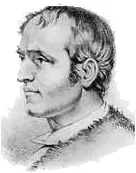
William Godwin
(1756-1836)
‘Anarchist fiction’, rhetorically considered, is either a redundancy or an oxymoron. The phrase is redundant if the ideology of anarchism is considered from the uncharitable perspective of political history. Despite a number of sensational, even explosive, moments in its history, anarchism has fared less well over the centuries than other ideologies, such as liberalism or socialism. The continuing relevance of these two ideologies in particular is especially obvious in the age of Obama, since the talking heads on satellite radio and cable television make a habit of calling the President ‘liberal’ or ‘socialist’ (not to mention ‘fascist’). But so far, the right-wing machine has refrained from calling President Obama an ‘anarchist’. If anything, his right-wing detractors, with their jeremiads against ‘government takeovers’ of everything from Detroit automobile companies to the healthcare system, might be called ‘anarchists’ because of their hatred of the State, even though they would be reluctant to describe themselves as such. The reason for such reticence may be that anarchism today, for all practical purposes, is little more than a fiction, a make-believe ideology that might be fun to entertain or dream about, but stands little chance of emerging as a real alternative to other ideologies, as it assuredly did in the nineteenth century and at critical periods in the twentieth (during the Spanish Civil War, for example). A stateless society —a system of mutual, contractual arrangements between autonomous individuals rather than a system that subjects individuals to governance and law — does seem little more these days than the stuff of fantasy, an anarchist fiction.
At the same time, ‘anarchist fiction’, considered from the perspective not of political history but of literary history,sounds contradictory, especially if by fiction we mean the novel, a literary genre widely understood to have originated as an artistic expression of capitalist ideology. The argument for the novel as a capitalist genre is most often made with reference to the English variant, given the political and economic reforms that followed from the Glorious Revolution of 1688: ‘The features of a modern capitalist economy, so familiar to us now, were just being consolidated in England in the first half of the eighteenth century … The Bank of England and the sustaining of a substantial national debt, initiated at the end of the seventeenth century, developed so rapidly and so consequentially in the early eighteenth century as to represent what some have called a financial revolution’, the period ‘in which a true “consumer society” was born in England’. [1] Add to these social and economic circumstances certain older narrative traditions, such as the romance and the picaresque, and you get a form of fiction that highlights the adventures of some rather randy economic individualists, lusty characters who aim to enter the existing social order, not to overturn it: Tom Jones, Moll Flanders, Benjamin Franklin (a historical personage, yes, but an economic picaro in his Autobiography if there ever was one). The anarchist who would write a novel, then, has the game stacked against him from the outset, since the fictional form itself is stamped with capitalist coin.
But the socio-economic world of the eighteenth century reflected in the novels of Daniel Defoe, Henry Fielding, and the like has another side. The active, mostly masculine narrative of the picaresque adventurer who acquires prestige and wealth over the course of the typical eighteenth-century novel is countered by the passive, largely feminine story of those excluded from the new economic adventure but who nonetheless experience its effects. Novels about how economic and social power feels to those who are not themselves in control of that power are usually called sentimental: such novels form a mostly domestic record, frequently epistolary, of emotional sensibility. This type of novel, one critic writes, ‘supplied what was undoubtedly a potentially radical politics of subjectivity, promulgating a notion of exquisite individual sensibility which, although called into play by the outside world, was essentially self-authorizing rather than produced through subjection to any social structure (most especially the State) whatsoever’. [2] In other words, even though sentiment is called forth, initially, as a response to socio-economic reality, the feeling that reality evokes takes on its own autonomous, ungovernable character. Given this scenario of sensibility, the type of novel that explores it would seem to be the perfect medium for specifically anarchist sentiment. Thus far I have refrained from noting the familiar fact that novels of sensibility, despite the considerable precedent of Jean-Jacques Rousseau’s La Nouvelle Héloïse (1761), were written mainly by women. The novels of Jane Austen, for example, offer sentiment aplenty. Austen’s narratives of female protagonists in patriarchal circumstances, however, hardly seem suited to anarchist sensibility, mainly because the plots of Austen’s novels so often find their resolution in marriage, a contractual arrangement that requires sanctification by the Church and certification by the State, two institutions all anarchists abhor. Still, there is a remarkable confluence of political and literary history toward the end of the eighteenth century: the political philosophy of anarchism and the literary aesthetic of sensibility emerge around the same time, and both the philosophy and the aesthetic encourage an individualistic response to the social and economic order of eighteenth-century capitalism.
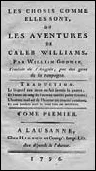
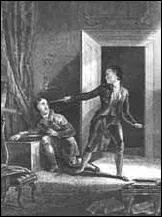
Title page of 1796 French language edition of Caleb Williams
The first systematic elaboration of anarchist philosophy is the one provided by William Godwin, the British rationalist philosopher who published his Enquiry Concerning Political Justice in 1793. Although he did not actually use the term ‘anarchist’ (that honor belongs to Pierre-Joseph Proudhon, who called himself an anarchiste around 1840), [3] Godwin believed in the supremacy of reason and sentiment as the basis for human society —not law. He understood ‘political government’, based on law, as a ‘brute engine which has been the only perennial cause of the vices of mankind’. [4] Against the vices of political government Godwin sets the virtues of rationalistic morality, and imagines a highly altruistic society in which each person is so respectful of his fellow man that the rule of law becomes redundant and unnecessary: ‘No man so truly promotes his own interest as he that forgets it. No man reaps so copious a harvest of pleasure as he who thinks only of the pleasures of other men’ (Enquiry, 395). Godwin’s world is indeed a utopian one where virtue and reason have slain the Leviathan of the State, but it is also one that preserves sentiment as a source of human happiness. The ‘man of taste and liberal accomplishments’, for example, may still experience ‘the pleasures of solitude’ and hold ‘commerce alone with the tranquil solemnity of nature’ (Enquiry, 394). The year after Godwin published the political treatise that proposed a society based on virtuous reason and tasteful sentiment rather than oppressive laws and vengeful government, he published a novel that demonstrated in fictional form the need for the utopian system the treatise described. Things as They Are; or, the Adventures of Caleb Williams (1794) is anarchist fiction of a high order, and here the descriptive phrase is neither redundant nor oxymoronic. The redundancy is avoided because the novel does not actually present an anarchist vision of society but, instead, reveals the oppressive nature of existing society. And the oxymoron is avoided because the novel does not simply follow the capitalistic form of either the novel of economic adventure or the novel of emotional sensibility but, instead, combines the two forms into one. Caleb Williams does not pursue socioe-conomic power but is instead pursued by that power; but like the protagonist of the novel of sensibility, Godwin’s hero feels the effects of the capitalist world just outside his experience, only in a more extreme way than the typical sentimental protagonist: that is his adventure.
The plot of Caleb Williams is clearly calculated to evoke in sentimental form many of the same issues of state control and political injustice that Godwin explored through his carefully reasoned treatise. The author makes this point clear in the preface to the second edition of the novel, originally intended to accompany the first edition but withdrawn, Godwin says, ‘in compliance with the alarms of booksellers’. [5] The booksellers were evidently alarmed because Godwin dated the original preface the very day that Prime Minister Pitt suspended habeas corpus, 12 May 1794, and defiantly asserted in it ‘that the government intrudes itself into every rank of society’. The intrusive nature of government is ‘known to philosophers’, but needs ‘to be communicated to persons whom books of philosophy and science are never likely to reach’. Hence the novel is intended to show the oppressive operations of government and law in a manner more comprehensible to the general public by proposing ‘a general review of domestic and unrecorded despotism by which man becomes the destroyer of man’ (p3). Caleb Williams allows the reader to experience, vicariously, the ‘terror’ (Godwin’s word) that accompanies the government’s abridgment of liberty and to see how smaller domestic injustices reflect those of the broader political world.
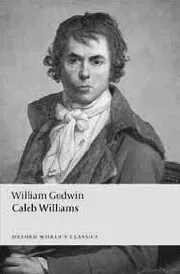
Caleb Williams
The initial injustice that drives the plot of the novel concerns the treatment of a poor tenant farmer named Hawkins by the wealthy country squire Barnabas Tyrrel. As his name implies, Tyrrel exercises tyrannical control over his hapless tenant, who initially refuses to place his son in service to the squire. The act of disobedience on the part of the father prompts Tyrrel to persecute his tenant by flooding his land and poisoning his livestock. Hawkins naively hopes to gain relief through legal means, thinking that there might be ‘some law for poor folk, as well as for rich’. Caleb Williams, who is in service to another country squire named Falkland, comments on the futility of Hawkins’s hopes: ‘Nothing could have been more easy to predict, than that it was of no avail for him to have right on his side when his adversary had influence and wealth’, for ‘[w]ealth and despotism easily know how to engage those laws as the coadjutors of their oppression’ (p75). Predictably, Hawkins and his son are ruined. Thereafter, Tyrrel turns his embittered attention to Falkland.
Tyrrel targets Falkland because his cousin Emily Melville begins to dote on the rival squire after he saves her from a burning building. The man can’t abide his cousin’s affections for Falkland and is on the point of forcing her to marry against her will when Falkland intervenes and stops the marriage, not because he wants the homely Emily for himself, but, rather, out of a sense of chivalry. Tyrrel is outraged and takes unreasonable, but legal, action against the poor girl, whom he regards as his property. In a section of the novel that shows its clear connection to the novel of sentiment, Emily Melville is so distraught that she dies, but when Tyrrel is confronted with the fact he is sanguine about his role in the matter: ‘I did nothing but what the law allows. If she be dead, nobody can say that I am to blame!’ (p95). When Falkland shames the man over his behavior, calling him an ‘inhuman, relentless tyrant’ (p98), Tyrrel first appears to accept the censure and retires from the scene. But he returns, ‘having intoxicated himself with large draughts of brandy’, and gives Falkland a public beating (p99). Falkland means to take his revenge, but ‘was baffled of the vengeance that yet remained to him’ because Tyrell turns up dead, ‘having been murdered at the distance of a few yards from the assembly house’ (p100).
Caleb Williams
All of these events are reported from the first-person perspective of Caleb Williams, who assumes, like everyone else, that Tyrrel has been murdered by the much-wronged Hawkins and his son,...