![]()
Cosmic Dialectics, The Libertarian Philosophy of Joseph Dietzgen
by Larry Gambone
Thinking About Thinking
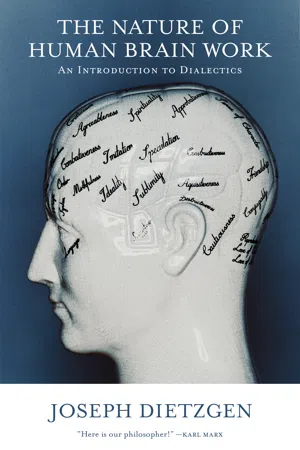
Dietzgen began by asking the question, “What happens when we think?” He observed that the basic thinking process was essentially the same whether done by the greatest scientist or a common person. For “the simplest conception, or any idea for that matter, is of the same general nature as the most perfect understanding … Thought is work.”1
By showing the common basis of thought, Dietzgen democratized science and philosophy. The belief that every person’s opinion must be valued and that thinking must not be especially reserved for an intellectual elite puts him at variance with both academia and Marxist specialists in revolution. “The knowledge and study of this theory cannot be left to any particular guild … general thought is a public matter which everyone should be required to attend to himself.”2
But what happens when we think? What is the innate process that underlies thought, whether thinking about plowing a field, contemplating the cosmos or just plain day-dreaming? Thought requires the formation of concepts about the world, a process which involves two differing aspects:
By means of thought we become aware of all things in a twofold manner, outside in reality and inside in thought… Our brain does not assimilate the things themselves, but only their images. The imagined tree is only a general tree. The real tree is different from any other. And although I may have the picture of some special tree in my head, yet the real tree is still different from its conception as the specific is different from the general.3
One must not make the mistake of confusing one’s mental pictures of the world with reality itself. The real, existing thing is not exactly like the generalization which is formed in the mind. “What abstract thing, being, existence, generality is there that is not manifold in its sense manifestations, and individually different from all other things? There are no two drops of water alike.”4
Thought is a process of forming generalizations out of specific incidences or specific things. Thinking involves the specific and individual things of the world and our generalizations about them. Thought involves generalization.
The common feature of all separate thought processes consists in their seeking the general character or unity which is common to all objects experienced in their manifold variety.5
But generalization isn’t all we do when we think, nor is it without inherent problems. If we take our generalizations to an extreme, we can easily get lost in what are essentially our own mental constructions. We trap ourselves by thinking our productions are reality. This is what happens to people who get caught up in extreme religious or political cults. To bring ourselves back down to reality, it is necessary to never forget the individual and specific aspects of things.
Mere generalization is one-sided and leads to fantastical dreams. By this method one can transform anything into everything. It is necessary to supplement generalization by specialization … the general must be conceived in its relation to its specific forms, and these forms in their universal interconnection.6
Contradiction Inherent in Thought
Thought is a process which involves a relationship between two opposing aspects: the aspect of generalization and the aspect of specialization. To think means to always be engaged in a contradictory process.
For consciousness generalizes differences and differentiates generalities. Contradiction is innate in consciousness and its nature is so contradictory that it is at the same time a differentiating, a generalizing and an understanding nature. Consciousness … recognizes that all nature, all being, lives in contradictions, that everything is what it is only in co-operating with its opposite.7
As with generalization, here is a trap we must avoid. One can get so caught up in the contradictions confronting us that it becomes impossible to make decisions. However, it is possible to achieve some sort of balance or synthesis between opposite views and the contradictions can, at least in part, be overcome.
Reason develops its understanding out of contradictions. It is in the nature of mind to perceive … the nature of things by their semblance, and their semblance by their nature … or in other words to compare the contrasts of the world with one and other, to harmonize them.8
The Limitations of Our Knowledge
It should be obvious by now, that this contradictory process of generalization or concept formation gives us only a limited understanding of the world. That ten people witnessing a traffic accident might have ten different versions of what happened is perfectly understandable. What we are doing is forming our concepts about the world through our thinking processes, resulting in a viewpoint which approximates reality, but is not reality itself. Hence, and this should be engraved on stone in letters two feet high, there is no perfect knowledge or truth.
Our brain is supposed to solve the contradictions of nature. If it knows enough about itself to realize that it is not an exception from general nature … then it also knows that its clearness can differ but moderately from the general confusion … The contradictions are solved only by reasonable differentiation … extravagant differences are nothing but extravagant speculations … and it is a relic of untrained habits to differentiate in an absolute manner.9
“The rule [is] not to make exaggerated, but only graduated distinctions. Compared to the wealth of the Cosmos, the intellect is only a poor fellow.”10
Given the difficulty of attaining a clear understanding of reality, it comes as no surprise that Dietzgen regarded truth in relative terms There could be no such thing as absolute truth. “A perfect understanding is possible only within limits.”11 While truth with a capital “T” is unattainable, this should not stop us from trying to get as near to the goal of absolute truth as possible. “The improvement in the method of thinking is like every other improvement, a limitless problem, the solution which must always remain unachieved. This, however, must in no way keep us from striving after it.”12
The Importance of Error
For Dietzgen, no absolute separation existed between truth and error. All truths contain some amount of error, and all errors contain some amount of truth. “Truth and error differ only comparatively, in volume of degree … like all other opposites in the world … Everything, every sense perception, no matter how subjective is true, a certain part of truth.”13
Aside from fanatics and dogmatists, it is not very difficult to admit a truth might contain some element of error, but what about the idea that truth can be found in error? This is not such an offbeat concept when you realize even the wildest dreams are based upon material ultimately taken from the real world, in the manner that the fantasy of the unicorn is constructed by mentally attaching a narwhal’s horn upon the head of a horse. Error results from universalizing or absolutizing some aspect of limited applicability, or as in the case of the narwhal horn, placing something, which would otherwise be real and true, where it does not belong.
Error … arises when the faculty of thought… inadvertently or short-sightedly and without previous experience concedes to certain phenomena a more general scope.14
In a nutshell, “unwarranted assumption is the nature of error.”15 Dogmatism is to be avoided.
All distinctions are only quantitative, not absolute, only graduated, not irreconcilable … Instead of realizing the limited applicability of its rules by the existence of opposing practices, convention seeks to establish an absolute applicability of its rules by simply ignoring the cause of the opposition. This is a dogmatic procedure.16
One of the problems which Di...