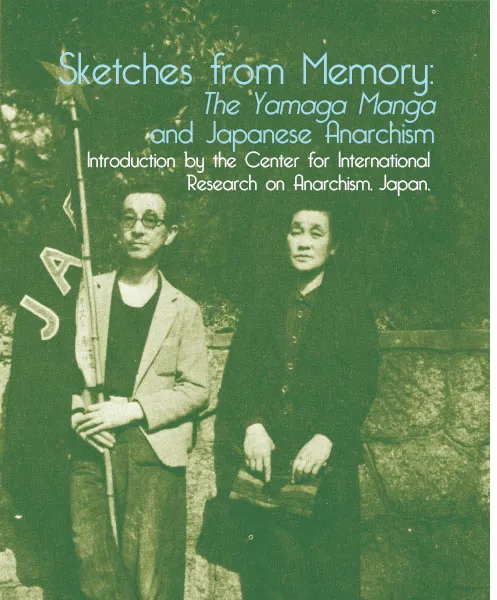
Taiji Yamaga was a seminal figure in the early anarchist movement in Japan. A printer and propagandist, Yamaga was involved in international labor, anti-militarist, and anti-fascist struggles. He traveled extensively and worked with some of the most well known figures of Japanese anarchism, including Sakae
sugi, the Bluestocking Society, and Noe It
. Yamaga was also an avid Esperantist who produced translations, collaborated, and corresponded with hundreds of comrades abroad. In his later years Yamaga was a crucial figure in the sharing of stories about anarchist history in Japan.
The Yamaga Manga, printed here, is a visual autobiography drawn by Yamaga towards the end of his life.
Taiji Yamaga was born into a printing family in 1892 in Kyoto. His father, Zenbei, had established the first movable-type printing press in the area. At the age of fifteen, Yamaga moved to Tokyo, where he studied Esperanto with the historian and noted Esperantist Katsumi Kuroita (1874–1946). Kuroita was the founder of the Japan Esperanto Society (Japana Esperantista Asocio), which had an office where Yamaga lived. At the age of sixteen, Yamaga served as the secretary of the Japan Esperanto Society.
Soon after twelve anarchists and socialists were executed in the High Treason Incident of 1911, Yamaga borrowed a coworker’s copy of Peter Kropotkin’s
Conquest of Bread, which greatly influenced him. Later that year Yamaga was introduced to the well-known anarchist Sakae
sugi (1885–1923). Upon
sugi’s recommendation, Yamaga went to Shanghai in March of 1914 to meet Liu Shifu. Yamaga wrote articles in Esperanto for
The People’s Voice (La Voco de la Popolo), a newspaper with content in both Chinese and Esperanto published by Shifu’s underground People’s Voice Press.
Yamaga returned to Japan after nine months to help with the publication of
The People’s Newspaper (Heimin Shimbun). Launched in 1903 by Toshihiko Sakai and Shûsui K
toku,
The People’s Newspaper was arguably the leading radical newspaper in early-twentieth-century Japan. Yamaga also continued to publish anarchist books in spite of fierce state repression. In 1915, along with Tadashi Aisaka and Shinroku Momose, he published Kropotkin’s An
Appeal to the Young.In 1916 while visiting the home of radical thinker and fellow Esperantist Ikki Kita, Yamaga met Mika Shigehara (1896–1996), an apprentice in the Kita household. They married and continued to live together as partners until Yamaga’s death in 1970. Yamaga’s older brother who had been managing the family business died in 1918, and Yamaga moved back to Kyoto to resurrect Tenrind
, the family print shop. Yamaga used Tenrindô to publish criminalized and banned materials, such as books by Paul Berthelot and documents related to the High Treason Incident.
In 1922, he visited Shanghai again, this time to join the Anarchist Federation. He was the only person from Japan to do so. He returned to China later that year to obtain a passport for Sakae
sugi, who was attempting to travel to Berlin for the International Workers’ Association congress. With a counterfeit passport that identified him as a Chinese student,
sugi was able to travel to Europe, where he was arrested and extradited to Japan after attending a May Day rally in Paris in 1923. In September, the Great Kanto Earthquake struck Japan. Police and vigilantes killed thousands of Koreans and Chinese during the days of martial law after the quake, and military police beat
sugi, Noe It
, and Munekazu Tachibana to death. Yamaga would inform the world of these killings in a communiqué written in Esperanto.
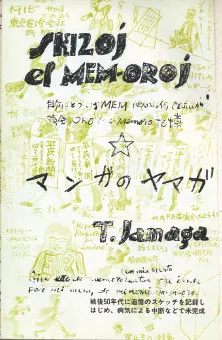
The cover of The Yamaga Manga.
Translation: “Sketches from Memory. The golden ‘ORO’-like ‘Memoro’ memories—to me it is ‘MEM’; to others perhaps nothing. From my experiences, I can carve out the memories that are worthy of gold. To myself, I call them ‘mem-oro’.”
[Translators’ note: in Esperanto, ‘mem’ means ‘self,’ ‘oro’ means ‘gold,’ and ‘memoro’ means ‘memory’.]